licensed under a Creative Commons Attribution 3.0
Communication theory
Communication 2018
Developed by Joelle Peters, Delivered by Kim Thomas
Contents
licensed under a Creative Commons Attribution 3.0
~ What is communication
~ Types of communication
~ Channels of communication
- One way
- 1.5 way
- Two way
~ Barriers to communication
2
licensed under a Creative Commons Attribution 3.0
What is communication?
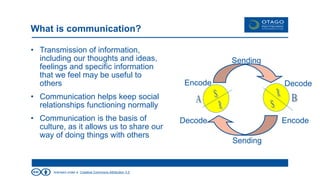
• Transmission of information,
including our thoughts and ideas,
feelings and specific information
that we feel may be useful to
others
• Communication helps keep social
relationships functioning normally
• Communication is the basis of
culture, as it allows us to share our
way of doing things with others
Sending
Sending
Encode Decode
EncodeDecode
licensed under a Creative Commons Attribution 3.0
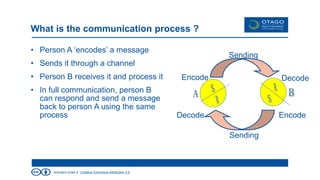
What is the communication process ?
Sending
Sending
Encode Decode
EncodeDecode
• Person A ‘encodes’ a message
• Sends it through a channel
• Person B receives it and process it
• In full communication, person B
can respond and send a message
back to person A using the same
process
licensed under a Creative Commons Attribution 3.0
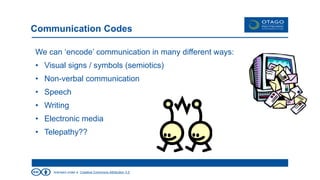
Communication Codes
We can ‘encode’ communication in many different ways:
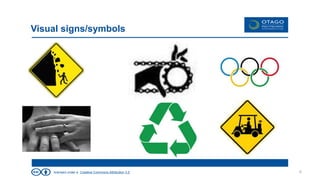
• Visual signs / symbols (semiotics)
• Non-verbal communication
• Speech
• Writing
• Electronic media
• Telepathy??
licensed under a Creative Commons Attribution 3.0
Visual signs/symbols
6
licensed under a Creative Commons Attribution 3.0
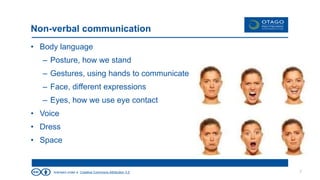
Non-verbal communication
• Body language
– Posture, how we stand
– Gestures, using hands to communicate
– Face, different expressions
– Eyes, how we use eye contact
• Voice
• Dress
• Space
7
licensed under a Creative Commons Attribution 3.0
The importance of non-verbal signs
• You cannot stop communicating non-verbally.
• Non-verbal communication, intentional or not, has a great
influence on forming and defining relationships.
• People are more inclined to believe non-verbal signals
rather than words.
• Miscommunication occurs more easily without non-verbal
communication because it carries so many important
cues.
licensed under a Creative Commons Attribution 3.0
Spoken communication
• Pronunciation
• Intonation
• Vocabulary
– Meaning
– context
licensed under a Creative Commons Attribution 3.0
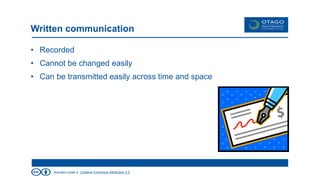
Written communication
• Recorded
• Cannot be changed easily
• Can be transmitted easily across time and space
licensed under a Creative Commons Attribution 3.0
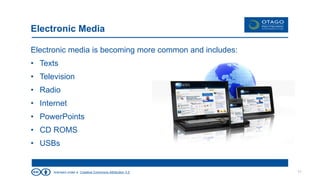
Electronic Media
Electronic media is becoming more common and includes:
• Texts
• Television
• Radio
• Internet
• PowerPoints
• CD ROMS
• USBs
11
licensed under a Creative Commons Attribution 3.0
Channels
• In the basic communication process, a sender puts a message in
words and transmits it to a receiver who interprets the message.
• The channel of communication depends on the audiences ability to
respond.
• There are three channels of communication
• One way
• 1.5 way
• Two way
licensed under a Creative Commons Attribution 3.0
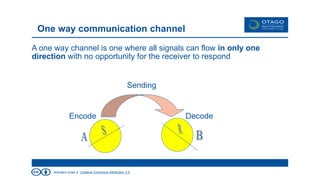
One way communication channel
A one way channel is one where all signals can flow in only one
direction with no opportunity for the receiver to respond
Sending
DecodeEncode
licensed under a Creative Commons Attribution 3.0
– A one way channel is one where all signals can flow in only one
direction with no opportunity for the receiver to respond. For
example a news radio broadcast or perhaps a movie.
Can you think of some examples?
• Commercial radio broadcast
• T.V.
• Internet multicast/podcast
• Security announcements
• Posters
One way communication channel
licensed under a Creative Commons Attribution 3.0
Communications Exercise part one
One way communication
• You will need to be in pairs, one person is ‘A’ and one person is ‘B’,
• ‘B’ needs paper and a pen
• ‘A’ will face the projector
• ‘B’ will face away from the projector
• ‘A’ will describe the shape on the screen to ‘B’
• ‘B’ will try to draw the shape
• ‘B’ can not look at the board or ask any questions
• ‘A’ can not look at what ‘B’ is drawing
15
licensed under a Creative Commons Attribution 3.0
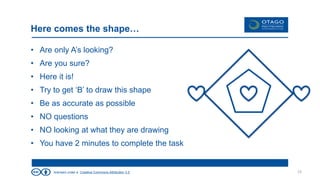
Here comes the shape…
• Are only A’s looking?
• Are you sure?
• Here it is!
• Try to get ‘B’ to draw this shape
• Be as accurate as possible
• NO questions
• NO looking at what they are drawing
• You have 2 minutes to complete the task
16
licensed under a Creative Commons Attribution 3.0
How did it go?
• Did your shape match the shape on the screen?
• If you were giving instructions, how confident were you that they were
being followed?
• If you were drawing the shape, how confident were you that you were
doing the right thing?
• Would you like to be communicated like this in a work environment?
17
licensed under a Creative Commons Attribution 3.0
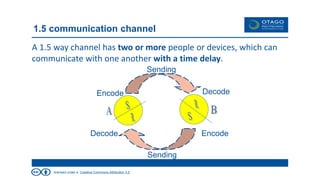
1.5 communication channel
A 1.5 way channel has two or more people or devices, which can
communicate with one another with a time delay.
Sending
Sending
Encode Decode
EncodeDecode
licensed under a Creative Commons Attribution 3.0
1.5 way communication channel
A 1.5 way channel has two or more people or devices, which can
communicate with one another with a time delay. For example a
letter.
Can you think of some examples?
Brochure, letter, email, text, report, voice mail
licensed under a Creative Commons Attribution 3.0
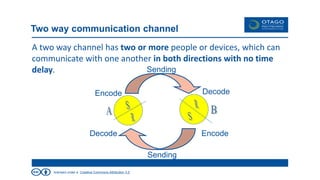
Two way communication channel
A two way channel has two or more people or devices, which can
communicate with one another in both directions with no time
delay. Sending
Sending
Encode Decode
EncodeDecode
licensed under a Creative Commons Attribution 3.0
Two way communication channel
A two way channel has two or more connected people or devices,
which can communicate with one another in both directions with
no time delay. For example a phone call.
Can you think of some examples?
Face to face conversations, telephone, video conferencing
licensed under a Creative Commons Attribution 3.0
Communications Exercise (part two)
Two way communication
• You will need to be in pairs, ‘A’ and ‘B’,
• ‘B’ needs paper and a pen
• ‘A’ will face the projector
• ‘B’ will face away from the projector
• ‘A’ will describe the shape on the projector to B
• ‘B’ will try to draw the shape
• ‘B’ can ask questions
• ‘A’ can look at what ‘B’ is drawing and point at the drawing etc.
22
licensed under a Creative Commons Attribution 3.0
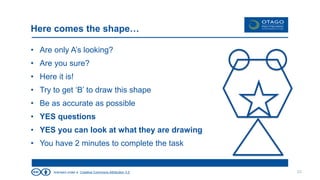
Here comes the shape…
• Are only A’s looking?
• Are you sure?
• Here it is!
• Try to get ‘B’ to draw this shape
• Be as accurate as possible
• YES questions
• YES you can look at what they are drawing
• You have 2 minutes to complete the task
23
licensed under a Creative Commons Attribution 3.0
How did it feel?
• Was this shape more accurate?
• If you were giving instructions how confident were you that they were
being followed correctly?
• If you were drawing the shape how confident were you that you that
you were doing the right thing?
24
licensed under a Creative Commons Attribution 3.0
Advantages of the right channel
An ‘advantage’ is a good, positive, or beneficial outcome. What are
some advantages of using the right channel of communication?
• Speed
• Personal attention of listener
• Immediate feedback and clarification
• Supplemented by nonverbal cues
• Targets correct audience
licensed under a Creative Commons Attribution 3.0
Disadvantages of wrong channel
An ‘disadvantage’ is a bad, negative, or harmful outcome. What are
some disadvantages of using the wrong channel of
communication?
• Time consuming
• No evidence of understanding
• Serious decision is not possible or delayed
• Delay feedback
• Different interpretation
• Cause damage in business (loss of time or damage to resources)
licensed under a Creative Commons Attribution 3.0
Campus Communication Exercise
• You will have half an hour to walk around campus and find at least
two examples of each type of communication channel and describe it
on your hand out. This may include communication which you know
happens in a polytechnic context but couldn’t see today.
• Be back in class 30min from now to share what you found
27
licensed under a Creative Commons Attribution 3.0
Campus Communication Investigation
• What examples of one way communication did you see?
• What examples of 1.5 way communication did you see?
• What examples of 2 way communication did you see?
28
licensed under a Creative Commons Attribution 3.0
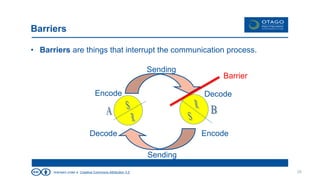
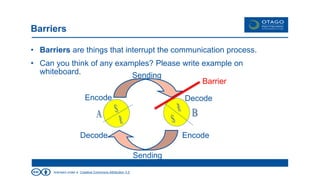
Barriers
• Barriers are things that interrupt the communication process.
29
Sending
Sending
Encode Decode
EncodeDecode
Barrier
licensed under a Creative Commons Attribution 3.0
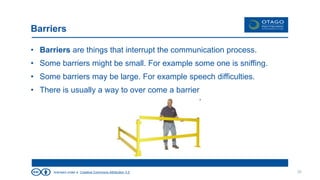
Barriers
• Barriers are things that interrupt the communication process.
• Some barriers might be small. For example some one is sniffing.
• Some barriers may be large. For example speech difficulties.
• There is usually a way to over come a barrier
30
licensed under a Creative Commons Attribution 3.0
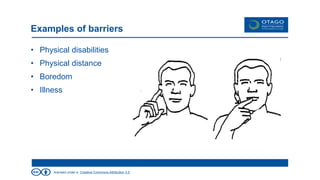
Examples of barriers
• Physical disabilities
• Physical distance
• Boredom
• Illness
licensed under a Creative Commons Attribution 3.0
Barriers
• Barriers are things that interrupt the communication process.
• Can you think of any examples? Please write example on
whiteboard. Sending
Sending
Encode Decode
EncodeDecode
Barrier
licensed under a Creative Commons Attribution 3.0
And more examples of barriers
• Physical disabilities
• Physical distance
• Boredom
• Illness
• Different languages
• Cultural differences
• Different values
• Misunderstandings
• Unequal power
• Lack of trust
• First impressions - prior contacts
• Environment (wind and rain on tunnel
house roof vents)
• Poor listening skills
• Different meanings given to same
words
• Problems with technology
licensed under a Creative Commons Attribution 3.0
Barriers
• In a professional environment you will need to work around barriers.
• In groups of four or five choose two or three barriers, and discuss
how you would work around these to communicate in a workplace
context.
• Share one of your barriers and solutions with the rest of the class.
34
licensed under a Creative Commons Attribution 3.0
Homework! Reflective work book
• Over the next week pay attention to the communication which is
happening around you.
• Look for barriers to communication and how these are solved.
• One part of your assessment is creating a reflection work book. It’s a
good idea to fill in the ‘barriers to effective communication’ section of
your reflective workbook while this idea is still fresh in your minds.
• Well that is if I had your workbook for you-let me communicate more
about this next week-in the meantime please ponder your first
communication session and try to nutshell your learning today.
35

Introduction to Communication

  • 1.
    licensed under aCreative Commons Attribution 3.0 Communication theory Communication 2018 Developed by Joelle Peters, Delivered by Kim Thomas
  • 2.
    Contents licensed under aCreative Commons Attribution 3.0 ~ What is communication ~ Types of communication ~ Channels of communication - One way - 1.5 way - Two way ~ Barriers to communication 2
  • 3.
    licensed under aCreative Commons Attribution 3.0 What is communication? • Transmission of information, including our thoughts and ideas, feelings and specific information that we feel may be useful to others • Communication helps keep social relationships functioning normally • Communication is the basis of culture, as it allows us to share our way of doing things with others Sending Sending Encode Decode EncodeDecode
  • 4.
    licensed under aCreative Commons Attribution 3.0 What is the communication process ? Sending Sending Encode Decode EncodeDecode • Person A ‘encodes’ a message • Sends it through a channel • Person B receives it and process it • In full communication, person B can respond and send a message back to person A using the same process
  • 5.
    licensed under aCreative Commons Attribution 3.0 Communication Codes We can ‘encode’ communication in many different ways: • Visual signs / symbols (semiotics) • Non-verbal communication • Speech • Writing • Electronic media • Telepathy??
  • 6.
    licensed under aCreative Commons Attribution 3.0 Visual signs/symbols 6
  • 7.
    licensed under aCreative Commons Attribution 3.0 Non-verbal communication • Body language – Posture, how we stand – Gestures, using hands to communicate – Face, different expressions – Eyes, how we use eye contact • Voice • Dress • Space 7
  • 8.
    licensed under aCreative Commons Attribution 3.0 The importance of non-verbal signs • You cannot stop communicating non-verbally. • Non-verbal communication, intentional or not, has a great influence on forming and defining relationships. • People are more inclined to believe non-verbal signals rather than words. • Miscommunication occurs more easily without non-verbal communication because it carries so many important cues.
  • 9.
    licensed under aCreative Commons Attribution 3.0 Spoken communication • Pronunciation • Intonation • Vocabulary – Meaning – context
  • 10.
    licensed under aCreative Commons Attribution 3.0 Written communication • Recorded • Cannot be changed easily • Can be transmitted easily across time and space
  • 11.
    licensed under aCreative Commons Attribution 3.0 Electronic Media Electronic media is becoming more common and includes: • Texts • Television • Radio • Internet • PowerPoints • CD ROMS • USBs 11
  • 12.
    licensed under aCreative Commons Attribution 3.0 Channels • In the basic communication process, a sender puts a message in words and transmits it to a receiver who interprets the message. • The channel of communication depends on the audiences ability to respond. • There are three channels of communication • One way • 1.5 way • Two way
  • 13.
    licensed under aCreative Commons Attribution 3.0 One way communication channel A one way channel is one where all signals can flow in only one direction with no opportunity for the receiver to respond Sending DecodeEncode
  • 14.
    licensed under aCreative Commons Attribution 3.0 – A one way channel is one where all signals can flow in only one direction with no opportunity for the receiver to respond. For example a news radio broadcast or perhaps a movie. Can you think of some examples? • Commercial radio broadcast • T.V. • Internet multicast/podcast • Security announcements • Posters One way communication channel
  • 15.
    licensed under aCreative Commons Attribution 3.0 Communications Exercise part one One way communication • You will need to be in pairs, one person is ‘A’ and one person is ‘B’, • ‘B’ needs paper and a pen • ‘A’ will face the projector • ‘B’ will face away from the projector • ‘A’ will describe the shape on the screen to ‘B’ • ‘B’ will try to draw the shape • ‘B’ can not look at the board or ask any questions • ‘A’ can not look at what ‘B’ is drawing 15
  • 16.
    licensed under aCreative Commons Attribution 3.0 Here comes the shape… • Are only A’s looking? • Are you sure? • Here it is! • Try to get ‘B’ to draw this shape • Be as accurate as possible • NO questions • NO looking at what they are drawing • You have 2 minutes to complete the task 16
  • 17.
    licensed under aCreative Commons Attribution 3.0 How did it go? • Did your shape match the shape on the screen? • If you were giving instructions, how confident were you that they were being followed? • If you were drawing the shape, how confident were you that you were doing the right thing? • Would you like to be communicated like this in a work environment? 17
  • 18.
    licensed under aCreative Commons Attribution 3.0 1.5 communication channel A 1.5 way channel has two or more people or devices, which can communicate with one another with a time delay. Sending Sending Encode Decode EncodeDecode
  • 19.
    licensed under aCreative Commons Attribution 3.0 1.5 way communication channel A 1.5 way channel has two or more people or devices, which can communicate with one another with a time delay. For example a letter. Can you think of some examples? Brochure, letter, email, text, report, voice mail
  • 20.
    licensed under aCreative Commons Attribution 3.0 Two way communication channel A two way channel has two or more people or devices, which can communicate with one another in both directions with no time delay. Sending Sending Encode Decode EncodeDecode
  • 21.
    licensed under aCreative Commons Attribution 3.0 Two way communication channel A two way channel has two or more connected people or devices, which can communicate with one another in both directions with no time delay. For example a phone call. Can you think of some examples? Face to face conversations, telephone, video conferencing
  • 22.
    licensed under aCreative Commons Attribution 3.0 Communications Exercise (part two) Two way communication • You will need to be in pairs, ‘A’ and ‘B’, • ‘B’ needs paper and a pen • ‘A’ will face the projector • ‘B’ will face away from the projector • ‘A’ will describe the shape on the projector to B • ‘B’ will try to draw the shape • ‘B’ can ask questions • ‘A’ can look at what ‘B’ is drawing and point at the drawing etc. 22
  • 23.
    licensed under aCreative Commons Attribution 3.0 Here comes the shape… • Are only A’s looking? • Are you sure? • Here it is! • Try to get ‘B’ to draw this shape • Be as accurate as possible • YES questions • YES you can look at what they are drawing • You have 2 minutes to complete the task 23
  • 24.
    licensed under aCreative Commons Attribution 3.0 How did it feel? • Was this shape more accurate? • If you were giving instructions how confident were you that they were being followed correctly? • If you were drawing the shape how confident were you that you that you were doing the right thing? 24
  • 25.
    licensed under aCreative Commons Attribution 3.0 Advantages of the right channel An ‘advantage’ is a good, positive, or beneficial outcome. What are some advantages of using the right channel of communication? • Speed • Personal attention of listener • Immediate feedback and clarification • Supplemented by nonverbal cues • Targets correct audience
  • 26.
    licensed under aCreative Commons Attribution 3.0 Disadvantages of wrong channel An ‘disadvantage’ is a bad, negative, or harmful outcome. What are some disadvantages of using the wrong channel of communication? • Time consuming • No evidence of understanding • Serious decision is not possible or delayed • Delay feedback • Different interpretation • Cause damage in business (loss of time or damage to resources)
  • 27.
    licensed under aCreative Commons Attribution 3.0 Campus Communication Exercise • You will have half an hour to walk around campus and find at least two examples of each type of communication channel and describe it on your hand out. This may include communication which you know happens in a polytechnic context but couldn’t see today. • Be back in class 30min from now to share what you found 27
  • 28.
    licensed under aCreative Commons Attribution 3.0 Campus Communication Investigation • What examples of one way communication did you see? • What examples of 1.5 way communication did you see? • What examples of 2 way communication did you see? 28
  • 29.
    licensed under aCreative Commons Attribution 3.0 Barriers • Barriers are things that interrupt the communication process. 29 Sending Sending Encode Decode EncodeDecode Barrier
  • 30.
    licensed under aCreative Commons Attribution 3.0 Barriers • Barriers are things that interrupt the communication process. • Some barriers might be small. For example some one is sniffing. • Some barriers may be large. For example speech difficulties. • There is usually a way to over come a barrier 30
  • 31.
    licensed under aCreative Commons Attribution 3.0 Examples of barriers • Physical disabilities • Physical distance • Boredom • Illness
  • 32.
    licensed under aCreative Commons Attribution 3.0 Barriers • Barriers are things that interrupt the communication process. • Can you think of any examples? Please write example on whiteboard. Sending Sending Encode Decode EncodeDecode Barrier
  • 33.
    licensed under aCreative Commons Attribution 3.0 And more examples of barriers • Physical disabilities • Physical distance • Boredom • Illness • Different languages • Cultural differences • Different values • Misunderstandings • Unequal power • Lack of trust • First impressions - prior contacts • Environment (wind and rain on tunnel house roof vents) • Poor listening skills • Different meanings given to same words • Problems with technology
  • 34.
    licensed under aCreative Commons Attribution 3.0 Barriers • In a professional environment you will need to work around barriers. • In groups of four or five choose two or three barriers, and discuss how you would work around these to communicate in a workplace context. • Share one of your barriers and solutions with the rest of the class. 34
  • 35.
    licensed under aCreative Commons Attribution 3.0 Homework! Reflective work book • Over the next week pay attention to the communication which is happening around you. • Look for barriers to communication and how these are solved. • One part of your assessment is creating a reflection work book. It’s a good idea to fill in the ‘barriers to effective communication’ section of your reflective workbook while this idea is still fresh in your minds. • Well that is if I had your workbook for you-let me communicate more about this next week-in the meantime please ponder your first communication session and try to nutshell your learning today. 35