FEEDBACK
What is Feedback
•   Process in which the effect or output of an action is 'returned'
    (fed-back) to modify the next action.

•   It is a dialogue between people which reflects back how
    another person sees someone else's behavior or performance.

•   It is essential to the working and survival of all
    regulatory mechanisms found throughout in our
    Surroundings systems such as education system and economy

•   Feedback occurs when an environment reacts to an action or
    behavior.
Why is Feedback so
            Important
1. People want Feedback so they feel more secure in their jobs.
2. Basically tells you what your strengths and weaknesses are.
3. A low-feedback may be harmful to the health of a business.
4. Employees are able to check their assumptions.
5. Failing to give feedback sends a non-verbal communication in
   itself and can lead to mixed messages and false assessment
6. If the feedback process is handled properly, it can be
   rewarding for everyone involved.

Someone said “How can your people know they’re doing the right
thing unless you tell them?”
Types of Feedback
1.   Motivational Feedback
2.   Developmental Feedback
3.   Constructive Feedback
4.   Intrinsic Feedback
5.   Extrinsic Feedback

Some other common types of Feedback include :-
• Negative Feedback
• Positive Feedback
• Immediate Feedback
• Delayed Feedback
Principles of giving
       effective Feedback
• Give feedback only when asked to do so or
  when your offer is accepted.
• Give feedback as soon as possible.
• Focus on the positive.
• Needs to be given privately wherever
  possible.
• Focus on behaviors that can be changed, not
  personality traits
• Use ‘I’ and give your experience of the
  behavior (‘When you said…, I thought that
  you were…’).
• When giving negative feedback, suggest
  alternative behaviors.
• Be clear about what you are giving feedback
  on.
• Do not overload – identify two or three key
  messages that you summarize at the end.
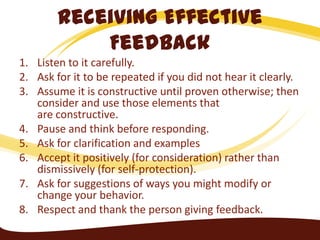
Receiving Effective
            Feedback
1. Listen to it carefully.
2. Ask for it to be repeated if you did not hear it clearly.
3. Assume it is constructive until proven otherwise; then
   consider and use those elements that
   are constructive.
4. Pause and think before responding.
5. Ask for clarification and examples
6. Accept it positively (for consideration) rather than
   dismissively (for self-protection).
7. Ask for suggestions of ways you might modify or
   change your behavior.
8. Respect and thank the person giving feedback.
Bibliography
•   Read more: http://www.businessdictionary.com/definition/feedback.html#ixzz2CrtbiiKr { Dt –
    21/11/2012}
•   Read more: http://www.faculty.londondeanery.ac.uk { Dt – 21/11/2012}
•   Read more: http://www.tlnt.com/2012/09/26/help-them-grow-or-watch-them-go-why-feedback-matters/
    { Dt – 21/11/2012}

Feedback

  • 1.
  • 2.
    What is Feedback • Process in which the effect or output of an action is 'returned' (fed-back) to modify the next action. • It is a dialogue between people which reflects back how another person sees someone else's behavior or performance. • It is essential to the working and survival of all regulatory mechanisms found throughout in our Surroundings systems such as education system and economy • Feedback occurs when an environment reacts to an action or behavior.
  • 3.
    Why is Feedbackso Important 1. People want Feedback so they feel more secure in their jobs. 2. Basically tells you what your strengths and weaknesses are. 3. A low-feedback may be harmful to the health of a business. 4. Employees are able to check their assumptions. 5. Failing to give feedback sends a non-verbal communication in itself and can lead to mixed messages and false assessment 6. If the feedback process is handled properly, it can be rewarding for everyone involved. Someone said “How can your people know they’re doing the right thing unless you tell them?”
  • 4.
    Types of Feedback 1. Motivational Feedback 2. Developmental Feedback 3. Constructive Feedback 4. Intrinsic Feedback 5. Extrinsic Feedback Some other common types of Feedback include :- • Negative Feedback • Positive Feedback • Immediate Feedback • Delayed Feedback
  • 5.
    Principles of giving effective Feedback • Give feedback only when asked to do so or when your offer is accepted. • Give feedback as soon as possible. • Focus on the positive. • Needs to be given privately wherever possible. • Focus on behaviors that can be changed, not personality traits
  • 6.
    • Use ‘I’and give your experience of the behavior (‘When you said…, I thought that you were…’). • When giving negative feedback, suggest alternative behaviors. • Be clear about what you are giving feedback on. • Do not overload – identify two or three key messages that you summarize at the end.
  • 7.
    Receiving Effective Feedback 1. Listen to it carefully. 2. Ask for it to be repeated if you did not hear it clearly. 3. Assume it is constructive until proven otherwise; then consider and use those elements that are constructive. 4. Pause and think before responding. 5. Ask for clarification and examples 6. Accept it positively (for consideration) rather than dismissively (for self-protection). 7. Ask for suggestions of ways you might modify or change your behavior. 8. Respect and thank the person giving feedback.
  • 8.
    Bibliography • Read more: http://www.businessdictionary.com/definition/feedback.html#ixzz2CrtbiiKr { Dt – 21/11/2012} • Read more: http://www.faculty.londondeanery.ac.uk { Dt – 21/11/2012} • Read more: http://www.tlnt.com/2012/09/26/help-them-grow-or-watch-them-go-why-feedback-matters/ { Dt – 21/11/2012}