Communications Lab 2:
Giving & Receiving
Feedback
Kevin R. Thomas
Manager, Training & Development
x3542
kevin.r.thomas@williams.edu
Introductions
• Name
• Your relationship to
Williams
• Time when you
received helpful
feedback. How did
they do it? What was
the impact?
Objectives
• Learn and practice
effective strategies
for giving and
receiving feedback.
• Focus on feedback,
rather than on
discipline or
evaluation.
Norms
• Confidentiality
• Participation
• Listening
• Self-care
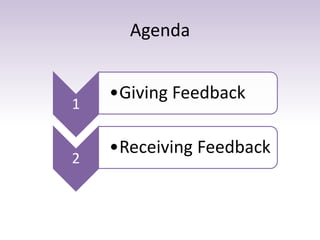
Agenda
1
•Giving Feedback
2
•Receiving Feedback
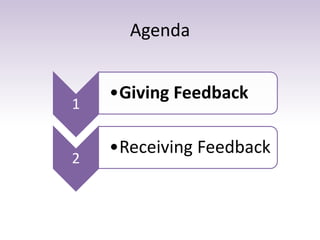
Agenda
1
•Giving Feedback
2
•Receiving Feedback
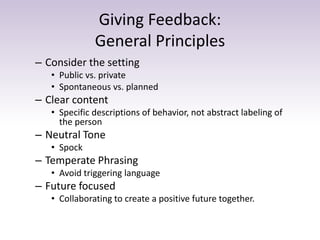
Giving Feedback:
General Principles
– Consider the setting
• Public vs. private
• Spontaneous vs. planned
– Clear content
• Specific descriptions of behavior, not abstract labeling of
the person
– Neutral Tone
• Spock
– Temperate Phrasing
• Avoid triggering language
– Future focused
• Collaborating to create a positive future together.
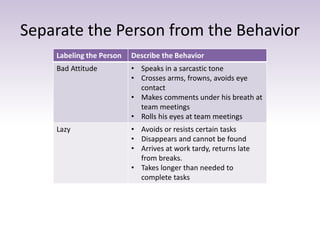
Separate the Person from the Behavior
Labeling the Person Describe the Behavior
Bad Attitude • Speaks in a sarcastic tone
• Crosses arms, frowns, avoids eye
contact
• Makes comments under his breath at
team meetings
• Rolls his eyes at team meetings
Lazy • Avoids or resists certain tasks
• Disappears and cannot be found
• Arrives at work tardy, returns late
from breaks.
• Takes longer than needed to
complete tasks
Giving Feedback
• Positive Feedback
• Constructive Feedback
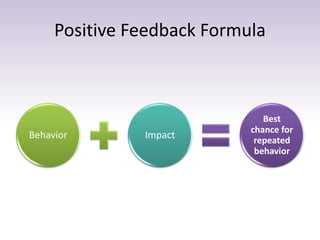
Positive Feedback Formula
Behavior Impact
Best
chance for
repeated
behavior
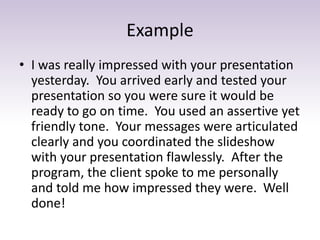
Example
• I was really impressed with your presentation
yesterday. You arrived early and tested your
presentation so you were sure it would be
ready to go on time. You used an assertive yet
friendly tone. Your messages were articulated
clearly and you coordinated the slideshow
with your presentation flawlessly. After the
program, the client spoke to me personally
and told me how impressed they were. Well
done!
Your Turn!
• Complete the positive feedback worksheet.
• With a partner, practice giving the feedback.
Giving Feedback
• Positive Feedback
• Constructive Feedback
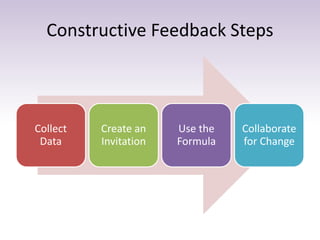
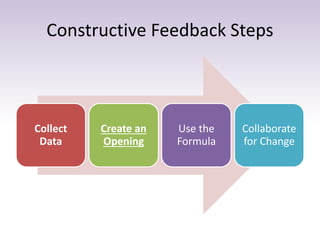
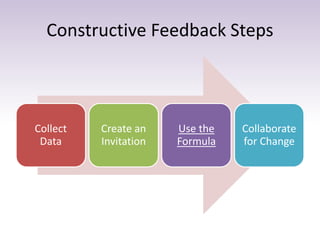
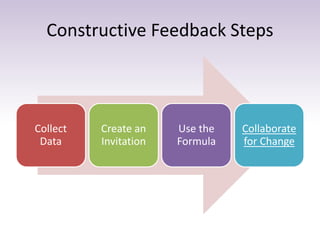
Constructive Feedback Steps
Collect
Data
Create an
Invitation
Use the
Formula
Collaborate
for Change
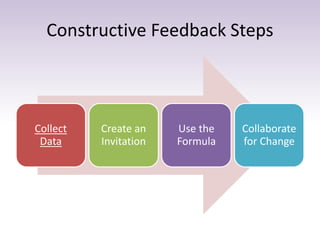
Constructive Feedback Steps
Collect
Data
Create an
Invitation
Use the
Formula
Collaborate
for Change
Collect Data
• What has happened that has led you to
believe the person may need to change their
behavior?
• What else could you find out before speaking
with the person?
• What other factors could have contributed to
the problem?
• Is the person aware of the problem? How
might they see it?
Constructive Feedback Steps
Collect
Data
Create an
Opening
Use the
Formula
Collaborate
for Change
Create the Invitation
• Describe what led you to want to give the
person feedback.
• Say you’d like to share what you’ve learned
about the issue so far.
• Say you’d like to hear their point of view.
• Say you’d like to work collaboratively with the
person towards a better outcome in the
future.
Create the Invitation: Example
• “Judy, I’d like to discuss what happened on
your customer call earlier this week. I’d first
like to share the information I have about the
situation, and then I want to hear your point
of view. After that, we can discuss what to do
next. How does that sound to you?”
Create the Invitation: Your Turn
• Complete the “Create the Invitation”
Worksheet
Constructive Feedback Steps
Collect
Data
Create an
Invitation
Use the
Formula
Collaborate
for Change
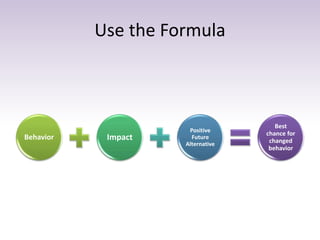
Use the Formula
Behavior Impact
Positive
Future
Alternative
Best
chance for
changed
behavior
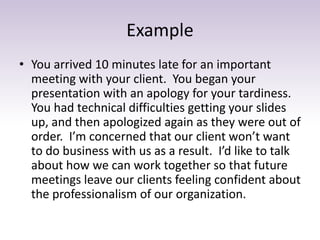
Example
• You arrived 10 minutes late for an important
meeting with your client. You began your
presentation with an apology for your tardiness.
You had technical difficulties getting your slides
up, and then apologized again as they were out of
order. I’m concerned that our client won’t want
to do business with us as a result. I’d like to talk
about how we can work together so that future
meetings leave our clients feeling confident about
the professionalism of our organization.
Your Turn
• Complete the Constructive Feedback Formula
worksheet
Constructive Feedback Steps
Collect
Data
Create an
Invitation
Use the
Formula
Collaborate
for Change
Collaborate for Change
• Ensure agreement on a joint vision for the
future.
(Ex: “Do we both agree that we want our
customers to keep coming back?”)
• Brainstorm possible changes both of you
might make that could improve the outcome.
• Plan to follow up to assess the outcome.
Putting It All Together: Role Play
• Pair up.
• Decide who will give feedback.
• Give the other person a minimum amount of
background about the situation (timed)
• Role play the feedback conversation, starting
from your opening.
Agenda
1
•Giving Feedback
2
•Receiving Feedback
Receiving Feedback Tips
• Stay in listening mode as long as possible. Keep
asking questions until you understand the other
person’s perspective completely.
• Listen for the “signal in the noise”. What about
this feedback could possibly be true?
• Notice feelings without acting on them. Breathe.
• Use questions to guide the person to give their
feedback more skillfully.
Ex: “What specific behaviors have you noticed
that have led you to believe I have a bad
attitude?”
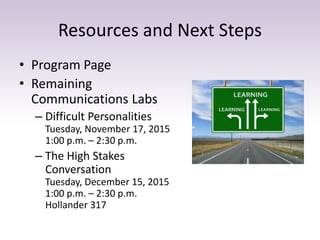
Resources and Next Steps
• Program Page
• Remaining
Communications Labs
– Difficult Personalities
Tuesday, November 17, 2015
1:00 p.m. – 2:30 p.m.
– The High Stakes
Conversation
Tuesday, December 15, 2015
1:00 p.m. – 2:30 p.m.
Hollander 317
Kevin R. Thomas
Manager, Training & Development
x3542
Kevin.R.Thomas@williams.edu
• Program evaluation link will be sent by email.
• You’ll get a link to a course page with all the materials.

Giving and receiving feedback

  • 1.
    Communications Lab 2: Giving& Receiving Feedback Kevin R. Thomas Manager, Training & Development x3542 kevin.r.thomas@williams.edu
  • 2.
    Introductions • Name • Yourrelationship to Williams • Time when you received helpful feedback. How did they do it? What was the impact?
  • 3.
    Objectives • Learn andpractice effective strategies for giving and receiving feedback. • Focus on feedback, rather than on discipline or evaluation.
  • 4.
  • 5.
  • 6.
  • 7.
    Giving Feedback: General Principles –Consider the setting • Public vs. private • Spontaneous vs. planned – Clear content • Specific descriptions of behavior, not abstract labeling of the person – Neutral Tone • Spock – Temperate Phrasing • Avoid triggering language – Future focused • Collaborating to create a positive future together.
  • 8.
    Separate the Personfrom the Behavior Labeling the Person Describe the Behavior Bad Attitude • Speaks in a sarcastic tone • Crosses arms, frowns, avoids eye contact • Makes comments under his breath at team meetings • Rolls his eyes at team meetings Lazy • Avoids or resists certain tasks • Disappears and cannot be found • Arrives at work tardy, returns late from breaks. • Takes longer than needed to complete tasks
  • 9.
    Giving Feedback • PositiveFeedback • Constructive Feedback
  • 10.
    Positive Feedback Formula BehaviorImpact Best chance for repeated behavior
  • 11.
    Example • I wasreally impressed with your presentation yesterday. You arrived early and tested your presentation so you were sure it would be ready to go on time. You used an assertive yet friendly tone. Your messages were articulated clearly and you coordinated the slideshow with your presentation flawlessly. After the program, the client spoke to me personally and told me how impressed they were. Well done!
  • 12.
    Your Turn! • Completethe positive feedback worksheet. • With a partner, practice giving the feedback.
  • 13.
    Giving Feedback • PositiveFeedback • Constructive Feedback
  • 14.
    Constructive Feedback Steps Collect Data Createan Invitation Use the Formula Collaborate for Change
  • 15.
    Constructive Feedback Steps Collect Data Createan Invitation Use the Formula Collaborate for Change
  • 16.
    Collect Data • Whathas happened that has led you to believe the person may need to change their behavior? • What else could you find out before speaking with the person? • What other factors could have contributed to the problem? • Is the person aware of the problem? How might they see it?
  • 17.
    Constructive Feedback Steps Collect Data Createan Opening Use the Formula Collaborate for Change
  • 18.
    Create the Invitation •Describe what led you to want to give the person feedback. • Say you’d like to share what you’ve learned about the issue so far. • Say you’d like to hear their point of view. • Say you’d like to work collaboratively with the person towards a better outcome in the future.
  • 19.
    Create the Invitation:Example • “Judy, I’d like to discuss what happened on your customer call earlier this week. I’d first like to share the information I have about the situation, and then I want to hear your point of view. After that, we can discuss what to do next. How does that sound to you?”
  • 20.
    Create the Invitation:Your Turn • Complete the “Create the Invitation” Worksheet
  • 21.
    Constructive Feedback Steps Collect Data Createan Invitation Use the Formula Collaborate for Change
  • 22.
    Use the Formula BehaviorImpact Positive Future Alternative Best chance for changed behavior
  • 23.
    Example • You arrived10 minutes late for an important meeting with your client. You began your presentation with an apology for your tardiness. You had technical difficulties getting your slides up, and then apologized again as they were out of order. I’m concerned that our client won’t want to do business with us as a result. I’d like to talk about how we can work together so that future meetings leave our clients feeling confident about the professionalism of our organization.
  • 24.
    Your Turn • Completethe Constructive Feedback Formula worksheet
  • 25.
    Constructive Feedback Steps Collect Data Createan Invitation Use the Formula Collaborate for Change
  • 26.
    Collaborate for Change •Ensure agreement on a joint vision for the future. (Ex: “Do we both agree that we want our customers to keep coming back?”) • Brainstorm possible changes both of you might make that could improve the outcome. • Plan to follow up to assess the outcome.
  • 27.
    Putting It AllTogether: Role Play • Pair up. • Decide who will give feedback. • Give the other person a minimum amount of background about the situation (timed) • Role play the feedback conversation, starting from your opening.
  • 28.
  • 29.
    Receiving Feedback Tips •Stay in listening mode as long as possible. Keep asking questions until you understand the other person’s perspective completely. • Listen for the “signal in the noise”. What about this feedback could possibly be true? • Notice feelings without acting on them. Breathe. • Use questions to guide the person to give their feedback more skillfully. Ex: “What specific behaviors have you noticed that have led you to believe I have a bad attitude?”
  • 30.
    Resources and NextSteps • Program Page • Remaining Communications Labs – Difficult Personalities Tuesday, November 17, 2015 1:00 p.m. – 2:30 p.m. – The High Stakes Conversation Tuesday, December 15, 2015 1:00 p.m. – 2:30 p.m. Hollander 317
  • 31.
    Kevin R. Thomas Manager,Training & Development x3542 Kevin.R.Thomas@williams.edu • Program evaluation link will be sent by email. • You’ll get a link to a course page with all the materials.