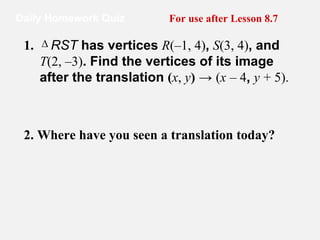
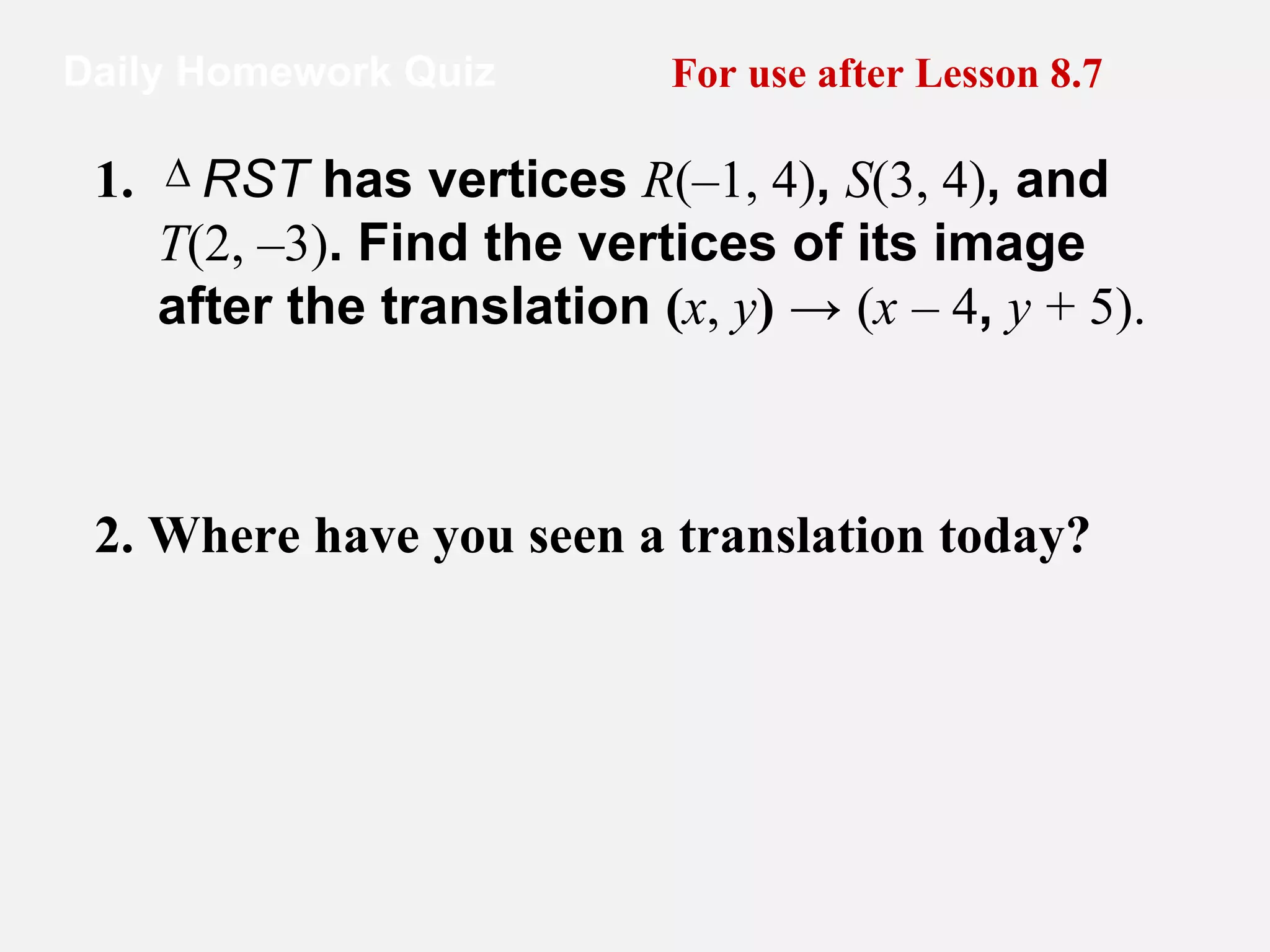
Daily Homework Quiz For use after Lesson 8.7 2. Where have you seen a translation today?   1.     RST  has vertices  R (–1, 4) ,  S (3, 4) , and  T (2, –3) . Find the vertices of its image after the translation  ( x ,  y )  ->  ( x   – 4 ,  y   + 5). ∆
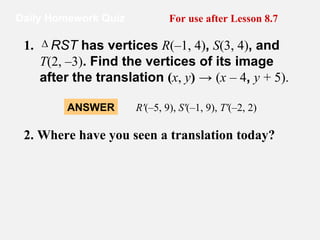
Daily Homework Quiz For use after Lesson 8.7 2. Where have you seen a translation today?   1.     RST  has vertices  R (–1, 4) ,  S (3, 4) , and  T (2, –3) . Find the vertices of its image after the translation  ( x ,  y )  ->  ( x   – 4 ,  y   + 5). ∆ ANSWER R' (–5, 9),  S' (–1, 9),  T' (–2, 2)
Translations and Rotations Section 8.7 P. 439 - 443
Essential Questions What are the similarities and differences among transformations? How are the principles of transformational geometry used in art, architecture and fashion? What are the applications for transformations?
A rotation is a transformation that “TURNS” each point of a figure the same number of degrees around a common point.  For our lessons, that point will be the origin (0,0).  Rotations may be clockwise or counterclockwise.
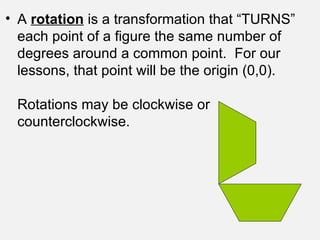
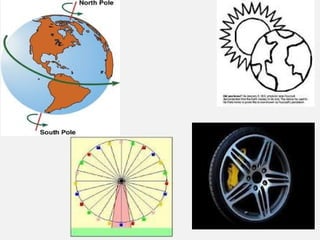
A  rotation  is a transformation that “TURNS” each point of a figure the same number of degrees around a common point.  For our lessons, that point will be the origin (0,0).  Rotations may be clockwise or counterclockwise.


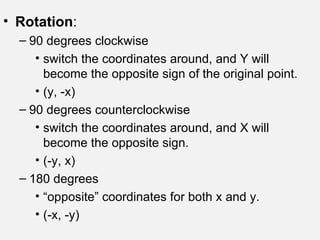
Rotation : 90 degrees clockwise switch the coordinates around, and Y will become the opposite sign of the original point. (y, -x) 90 degrees counterclockwise switch the coordinates around, and X will become the opposite sign. (-y, x) 180 degrees  “ opposite” coordinates for both x and y. (-x, -y)
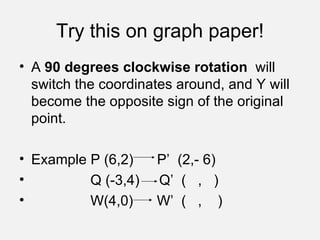
Try this on graph paper! A  90 degrees clockwise rotation   will switch the coordinates around, and Y will become the opposite sign of the original point. Example P (6,2)  P’  (2,- 6) Q (-3,4)  Q’  (  ,  ) W(4,0)  W’  (  ,  )
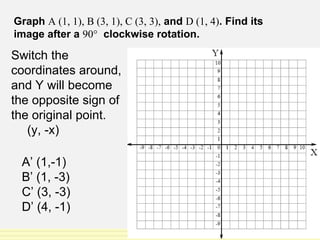
Graph  A (1, 1), B (3, 1), C (3, 3),  and  D (1, 4) . Find its image after a  90°   clockwise rotation. Switch the coordinates around, and Y will become the opposite sign of the original point. (y, -x) A’ (1,-1) B’ (1, -3) C’ (3, -3) D’ (4, -1)
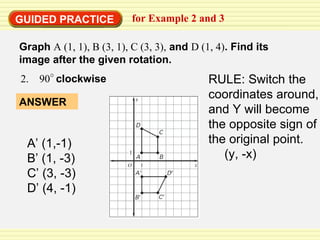
GUIDED PRACTICE for Example 2 and 3  Graph  A (1, 1), B (3, 1), C (3, 3),  and  D (1, 4) . Find its image after the given rotation. A’ (1,-1) B’ (1, -3) C’ (3, -3) D’ (4, -1) RULE: Switch the coordinates around, and Y will become the opposite sign of the original point. (y, -x) 2.  90   clockwise ANSWER
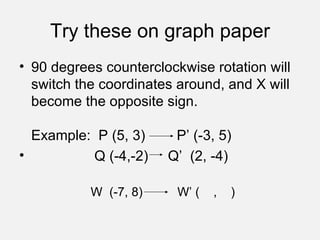
Try these on graph paper 90 degrees counterclockwise rotation will switch the coordinates around, and X will become the opposite sign. Example:  P (5, 3)  P’ (-3, 5) Q (-4,-2)  Q’  (2, -4) W  (-7, 8)  W’ (  ,  )
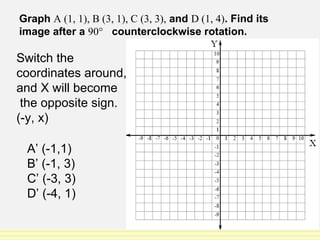
Graph  A (1, 1), B (3, 1), C (3, 3),  and  D (1, 4) . Find its image after a  90°   counterclockwise rotation. Switch the coordinates around, and X will become the opposite sign.  (-y, x) A’ (-1,1) B’ (-1, 3) C’ (-3, 3) D’ (-4, 1)
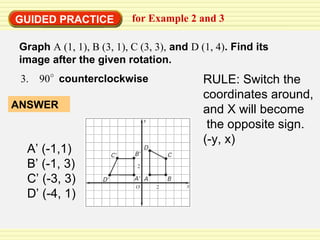
GUIDED PRACTICE for Example 2 and 3  Graph  A (1, 1), B (3, 1), C (3, 3),  and  D (1, 4) . Find its image after the given rotation. A’ (-1,1) B’ (-1, 3) C’ (-3, 3) D’ (-4, 1) RULE: Switch the coordinates around, and X will become the opposite sign.  (-y, x) 3.  90   counterclockwise ANSWER
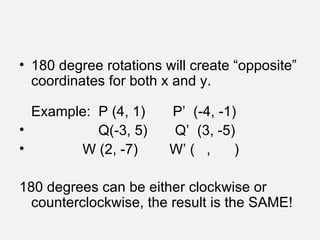
180 degree rotations will create “opposite” coordinates for both x and y. Example:  P (4, 1)  P’  (-4, -1) Q(-3, 5)  Q’  (3, -5) W (2, -7)  W’ (  ,  ) 180 degrees can be either clockwise or counterclockwise, the result is the SAME!
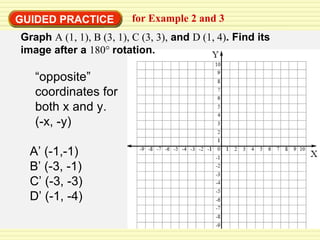
GUIDED PRACTICE for Example 2 and 3  Graph  A (1, 1), B (3, 1), C (3, 3),  and  D (1, 4) . Find its image after a  180°  rotation. “ opposite” coordinates for both x and y. (-x, -y) A’ (-1,-1) B’ (-3, -1) C’ (-3, -3) D’ (-1, -4)
GUIDED PRACTICE for Example 2 and 3  Graph  A (1, 1), B (3, 1), C (3, 3),  and  D (1, 4) . Find its image after the given rotation. A’ (-1,-1) B’ (-3, -1) C’ (-3, -3) D’ (-1, -4) RULE: “opposite” coordinates for both x and y. (-x, -y) 4.  180 ANSWER
Homework Page 441 #1-3, 9, 11, 12

8.7 translations and rotations 2

  • 1.
    Daily Homework QuizFor use after Lesson 8.7 2. Where have you seen a translation today? 1. RST has vertices R (–1, 4) , S (3, 4) , and T (2, –3) . Find the vertices of its image after the translation ( x , y ) -> ( x – 4 , y + 5). ∆
  • 2.
    Daily Homework QuizFor use after Lesson 8.7 2. Where have you seen a translation today? 1. RST has vertices R (–1, 4) , S (3, 4) , and T (2, –3) . Find the vertices of its image after the translation ( x , y ) -> ( x – 4 , y + 5). ∆ ANSWER R' (–5, 9), S' (–1, 9), T' (–2, 2)
  • 3.
    Translations and RotationsSection 8.7 P. 439 - 443
  • 4.
    Essential Questions Whatare the similarities and differences among transformations? How are the principles of transformational geometry used in art, architecture and fashion? What are the applications for transformations?
  • 5.
    A rotation isa transformation that “TURNS” each point of a figure the same number of degrees around a common point. For our lessons, that point will be the origin (0,0). Rotations may be clockwise or counterclockwise.
  • 6.
    A rotation is a transformation that “TURNS” each point of a figure the same number of degrees around a common point. For our lessons, that point will be the origin (0,0). Rotations may be clockwise or counterclockwise.
  • 7.
  • 8.
  • 9.
  • 10.
    Rotation : 90degrees clockwise switch the coordinates around, and Y will become the opposite sign of the original point. (y, -x) 90 degrees counterclockwise switch the coordinates around, and X will become the opposite sign. (-y, x) 180 degrees “ opposite” coordinates for both x and y. (-x, -y)
  • 11.
    Try this ongraph paper! A 90 degrees clockwise rotation will switch the coordinates around, and Y will become the opposite sign of the original point. Example P (6,2) P’ (2,- 6) Q (-3,4) Q’ ( , ) W(4,0) W’ ( , )
  • 12.
    Graph A(1, 1), B (3, 1), C (3, 3), and D (1, 4) . Find its image after a 90° clockwise rotation. Switch the coordinates around, and Y will become the opposite sign of the original point. (y, -x) A’ (1,-1) B’ (1, -3) C’ (3, -3) D’ (4, -1)
  • 13.
    GUIDED PRACTICE forExample 2 and 3 Graph A (1, 1), B (3, 1), C (3, 3), and D (1, 4) . Find its image after the given rotation. A’ (1,-1) B’ (1, -3) C’ (3, -3) D’ (4, -1) RULE: Switch the coordinates around, and Y will become the opposite sign of the original point. (y, -x) 2. 90 clockwise ANSWER
  • 14.
    Try these ongraph paper 90 degrees counterclockwise rotation will switch the coordinates around, and X will become the opposite sign. Example: P (5, 3) P’ (-3, 5) Q (-4,-2) Q’ (2, -4) W (-7, 8) W’ ( , )
  • 15.
    Graph A(1, 1), B (3, 1), C (3, 3), and D (1, 4) . Find its image after a 90° counterclockwise rotation. Switch the coordinates around, and X will become the opposite sign. (-y, x) A’ (-1,1) B’ (-1, 3) C’ (-3, 3) D’ (-4, 1)
  • 16.
    GUIDED PRACTICE forExample 2 and 3 Graph A (1, 1), B (3, 1), C (3, 3), and D (1, 4) . Find its image after the given rotation. A’ (-1,1) B’ (-1, 3) C’ (-3, 3) D’ (-4, 1) RULE: Switch the coordinates around, and X will become the opposite sign. (-y, x) 3. 90 counterclockwise ANSWER
  • 17.
    180 degree rotationswill create “opposite” coordinates for both x and y. Example: P (4, 1) P’ (-4, -1) Q(-3, 5) Q’ (3, -5) W (2, -7) W’ ( , ) 180 degrees can be either clockwise or counterclockwise, the result is the SAME!
  • 18.
    GUIDED PRACTICE forExample 2 and 3 Graph A (1, 1), B (3, 1), C (3, 3), and D (1, 4) . Find its image after a 180° rotation. “ opposite” coordinates for both x and y. (-x, -y) A’ (-1,-1) B’ (-3, -1) C’ (-3, -3) D’ (-1, -4)
  • 19.
    GUIDED PRACTICE forExample 2 and 3 Graph A (1, 1), B (3, 1), C (3, 3), and D (1, 4) . Find its image after the given rotation. A’ (-1,-1) B’ (-3, -1) C’ (-3, -3) D’ (-1, -4) RULE: “opposite” coordinates for both x and y. (-x, -y) 4. 180 ANSWER
  • 20.
    Homework Page 441#1-3, 9, 11, 12