Rotations
Key Vocabulary
• Rotation
• Center of rotation
• Angle of rotation
• Rotational symmetry
Rotation Vocabulary
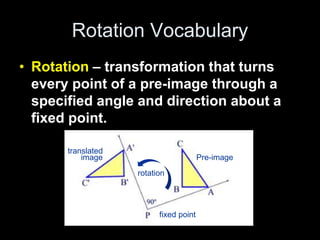
• Rotation – transformation that turns
every point of a pre-image through a
specified angle and direction about a
fixed point.
Pre-imageimage
fixed point
rotation
translated
Rotation Vocabulary
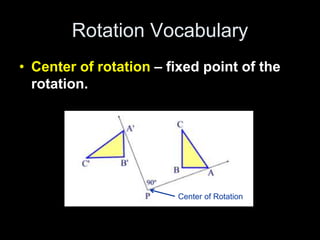
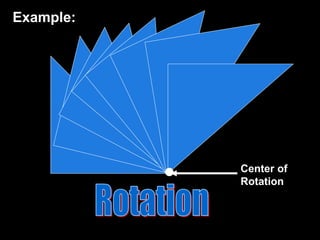
• Center of rotation – fixed point of the
rotation.
Center of Rotation
Rotation Vocabulary
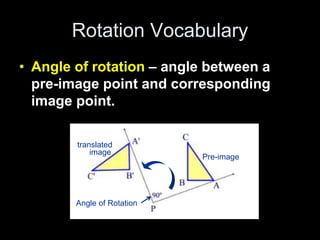
• Angle of rotation – angle between a
pre-image point and corresponding
image point.
Angle of Rotation
image
Pre-image
translated
Center of
Rotation
Example:
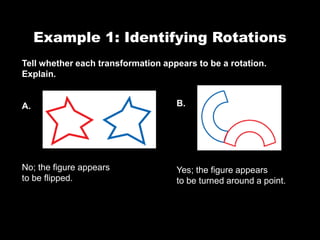
Example 1: Identifying Rotations
Tell whether each transformation appears to be a rotation.
Explain.
No; the figure appears
to be flipped.
Yes; the figure appears
to be turned around a point.
A. B.
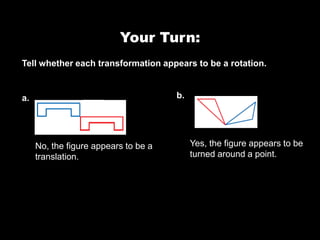
Your Turn:
Tell whether each transformation appears to be a rotation.
No, the figure appears to be a
translation.
Yes, the figure appears to be
turned around a point.
a. b.
Rotation Vocabulary
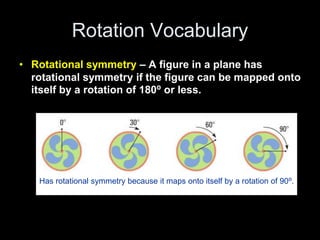
• Rotational symmetry – A figure in a plane has
rotational symmetry if the figure can be mapped onto
itself by a rotation of 180⁰ or less.
Has rotational symmetry because it maps onto itself by a rotation of 90⁰.
Rotational Symmetry
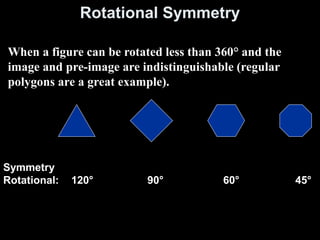
When a figure can be rotated less than 360° and the
image and pre-image are indistinguishable (regular
polygons are a great example).
Symmetry
Rotational: 120° 90° 60° 45°
Identify Rotational SymmetryExample 2
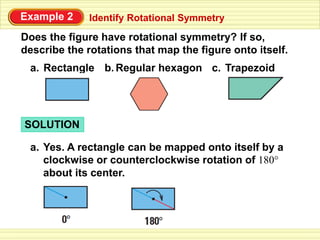
Does the figure have rotational symmetry? If so,
describe the rotations that map the figure onto itself.
Regular hexagonb.Rectanglea. Trapezoidc.
SOLUTION
Yes. A rectangle can be mapped onto itself by a
clockwise or counterclockwise rotation of 180°
about its center.
a.
Identify Rotational SymmetryExample 2
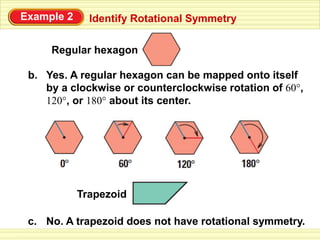
Yes. A regular hexagon can be mapped onto itself
by a clockwise or counterclockwise rotation of 60°,
120°, or 180° about its center.
b.
No. A trapezoid does not have rotational symmetry.c.
Regular hexagon
Trapezoid
Your Turn:
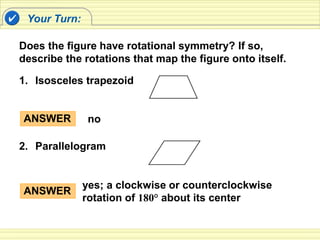
Does the figure have rotational symmetry? If so,
describe the rotations that map the figure onto itself.
Isosceles trapezoid1.
Parallelogram2.
noANSWER
yes; a clockwise or counterclockwise
rotation of 180° about its center
ANSWER
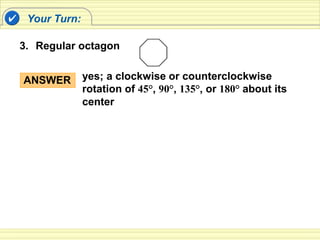
Your Turn:
Regular octagon3.
yes; a clockwise or counterclockwise
rotation of 45°, 90°, 135°, or 180° about its
center
ANSWER
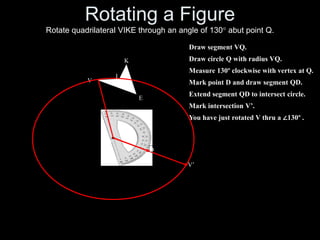
Rotating a Figure
Rotate quadrilateral VIKE through an angle of 130 abut point Q.
V
Q
V’
Draw segment VQ.
Draw circle Q with radius VQ.
Measure 130º clockwise with vertex at Q.
Mark point D and draw segment QD.
I
K
E
Extend segment QD to intersect circle.
Mark intersection V’.
D
You have just rotated V thru a ∠130º .
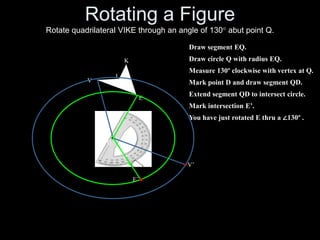
Rotating a Figure
Rotate quadrilateral VIKE through an angle of 130 abut point Q.
V
I
K
E
Q
V’
E’
Draw segment EQ.
Draw circle Q with radius EQ.
Measure 130º clockwise with vertex at Q.
Mark point D and draw segment QD.
Extend segment QD to intersect circle.
Mark intersection E’.
You have just rotated E thru a ∠130º .
Rotating a Figure
Rotate quadrilateral VIKE through an angle of 130 abut point Q.
V
I
K
E
Q
V’
K’
E’
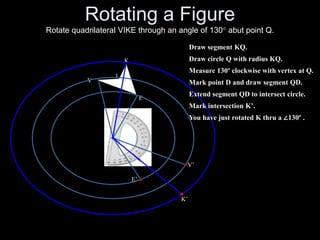
Draw segment KQ.
Draw circle Q with radius KQ.
Measure 130º clockwise with vertex at Q.
Mark point D and draw segment QD.
Extend segment QD to intersect circle.
Mark intersection K’.
You have just rotated K thru a ∠130º .
Rotating a Figure
Rotate quadrilateral VIKE through an angle of 130 abut point Q.
V
I
K
E
Q
V’
I’
K’
E’
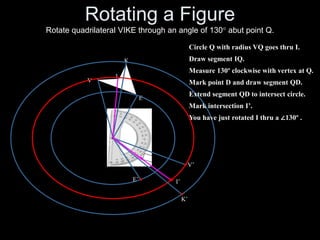
Circle Q with radius VQ goes thru I.
Draw segment IQ.
Measure 130º clockwise with vertex at Q.
Mark point D and draw segment QD.
Extend segment QD to intersect circle.
Mark intersection I’.
You have just rotated I thru a ∠130º .
Rotating a Figure
Rotate quadrilateral VIKE through an angle of 130 abut point Q.
V
I
K
E
Q
V’
I’
K’
E’
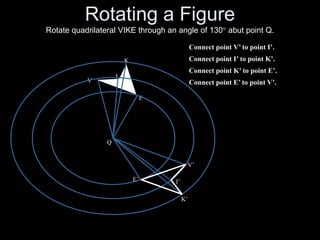
Connect point V’ to point I’.
Connect point I’ to point K’.
Connect point K’ to point E’.
Connect point E’ to point V’.
RotationsExample 3
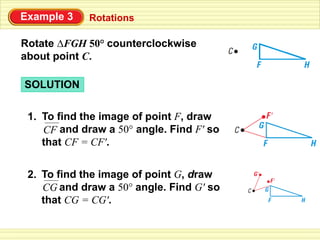
Rotate ∆FGH 50° counterclockwise
about point C.
SOLUTION
1. To find the image of point F, draw
and draw a 50° angle. Find F' so
that CF = CF'.
CF
2. To find the image of point G, draw
and draw a 50° angle. Find G' so
that CG = CG'.
CG
RotationsExample 3
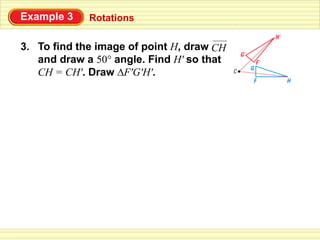
3. To find the image of point H, draw
and draw a 50° angle. Find H' so that
CH = CH'. Draw ∆F'G'H'.
CH
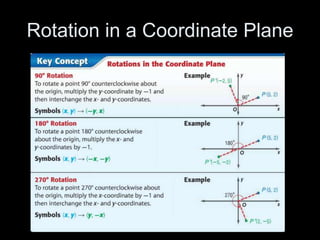
Rotation in a Coordinate Plane
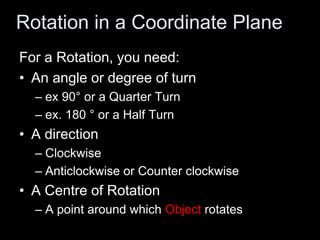
For a Rotation, you need:
• An angle or degree of turn
– ex 90° or a Quarter Turn
– ex. 180 ° or a Half Turn
• A direction
– Clockwise
– Anticlockwise or Counter clockwise
• A Centre of Rotation
– A point around which Object rotates
y
x1 2 3 4 5 6 7 8
1
2
3
4
5
6
7
8
–7 –6 –5 –4 –3 –2 –1-1
-2
-3
-4
-5
-6
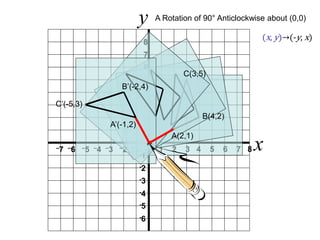
A Rotation of 90° Anticlockwise about (0,0)
x
x
A(2,1)
B(4,2)
C(3,5)
A’(-1,2)
B’(-2,4)
C’(-5,3)
(x, y)→(-y, x)
y
x1 2 3 4 5 6 7 8
1
2
3
4
5
6
7
8
–7 –6 –5 –4 –3 –2 –1-1
-2
-3
-4
-5
-6
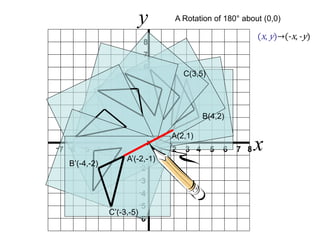
A Rotation of 180° about (0,0)
x
x
A(2,1)
B(4,2)
C(3,5)
(x, y)→(-x, -y)
A’(-2,-1)
B’(-4,-2)
C’(-3,-5)
Rotation in a Coordinate Plane
Rotations in a Coordinate PlaneExample 4
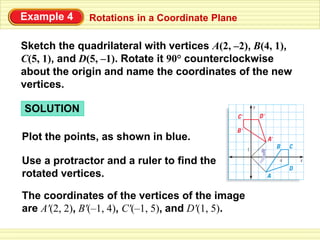
Sketch the quadrilateral with vertices A(2, –2), B(4, 1),
C(5, 1), and D(5, –1). Rotate it 90° counterclockwise
about the origin and name the coordinates of the new
vertices.
Use a protractor and a ruler to find the
rotated vertices.
The coordinates of the vertices of the image
are A'(2, 2), B'(–1, 4), C'(–1, 5), and D'(1, 5).
SOLUTION
Plot the points, as shown in blue.
Checkpoint Rotations in a Coordinate Plane
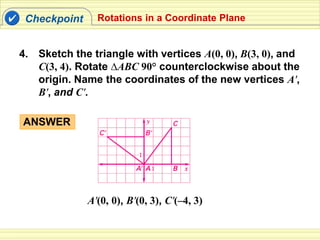
Sketch the triangle with vertices A(0, 0), B(3, 0), and
C(3, 4). Rotate ∆ABC 90° counterclockwise about the
origin. Name the coordinates of the new vertices A',
B', and C'.
4.
A'(0, 0), B'(0, 3), C'(–4, 3)
ANSWER
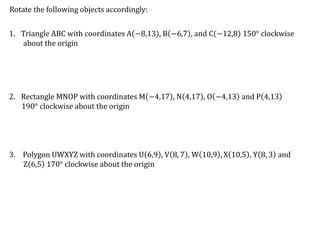
Rotate the following objects accordingly:
1. Triangle ABC with coordinates A −8,13 , B −6,7 , and C −12,8 150° clockwise
about the origin
2. Rectangle MNOP with coordinates M −4,17 , N 4,17 , O −4,13 and P 4,13
190° clockwise about the origin
3. Polygon UWXYZ with coordinates U 6,9 , V 8, 7 , W 10,9 , X 10,5 , Y 8, 3 and
Z 6,5 170° clockwise about the origin