


Holt Geometry 
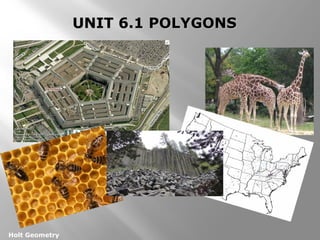
UUNNIITT 66..11 PPOOLLYYGGOONNSS
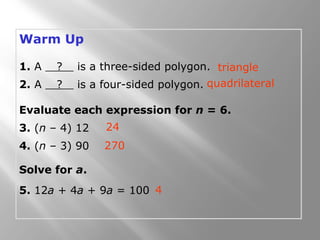
Warm Up 
1. A ? is a three-sided polygon. 
2. A ? is a four-sided polygon. 
Evaluate each expression for n = 6. 
3. (n – 4) 12 
4. (n – 3) 90 
Solve for a. 
5. 12a + 4a + 9a = 100 
triangle 
quadrilateral 
24 
270 
4
Objectives 
Classify polygons based on their sides 
and angles. 
Find and use the measures of interior 
and exterior angles of polygons.
Vocabulary 
side of a polygon 
vertex of a polygon 
diagonal 
regular polygon 
concave 
convex
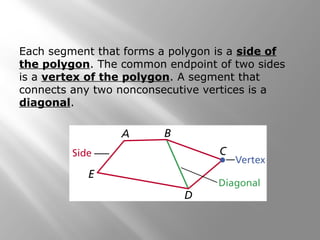
Each segment that forms a polygon is a side of 
the polygon. The common endpoint of two sides 
is a vertex of the polygon. A segment that 
connects any two nonconsecutive vertices is a 
diagonal.
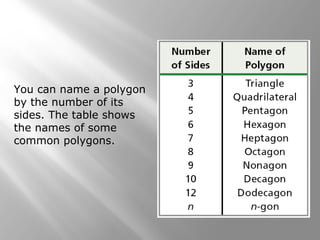
You can name a polygon 
by the number of its 
sides. The table shows 
the names of some 
common polygons.
Remember! 
A polygon is a closed plane figure formed by 
three or more segments that intersect only at 
their endpoints.
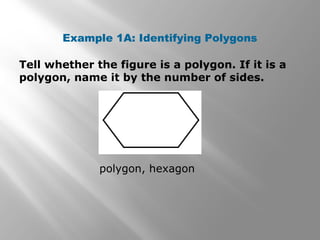
Example 1A: Identifying Polygons 
Tell whether the figure is a polygon. If it is a 
polygon, name it by the number of sides. 
polygon, hexagon
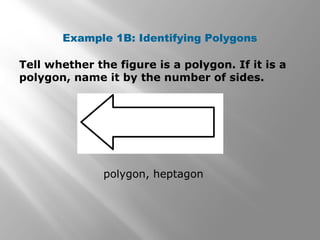
Example 1B: Identifying Polygons 
Tell whether the figure is a polygon. If it is a 
polygon, name it by the number of sides. 
polygon, heptagon
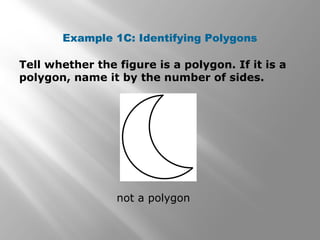
Example 1C: Identifying Polygons 
Tell whether the figure is a polygon. If it is a 
polygon, name it by the number of sides. 
not a polygon
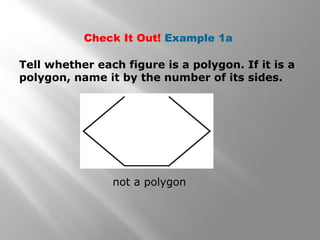
Check It Out! Example 1a 
Tell whether each figure is a polygon. If it is a 
polygon, name it by the number of its sides. 
not a polygon
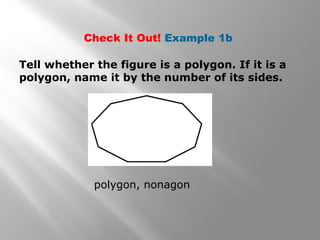
Check It Out! Example 1b 
Tell whether the figure is a polygon. If it is a 
polygon, name it by the number of its sides. 
polygon, nonagon
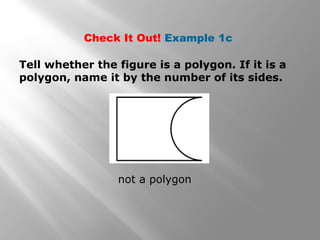
Check It Out! Example 1c 
Tell whether the figure is a polygon. If it is a 
polygon, name it by the number of its sides. 
not a polygon
All the sides are congruent in an equilateral polygon. 
All the angles are congruent in an equiangular 
polygon. A regular polygon is one that is both 
equilateral and equiangular. If a polygon is not 
regular, it is called irregular.
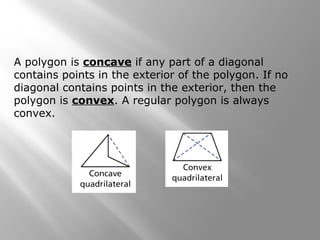
A polygon is concave if any part of a diagonal 
contains points in the exterior of the polygon. If no 
diagonal contains points in the exterior, then the 
polygon is convex. A regular polygon is always 
convex.
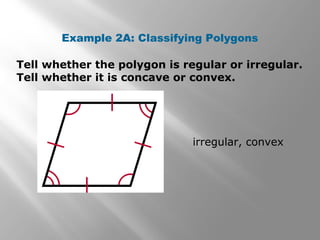
Example 2A: Classifying Polygons 
Tell whether the polygon is regular or irregular. 
Tell whether it is concave or convex. 
irregular, convex
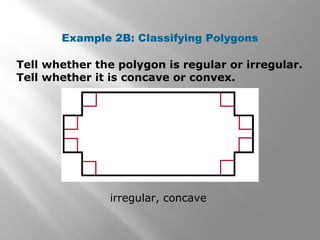
Example 2B: Classifying Polygons 
Tell whether the polygon is regular or irregular. 
Tell whether it is concave or convex. 
irregular, concave
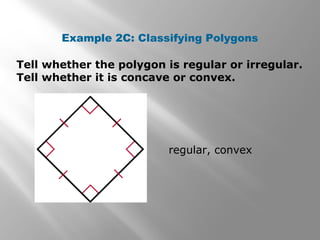
Example 2C: Classifying Polygons 
Tell whether the polygon is regular or irregular. 
Tell whether it is concave or convex. 
regular, convex
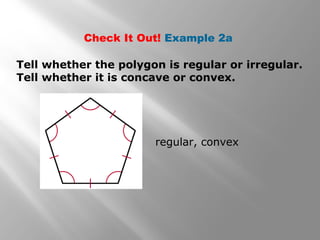
Check It Out! Example 2a 
Tell whether the polygon is regular or irregular. 
Tell whether it is concave or convex. 
regular, convex
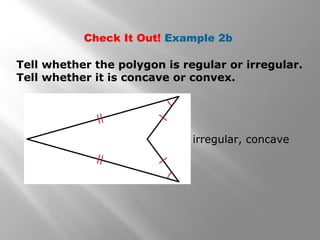
Check It Out! Example 2b 
Tell whether the polygon is regular or irregular. 
Tell whether it is concave or convex. 
irregular, concave
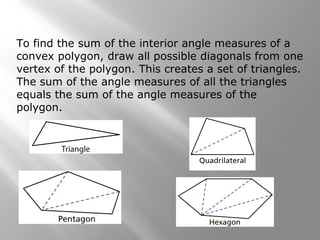
To find the sum of the interior angle measures of a 
convex polygon, draw all possible diagonals from one 
vertex of the polygon. This creates a set of triangles. 
The sum of the angle measures of all the triangles 
equals the sum of the angle measures of the 
polygon.
Remember! 
By the Triangle Sum Theorem, the sum of the 
interior angle measures of a triangle is 180°.
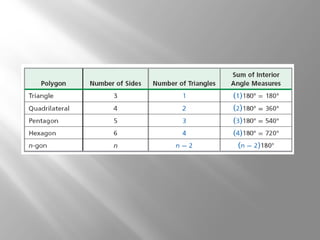
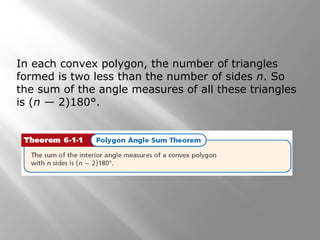
In each convex polygon, the number of triangles 
formed is two less than the number of sides n. So 
the sum of the angle measures of all these triangles 
is (n — 2)180°.
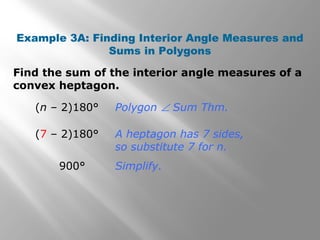
Example 3A: Finding Interior Angle Measures and 
Sums in Polygons 
Find the sum of the interior angle measures of a 
convex heptagon. 
(n – 2)180° 
(7 – 2)180° 
900° 
Polygon Ð Sum Thm. 
A heptagon has 7 sides, 
so substitute 7 for n. 
Simplify.
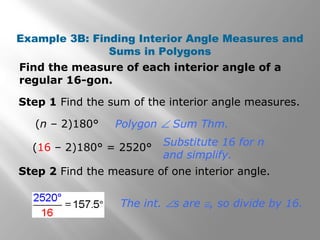
Example 3B: Finding Interior Angle Measures and 
Sums in Polygons 
Find the measure of each interior angle of a 
regular 16-gon. 
Step 1 Find the sum of the interior angle measures. 
Polygon Ð Sum Thm. 
(n – 2)180° 
(16 – 2)180° = 2520° 
Substitute 16 for n 
and simplify. 
Step 2 Find the measure of one interior angle. 
The int. Ðs are @, so divide by 16.
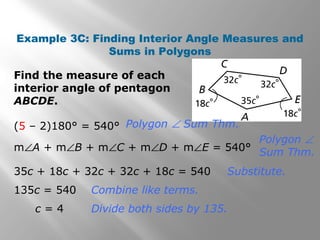
Example 3C: Finding Interior Angle Measures and 
Sums in Polygons 
Find the measure of each 
interior angle of pentagon 
ABCDE. 
(5 – 2)180° = 540° Polygon Ð Sum Thm. 
mÐA + mÐB + mÐC + mÐD + mÐE = 540° 
Polygon Ð 
Sum Thm. 
35c + 18c + 32c + 32c + 18c = 540 Substitute. 
135c = 540 Combine like terms. 
c = 4 Divide both sides by 135.
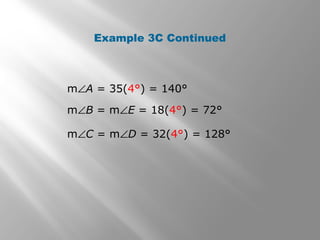
Example 3C Continued 
mÐA = 35(4°) = 140° 
mÐB = mÐE = 18(4°) = 72° 
mÐC = mÐD = 32(4°) = 128°
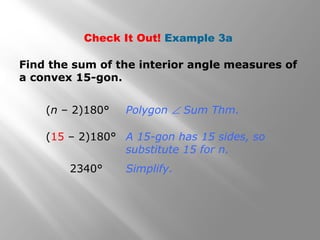
Check It Out! Example 3a 
Find the sum of the interior angle measures of 
a convex 15-gon. 
(n – 2)180° 
(15 – 2)180° 
2340° 
Polygon Ð Sum Thm. 
A 15-gon has 15 sides, so 
substitute 15 for n. 
Simplify.
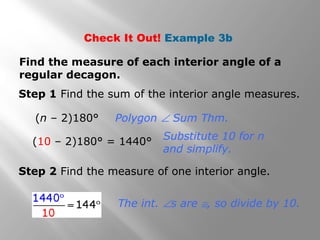
Check It Out! Example 3b 
Find the measure of each interior angle of a 
regular decagon. 
Step 1 Find the sum of the interior angle measures. 
Polygon Ð Sum Thm. 
(n – 2)180° 
(10 – 2)180° = 1440° 
Substitute 10 for n 
and simplify. 
Step 2 Find the measure of one interior angle. 
The int. Ðs are @, so divide by 10.
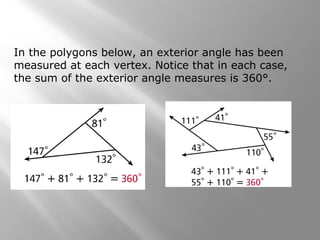
In the polygons below, an exterior angle has been 
measured at each vertex. Notice that in each case, 
the sum of the exterior angle measures is 360°.
Remember! 
An exterior angle is formed by one side of a 
polygon and the extension of a consecutive side.
Example 4A: Finding Interior Angle Measures and 
Sums in Polygons 
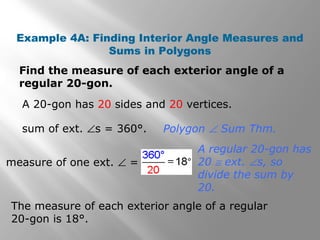
Find the measure of each exterior angle of a 
regular 20-gon. 
A 20-gon has 20 sides and 20 vertices. 
sum of ext. Ðs = 360°. 
Polygon Ð Sum Thm. 
A regular 20-gon has 
20 @ ext. Ðs, so 
divide the sum by 
20. 
measure of one ext. Ð = 
The measure of each exterior angle of a regular 
20-gon is 18°.
Example 4B: Finding Interior Angle Measures and 
Sums in Polygons 
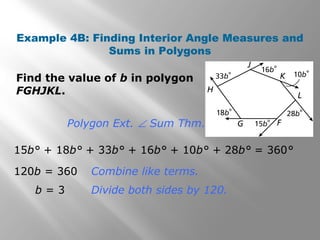
Find the value of b in polygon 
FGHJKL. 
Polygon Ext. Ð Sum Thm. 
15b° + 18b° + 33b° + 16b° + 10b° + 28b° = 360° 
120b = 360 Combine like terms. 
b = 3 Divide both sides by 120.
Check It Out! Example 4a 
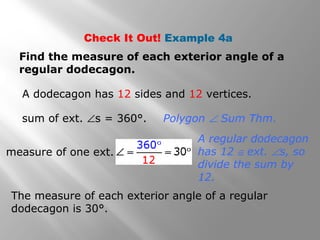
Find the measure of each exterior angle of a 
regular dodecagon. 
A dodecagon has 12 sides and 12 vertices. 
sum of ext. Ðs = 360°. 
Polygon Ð Sum Thm. 
A regular dodecagon 
has 12 @ ext. Ðs, so 
divide the sum by 
12. 
measure of one ext. 
The measure of each exterior angle of a regular 
dodecagon is 30°.
Check It Out! Example 4b 
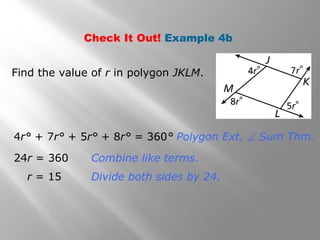
Find the value of r in polygon JKLM. 
4r° + 7r° + 5r° + 8r° = 360° Polygon Ext. Ð Sum Thm. 
24r = 360 Combine like terms. 
r = 15 Divide both sides by 24.
Example 5: Art Application 
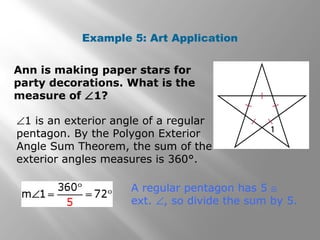
Ann is making paper stars for 
party decorations. What is the 
measure of Ð1? 
Ð1 is an exterior angle of a regular 
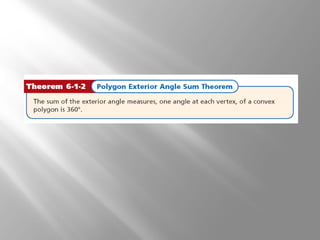
pentagon. By the Polygon Exterior 
Angle Sum Theorem, the sum of the 
exterior angles measures is 360°. 
A regular pentagon has 5 @ 
ext. Ð, so divide the sum by 5.
Check It Out! Example 5 
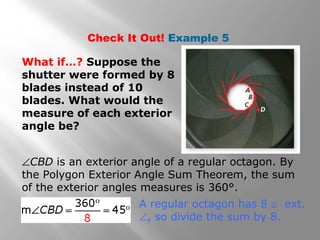
What if…? Suppose the 
shutter were formed by 8 
blades instead of 10 
blades. What would the 
measure of each exterior 
angle be? 
ÐCBD is an exterior angle of a regular octagon. By 
the Polygon Exterior Angle Sum Theorem, the sum 
of the exterior angles measures is 360°. 
A regular octagon has 8 @ ext. 
Ð, so divide the sum by 8.
Lesson Quiz 
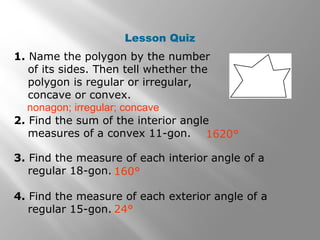
1. Name the polygon by the number 
of its sides. Then tell whether the 
polygon is regular or irregular, 
concave or convex. 
nonagon; irregular; concave 
2. Find the sum of the interior angle 
measures of a convex 11-gon. 
1620° 
3. Find the measure of each interior angle of a 
regular 18-gon. 
4. Find the measure of each exterior angle of a 
regular 15-gon. 
160° 
24°
All rights belong to their 
respective owners. 
Copyright Disclaimer Under 
Section 107 of the 
Copyright Act 1976, 
allowance is made for "fair 
use" for purposes such as 
criticism, comment, news 
reporting, TEACHING, 
scholarship, and research. 
Fair use is a use permitted 
by copyright statute that 
might otherwise be 
infringing. 
Non-profit, EDUCATIONAL 
or personal use tips the 
balance in favor of fair use.

Geometry unit 6.1

  • 1.
    Holt Geometry UUNNIITT66..11 PPOOLLYYGGOONNSS
  • 2.
    Warm Up 1.A ? is a three-sided polygon. 2. A ? is a four-sided polygon. Evaluate each expression for n = 6. 3. (n – 4) 12 4. (n – 3) 90 Solve for a. 5. 12a + 4a + 9a = 100 triangle quadrilateral 24 270 4
  • 3.
    Objectives Classify polygonsbased on their sides and angles. Find and use the measures of interior and exterior angles of polygons.
  • 4.
    Vocabulary side ofa polygon vertex of a polygon diagonal regular polygon concave convex
  • 5.
    Each segment thatforms a polygon is a side of the polygon. The common endpoint of two sides is a vertex of the polygon. A segment that connects any two nonconsecutive vertices is a diagonal.
  • 6.
    You can namea polygon by the number of its sides. The table shows the names of some common polygons.
  • 7.
    Remember! A polygonis a closed plane figure formed by three or more segments that intersect only at their endpoints.
  • 8.
    Example 1A: IdentifyingPolygons Tell whether the figure is a polygon. If it is a polygon, name it by the number of sides. polygon, hexagon
  • 9.
    Example 1B: IdentifyingPolygons Tell whether the figure is a polygon. If it is a polygon, name it by the number of sides. polygon, heptagon
  • 10.
    Example 1C: IdentifyingPolygons Tell whether the figure is a polygon. If it is a polygon, name it by the number of sides. not a polygon
  • 11.
    Check It Out!Example 1a Tell whether each figure is a polygon. If it is a polygon, name it by the number of its sides. not a polygon
  • 12.
    Check It Out!Example 1b Tell whether the figure is a polygon. If it is a polygon, name it by the number of its sides. polygon, nonagon
  • 13.
    Check It Out!Example 1c Tell whether the figure is a polygon. If it is a polygon, name it by the number of its sides. not a polygon
  • 14.
    All the sidesare congruent in an equilateral polygon. All the angles are congruent in an equiangular polygon. A regular polygon is one that is both equilateral and equiangular. If a polygon is not regular, it is called irregular.
  • 15.
    A polygon isconcave if any part of a diagonal contains points in the exterior of the polygon. If no diagonal contains points in the exterior, then the polygon is convex. A regular polygon is always convex.
  • 16.
    Example 2A: ClassifyingPolygons Tell whether the polygon is regular or irregular. Tell whether it is concave or convex. irregular, convex
  • 17.
    Example 2B: ClassifyingPolygons Tell whether the polygon is regular or irregular. Tell whether it is concave or convex. irregular, concave
  • 18.
    Example 2C: ClassifyingPolygons Tell whether the polygon is regular or irregular. Tell whether it is concave or convex. regular, convex
  • 19.
    Check It Out!Example 2a Tell whether the polygon is regular or irregular. Tell whether it is concave or convex. regular, convex
  • 20.
    Check It Out!Example 2b Tell whether the polygon is regular or irregular. Tell whether it is concave or convex. irregular, concave
  • 21.
    To find thesum of the interior angle measures of a convex polygon, draw all possible diagonals from one vertex of the polygon. This creates a set of triangles. The sum of the angle measures of all the triangles equals the sum of the angle measures of the polygon.
  • 22.
    Remember! By theTriangle Sum Theorem, the sum of the interior angle measures of a triangle is 180°.
  • 24.
    In each convexpolygon, the number of triangles formed is two less than the number of sides n. So the sum of the angle measures of all these triangles is (n — 2)180°.
  • 25.
    Example 3A: FindingInterior Angle Measures and Sums in Polygons Find the sum of the interior angle measures of a convex heptagon. (n – 2)180° (7 – 2)180° 900° Polygon Ð Sum Thm. A heptagon has 7 sides, so substitute 7 for n. Simplify.
  • 26.
    Example 3B: FindingInterior Angle Measures and Sums in Polygons Find the measure of each interior angle of a regular 16-gon. Step 1 Find the sum of the interior angle measures. Polygon Ð Sum Thm. (n – 2)180° (16 – 2)180° = 2520° Substitute 16 for n and simplify. Step 2 Find the measure of one interior angle. The int. Ðs are @, so divide by 16.
  • 27.
    Example 3C: FindingInterior Angle Measures and Sums in Polygons Find the measure of each interior angle of pentagon ABCDE. (5 – 2)180° = 540° Polygon Ð Sum Thm. mÐA + mÐB + mÐC + mÐD + mÐE = 540° Polygon Ð Sum Thm. 35c + 18c + 32c + 32c + 18c = 540 Substitute. 135c = 540 Combine like terms. c = 4 Divide both sides by 135.
  • 28.
    Example 3C Continued mÐA = 35(4°) = 140° mÐB = mÐE = 18(4°) = 72° mÐC = mÐD = 32(4°) = 128°
  • 29.
    Check It Out!Example 3a Find the sum of the interior angle measures of a convex 15-gon. (n – 2)180° (15 – 2)180° 2340° Polygon Ð Sum Thm. A 15-gon has 15 sides, so substitute 15 for n. Simplify.
  • 30.
    Check It Out!Example 3b Find the measure of each interior angle of a regular decagon. Step 1 Find the sum of the interior angle measures. Polygon Ð Sum Thm. (n – 2)180° (10 – 2)180° = 1440° Substitute 10 for n and simplify. Step 2 Find the measure of one interior angle. The int. Ðs are @, so divide by 10.
  • 31.
    In the polygonsbelow, an exterior angle has been measured at each vertex. Notice that in each case, the sum of the exterior angle measures is 360°.
  • 32.
    Remember! An exteriorangle is formed by one side of a polygon and the extension of a consecutive side.
  • 34.
    Example 4A: FindingInterior Angle Measures and Sums in Polygons Find the measure of each exterior angle of a regular 20-gon. A 20-gon has 20 sides and 20 vertices. sum of ext. Ðs = 360°. Polygon Ð Sum Thm. A regular 20-gon has 20 @ ext. Ðs, so divide the sum by 20. measure of one ext. Ð = The measure of each exterior angle of a regular 20-gon is 18°.
  • 35.
    Example 4B: FindingInterior Angle Measures and Sums in Polygons Find the value of b in polygon FGHJKL. Polygon Ext. Ð Sum Thm. 15b° + 18b° + 33b° + 16b° + 10b° + 28b° = 360° 120b = 360 Combine like terms. b = 3 Divide both sides by 120.
  • 36.
    Check It Out!Example 4a Find the measure of each exterior angle of a regular dodecagon. A dodecagon has 12 sides and 12 vertices. sum of ext. Ðs = 360°. Polygon Ð Sum Thm. A regular dodecagon has 12 @ ext. Ðs, so divide the sum by 12. measure of one ext. The measure of each exterior angle of a regular dodecagon is 30°.
  • 37.
    Check It Out!Example 4b Find the value of r in polygon JKLM. 4r° + 7r° + 5r° + 8r° = 360° Polygon Ext. Ð Sum Thm. 24r = 360 Combine like terms. r = 15 Divide both sides by 24.
  • 38.
    Example 5: ArtApplication Ann is making paper stars for party decorations. What is the measure of Ð1? Ð1 is an exterior angle of a regular pentagon. By the Polygon Exterior Angle Sum Theorem, the sum of the exterior angles measures is 360°. A regular pentagon has 5 @ ext. Ð, so divide the sum by 5.
  • 39.
    Check It Out!Example 5 What if…? Suppose the shutter were formed by 8 blades instead of 10 blades. What would the measure of each exterior angle be? ÐCBD is an exterior angle of a regular octagon. By the Polygon Exterior Angle Sum Theorem, the sum of the exterior angles measures is 360°. A regular octagon has 8 @ ext. Ð, so divide the sum by 8.
  • 40.
    Lesson Quiz 1.Name the polygon by the number of its sides. Then tell whether the polygon is regular or irregular, concave or convex. nonagon; irregular; concave 2. Find the sum of the interior angle measures of a convex 11-gon. 1620° 3. Find the measure of each interior angle of a regular 18-gon. 4. Find the measure of each exterior angle of a regular 15-gon. 160° 24°
  • 41.
    All rights belongto their respective owners. Copyright Disclaimer Under Section 107 of the Copyright Act 1976, allowance is made for "fair use" for purposes such as criticism, comment, news reporting, TEACHING, scholarship, and research. Fair use is a use permitted by copyright statute that might otherwise be infringing. Non-profit, EDUCATIONAL or personal use tips the balance in favor of fair use.