
Factoring : Difference of
Two Squares
Lorie Jane L. Letada
Module 1
Objectives
At the end of this lesson, you are expected to:
• identify expression factorable
by difference of two squares;
• factor difference of two
squares completely.
Review
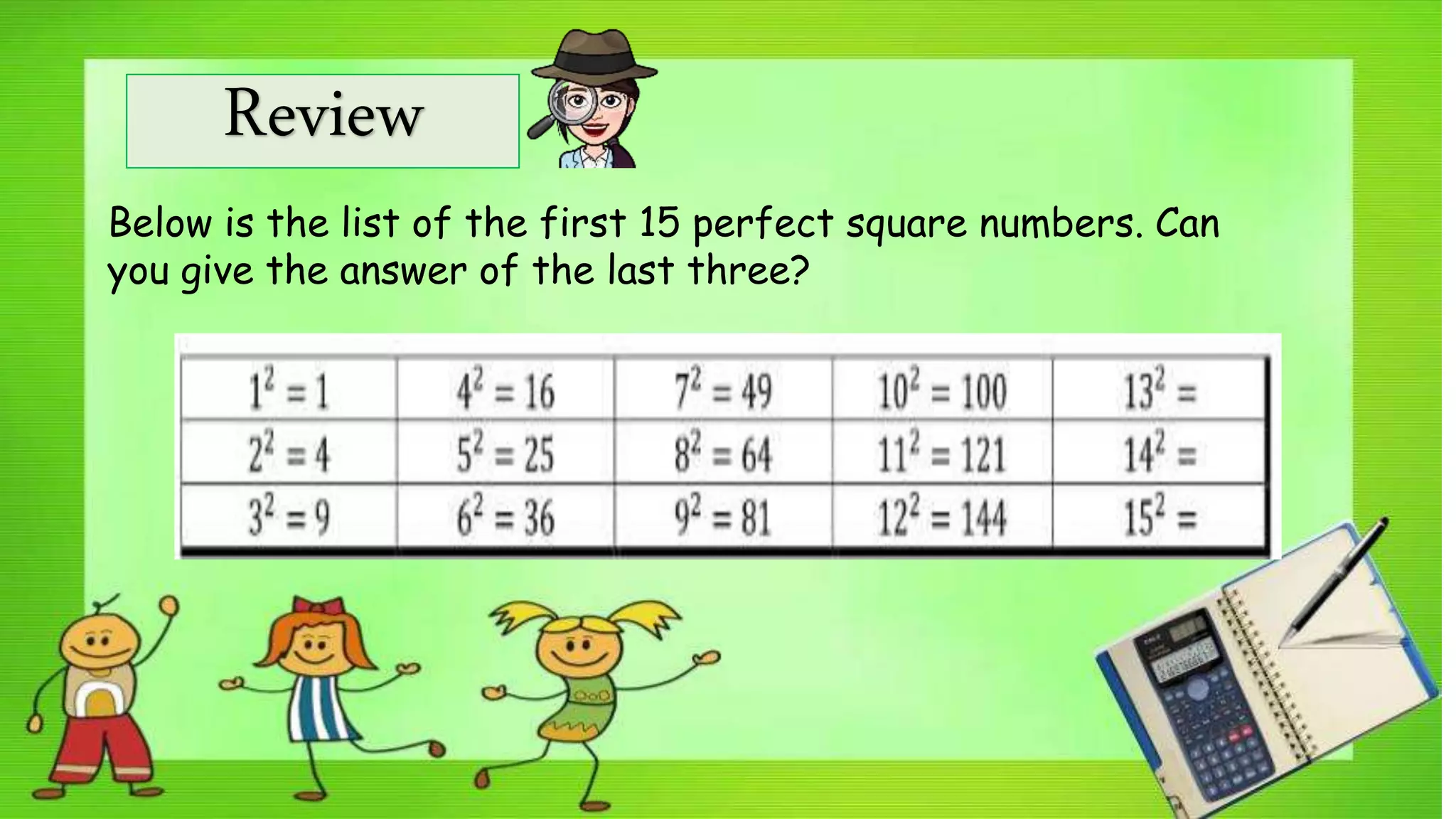
Below is the list of the first 15 perfect square numbers. Can
you give the answer of the last three?
What’s New
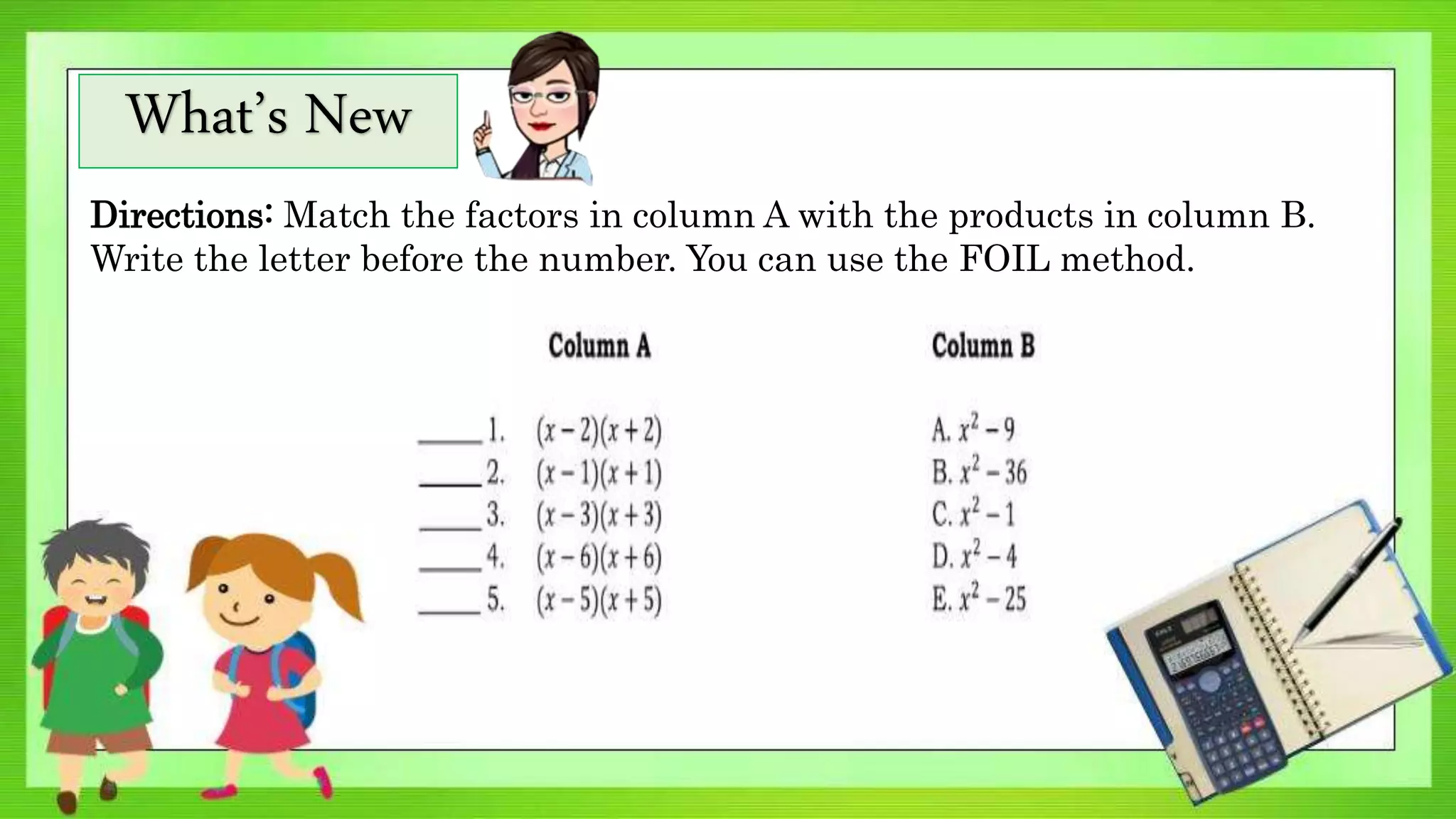
Directions: Match the factors in column A with the products in column B.
Write the letter before the number. You can use the FOIL method.
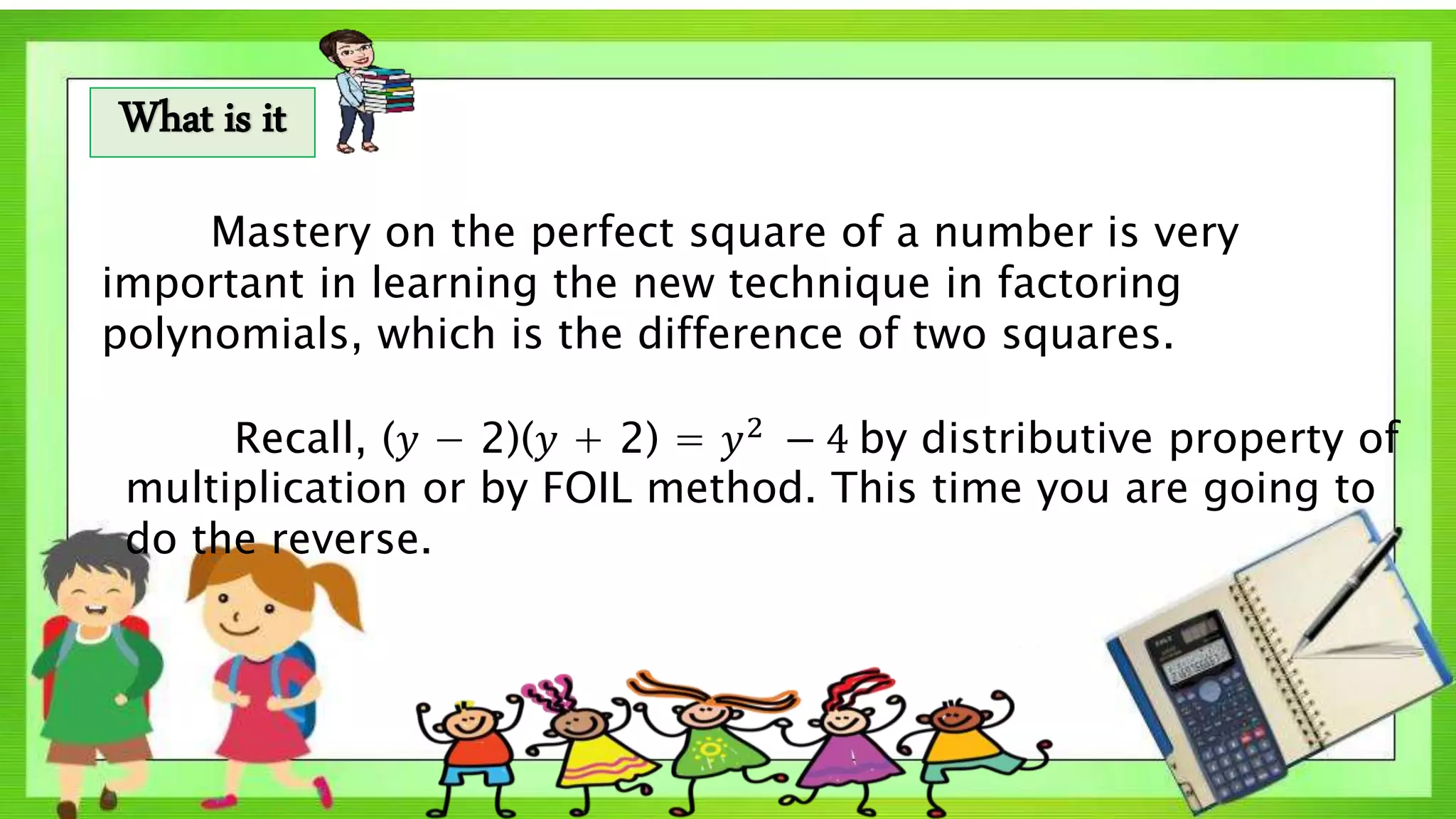
What is it
Mastery on the perfect square of a number is very
important in learning the new technique in factoring
polynomials, which is the difference of two squares.
Recall, (𝑦 − 2)(𝑦 + 2) = 𝑦2 − 4 by distributive property of
multiplication or by FOIL method. This time you are going to
do the reverse.
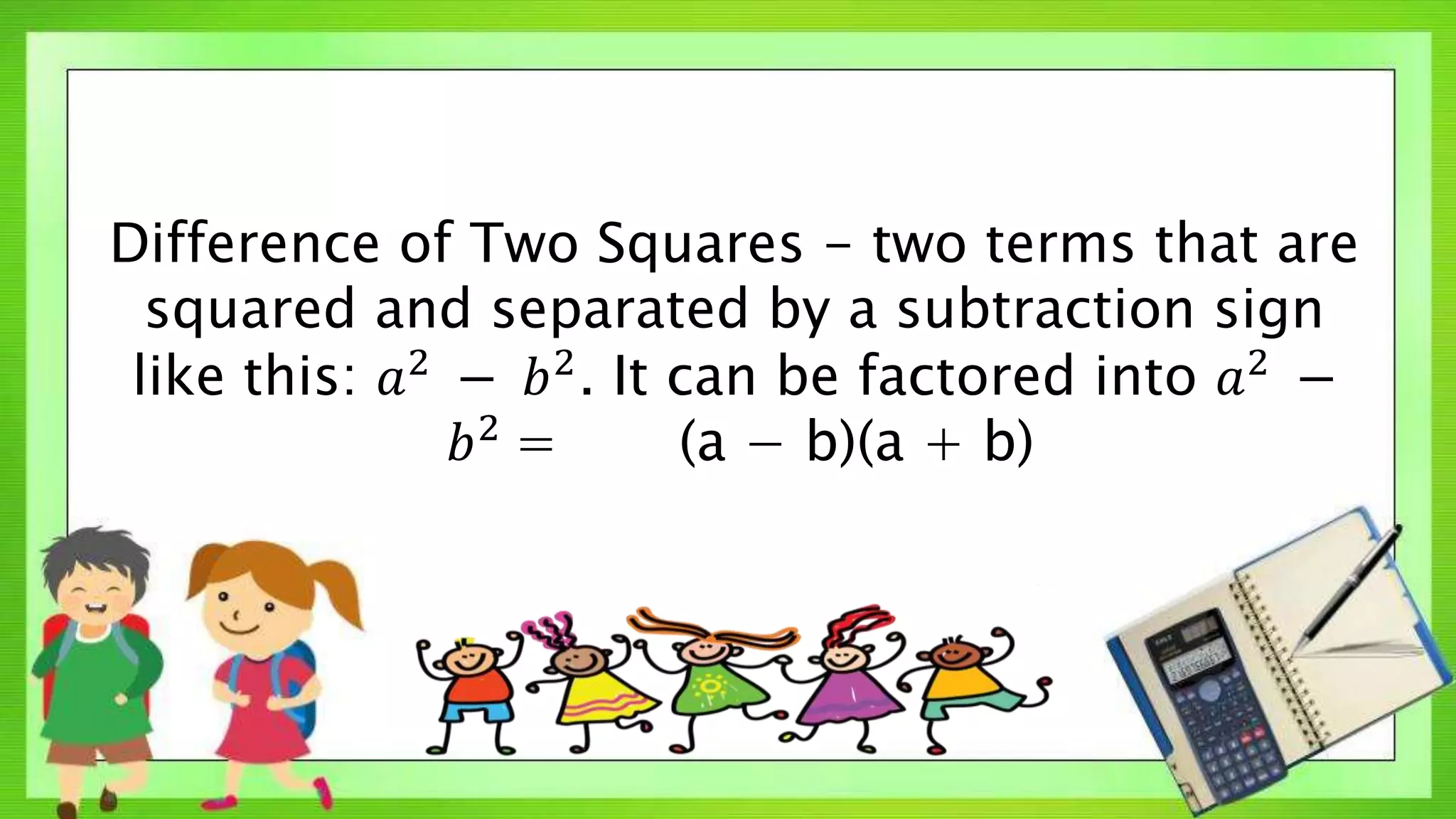
Difference of Two Squares - two terms that are
squared and separated by a subtraction sign
like this: 𝑎2
− 𝑏2
. It can be factored into 𝑎2
−
𝑏2
= (a − b)(a + b)
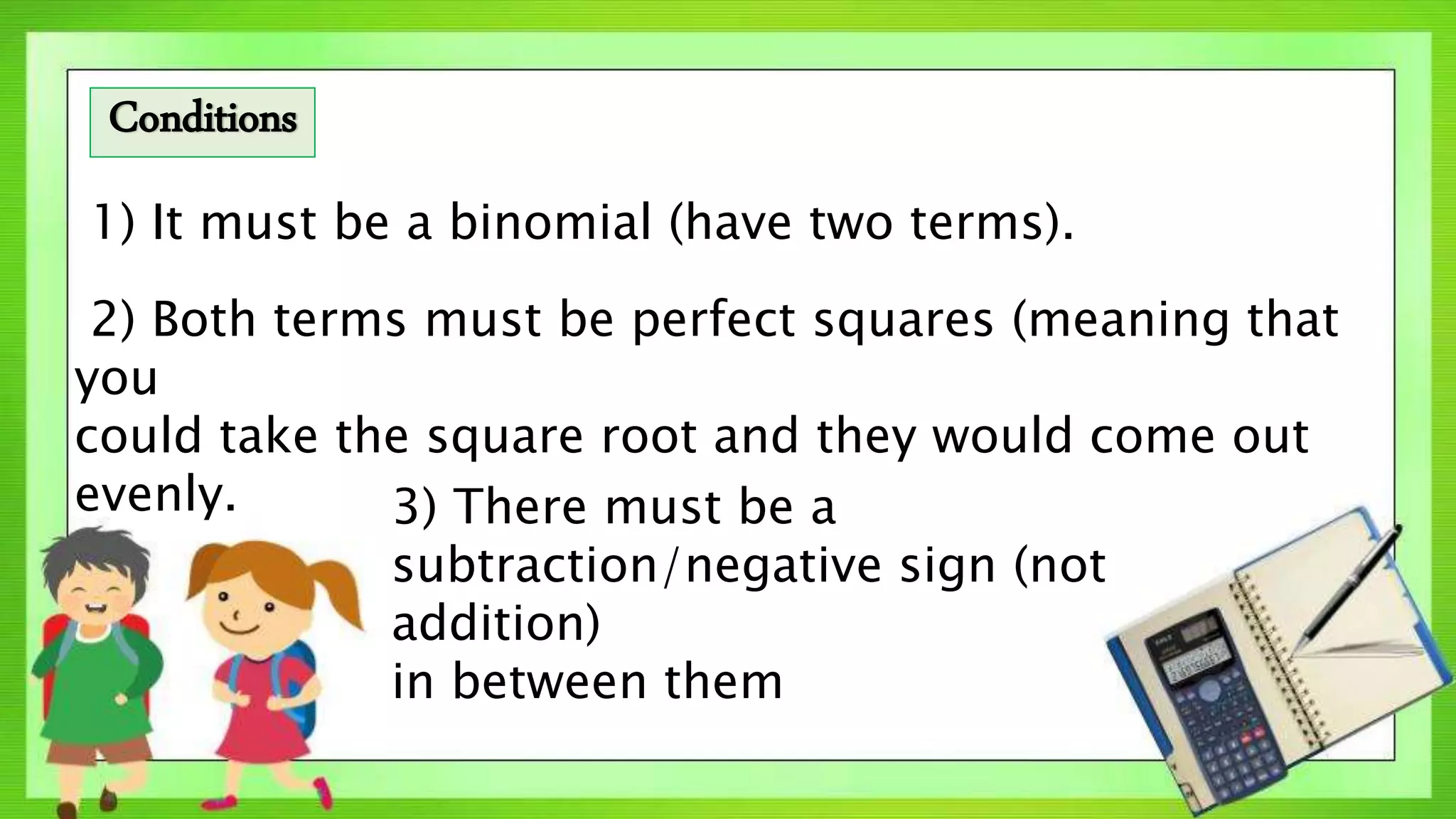
1) It must be a binomial (have two terms).
2) Both terms must be perfect squares (meaning that
you
could take the square root and they would come out
evenly. 3) There must be a
subtraction/negative sign (not
addition)
in between them
Conditions
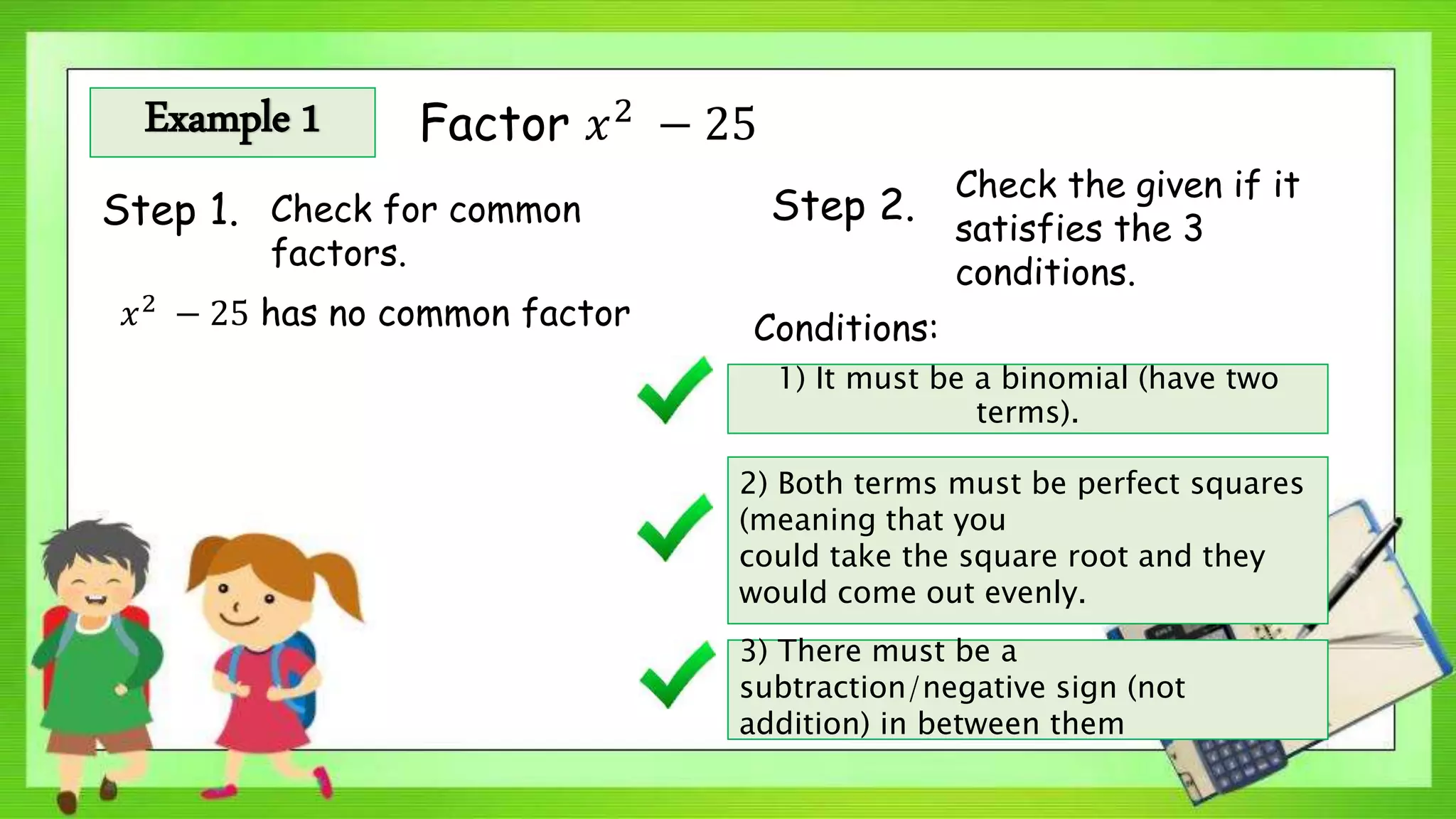
Example 1 Factor 𝑥2
− 25
Step 1. Check for common
factors.
Step 2.
Check the given if it
satisfies the 3
conditions.
𝑥2 − 25 has no common factor Conditions:
1) It must be a binomial (have two
terms).
2) Both terms must be perfect squares
(meaning that you
could take the square root and they
would come out evenly.
3) There must be a
subtraction/negative sign (not
addition) in between them
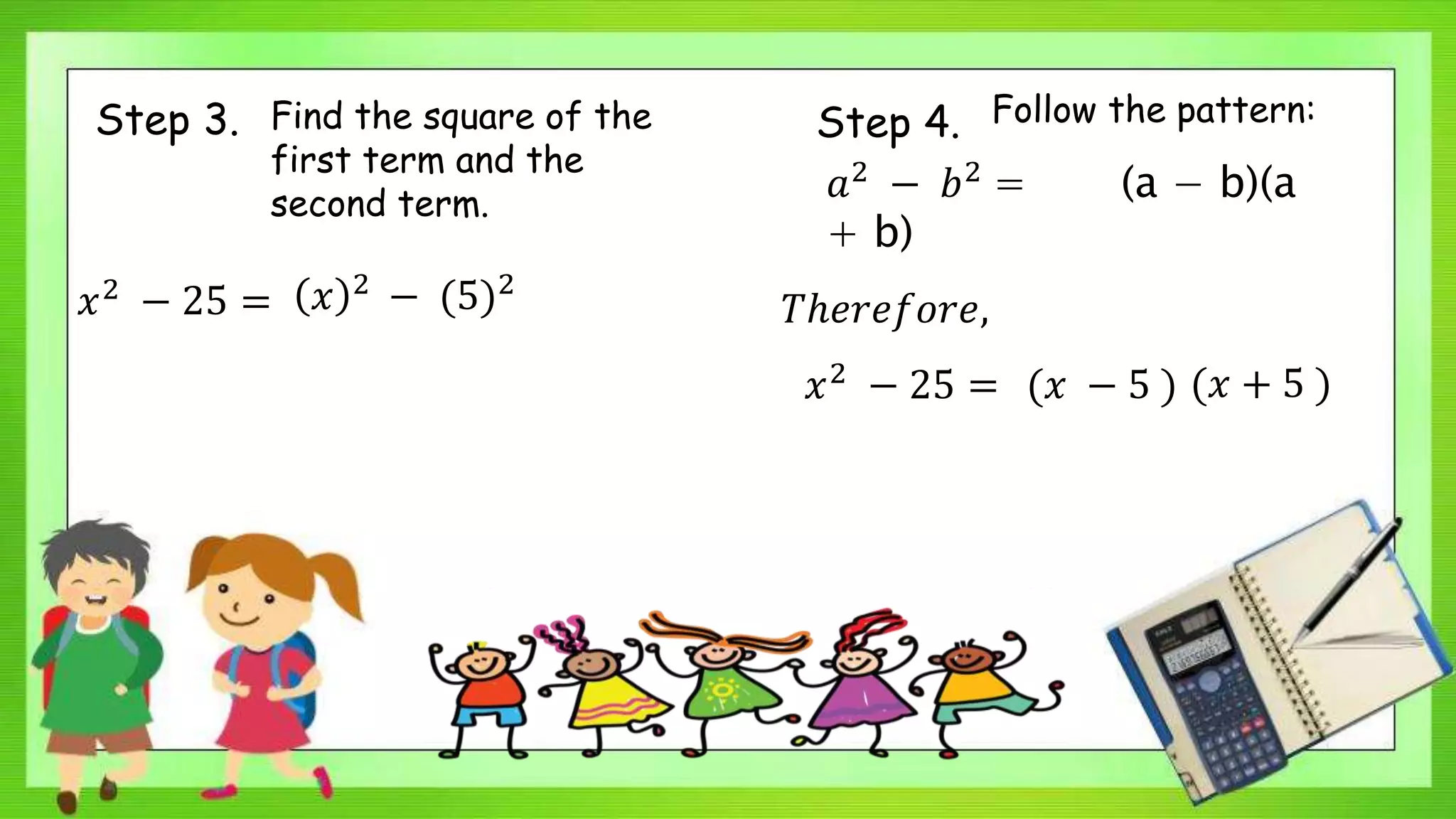
Step 3. Find the square of the
first term and the
second term.
𝑥2 − 25 = 𝑥 2 − (5)2
Step 4. Follow the pattern:
𝑎2 − 𝑏2 = (a − b)(a
+ b)
𝑇ℎ𝑒𝑟𝑒𝑓𝑜𝑟𝑒,
𝑥2 − 25 = (𝑥 − 5 ) (𝑥 + 5 )
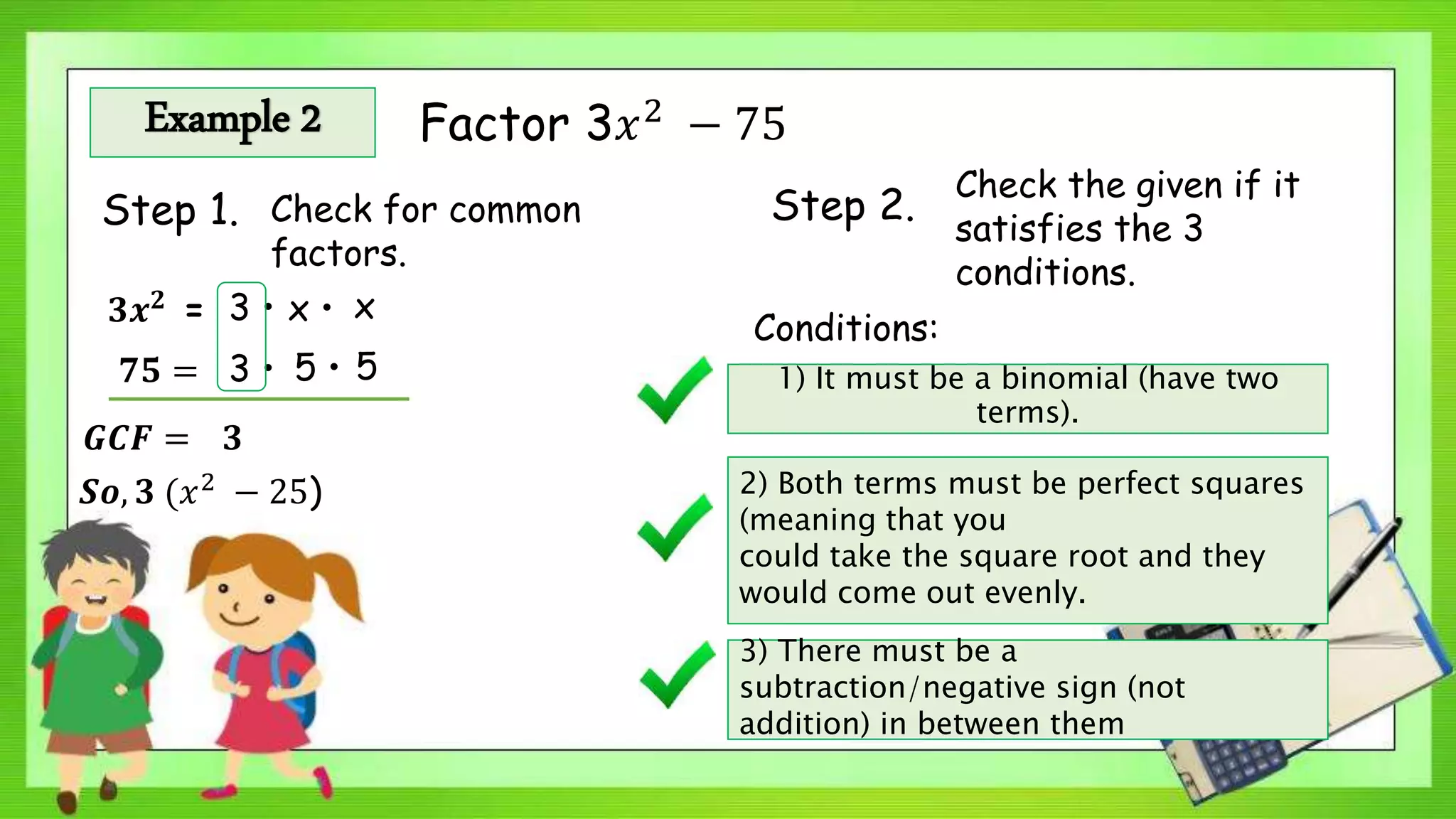
Example 2 Factor 3𝑥2
− 75
Step 1. Check for common
factors.
Step 2.
Check the given if it
satisfies the 3
conditions.
𝟑𝒙 𝟐
=
Conditions:
1) It must be a binomial (have two
terms).
2) Both terms must be perfect squares
(meaning that you
could take the square root and they
would come out evenly.
3) There must be a
subtraction/negative sign (not
addition) in between them
3 • x • x
𝟕𝟓 = 3 • 5 • 5
𝑮𝑪𝑭 = 𝟑
𝑺𝒐, 𝟑 (𝑥2 − 25)
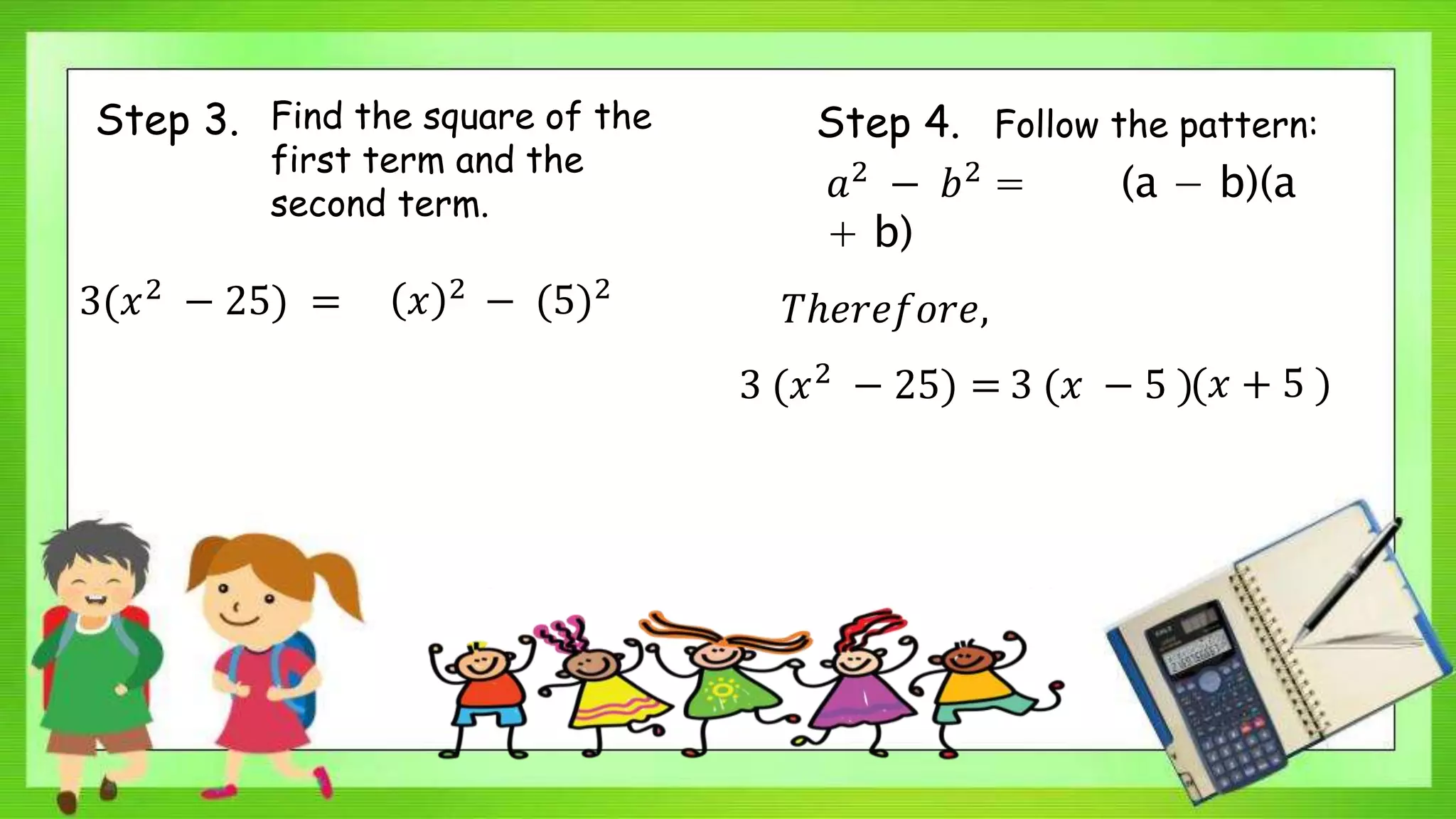
Step 3. Find the square of the
first term and the
second term.
3(𝑥2 − 25) = 𝑥 2 − (5)2
Step 4. Follow the pattern:
𝑎2 − 𝑏2 = (a − b)(a
+ b)
𝑇ℎ𝑒𝑟𝑒𝑓𝑜𝑟𝑒,
3 (𝑥2 − 25) = 3 (𝑥 − 5 )(𝑥 + 5 )
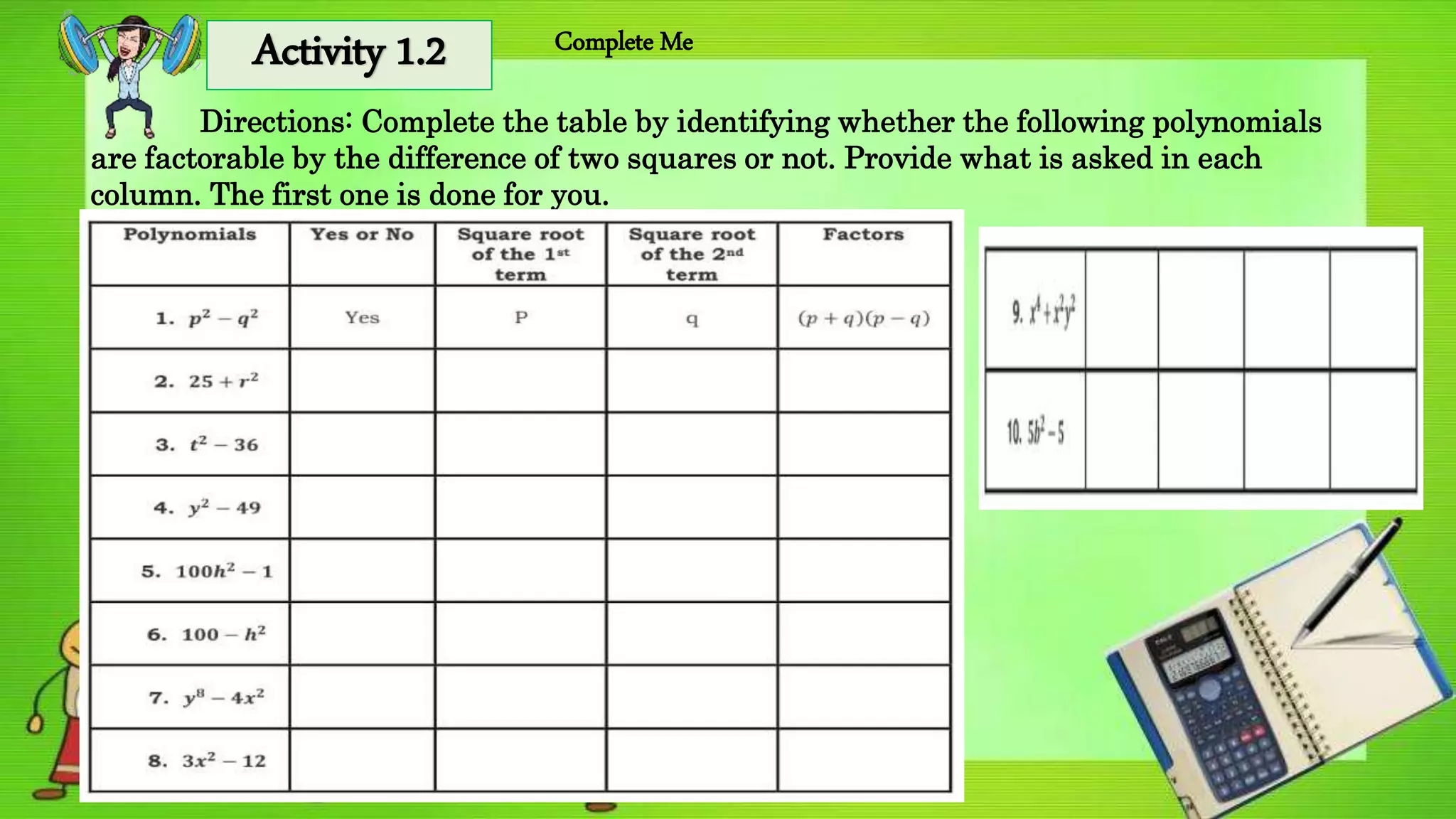
Activity 1.2 Complete Me
Directions: Complete the table by identifying whether the following polynomials
are factorable by the difference of two squares or not. Provide what is asked in each
column. The first one is done for you.
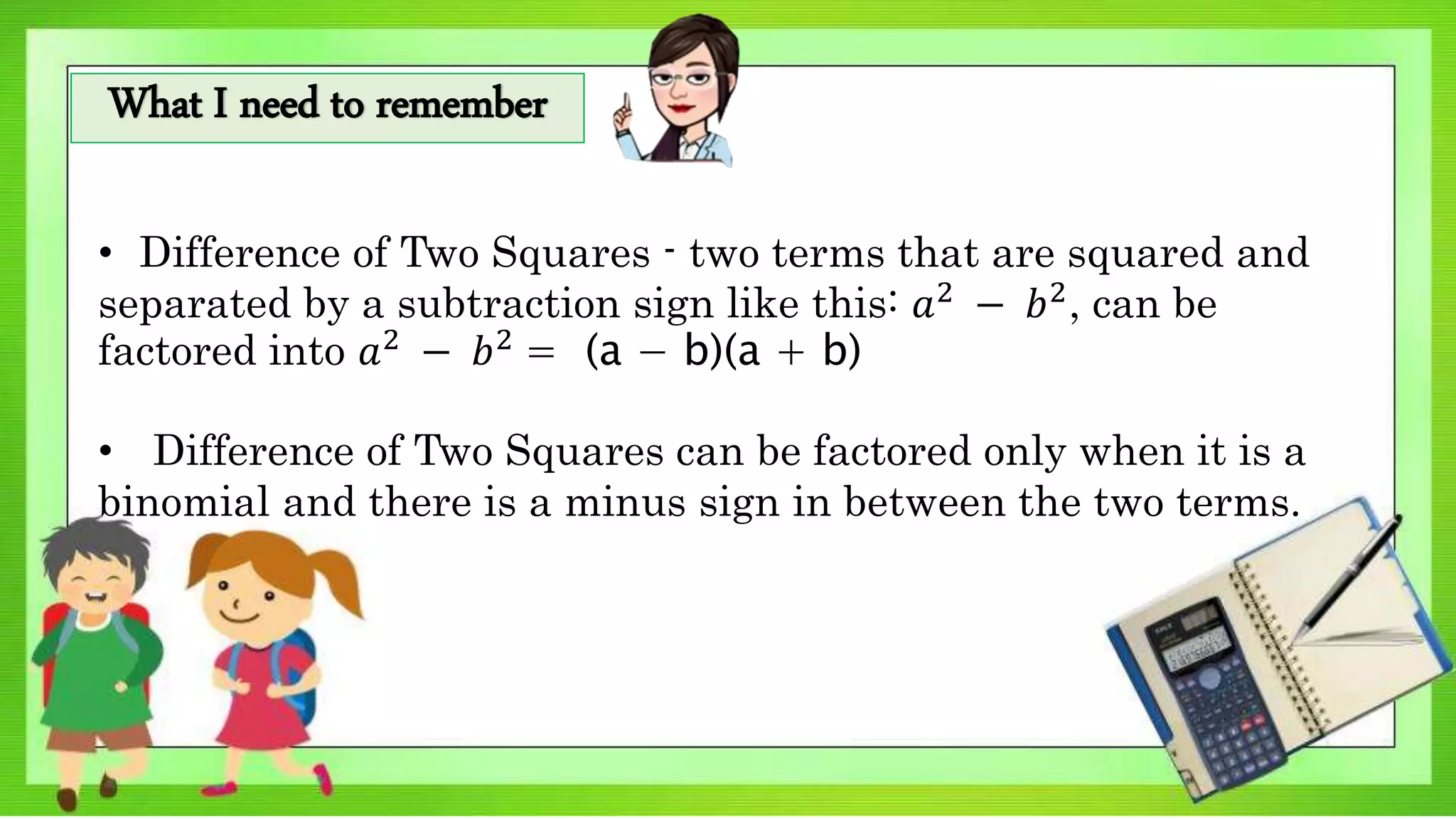
What I need to remember
• Difference of Two Squares - two terms that are squared and
separated by a subtraction sign like this: 𝑎2 − 𝑏2, can be
factored into 𝑎2 − 𝑏2 = (a − b)(a + b)
• Difference of Two Squares can be factored only when it is a
binomial and there is a minus sign in between the two terms.
Difference of Two Squares

Difference of Two Squares

  • 1.
    Factoring : Differenceof Two Squares Lorie Jane L. Letada Module 1
  • 2.
    Objectives At the endof this lesson, you are expected to: • identify expression factorable by difference of two squares; • factor difference of two squares completely.
  • 3.
    Review Below is thelist of the first 15 perfect square numbers. Can you give the answer of the last three?
  • 4.
    What’s New Directions: Matchthe factors in column A with the products in column B. Write the letter before the number. You can use the FOIL method.
  • 5.
    What is it Masteryon the perfect square of a number is very important in learning the new technique in factoring polynomials, which is the difference of two squares. Recall, (𝑦 − 2)(𝑦 + 2) = 𝑦2 − 4 by distributive property of multiplication or by FOIL method. This time you are going to do the reverse.
  • 6.
    Difference of TwoSquares - two terms that are squared and separated by a subtraction sign like this: 𝑎2 − 𝑏2 . It can be factored into 𝑎2 − 𝑏2 = (a − b)(a + b)
  • 7.
    1) It mustbe a binomial (have two terms). 2) Both terms must be perfect squares (meaning that you could take the square root and they would come out evenly. 3) There must be a subtraction/negative sign (not addition) in between them Conditions
  • 8.
    Example 1 Factor𝑥2 − 25 Step 1. Check for common factors. Step 2. Check the given if it satisfies the 3 conditions. 𝑥2 − 25 has no common factor Conditions: 1) It must be a binomial (have two terms). 2) Both terms must be perfect squares (meaning that you could take the square root and they would come out evenly. 3) There must be a subtraction/negative sign (not addition) in between them
  • 9.
    Step 3. Findthe square of the first term and the second term. 𝑥2 − 25 = 𝑥 2 − (5)2 Step 4. Follow the pattern: 𝑎2 − 𝑏2 = (a − b)(a + b) 𝑇ℎ𝑒𝑟𝑒𝑓𝑜𝑟𝑒, 𝑥2 − 25 = (𝑥 − 5 ) (𝑥 + 5 )
  • 10.
    Example 2 Factor3𝑥2 − 75 Step 1. Check for common factors. Step 2. Check the given if it satisfies the 3 conditions. 𝟑𝒙 𝟐 = Conditions: 1) It must be a binomial (have two terms). 2) Both terms must be perfect squares (meaning that you could take the square root and they would come out evenly. 3) There must be a subtraction/negative sign (not addition) in between them 3 • x • x 𝟕𝟓 = 3 • 5 • 5 𝑮𝑪𝑭 = 𝟑 𝑺𝒐, 𝟑 (𝑥2 − 25)
  • 11.
    Step 3. Findthe square of the first term and the second term. 3(𝑥2 − 25) = 𝑥 2 − (5)2 Step 4. Follow the pattern: 𝑎2 − 𝑏2 = (a − b)(a + b) 𝑇ℎ𝑒𝑟𝑒𝑓𝑜𝑟𝑒, 3 (𝑥2 − 25) = 3 (𝑥 − 5 )(𝑥 + 5 )
  • 12.
    Activity 1.2 CompleteMe Directions: Complete the table by identifying whether the following polynomials are factorable by the difference of two squares or not. Provide what is asked in each column. The first one is done for you.
  • 13.
    What I needto remember • Difference of Two Squares - two terms that are squared and separated by a subtraction sign like this: 𝑎2 − 𝑏2, can be factored into 𝑎2 − 𝑏2 = (a − b)(a + b) • Difference of Two Squares can be factored only when it is a binomial and there is a minus sign in between the two terms.