
UNITS 1.1/1.2 AREA OFUNITS 1.1/1.2 AREA OF
PARALLELOGRAMS, TRIANGLES,PARALLELOGRAMS, TRIANGLES,
TRAPEZOIDS, RHOMBUSES, ANDTRAPEZOIDS, RHOMBUSES, AND
KITESKITES
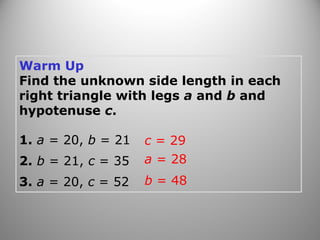
Warm Up
Find the unknown side length in each
right triangle with legs a and b and
hypotenuse c.
1. a = 20, b = 21
2. b = 21, c = 35
3. a = 20, c = 52
c = 29
a = 28
b = 48
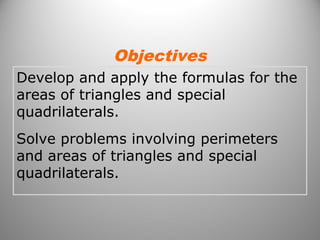
Develop and apply the formulas for the
areas of triangles and special
quadrilaterals.
Solve problems involving perimeters
and areas of triangles and special
quadrilaterals.
Objectives
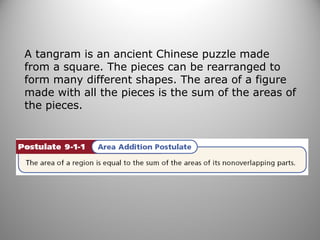
A tangram is an ancient Chinese puzzle made
from a square. The pieces can be rearranged to
form many different shapes. The area of a figure
made with all the pieces is the sum of the areas of
the pieces.
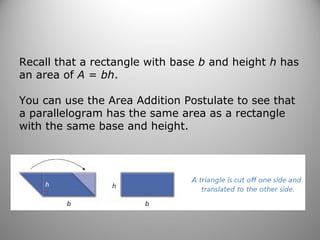
Recall that a rectangle with base b and height h has
an area of A = bh.
You can use the Area Addition Postulate to see that
a parallelogram has the same area as a rectangle
with the same base and height.
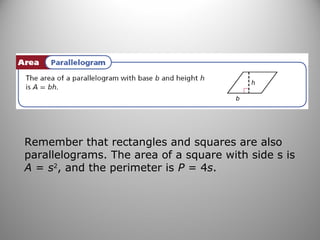
Remember that rectangles and squares are also
parallelograms. The area of a square with side s is
A = s2
, and the perimeter is P = 4s.
The height of a parallelogram is measured
along a segment perpendicular to a line
containing the base.
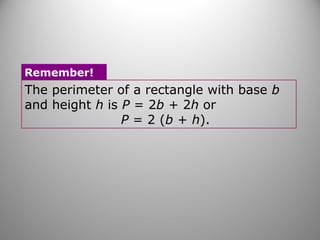
Remember!
The perimeter of a rectangle with base b
and height h is P = 2b + 2h or
P = 2 (b + h).
Remember!
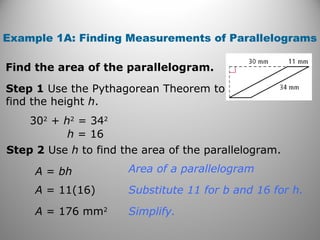
Find the area of the parallelogram.
Example 1A: Finding Measurements of Parallelograms
Step 1 Use the Pythagorean Theorem to
find the height h.
Step 2 Use h to find the area of the parallelogram.
Simplify.
Substitute 11 for b and 16 for h.
Area of a parallelogram
302
+ h2
= 342
h = 16
A = bh
A = 11(16)
A = 176 mm2
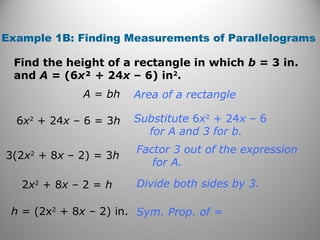
Example 1B: Finding Measurements of Parallelograms
Find the height of a rectangle in which b = 3 in.
and A = (6x² + 24x – 6) in2
.
Sym. Prop. of =
Divide both sides by 3.
Factor 3 out of the expression
for A.
Substitute 6x2
+ 24x – 6
for A and 3 for b.
Area of a rectangleA = bh
6x2
+ 24x – 6 = 3h
3(2x2
+ 8x – 2) = 3h
2x2
+ 8x – 2 = h
h = (2x2
+ 8x – 2) in.
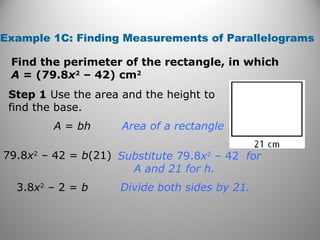
Example 1C: Finding Measurements of Parallelograms
Find the perimeter of the rectangle, in which
A = (79.8x2
– 42) cm2
Step 1 Use the area and the height to
find the base.
Substitute 79.8x2
– 42 for
A and 21 for h.
Divide both sides by 21.
Area of a rectangleA = bh
79.8x2
– 42 = b(21)
3.8x2
– 2 = b
Example 1C Continued
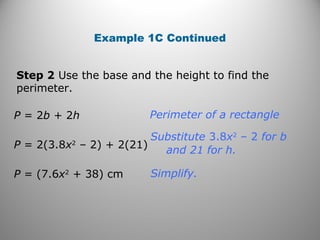
Step 2 Use the base and the height to find the
perimeter.
Simplify.
Perimeter of a rectangle
Substitute 3.8x2
– 2 for b
and 21 for h.
P = 2b + 2h
P = 2(3.8x2
– 2) + 2(21)
P = (7.6x2
+ 38) cm
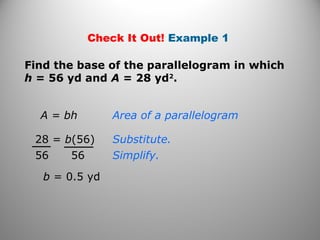
Check It Out! Example 1
A = bh
Find the base of the parallelogram in which
h = 56 yd and A = 28 yd2
.
28 = b(56)
56 56
b = 0.5 yd
Area of a parallelogram
Substitute.
Simplify.
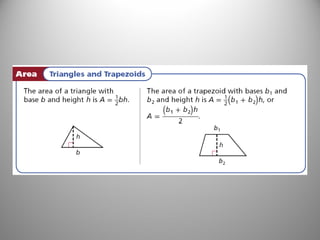
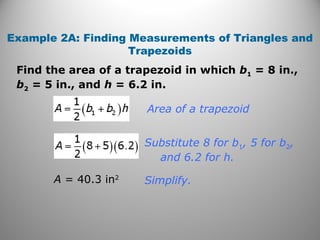
Find the area of a trapezoid in which b1 = 8 in.,
b2 = 5 in., and h = 6.2 in.
Example 2A: Finding Measurements of Triangles and
Trapezoids
Simplify.
Area of a trapezoid
Substitute 8 for b1, 5 for b2,
and 6.2 for h.
A = 40.3 in2
Example 2B: Finding Measurements of Triangles and
Trapezoids
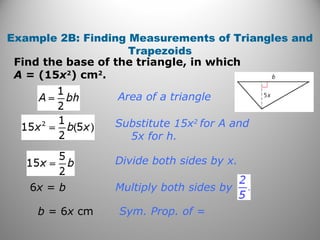
Find the base of the triangle, in which
A = (15x2
) cm2
.
Sym. Prop. of =
Divide both sides by x.
Substitute 15x2
for A and
5x for h.
Area of a triangle
6x = b
b = 6x cm
Multiply both sides by
Example 2C: Finding Measurements of Triangles and
Trapezoids
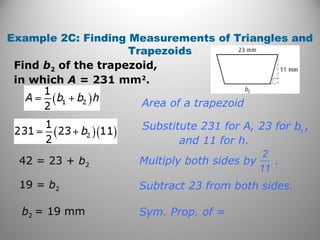
Find b2 of the trapezoid,
in which A = 231 mm2
.
2
11
Multiply both sides by .
Sym. Prop. of =
Subtract 23 from both sides.
b1
Substitute 231 for A, 23 for ,
and 11 for h.
Area of a trapezoid
42 = 23 + b2
19 = b2
b2 = 19 mm
Check It Out! Example 2
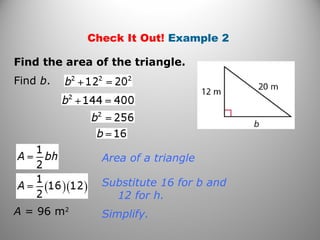
Find the area of the triangle.
Find b.
A = 96 m2
Substitute 16 for b and
12 for h.
Area of a triangle
Simplify.
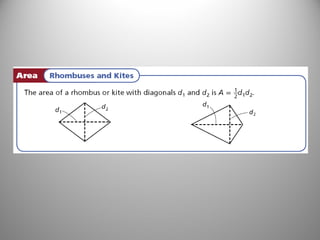
The diagonals of a rhombus or kite are
perpendicular, and the diagonals of a
rhombus bisect each other.
Remember!
Example 3A: Finding Measurements of Rhombuses
and Kites
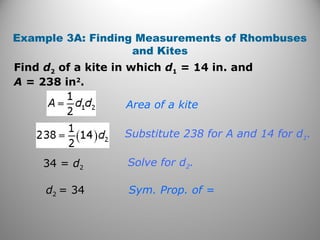
Find d2 of a kite in which d1 = 14 in. and
A = 238 in2
.
Area of a kite
Substitute 238 for A and 14 for d1.
Solve for d2.
Sym. Prop. of =
34 = d2
d2 = 34
Example 3B: Finding Measurements of Rhombuses
and Kites
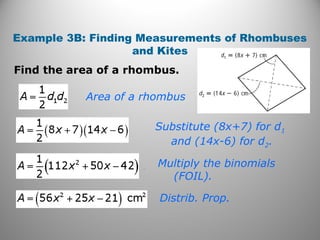
Find the area of a rhombus.
.
Substitute (8x+7) for d1
and (14x-6) for d2.
Multiply the binomials
(FOIL).
Distrib. Prop.
Area of a rhombus
Example 3C: Finding Measurements of Rhombuses
and Kites
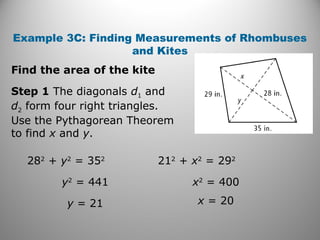
Find the area of the kite
Step 1 The diagonals d1 and
d2 form four right triangles.
Use the Pythagorean Theorem
to find x and y.
282
+ y2
= 352
y2
= 441
y = 21
212
+ x2
= 292
x2
= 400
x = 20
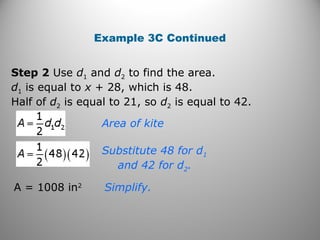
Step 2 Use d1 and d2 to find the area.
d1 is equal to x + 28, which is 48.
Half of d2 is equal to 21, so d2 is equal to 42.
A = 1008 in2
Area of kite
Substitute 48 for d1
and 42 for d2.
Simplify.
Example 3C Continued
Check It Out! Example 3
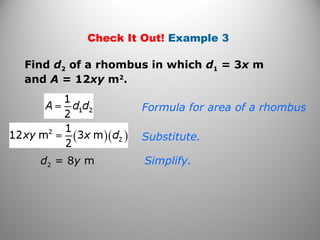
Find d2 of a rhombus in which d1 = 3x m
and A = 12xy m2
.
d2 = 8y m
Formula for area of a rhombus
Substitute.
Simplify.
Example 4: Games Application
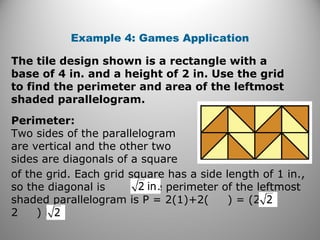
The tile design shown is a rectangle with a
base of 4 in. and a height of 2 in. Use the grid
to find the perimeter and area of the leftmost
shaded parallelogram.
Perimeter:
Two sides of the parallelogram
are vertical and the other two
sides are diagonals of a square
of the grid. Each grid square has a side length of 1 in.,
so the diagonal is The perimeter of the leftmost
shaded parallelogram is P = 2(1)+2( ) = (2 +
2 ) in.
Example 4 Continued
The tile design shown is a rectangle with a
base of 4 in. and a height of 2 in. Use the grid
to find the perimeter and area of the leftmost
shaded parallelogram.
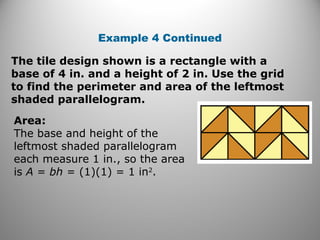
Area:
The base and height of the
leftmost shaded parallelogram
each measure 1 in., so the area
is A = bh = (1)(1) = 1 in2
.
Check It Out! Example 4
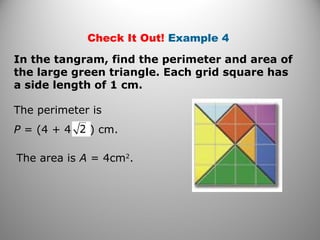
In the tangram, find the perimeter and area of
the large green triangle. Each grid square has
a side length of 1 cm.
The area is A = 4cm2
.
The perimeter is
P = (4 + 4 ) cm.
Lesson Quiz: Part I
Find each measurement.
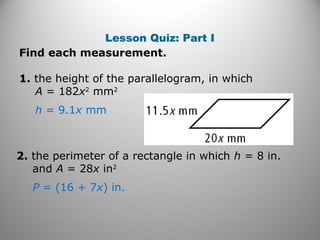
1. the height of the parallelogram, in which
A = 182x2
mm2
h = 9.1x mm
2. the perimeter of a rectangle in which h = 8 in.
and A = 28x in2
P = (16 + 7x) in.
Lesson Quiz: Part II
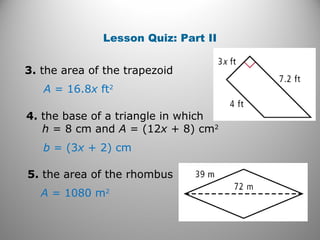
3. the area of the trapezoid
A = 16.8x ft2
4. the base of a triangle in which
h = 8 cm and A = (12x + 8) cm2
b = (3x + 2) cm
5. the area of the rhombus
A = 1080 m2
Lesson Quiz: Part III
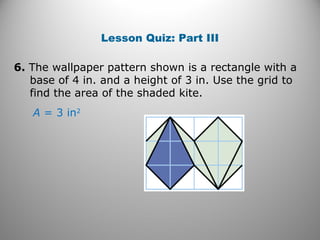
6. The wallpaper pattern shown is a rectangle with a
base of 4 in. and a height of 3 in. Use the grid to
find the area of the shaded kite.
A = 3 in2
 
All rights belong to their respective owners.
Copyright Disclaimer Under Section 107 of
the Copyright Act 1976, allowance is made
for "fair use" for purposes such as criticism,
comment, news reporting, TEACHING,
scholarship, and research. 
Fair use is a use permitted by copyright
statute that might otherwise be infringing. 
Non-profit, EDUCATIONAL or personal use
tips the balance in favor of fair use.

Geometry unit 10.1.2

  • 1.
    UNITS 1.1/1.2 AREAOFUNITS 1.1/1.2 AREA OF PARALLELOGRAMS, TRIANGLES,PARALLELOGRAMS, TRIANGLES, TRAPEZOIDS, RHOMBUSES, ANDTRAPEZOIDS, RHOMBUSES, AND KITESKITES
  • 2.
    Warm Up Find theunknown side length in each right triangle with legs a and b and hypotenuse c. 1. a = 20, b = 21 2. b = 21, c = 35 3. a = 20, c = 52 c = 29 a = 28 b = 48
  • 3.
    Develop and applythe formulas for the areas of triangles and special quadrilaterals. Solve problems involving perimeters and areas of triangles and special quadrilaterals. Objectives
  • 4.
    A tangram isan ancient Chinese puzzle made from a square. The pieces can be rearranged to form many different shapes. The area of a figure made with all the pieces is the sum of the areas of the pieces.
  • 5.
    Recall that arectangle with base b and height h has an area of A = bh. You can use the Area Addition Postulate to see that a parallelogram has the same area as a rectangle with the same base and height.
  • 6.
    Remember that rectanglesand squares are also parallelograms. The area of a square with side s is A = s2 , and the perimeter is P = 4s.
  • 7.
    The height ofa parallelogram is measured along a segment perpendicular to a line containing the base. Remember!
  • 8.
    The perimeter ofa rectangle with base b and height h is P = 2b + 2h or P = 2 (b + h). Remember!
  • 9.
    Find the areaof the parallelogram. Example 1A: Finding Measurements of Parallelograms Step 1 Use the Pythagorean Theorem to find the height h. Step 2 Use h to find the area of the parallelogram. Simplify. Substitute 11 for b and 16 for h. Area of a parallelogram 302 + h2 = 342 h = 16 A = bh A = 11(16) A = 176 mm2
  • 10.
    Example 1B: FindingMeasurements of Parallelograms Find the height of a rectangle in which b = 3 in. and A = (6x² + 24x – 6) in2 . Sym. Prop. of = Divide both sides by 3. Factor 3 out of the expression for A. Substitute 6x2 + 24x – 6 for A and 3 for b. Area of a rectangleA = bh 6x2 + 24x – 6 = 3h 3(2x2 + 8x – 2) = 3h 2x2 + 8x – 2 = h h = (2x2 + 8x – 2) in.
  • 11.
    Example 1C: FindingMeasurements of Parallelograms Find the perimeter of the rectangle, in which A = (79.8x2 – 42) cm2 Step 1 Use the area and the height to find the base. Substitute 79.8x2 – 42 for A and 21 for h. Divide both sides by 21. Area of a rectangleA = bh 79.8x2 – 42 = b(21) 3.8x2 – 2 = b
  • 12.
    Example 1C Continued Step2 Use the base and the height to find the perimeter. Simplify. Perimeter of a rectangle Substitute 3.8x2 – 2 for b and 21 for h. P = 2b + 2h P = 2(3.8x2 – 2) + 2(21) P = (7.6x2 + 38) cm
  • 13.
    Check It Out!Example 1 A = bh Find the base of the parallelogram in which h = 56 yd and A = 28 yd2 . 28 = b(56) 56 56 b = 0.5 yd Area of a parallelogram Substitute. Simplify.
  • 15.
    Find the areaof a trapezoid in which b1 = 8 in., b2 = 5 in., and h = 6.2 in. Example 2A: Finding Measurements of Triangles and Trapezoids Simplify. Area of a trapezoid Substitute 8 for b1, 5 for b2, and 6.2 for h. A = 40.3 in2
  • 16.
    Example 2B: FindingMeasurements of Triangles and Trapezoids Find the base of the triangle, in which A = (15x2 ) cm2 . Sym. Prop. of = Divide both sides by x. Substitute 15x2 for A and 5x for h. Area of a triangle 6x = b b = 6x cm Multiply both sides by
  • 17.
    Example 2C: FindingMeasurements of Triangles and Trapezoids Find b2 of the trapezoid, in which A = 231 mm2 . 2 11 Multiply both sides by . Sym. Prop. of = Subtract 23 from both sides. b1 Substitute 231 for A, 23 for , and 11 for h. Area of a trapezoid 42 = 23 + b2 19 = b2 b2 = 19 mm
  • 18.
    Check It Out!Example 2 Find the area of the triangle. Find b. A = 96 m2 Substitute 16 for b and 12 for h. Area of a triangle Simplify.
  • 19.
    The diagonals ofa rhombus or kite are perpendicular, and the diagonals of a rhombus bisect each other. Remember!
  • 21.
    Example 3A: FindingMeasurements of Rhombuses and Kites Find d2 of a kite in which d1 = 14 in. and A = 238 in2 . Area of a kite Substitute 238 for A and 14 for d1. Solve for d2. Sym. Prop. of = 34 = d2 d2 = 34
  • 22.
    Example 3B: FindingMeasurements of Rhombuses and Kites Find the area of a rhombus. . Substitute (8x+7) for d1 and (14x-6) for d2. Multiply the binomials (FOIL). Distrib. Prop. Area of a rhombus
  • 23.
    Example 3C: FindingMeasurements of Rhombuses and Kites Find the area of the kite Step 1 The diagonals d1 and d2 form four right triangles. Use the Pythagorean Theorem to find x and y. 282 + y2 = 352 y2 = 441 y = 21 212 + x2 = 292 x2 = 400 x = 20
  • 24.
    Step 2 Used1 and d2 to find the area. d1 is equal to x + 28, which is 48. Half of d2 is equal to 21, so d2 is equal to 42. A = 1008 in2 Area of kite Substitute 48 for d1 and 42 for d2. Simplify. Example 3C Continued
  • 25.
    Check It Out!Example 3 Find d2 of a rhombus in which d1 = 3x m and A = 12xy m2 . d2 = 8y m Formula for area of a rhombus Substitute. Simplify.
  • 26.
    Example 4: GamesApplication The tile design shown is a rectangle with a base of 4 in. and a height of 2 in. Use the grid to find the perimeter and area of the leftmost shaded parallelogram. Perimeter: Two sides of the parallelogram are vertical and the other two sides are diagonals of a square of the grid. Each grid square has a side length of 1 in., so the diagonal is The perimeter of the leftmost shaded parallelogram is P = 2(1)+2( ) = (2 + 2 ) in.
  • 27.
    Example 4 Continued Thetile design shown is a rectangle with a base of 4 in. and a height of 2 in. Use the grid to find the perimeter and area of the leftmost shaded parallelogram. Area: The base and height of the leftmost shaded parallelogram each measure 1 in., so the area is A = bh = (1)(1) = 1 in2 .
  • 28.
    Check It Out!Example 4 In the tangram, find the perimeter and area of the large green triangle. Each grid square has a side length of 1 cm. The area is A = 4cm2 . The perimeter is P = (4 + 4 ) cm.
  • 29.
    Lesson Quiz: PartI Find each measurement. 1. the height of the parallelogram, in which A = 182x2 mm2 h = 9.1x mm 2. the perimeter of a rectangle in which h = 8 in. and A = 28x in2 P = (16 + 7x) in.
  • 30.
    Lesson Quiz: PartII 3. the area of the trapezoid A = 16.8x ft2 4. the base of a triangle in which h = 8 cm and A = (12x + 8) cm2 b = (3x + 2) cm 5. the area of the rhombus A = 1080 m2
  • 31.
    Lesson Quiz: PartIII 6. The wallpaper pattern shown is a rectangle with a base of 4 in. and a height of 3 in. Use the grid to find the area of the shaded kite. A = 3 in2
  • 32.
      All rights belongto their respective owners. Copyright Disclaimer Under Section 107 of the Copyright Act 1976, allowance is made for "fair use" for purposes such as criticism, comment, news reporting, TEACHING, scholarship, and research.  Fair use is a use permitted by copyright statute that might otherwise be infringing.  Non-profit, EDUCATIONAL or personal use tips the balance in favor of fair use.