Geometry
Formulas:
Surface AreaSurface Area
& Volume& Volume
A formula is just a set of instructions.
It tells you exactly what to do!
All you have to do is look at the
picture and identify the parts.
Substitute numbers for the variables
and do the math. That’s it! 
Let’s start in the beginning…
Before you can do surface area or volume,
you have to know the following formulas.
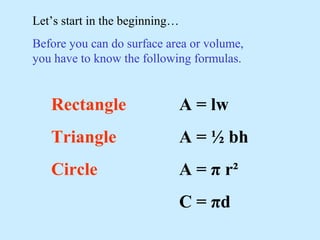
Rectangle A = lw
Triangle A = ½ bh
Circle A = π r²
C = πd
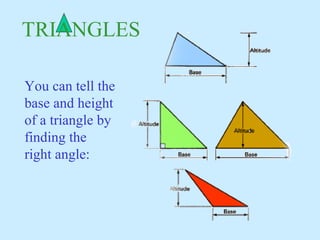
You can tell the
base and height
of a triangle by
finding the
right angle:
TRIANGLES
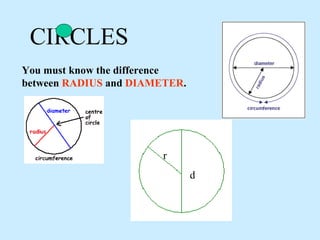
CIRCLES
You must know the difference
between RADIUS and DIAMETER.
r
d
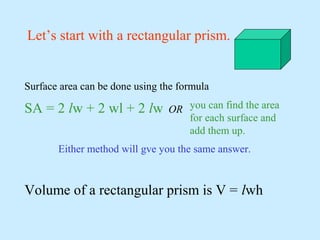
Let’s start with a rectangular prism.
Surface area can be done using the formula
SA = 2 lw + 2 wl + 2 lw OR
Either method will gve you the same answer.
you can find the area
for each surface and
add them up.
Volume of a rectangular prism is V = lwh
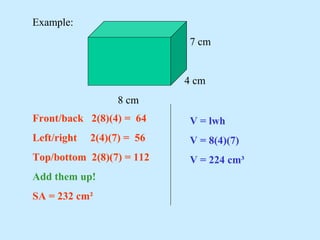
Example:
7 cm
4 cm
8 cm
Front/back 2(8)(4) = 64
Left/right 2(4)(7) = 56
Top/bottom 2(8)(7) = 112
Add them up!
SA = 232 cm²
V = lwh
V = 8(4)(7)
V = 224 cm³
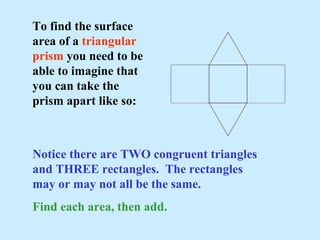
To find the surface
area of a triangular
prism you need to be
able to imagine that
you can take the
prism apart like so:
Notice there are TWO congruent triangles
and THREE rectangles. The rectangles
may or may not all be the same.
Find each area, then add.
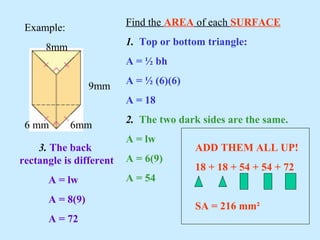
Example:
8mm
9mm
6 mm 6mm
Find the AREA of each SURFACE
1. Top or bottom triangle:
A = ½ bh
A = ½ (6)(6)
A = 18
2. The two dark sides are the same.
A = lw
A = 6(9)
A = 54
3. The back
rectangle is different
A = lw
A = 8(9)
A = 72
ADD THEM ALL UP!
18 + 18 + 54 + 54 + 72
SA = 216 mm²
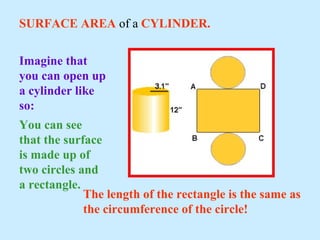
SURFACE AREA of a CYLINDER.
You can see
that the surface
is made up of
two circles and
a rectangle.
The length of the rectangle is the same as
the circumference of the circle!
Imagine that
you can open up
a cylinder like
so:
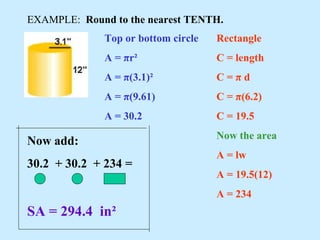
EXAMPLE: Round to the nearest TENTH.
Top or bottom circle
A = πr²
A = π(3.1)²
A = π(9.61)
A = 30.2
Rectangle
C = length
C = π d
C = π(6.2)
C = 19.5
Now the area
A = lw
A = 19.5(12)
A = 234
Now add:
30.2 + 30.2 + 234 =
SA = 294.4 in²
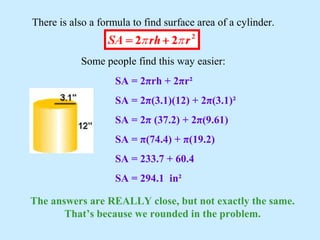
There is also a formula to find surface area of a cylinder.
Some people find this way easier:
SA = 2πrh + 2πr²
SA = 2π(3.1)(12) + 2π(3.1)²
SA = 2π (37.2) + 2π(9.61)
SA = π(74.4) + π(19.2)
SA = 233.7 + 60.4
SA = 294.1 in²
The answers are REALLY close, but not exactly the same.
That’s because we rounded in the problem.
Find the radius and height of the cylinder.
Then “Plug and Chug”…
Just plug in the numbers then do the math.
Remember the order of operations and you’re
ready to go.
The formula tells you what to do!!!!
2πrh + 2πr² means multiply 2(π)(r)(h) + 2(π)(r)(r)
Volume of Prisms or Cylinders
You already know how to find the volume of a
rectangular prism: V = lwh
The new formulas you need are:
Triangular Prism V = (½ bh)(H)
h = the height of the triangle and
H = the height of the cylinder
Cylinder V = (πr²)(H)
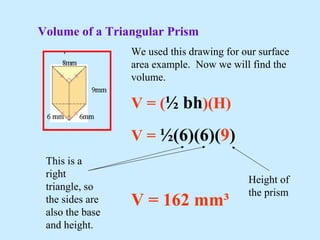
Volume of a Triangular Prism
We used this drawing for our surface
area example. Now we will find the
volume.
V = (½ bh)(H)
V = ½(6)(6)(9)
V = 162 mm³
This is a
right
triangle, so
the sides are
also the base
and height.
Height of
the prism
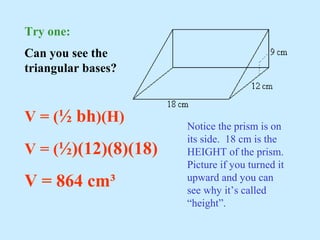
Try one:
Can you see the
triangular bases?
V = (½ bh)(H)
V = (½)(12)(8)(18)
V = 864 cm³
Notice the prism is on
its side. 18 cm is the
HEIGHT of the prism.
Picture if you turned it
upward and you can
see why it’s called
“height”.
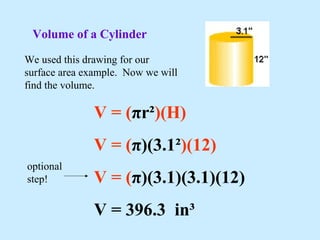
V = (πr²)(H)
V = (π)(3.1²)(12)
V = (π)(3.1)(3.1)(12)
V = 396.3 in³
Volume of a Cylinder
We used this drawing for our
surface area example. Now we will
find the volume.
optional
step!
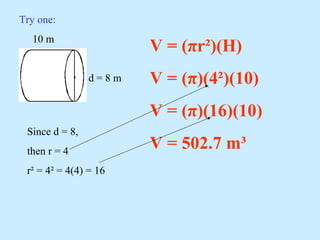
Try one:
10 m
d = 8 m
V = (πr²)(H)
V = (π)(4²)(10)
V = (π)(16)(10)
V = 502.7 m³
Since d = 8,
then r = 4
r² = 4² = 4(4) = 16
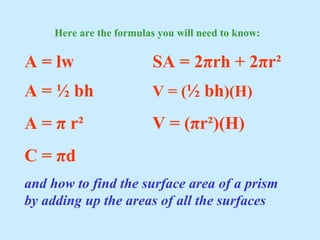
Here are the formulas you will need to know:
A = lw SA = 2πrh + 2πr²
A = ½ bh V = (½ bh)(H)
A = π r² V = (πr²)(H)
C = πd
and how to find the surface area of a prism
by adding up the areas of all the surfaces

Surface area and volume powerpoint

  • 1.
  • 2.
    A formula isjust a set of instructions. It tells you exactly what to do! All you have to do is look at the picture and identify the parts. Substitute numbers for the variables and do the math. That’s it! 
  • 3.
    Let’s start inthe beginning… Before you can do surface area or volume, you have to know the following formulas. Rectangle A = lw Triangle A = ½ bh Circle A = π r² C = πd
  • 4.
    You can tellthe base and height of a triangle by finding the right angle: TRIANGLES
  • 5.
    CIRCLES You must knowthe difference between RADIUS and DIAMETER. r d
  • 6.
    Let’s start witha rectangular prism. Surface area can be done using the formula SA = 2 lw + 2 wl + 2 lw OR Either method will gve you the same answer. you can find the area for each surface and add them up. Volume of a rectangular prism is V = lwh
  • 7.
    Example: 7 cm 4 cm 8cm Front/back 2(8)(4) = 64 Left/right 2(4)(7) = 56 Top/bottom 2(8)(7) = 112 Add them up! SA = 232 cm² V = lwh V = 8(4)(7) V = 224 cm³
  • 8.
    To find thesurface area of a triangular prism you need to be able to imagine that you can take the prism apart like so: Notice there are TWO congruent triangles and THREE rectangles. The rectangles may or may not all be the same. Find each area, then add.
  • 9.
    Example: 8mm 9mm 6 mm 6mm Findthe AREA of each SURFACE 1. Top or bottom triangle: A = ½ bh A = ½ (6)(6) A = 18 2. The two dark sides are the same. A = lw A = 6(9) A = 54 3. The back rectangle is different A = lw A = 8(9) A = 72 ADD THEM ALL UP! 18 + 18 + 54 + 54 + 72 SA = 216 mm²
  • 10.
    SURFACE AREA ofa CYLINDER. You can see that the surface is made up of two circles and a rectangle. The length of the rectangle is the same as the circumference of the circle! Imagine that you can open up a cylinder like so:
  • 11.
    EXAMPLE: Round tothe nearest TENTH. Top or bottom circle A = πr² A = π(3.1)² A = π(9.61) A = 30.2 Rectangle C = length C = π d C = π(6.2) C = 19.5 Now the area A = lw A = 19.5(12) A = 234 Now add: 30.2 + 30.2 + 234 = SA = 294.4 in²
  • 12.
    There is alsoa formula to find surface area of a cylinder. Some people find this way easier: SA = 2πrh + 2πr² SA = 2π(3.1)(12) + 2π(3.1)² SA = 2π (37.2) + 2π(9.61) SA = π(74.4) + π(19.2) SA = 233.7 + 60.4 SA = 294.1 in² The answers are REALLY close, but not exactly the same. That’s because we rounded in the problem.
  • 13.
    Find the radiusand height of the cylinder. Then “Plug and Chug”… Just plug in the numbers then do the math. Remember the order of operations and you’re ready to go. The formula tells you what to do!!!! 2πrh + 2πr² means multiply 2(π)(r)(h) + 2(π)(r)(r)
  • 14.
    Volume of Prismsor Cylinders You already know how to find the volume of a rectangular prism: V = lwh The new formulas you need are: Triangular Prism V = (½ bh)(H) h = the height of the triangle and H = the height of the cylinder Cylinder V = (πr²)(H)
  • 15.
    Volume of aTriangular Prism We used this drawing for our surface area example. Now we will find the volume. V = (½ bh)(H) V = ½(6)(6)(9) V = 162 mm³ This is a right triangle, so the sides are also the base and height. Height of the prism
  • 16.
    Try one: Can yousee the triangular bases? V = (½ bh)(H) V = (½)(12)(8)(18) V = 864 cm³ Notice the prism is on its side. 18 cm is the HEIGHT of the prism. Picture if you turned it upward and you can see why it’s called “height”.
  • 17.
    V = (πr²)(H) V= (π)(3.1²)(12) V = (π)(3.1)(3.1)(12) V = 396.3 in³ Volume of a Cylinder We used this drawing for our surface area example. Now we will find the volume. optional step!
  • 18.
    Try one: 10 m d= 8 m V = (πr²)(H) V = (π)(4²)(10) V = (π)(16)(10) V = 502.7 m³ Since d = 8, then r = 4 r² = 4² = 4(4) = 16
  • 19.
    Here are theformulas you will need to know: A = lw SA = 2πrh + 2πr² A = ½ bh V = (½ bh)(H) A = π r² V = (πr²)(H) C = πd and how to find the surface area of a prism by adding up the areas of all the surfaces