Holt Geometry
9-2
Developing Formulas for
Circles and Regular Polygons9-2
Developing Formulas for
Circles and Regular Polygons
Holt Geometry
Warm UpWarm Up
Lesson PresentationLesson Presentation
Lesson QuizLesson Quiz
Holt Geometry
9-2
Developing Formulas for
Circles and Regular Polygons
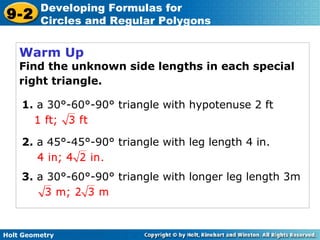
Warm Up
Find the unknown side lengths in each special
right triangle.
1. a 30°-60°-90° triangle with hypotenuse 2 ft
2. a 45°-45°-90° triangle with leg length 4 in.
3. a 30°-60°-90° triangle with longer leg length 3m
Holt Geometry
9-2
Developing Formulas for
Circles and Regular Polygons
Develop and apply the formulas for the
area and circumference of a circle.
Develop and apply the formula for the
area of a regular polygon.
Objectives
Holt Geometry
9-2
Developing Formulas for
Circles and Regular Polygons
circle
center of a circle
center of a regular polygon
apothem
central angle of a regular polygon
Vocabulary
Holt Geometry
9-2
Developing Formulas for
Circles and Regular Polygons
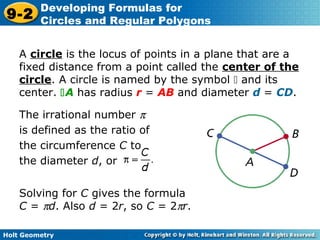
A circle is the locus of points in a plane that are a
fixed distance from a point called the center of the
circle. A circle is named by the symbol  and its
center. A has radius r = AB and diameter d = CD.
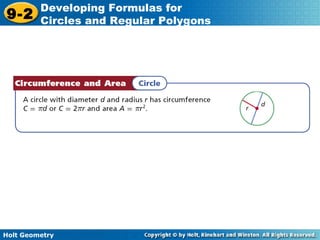
Solving for C gives the formula
C = πd. Also d = 2r, so C = 2πr.
The irrational number π
is defined as the ratio of
the circumference C to
the diameter d, or
Holt Geometry
9-2
Developing Formulas for
Circles and Regular Polygons
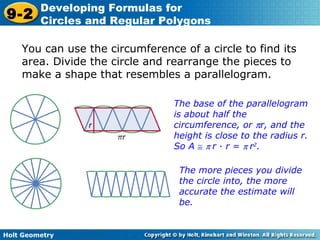
You can use the circumference of a circle to find its
area. Divide the circle and rearrange the pieces to
make a shape that resembles a parallelogram.
The base of the parallelogram
is about half the
circumference, or πr, and the
height is close to the radius r.
So A ≅ π r · r = π r2
.
The more pieces you divide
the circle into, the more
accurate the estimate will
be.
Holt Geometry
9-2
Developing Formulas for
Circles and Regular Polygons
Holt Geometry
9-2
Developing Formulas for
Circles and Regular Polygons
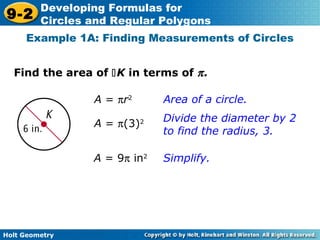
Find the area of K in terms of π.
Example 1A: Finding Measurements of Circles
A = πr2
Area of a circle.
Divide the diameter by 2
to find the radius, 3.
Simplify.
A = π(3)2
A = 9π in2
Holt Geometry
9-2
Developing Formulas for
Circles and Regular Polygons
Find the radius of J if the circumference is
(65x + 14)π m.
Example 1B: Finding Measurements of Circles
Circumference of a circle
Substitute (65x + 14)π for C.
Divide both sides by 2π.
C = 2πr
(65x + 14)π = 2πr
r = (32.5x + 7) m
Holt Geometry
9-2
Developing Formulas for
Circles and Regular Polygons
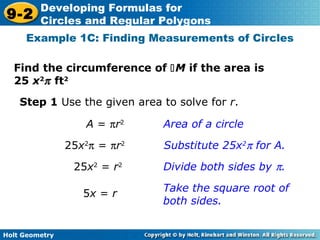
Find the circumference of M if the area is
25 x2
π ft2
Example 1C: Finding Measurements of Circles
Step 1 Use the given area to solve for r.
Area of a circle
Substitute 25x2
π for A.
Divide both sides by π.
Take the square root of
both sides.
A = πr2
25x2
π = πr2
25x2
= r2
5x = r
Holt Geometry
9-2
Developing Formulas for
Circles and Regular Polygons
Example 1C Continued
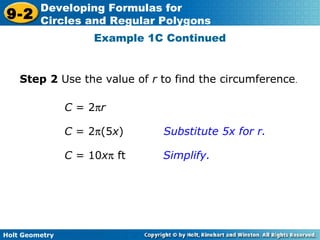
Step 2 Use the value of r to find the circumference.
Substitute 5x for r.
Simplify.
C = 2π(5x)
C = 10xπ ft
C = 2πr
Holt Geometry
9-2
Developing Formulas for
Circles and Regular Polygons
Check It Out! Example 1
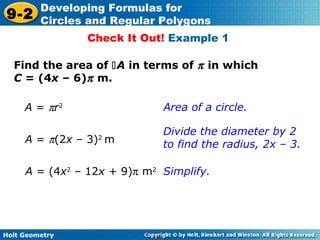
Find the area of A in terms of π in which
C = (4x – 6)π m.
A = πr2 Area of a circle.
A = π(2x – 3)2
m
A = (4x2
– 12x + 9)π m2
Divide the diameter by 2
to find the radius, 2x – 3.
Simplify.
Holt Geometry
9-2
Developing Formulas for
Circles and Regular Polygons
The π key gives the best possible
approximation for π on your calculator.
Always wait until the last step to round.
Helpful Hint
Holt Geometry
9-2
Developing Formulas for
Circles and Regular Polygons
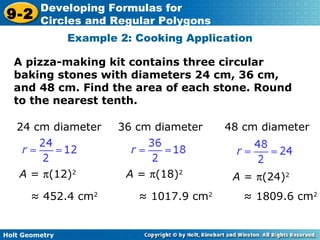
A pizza-making kit contains three circular
baking stones with diameters 24 cm, 36 cm,
and 48 cm. Find the area of each stone. Round
to the nearest tenth.
Example 2: Cooking Application
24 cm diameter 36 cm diameter 48 cm diameter
A = π(12)2
A = π(18)2
A = π(24)2
≈ 452.4 cm2
≈ 1017.9 cm2
≈ 1809.6 cm2
Holt Geometry
9-2
Developing Formulas for
Circles and Regular Polygons
Check It Out! Example 2
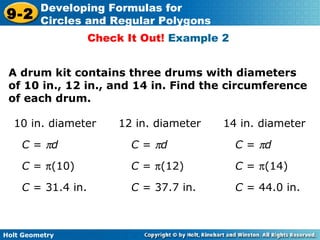
A drum kit contains three drums with diameters
of 10 in., 12 in., and 14 in. Find the circumference
of each drum.
10 in. diameter 12 in. diameter 14 in. diameter
C = πd C = πd C = πd
C = π(10) C = π(12) C = π(14)
C = 31.4 in. C = 37.7 in. C = 44.0 in.
Holt Geometry
9-2
Developing Formulas for
Circles and Regular Polygons
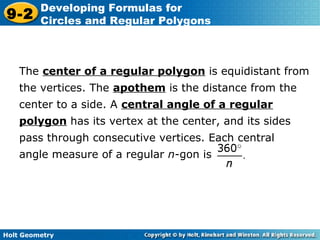
The center of a regular polygon is equidistant from
the vertices. The apothem is the distance from the
center to a side. A central angle of a regular
polygon has its vertex at the center, and its sides
pass through consecutive vertices. Each central
angle measure of a regular n-gon is
Holt Geometry
9-2
Developing Formulas for
Circles and Regular Polygons
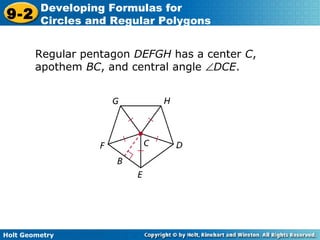
Regular pentagon DEFGH has a center C,
apothem BC, and central angle ∠DCE.
Holt Geometry
9-2
Developing Formulas for
Circles and Regular Polygons
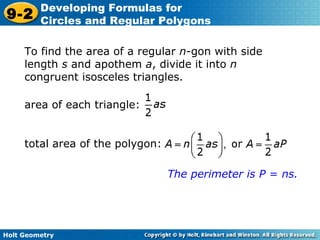
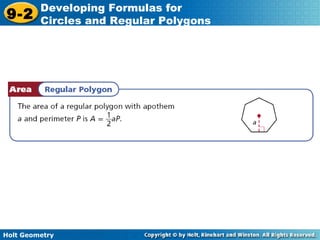
To find the area of a regular n-gon with side
length s and apothem a, divide it into n
congruent isosceles triangles.
The perimeter is P = ns.
area of each triangle:
total area of the polygon:
Holt Geometry
9-2
Developing Formulas for
Circles and Regular Polygons
Holt Geometry
9-2
Developing Formulas for
Circles and Regular Polygons
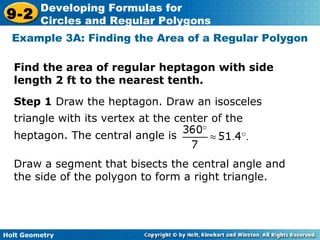
Find the area of regular heptagon with side
length 2 ft to the nearest tenth.
Example 3A: Finding the Area of a Regular Polygon
Draw a segment that bisects the central angle and
the side of the polygon to form a right triangle.
Step 1 Draw the heptagon. Draw an isosceles
triangle with its vertex at the center of the
heptagon. The central angle is °.
Holt Geometry
9-2
Developing Formulas for
Circles and Regular Polygons
Example 3A Continued
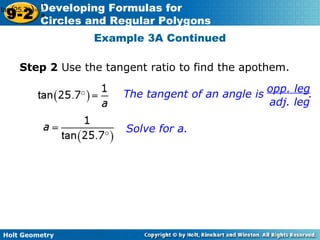
tan 25.7°( )=
1
a
Solve for a.
The tangent of an angle is .
opp. leg
adj. leg
Step 2 Use the tangent ratio to find the apothem.
Holt Geometry
9-2
Developing Formulas for
Circles and Regular Polygons
Example 3A Continued
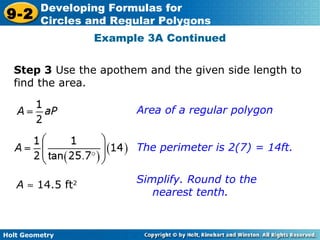
Step 3 Use the apothem and the given side length to
find the area.
Area of a regular polygon
The perimeter is 2(7) = 14ft.
Simplify. Round to the
nearest tenth.
A ≈ 14.5 ft2
Holt Geometry
9-2
Developing Formulas for
Circles and Regular Polygons
The tangent of an angle in a right triangle
is the ratio of the opposite leg length to
the adjacent leg length. See page 525.
Remember!
Holt Geometry
9-2
Developing Formulas for
Circles and Regular Polygons
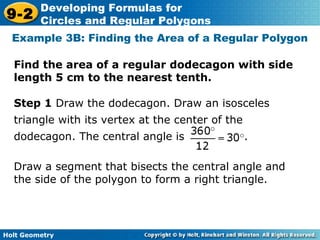
Example 3B: Finding the Area of a Regular Polygon
Find the area of a regular dodecagon with side
length 5 cm to the nearest tenth.
Draw a segment that bisects the central angle and
the side of the polygon to form a right triangle.
Step 1 Draw the dodecagon. Draw an isosceles
triangle with its vertex at the center of the
dodecagon. The central angle is .
Holt Geometry
9-2
Developing Formulas for
Circles and Regular Polygons
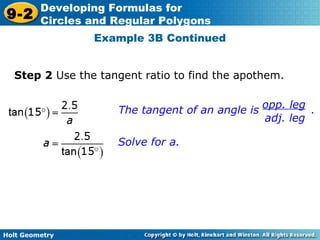
Example 3B Continued
Solve for a.
The tangent of an angle is .
opp. leg
adj. leg
Step 2 Use the tangent ratio to find the apothem.
Holt Geometry
9-2
Developing Formulas for
Circles and Regular Polygons
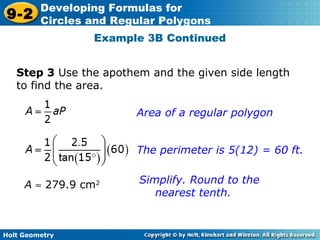
Example 3B Continued
Step 3 Use the apothem and the given side length
to find the area.
Area of a regular polygon
The perimeter is 5(12) = 60 ft.
Simplify. Round to the
nearest tenth.
A ≈ 279.9 cm2
Holt Geometry
9-2
Developing Formulas for
Circles and Regular Polygons
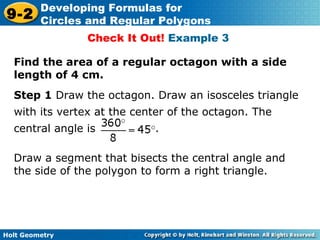
Check It Out! Example 3
Find the area of a regular octagon with a side
length of 4 cm.
Draw a segment that bisects the central angle and
the side of the polygon to form a right triangle.
Step 1 Draw the octagon. Draw an isosceles triangle
with its vertex at the center of the octagon. The
central angle is .
Holt Geometry
9-2
Developing Formulas for
Circles and Regular Polygons
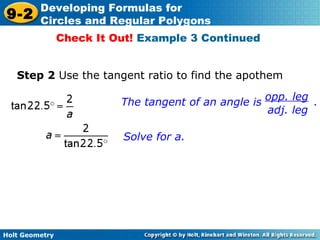
Step 2 Use the tangent ratio to find the apothem
Solve for a.
Check It Out! Example 3 Continued
The tangent of an angle is .
opp. leg
adj. leg
Holt Geometry
9-2
Developing Formulas for
Circles and Regular Polygons
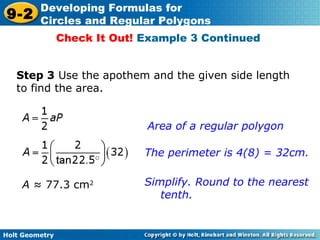
Step 3 Use the apothem and the given side length
to find the area.
Check It Out! Example 3 Continued
Area of a regular polygon
The perimeter is 4(8) = 32cm.
Simplify. Round to the nearest
tenth.
A ≈ 77.3 cm2
Holt Geometry
9-2
Developing Formulas for
Circles and Regular Polygons
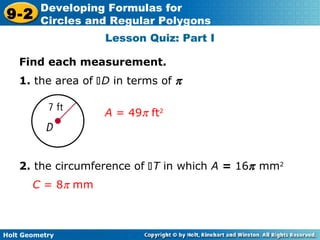
Lesson Quiz: Part I
Find each measurement.
1. the area of D in terms of π
A = 49π ft2
2. the circumference of T in which A = 16π mm2
C = 8π mm
Holt Geometry
9-2
Developing Formulas for
Circles and Regular Polygons
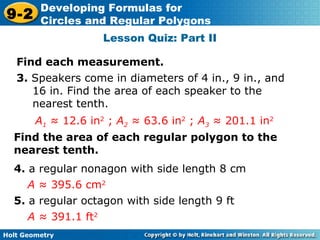
Lesson Quiz: Part II
Find each measurement.
3. Speakers come in diameters of 4 in., 9 in., and
16 in. Find the area of each speaker to the
nearest tenth.
A1 ≈ 12.6 in2
; A2 ≈ 63.6 in2
; A3 ≈ 201.1 in2
Find the area of each regular polygon to the
nearest tenth.
4. a regular nonagon with side length 8 cm
A ≈ 395.6 cm2
5. a regular octagon with side length 9 ft
A ≈ 391.1 ft2

Gch9 l2

  • 1.
    Holt Geometry 9-2 Developing Formulasfor Circles and Regular Polygons9-2 Developing Formulas for Circles and Regular Polygons Holt Geometry Warm UpWarm Up Lesson PresentationLesson Presentation Lesson QuizLesson Quiz
  • 2.
    Holt Geometry 9-2 Developing Formulasfor Circles and Regular Polygons Warm Up Find the unknown side lengths in each special right triangle. 1. a 30°-60°-90° triangle with hypotenuse 2 ft 2. a 45°-45°-90° triangle with leg length 4 in. 3. a 30°-60°-90° triangle with longer leg length 3m
  • 3.
    Holt Geometry 9-2 Developing Formulasfor Circles and Regular Polygons Develop and apply the formulas for the area and circumference of a circle. Develop and apply the formula for the area of a regular polygon. Objectives
  • 4.
    Holt Geometry 9-2 Developing Formulasfor Circles and Regular Polygons circle center of a circle center of a regular polygon apothem central angle of a regular polygon Vocabulary
  • 5.
    Holt Geometry 9-2 Developing Formulasfor Circles and Regular Polygons A circle is the locus of points in a plane that are a fixed distance from a point called the center of the circle. A circle is named by the symbol  and its center. A has radius r = AB and diameter d = CD. Solving for C gives the formula C = πd. Also d = 2r, so C = 2πr. The irrational number π is defined as the ratio of the circumference C to the diameter d, or
  • 6.
    Holt Geometry 9-2 Developing Formulasfor Circles and Regular Polygons You can use the circumference of a circle to find its area. Divide the circle and rearrange the pieces to make a shape that resembles a parallelogram. The base of the parallelogram is about half the circumference, or πr, and the height is close to the radius r. So A ≅ π r · r = π r2 . The more pieces you divide the circle into, the more accurate the estimate will be.
  • 7.
    Holt Geometry 9-2 Developing Formulasfor Circles and Regular Polygons
  • 8.
    Holt Geometry 9-2 Developing Formulasfor Circles and Regular Polygons Find the area of K in terms of π. Example 1A: Finding Measurements of Circles A = πr2 Area of a circle. Divide the diameter by 2 to find the radius, 3. Simplify. A = π(3)2 A = 9π in2
  • 9.
    Holt Geometry 9-2 Developing Formulasfor Circles and Regular Polygons Find the radius of J if the circumference is (65x + 14)π m. Example 1B: Finding Measurements of Circles Circumference of a circle Substitute (65x + 14)π for C. Divide both sides by 2π. C = 2πr (65x + 14)π = 2πr r = (32.5x + 7) m
  • 10.
    Holt Geometry 9-2 Developing Formulasfor Circles and Regular Polygons Find the circumference of M if the area is 25 x2 π ft2 Example 1C: Finding Measurements of Circles Step 1 Use the given area to solve for r. Area of a circle Substitute 25x2 π for A. Divide both sides by π. Take the square root of both sides. A = πr2 25x2 π = πr2 25x2 = r2 5x = r
  • 11.
    Holt Geometry 9-2 Developing Formulasfor Circles and Regular Polygons Example 1C Continued Step 2 Use the value of r to find the circumference. Substitute 5x for r. Simplify. C = 2π(5x) C = 10xπ ft C = 2πr
  • 12.
    Holt Geometry 9-2 Developing Formulasfor Circles and Regular Polygons Check It Out! Example 1 Find the area of A in terms of π in which C = (4x – 6)π m. A = πr2 Area of a circle. A = π(2x – 3)2 m A = (4x2 – 12x + 9)π m2 Divide the diameter by 2 to find the radius, 2x – 3. Simplify.
  • 13.
    Holt Geometry 9-2 Developing Formulasfor Circles and Regular Polygons The π key gives the best possible approximation for π on your calculator. Always wait until the last step to round. Helpful Hint
  • 14.
    Holt Geometry 9-2 Developing Formulasfor Circles and Regular Polygons A pizza-making kit contains three circular baking stones with diameters 24 cm, 36 cm, and 48 cm. Find the area of each stone. Round to the nearest tenth. Example 2: Cooking Application 24 cm diameter 36 cm diameter 48 cm diameter A = π(12)2 A = π(18)2 A = π(24)2 ≈ 452.4 cm2 ≈ 1017.9 cm2 ≈ 1809.6 cm2
  • 15.
    Holt Geometry 9-2 Developing Formulasfor Circles and Regular Polygons Check It Out! Example 2 A drum kit contains three drums with diameters of 10 in., 12 in., and 14 in. Find the circumference of each drum. 10 in. diameter 12 in. diameter 14 in. diameter C = πd C = πd C = πd C = π(10) C = π(12) C = π(14) C = 31.4 in. C = 37.7 in. C = 44.0 in.
  • 16.
    Holt Geometry 9-2 Developing Formulasfor Circles and Regular Polygons The center of a regular polygon is equidistant from the vertices. The apothem is the distance from the center to a side. A central angle of a regular polygon has its vertex at the center, and its sides pass through consecutive vertices. Each central angle measure of a regular n-gon is
  • 17.
    Holt Geometry 9-2 Developing Formulasfor Circles and Regular Polygons Regular pentagon DEFGH has a center C, apothem BC, and central angle ∠DCE.
  • 18.
    Holt Geometry 9-2 Developing Formulasfor Circles and Regular Polygons To find the area of a regular n-gon with side length s and apothem a, divide it into n congruent isosceles triangles. The perimeter is P = ns. area of each triangle: total area of the polygon:
  • 19.
    Holt Geometry 9-2 Developing Formulasfor Circles and Regular Polygons
  • 20.
    Holt Geometry 9-2 Developing Formulasfor Circles and Regular Polygons Find the area of regular heptagon with side length 2 ft to the nearest tenth. Example 3A: Finding the Area of a Regular Polygon Draw a segment that bisects the central angle and the side of the polygon to form a right triangle. Step 1 Draw the heptagon. Draw an isosceles triangle with its vertex at the center of the heptagon. The central angle is °.
  • 21.
    Holt Geometry 9-2 Developing Formulasfor Circles and Regular Polygons Example 3A Continued tan 25.7°( )= 1 a Solve for a. The tangent of an angle is . opp. leg adj. leg Step 2 Use the tangent ratio to find the apothem.
  • 22.
    Holt Geometry 9-2 Developing Formulasfor Circles and Regular Polygons Example 3A Continued Step 3 Use the apothem and the given side length to find the area. Area of a regular polygon The perimeter is 2(7) = 14ft. Simplify. Round to the nearest tenth. A ≈ 14.5 ft2
  • 23.
    Holt Geometry 9-2 Developing Formulasfor Circles and Regular Polygons The tangent of an angle in a right triangle is the ratio of the opposite leg length to the adjacent leg length. See page 525. Remember!
  • 24.
    Holt Geometry 9-2 Developing Formulasfor Circles and Regular Polygons Example 3B: Finding the Area of a Regular Polygon Find the area of a regular dodecagon with side length 5 cm to the nearest tenth. Draw a segment that bisects the central angle and the side of the polygon to form a right triangle. Step 1 Draw the dodecagon. Draw an isosceles triangle with its vertex at the center of the dodecagon. The central angle is .
  • 25.
    Holt Geometry 9-2 Developing Formulasfor Circles and Regular Polygons Example 3B Continued Solve for a. The tangent of an angle is . opp. leg adj. leg Step 2 Use the tangent ratio to find the apothem.
  • 26.
    Holt Geometry 9-2 Developing Formulasfor Circles and Regular Polygons Example 3B Continued Step 3 Use the apothem and the given side length to find the area. Area of a regular polygon The perimeter is 5(12) = 60 ft. Simplify. Round to the nearest tenth. A ≈ 279.9 cm2
  • 27.
    Holt Geometry 9-2 Developing Formulasfor Circles and Regular Polygons Check It Out! Example 3 Find the area of a regular octagon with a side length of 4 cm. Draw a segment that bisects the central angle and the side of the polygon to form a right triangle. Step 1 Draw the octagon. Draw an isosceles triangle with its vertex at the center of the octagon. The central angle is .
  • 28.
    Holt Geometry 9-2 Developing Formulasfor Circles and Regular Polygons Step 2 Use the tangent ratio to find the apothem Solve for a. Check It Out! Example 3 Continued The tangent of an angle is . opp. leg adj. leg
  • 29.
    Holt Geometry 9-2 Developing Formulasfor Circles and Regular Polygons Step 3 Use the apothem and the given side length to find the area. Check It Out! Example 3 Continued Area of a regular polygon The perimeter is 4(8) = 32cm. Simplify. Round to the nearest tenth. A ≈ 77.3 cm2
  • 30.
    Holt Geometry 9-2 Developing Formulasfor Circles and Regular Polygons Lesson Quiz: Part I Find each measurement. 1. the area of D in terms of π A = 49π ft2 2. the circumference of T in which A = 16π mm2 C = 8π mm
  • 31.
    Holt Geometry 9-2 Developing Formulasfor Circles and Regular Polygons Lesson Quiz: Part II Find each measurement. 3. Speakers come in diameters of 4 in., 9 in., and 16 in. Find the area of each speaker to the nearest tenth. A1 ≈ 12.6 in2 ; A2 ≈ 63.6 in2 ; A3 ≈ 201.1 in2 Find the area of each regular polygon to the nearest tenth. 4. a regular nonagon with side length 8 cm A ≈ 395.6 cm2 5. a regular octagon with side length 9 ft A ≈ 391.1 ft2