5.1 Angles
Chapter 5 Trigonometric Functions
Concepts and Objectives
⚫ Review classifying angles
⚫ Review complementary and supplementary angles
⚫ Convert between decimal degrees and degrees-minutes-
seconds degrees
⚫ Find measures of coterminal angles
Basic Terminology
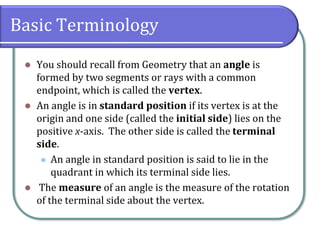
⚫ You should recall from Geometry that an angle is
formed by two segments or rays with a common
endpoint, which is called the vertex.
⚫ An angle is in standard position if its vertex is at the
origin and one side (called the initial side) lies on the
positive x-axis. The other side is called the terminal
side.
⚫ An angle in standard position is said to lie in the
quadrant in which its terminal side lies.
⚫ The measure of an angle is the measure of the rotation
of the terminal side about the vertex.
Basic Terminology (cont.)
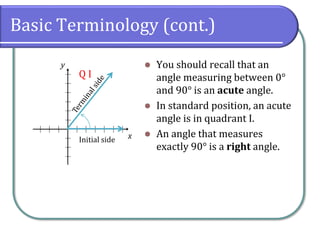
⚫ You should recall that an
angle measuring between 0°
and 90° is an acute angle.
⚫ In standard position, an acute
angle is in quadrant I.
⚫ An angle that measures
exactly 90° is a right angle.
Initial side
Q I
Basic Terminology (cont.)
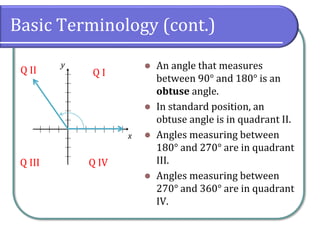
⚫ An angle that measures
between 90° and 180° is an
obtuse angle.
⚫ In standard position, an
obtuse angle is in quadrant II.
⚫ Angles measuring between
180° and 270° are in quadrant
III.
⚫ Angles measuring between
270° and 360° are in quadrant
IV.
Q IQ II
Q III Q IV
Basic Terminology (cont.)
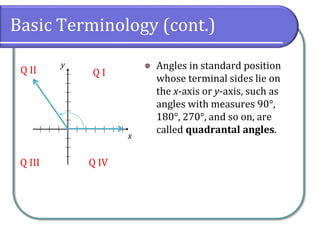
⚫ Angles in standard position
whose terminal sides lie on
the x-axis or y-axis, such as
angles with measures 90°,
180°, 270°, and so on, are
called quadrantal angles.
Q IQ II
Q III Q IV
Basic Terminology (still cont.)
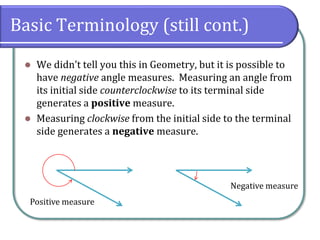
⚫ We didn’t tell you this in Geometry, but it is possible to
have negative angle measures. Measuring an angle from
its initial side counterclockwise to its terminal side
generates a positive measure.
⚫ Measuring clockwise from the initial side to the terminal
side generates a negative measure.
Positive measure
Negative measure
Degree Measure
⚫ The most common unit for measuring angles is the
degree, which was developed by the Babylonians
around 4000 years ago.
⚫ To use degree measure, we assign 360° to a complete
rotation of a terminal side about the vertex.
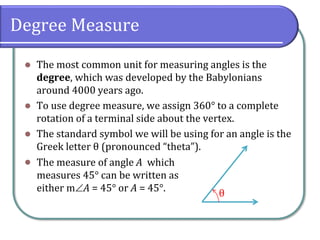
⚫ The standard symbol we will be using for an angle is the
Greek letter θ (pronounced “theta”).
⚫
θ
The measure of angle A which
measures 45° can be written as
either mA = 45° or A = 45°.
Complements & Supplements
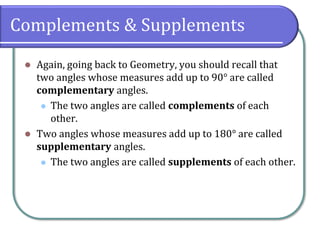
⚫ Again, going back to Geometry, you should recall that
two angles whose measures add up to 90° are called
complementary angles.
⚫ The two angles are called complements of each
other.
⚫ Two angles whose measures add up to 180° are called
supplementary angles.
⚫ The two angles are called supplements of each other.
Complements & Supplements
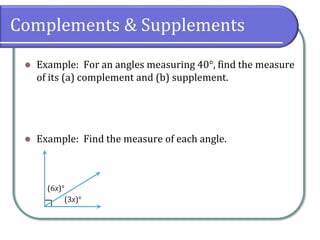
⚫ Example: For an angles measuring 40°, find the measure
of its (a) complement and (b) supplement.
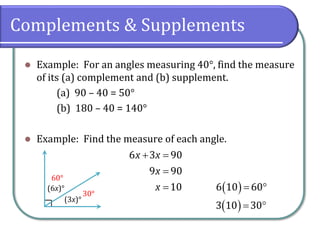
⚫ Example: Find the measure of each angle.
(3x)°
(6x)°
Complements & Supplements
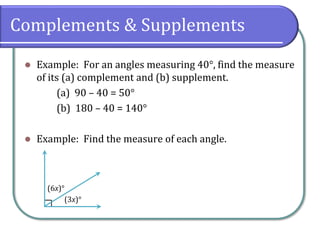
⚫ Example: For an angles measuring 40°, find the measure
of its (a) complement and (b) supplement.
(a) 90 – 40 = 50°
(b) 180 – 40 = 140°
⚫ Example: Find the measure of each angle.
(3x)°
(6x)°
Complements & Supplements
⚫ Example: For an angles measuring 40°, find the measure
of its (a) complement and (b) supplement.
(a) 90 – 40 = 50°
(b) 180 – 40 = 140°
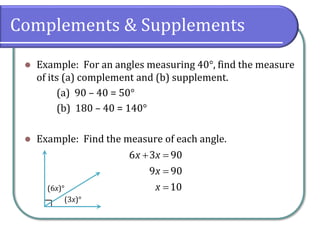
⚫ Example: Find the measure of each angle.
(3x)°
(6x)°
6 3 90
9 90
10
x x
x
x
+ =
=
=
Complements & Supplements
⚫ Example: For an angles measuring 40°, find the measure
of its (a) complement and (b) supplement.
(a) 90 – 40 = 50°
(b) 180 – 40 = 140°
⚫ Example: Find the measure of each angle.
(3x)°
(6x)°
6 3 90
9 90
10
x x
x
x
+ =
=
= ( )
( )
6 10 60
3 10 30
= 
= 
60°
30°
Degrees, Minutes, and Seconds
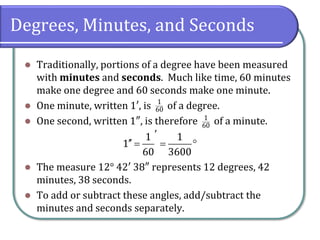
⚫ Traditionally, portions of a degree have been measured
with minutes and seconds. Much like time, 60 minutes
make one degree and 60 seconds make one minute.
⚫ One minute, written 1′, is of a degree.
⚫ One second, written 1″, is therefore of a minute.
⚫ The measure 12° 42′ 38″ represents 12 degrees, 42
minutes, 38 seconds.
⚫ To add or subtract these angles, add/subtract the
minutes and seconds separately.
1
60
1
60
1 1
1
60 3600

 = = 
Degrees, Minutes, and Seconds
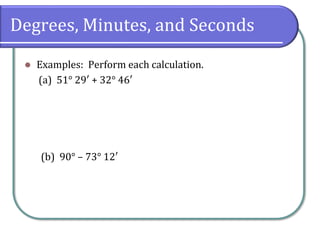
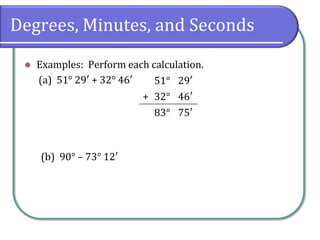
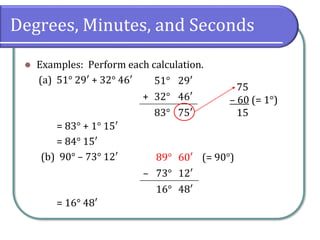
⚫ Examples: Perform each calculation.
(a) 51° 29′ + 32° 46′
(b) 90° – 73° 12′
Degrees, Minutes, and Seconds
⚫ Examples: Perform each calculation.
(a) 51° 29′ + 32° 46′
(b) 90° – 73° 12′
51° 29′
+ 32° 46′
Degrees, Minutes, and Seconds
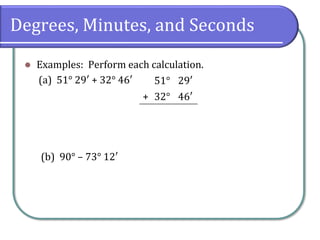
⚫ Examples: Perform each calculation.
(a) 51° 29′ + 32° 46′
(b) 90° – 73° 12′
51° 29′
+ 32° 46′
83° 75′
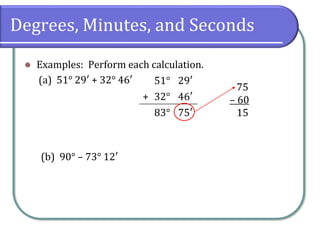
Degrees, Minutes, and Seconds
⚫ Examples: Perform each calculation.
(a) 51° 29′ + 32° 46′
(b) 90° – 73° 12′
51° 29′
+ 32° 46′
83° 75′
75
– 60
15
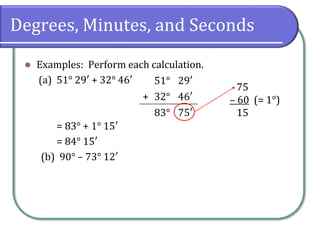
Degrees, Minutes, and Seconds
⚫ Examples: Perform each calculation.
(a) 51° 29′ + 32° 46′
= 83° + 1° 15′
= 84° 15′
(b) 90° – 73° 12′
51° 29′
+ 32° 46′
83° 75′
75
– 60 (= 1°)
15
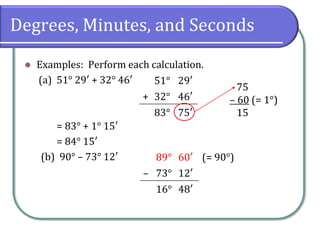
Degrees, Minutes, and Seconds
⚫ Examples: Perform each calculation.
(a) 51° 29′ + 32° 46′
= 83° + 1° 15′
= 84° 15′
(b) 90° – 73° 12′
51° 29′
+ 32° 46′
83° 75′
75
– 60 (= 1°)
15
89° 60′ (= 90°)
– 73° 12′
16° 48′
Degrees, Minutes, and Seconds
⚫ Examples: Perform each calculation.
(a) 51° 29′ + 32° 46′
= 83° + 1° 15′
= 84° 15′
(b) 90° – 73° 12′
= 16° 48′
51° 29′
+ 32° 46′
83° 75′
75
– 60 (= 1°)
15
89° 60′ (= 90°)
– 73° 12′
16° 48′
Decimal Degrees
⚫ Just to keep things interesting, since calculators made
decimals so much easier to work with, degrees are also
commonly measured in decimal degrees. For example,
58°30′ = 58.5° (since 30 is half of 60).
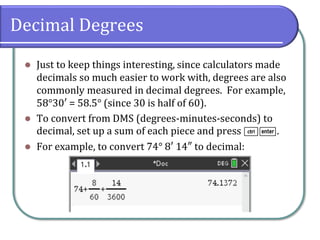
⚫ To convert from DMS (degrees-minutes-seconds) to
decimal, set up a sum of each piece and press /·.
⚫ For example, to convert 74° 8′ 14″ to decimal:
Decimal Degrees (cont.)
⚫ Unfortunately, converting from decimal to DMS is a bit
trickier.
⚫ Example: Convert 34.817° to DMS (don’t freak out!)
Decimal Degrees (cont.)
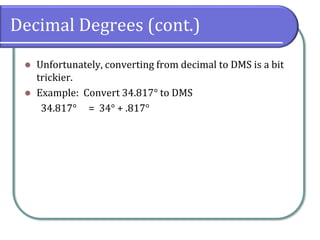
⚫ Unfortunately, converting from decimal to DMS is a bit
trickier.
⚫ Example: Convert 34.817° to DMS
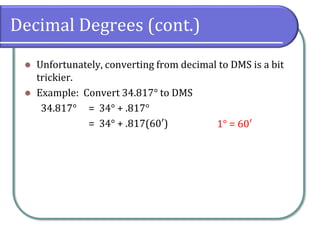
34.817° = 34° + .817°
Decimal Degrees (cont.)
⚫ Unfortunately, converting from decimal to DMS is a bit
trickier.
⚫ Example: Convert 34.817° to DMS
34.817° = 34° + .817°
= 34° + .817(60′) 1° = 60′
Decimal Degrees (cont.)
⚫ Unfortunately, converting from decimal to DMS is a bit
trickier.
⚫ Example: Convert 34.817° to DMS
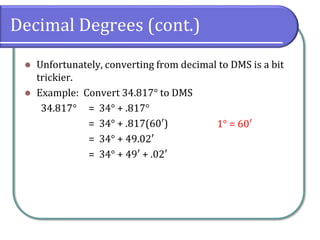
34.817° = 34° + .817°
= 34° + .817(60′)
= 34° + 49.02′
= 34° + 49′ + .02′
1° = 60′
Decimal Degrees (cont.)
⚫ Unfortunately, converting from decimal to DMS is a bit
trickier.
⚫ Example: Convert 34.817° to DMS
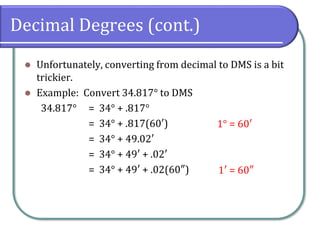
34.817° = 34° + .817°
= 34° + .817(60′)
= 34° + 49.02′
= 34° + 49′ + .02′
= 34° + 49′ + .02(60″)
1° = 60′
1′ = 60″
Decimal Degrees (cont.)
⚫ Unfortunately, converting from decimal to DMS is a bit
trickier.
⚫ Example: Convert 34.817° to DMS
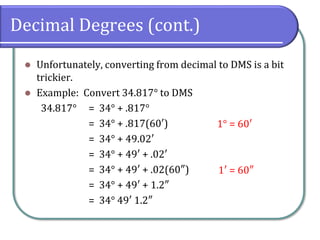
34.817° = 34° + .817°
= 34° + .817(60′)
= 34° + 49.02′
= 34° + 49′ + .02′
= 34° + 49′ + .02(60″)
= 34° + 49′ + 1.2″
= 34° 49′ 1.2″
1° = 60′
1′ = 60″
Decimal Degrees (cont.)
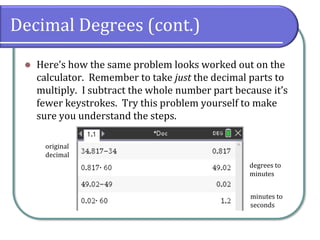
⚫ Here’s how the same problem looks worked out on the
calculator. Remember to take just the decimal parts to
multiply. I subtract the whole number part because it’s
fewer keystrokes. Try this problem yourself to make
sure you understand the steps.
degrees to
minutes
minutes to
seconds
original
decimal
Decimal Degrees (cont.)
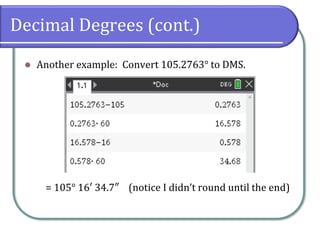
⚫ Another example: Convert 105.2763° to DMS.
= 105° 16′ 34.7″ (notice I didn’t round until the end)
Coterminal Angles
⚫ A complete rotation of a ray about a vertex results in an
angle measuring 360°. By continuing the rotation,
angles of measure larger than 360° can be produced.
The angles in the figure
with measures of 45°,
–315°, and 405° have the
same initial side and
terminal side, but different
amounts of rotation. Such
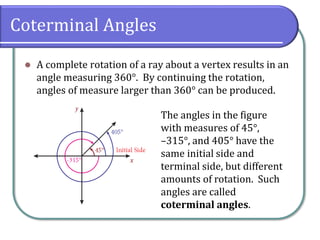
angles are called
coterminal angles.
Coterminal Angles (cont.)
⚫ To find the angle of least possible positive measure
coterminal with an angle, add or subtract 360° as many
times as needed to obtain an angle that is between 0°
and 360°. (You might want to memorize the first few
multiples of 360: 360, 720, 1080, 1440)
Coterminal Angles (cont.)
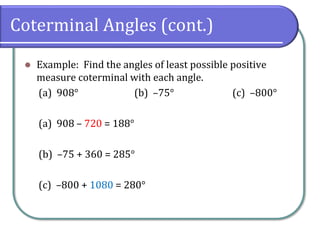
⚫ Example: Find the angles of least possible positive
measure coterminal with each angle.
(a) 908° (b) –75° (c) –800°
(a) 908 – 720 = 188°
(b) –75 + 360 = 285°
(c) –800 + 1080 = 280°
Classwork
⚫ College Algebra & Trigonometry
⚫ Page 500: 34-56 (even)

5.1 Angles

  • 1.
    5.1 Angles Chapter 5Trigonometric Functions
  • 2.
    Concepts and Objectives ⚫Review classifying angles ⚫ Review complementary and supplementary angles ⚫ Convert between decimal degrees and degrees-minutes- seconds degrees ⚫ Find measures of coterminal angles
  • 3.
    Basic Terminology ⚫ Youshould recall from Geometry that an angle is formed by two segments or rays with a common endpoint, which is called the vertex. ⚫ An angle is in standard position if its vertex is at the origin and one side (called the initial side) lies on the positive x-axis. The other side is called the terminal side. ⚫ An angle in standard position is said to lie in the quadrant in which its terminal side lies. ⚫ The measure of an angle is the measure of the rotation of the terminal side about the vertex.
  • 4.
    Basic Terminology (cont.) ⚫You should recall that an angle measuring between 0° and 90° is an acute angle. ⚫ In standard position, an acute angle is in quadrant I. ⚫ An angle that measures exactly 90° is a right angle. Initial side Q I
  • 5.
    Basic Terminology (cont.) ⚫An angle that measures between 90° and 180° is an obtuse angle. ⚫ In standard position, an obtuse angle is in quadrant II. ⚫ Angles measuring between 180° and 270° are in quadrant III. ⚫ Angles measuring between 270° and 360° are in quadrant IV. Q IQ II Q III Q IV
  • 6.
    Basic Terminology (cont.) ⚫Angles in standard position whose terminal sides lie on the x-axis or y-axis, such as angles with measures 90°, 180°, 270°, and so on, are called quadrantal angles. Q IQ II Q III Q IV
  • 7.
    Basic Terminology (stillcont.) ⚫ We didn’t tell you this in Geometry, but it is possible to have negative angle measures. Measuring an angle from its initial side counterclockwise to its terminal side generates a positive measure. ⚫ Measuring clockwise from the initial side to the terminal side generates a negative measure. Positive measure Negative measure
  • 8.
    Degree Measure ⚫ Themost common unit for measuring angles is the degree, which was developed by the Babylonians around 4000 years ago. ⚫ To use degree measure, we assign 360° to a complete rotation of a terminal side about the vertex. ⚫ The standard symbol we will be using for an angle is the Greek letter θ (pronounced “theta”). ⚫ θ The measure of angle A which measures 45° can be written as either mA = 45° or A = 45°.
  • 9.
    Complements & Supplements ⚫Again, going back to Geometry, you should recall that two angles whose measures add up to 90° are called complementary angles. ⚫ The two angles are called complements of each other. ⚫ Two angles whose measures add up to 180° are called supplementary angles. ⚫ The two angles are called supplements of each other.
  • 10.
    Complements & Supplements ⚫Example: For an angles measuring 40°, find the measure of its (a) complement and (b) supplement. ⚫ Example: Find the measure of each angle. (3x)° (6x)°
  • 11.
    Complements & Supplements ⚫Example: For an angles measuring 40°, find the measure of its (a) complement and (b) supplement. (a) 90 – 40 = 50° (b) 180 – 40 = 140° ⚫ Example: Find the measure of each angle. (3x)° (6x)°
  • 12.
    Complements & Supplements ⚫Example: For an angles measuring 40°, find the measure of its (a) complement and (b) supplement. (a) 90 – 40 = 50° (b) 180 – 40 = 140° ⚫ Example: Find the measure of each angle. (3x)° (6x)° 6 3 90 9 90 10 x x x x + = = =
  • 13.
    Complements & Supplements ⚫Example: For an angles measuring 40°, find the measure of its (a) complement and (b) supplement. (a) 90 – 40 = 50° (b) 180 – 40 = 140° ⚫ Example: Find the measure of each angle. (3x)° (6x)° 6 3 90 9 90 10 x x x x + = = = ( ) ( ) 6 10 60 3 10 30 =  =  60° 30°
  • 14.
    Degrees, Minutes, andSeconds ⚫ Traditionally, portions of a degree have been measured with minutes and seconds. Much like time, 60 minutes make one degree and 60 seconds make one minute. ⚫ One minute, written 1′, is of a degree. ⚫ One second, written 1″, is therefore of a minute. ⚫ The measure 12° 42′ 38″ represents 12 degrees, 42 minutes, 38 seconds. ⚫ To add or subtract these angles, add/subtract the minutes and seconds separately. 1 60 1 60 1 1 1 60 3600   = = 
  • 15.
    Degrees, Minutes, andSeconds ⚫ Examples: Perform each calculation. (a) 51° 29′ + 32° 46′ (b) 90° – 73° 12′
  • 16.
    Degrees, Minutes, andSeconds ⚫ Examples: Perform each calculation. (a) 51° 29′ + 32° 46′ (b) 90° – 73° 12′ 51° 29′ + 32° 46′
  • 17.
    Degrees, Minutes, andSeconds ⚫ Examples: Perform each calculation. (a) 51° 29′ + 32° 46′ (b) 90° – 73° 12′ 51° 29′ + 32° 46′ 83° 75′
  • 18.
    Degrees, Minutes, andSeconds ⚫ Examples: Perform each calculation. (a) 51° 29′ + 32° 46′ (b) 90° – 73° 12′ 51° 29′ + 32° 46′ 83° 75′ 75 – 60 15
  • 19.
    Degrees, Minutes, andSeconds ⚫ Examples: Perform each calculation. (a) 51° 29′ + 32° 46′ = 83° + 1° 15′ = 84° 15′ (b) 90° – 73° 12′ 51° 29′ + 32° 46′ 83° 75′ 75 – 60 (= 1°) 15
  • 20.
    Degrees, Minutes, andSeconds ⚫ Examples: Perform each calculation. (a) 51° 29′ + 32° 46′ = 83° + 1° 15′ = 84° 15′ (b) 90° – 73° 12′ 51° 29′ + 32° 46′ 83° 75′ 75 – 60 (= 1°) 15 89° 60′ (= 90°) – 73° 12′ 16° 48′
  • 21.
    Degrees, Minutes, andSeconds ⚫ Examples: Perform each calculation. (a) 51° 29′ + 32° 46′ = 83° + 1° 15′ = 84° 15′ (b) 90° – 73° 12′ = 16° 48′ 51° 29′ + 32° 46′ 83° 75′ 75 – 60 (= 1°) 15 89° 60′ (= 90°) – 73° 12′ 16° 48′
  • 22.
    Decimal Degrees ⚫ Justto keep things interesting, since calculators made decimals so much easier to work with, degrees are also commonly measured in decimal degrees. For example, 58°30′ = 58.5° (since 30 is half of 60). ⚫ To convert from DMS (degrees-minutes-seconds) to decimal, set up a sum of each piece and press /·. ⚫ For example, to convert 74° 8′ 14″ to decimal:
  • 23.
    Decimal Degrees (cont.) ⚫Unfortunately, converting from decimal to DMS is a bit trickier. ⚫ Example: Convert 34.817° to DMS (don’t freak out!)
  • 24.
    Decimal Degrees (cont.) ⚫Unfortunately, converting from decimal to DMS is a bit trickier. ⚫ Example: Convert 34.817° to DMS 34.817° = 34° + .817°
  • 25.
    Decimal Degrees (cont.) ⚫Unfortunately, converting from decimal to DMS is a bit trickier. ⚫ Example: Convert 34.817° to DMS 34.817° = 34° + .817° = 34° + .817(60′) 1° = 60′
  • 26.
    Decimal Degrees (cont.) ⚫Unfortunately, converting from decimal to DMS is a bit trickier. ⚫ Example: Convert 34.817° to DMS 34.817° = 34° + .817° = 34° + .817(60′) = 34° + 49.02′ = 34° + 49′ + .02′ 1° = 60′
  • 27.
    Decimal Degrees (cont.) ⚫Unfortunately, converting from decimal to DMS is a bit trickier. ⚫ Example: Convert 34.817° to DMS 34.817° = 34° + .817° = 34° + .817(60′) = 34° + 49.02′ = 34° + 49′ + .02′ = 34° + 49′ + .02(60″) 1° = 60′ 1′ = 60″
  • 28.
    Decimal Degrees (cont.) ⚫Unfortunately, converting from decimal to DMS is a bit trickier. ⚫ Example: Convert 34.817° to DMS 34.817° = 34° + .817° = 34° + .817(60′) = 34° + 49.02′ = 34° + 49′ + .02′ = 34° + 49′ + .02(60″) = 34° + 49′ + 1.2″ = 34° 49′ 1.2″ 1° = 60′ 1′ = 60″
  • 29.
    Decimal Degrees (cont.) ⚫Here’s how the same problem looks worked out on the calculator. Remember to take just the decimal parts to multiply. I subtract the whole number part because it’s fewer keystrokes. Try this problem yourself to make sure you understand the steps. degrees to minutes minutes to seconds original decimal
  • 30.
    Decimal Degrees (cont.) ⚫Another example: Convert 105.2763° to DMS. = 105° 16′ 34.7″ (notice I didn’t round until the end)
  • 31.
    Coterminal Angles ⚫ Acomplete rotation of a ray about a vertex results in an angle measuring 360°. By continuing the rotation, angles of measure larger than 360° can be produced. The angles in the figure with measures of 45°, –315°, and 405° have the same initial side and terminal side, but different amounts of rotation. Such angles are called coterminal angles.
  • 32.
    Coterminal Angles (cont.) ⚫To find the angle of least possible positive measure coterminal with an angle, add or subtract 360° as many times as needed to obtain an angle that is between 0° and 360°. (You might want to memorize the first few multiples of 360: 360, 720, 1080, 1440)
  • 33.
    Coterminal Angles (cont.) ⚫Example: Find the angles of least possible positive measure coterminal with each angle. (a) 908° (b) –75° (c) –800° (a) 908 – 720 = 188° (b) –75 + 360 = 285° (c) –800 + 1080 = 280°
  • 34.
    Classwork ⚫ College Algebra& Trigonometry ⚫ Page 500: 34-56 (even)