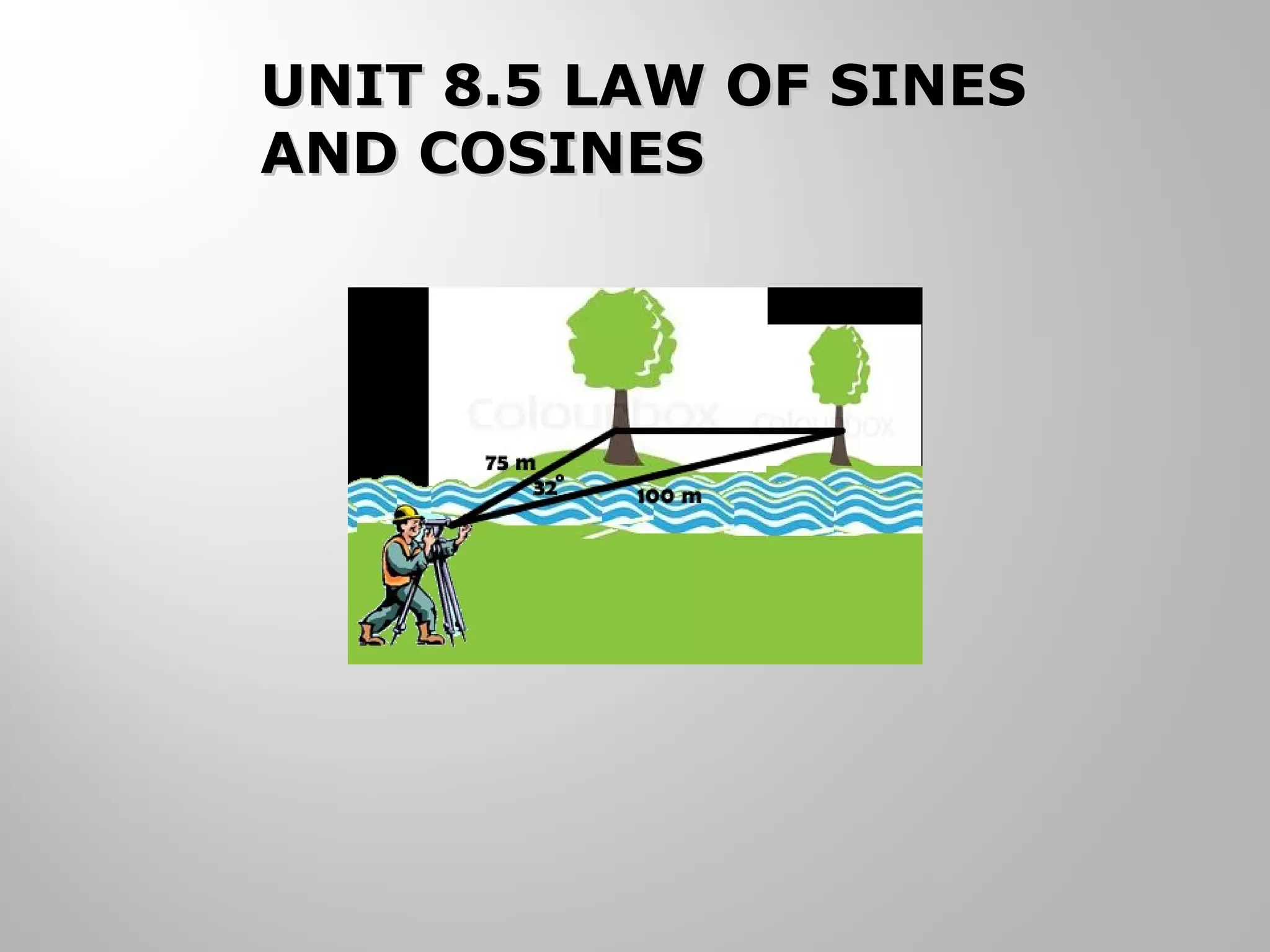

UUNNIITT 88..55 LLAAWW OOFF SSIINNEESS 
AANNDD CCOOSSIINNEESS
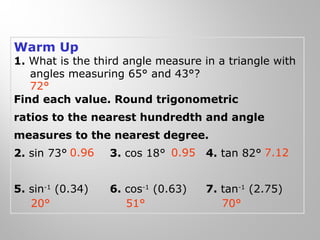
Warm Up 
1. What is the third angle measure in a triangle with 
angles measuring 65° and 43°? 
72° 
Find each value. Round trigonometric 
ratios to the nearest hundredth and angle 
measures to the nearest degree. 
2. sin 73° 3. cos 18° 4. tan 82° 
0.96 0.95 7.12 
5. sin-1 (0.34) 6. cos-1 (0.63) 7. tan-1 (2.75) 
20° 51° 70°
Objective 
Use the Law of Sines and the Law of 
Cosines to solve triangles.
In this lesson, you will learn to solve any triangle. 
To do so, you will need to calculate trigonometric 
ratios for angle measures up to 180°. You can use a 
calculator to find these values.
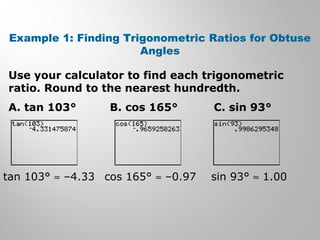
Example 1: Finding Trigonometric Ratios for Obtuse 
Angles 
Use your calculator to find each trigonometric 
ratio. Round to the nearest hundredth. 
A. tan 103° B. cos 165° C. sin 93° 
tan 103° » –4.33 cos 165° » –0.97 sin 93° » 1.00
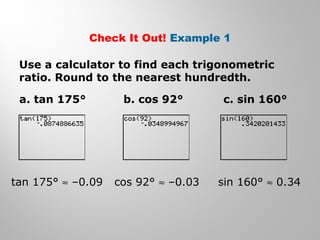
Check It Out! Example 1 
Use a calculator to find each trigonometric 
ratio. Round to the nearest hundredth. 
a. tan 175° 
tan 175° » –0.09 
b. cos 92° c. sin 160° 
cos 92° » –0.03 sin 160° » 0.34
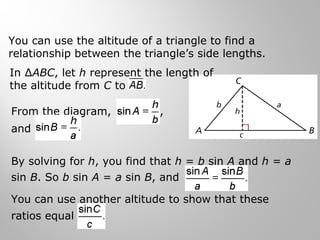
You can use the altitude of a triangle to find a 
relationship between the triangle’s side lengths. 
In ΔABC, let h represent the length of 
the altitude from C to 
From the diagram, , 
and 
By solving for h, you find that h = b sin A and h = a 
sin B. So b sin A = a sin B, and . 
You can use another altitude to show that these 
ratios equal
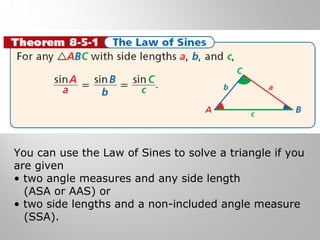
You can use the Law of Sines to solve a triangle if you 
are given 
• two angle measures and any side length 
(ASA or AAS) or 
• two side lengths and a non-included angle measure 
(SSA).
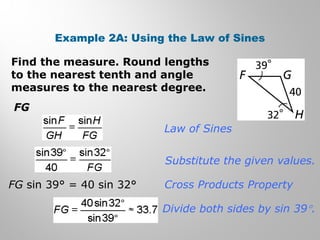
Example 2A: Using the Law of Sines 
Find the measure. Round lengths 
to the nearest tenth and angle 
measures to the nearest degree. 
FG 
Law of Sines 
Substitute the given values. 
Cross Products Property 
Divide both sides by sin 39°. 
FG sin 39° = 40 sin 32°
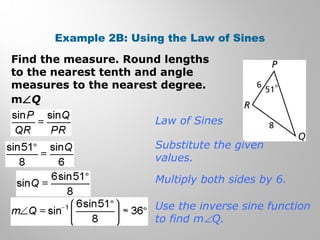
Example 2B: Using the Law of Sines 
Find the measure. Round lengths 
to the nearest tenth and angle 
measures to the nearest degree. 
mÐQ 
Law of Sines 
Substitute the given 
values. 
Multiply both sides by 6. 
Use the inverse sine function 
to find mÐQ.
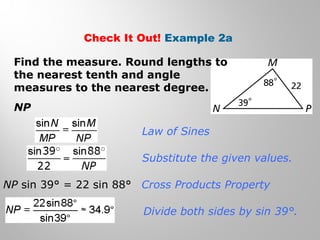
Check It Out! Example 2a 
Find the measure. Round lengths to 
the nearest tenth and angle 
measures to the nearest degree. 
NP 
Law of Sines 
Substitute the given values. 
Cross Products Property 
Divide both sides by sin 39°. 
NP sin 39° = 22 sin 88°
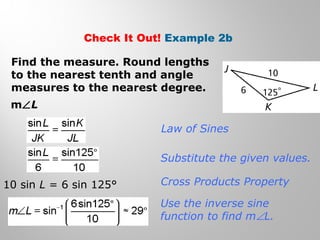
Check It Out! Example 2b 
Find the measure. Round lengths 
to the nearest tenth and angle 
measures to the nearest degree. 
mÐL 
Law of Sines 
Substitute the given values. 
Cross Products Property 
Use the inverse sine 
function to find mÐL. 
10 sin L = 6 sin 125°
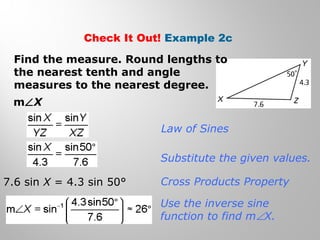
Check It Out! Example 2c 
Find the measure. Round lengths to 
the nearest tenth and angle 
measures to the nearest degree. 
mÐX 
Law of Sines 
Substitute the given values. 
Cross Products Property 
Use the inverse sine 
function to find mÐX. 
7.6 sin X = 4.3 sin 50°
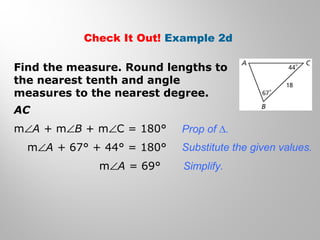
Check It Out! Example 2d 
Find the measure. Round lengths to 
the nearest tenth and angle 
measures to the nearest degree. 
AC 
mÐA + mÐB + mÐC = 180° 
mÐA + 67° + 44° = 180° 
mÐA = 69° 
Prop of Δ. 
Substitute the given values. 
Simplify.
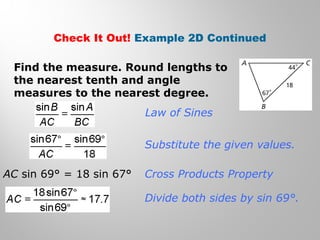
Check It Out! Example 2D Continued 
Find the measure. Round lengths to 
the nearest tenth and angle 
measures to the nearest degree. 
Law of Sines 
Substitute the given values. 
Cross Products Property 
Divide both sides by sin 69°. 
AC sin 69° = 18 sin 67°
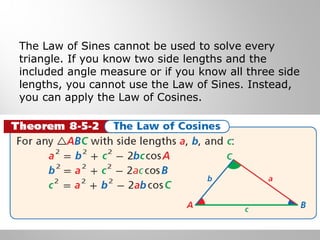
The Law of Sines cannot be used to solve every 
triangle. If you know two side lengths and the 
included angle measure or if you know all three side 
lengths, you cannot use the Law of Sines. Instead, 
you can apply the Law of Cosines.
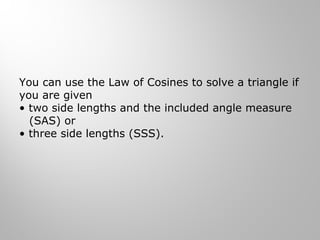
You can use the Law of Cosines to solve a triangle if 
you are given 
• two side lengths and the included angle measure 
(SAS) or 
• three side lengths (SSS).
Helpful Hint 
The angle referenced in the Law of Cosines is 
across the equal sign from its corresponding side.
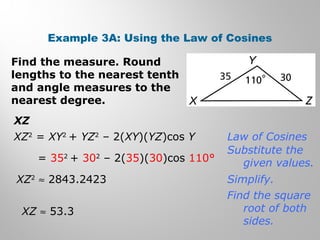
Example 3A: Using the Law of Cosines 
Find the measure. Round 
lengths to the nearest tenth 
and angle measures to the 
nearest degree. 
XZ 
XZ2 = XY2 + YZ2 – 2(XY)(YZ)cos Y 
= 352 + 302 – 2(35)(30)cos 110° 
XZ2 » 2843.2423 
XZ » 53.3 
Law of Cosines 
Substitute the 
given values. 
Simplify. 
Find the square 
root of both 
sides.
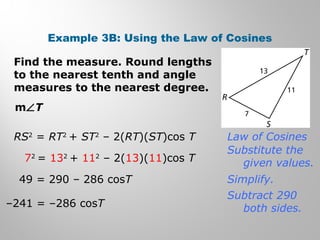
Example 3B: Using the Law of Cosines 
Find the measure. Round lengths 
to the nearest tenth and angle 
measures to the nearest degree. 
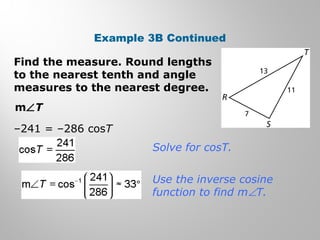
mÐT 
RS2 = RT2 + ST2 – 2(RT)(ST)cos T 
72 = 132 + 112 – 2(13)(11)cos T 
49 = 290 – 286 cosT 
–241 = –286 cosT 
Law of Cosines 
Substitute the 
given values. 
Simplify. 
Subtract 290 
both sides.
Example 3B Continued 
Find the measure. Round lengths 
to the nearest tenth and angle 
measures to the nearest degree. 
mÐT 
–241 = –286 cosT 
Solve for cosT. 
Use the inverse cosine 
function to find mÐT.
Check It Out! Example 3a 
Find the measure. Round lengths 
to the nearest tenth and angle 
measures to the nearest degree. 
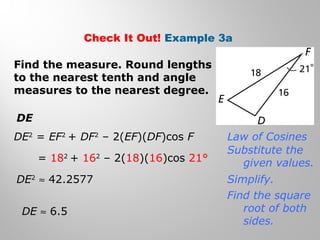
DE 
DE2 = EF2 + DF2 – 2(EF)(DF)cos F 
= 182 + 162 – 2(18)(16)cos 21° 
DE2 » 42.2577 
DE » 6.5 
Law of Cosines 
Substitute the 
given values. 
Simplify. 
Find the square 
root of both 
sides.
Check It Out! Example 3b 
Find the measure. Round 
lengths to the nearest tenth 
and angle measures to the 
nearest degree. 
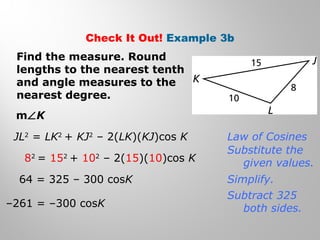
mÐK 
JL2 = LK2 + KJ2 – 2(LK)(KJ)cos K 
82 = 152 + 102 – 2(15)(10)cos K 
64 = 325 – 300 cosK 
–261 = –300 cosK 
Law of Cosines 
Substitute the 
given values. 
Simplify. 
Subtract 325 
both sides.
Check It Out! Example 3b Continued 
Find the measure. Round 
lengths to the nearest tenth 
and angle measures to the 
nearest degree. 
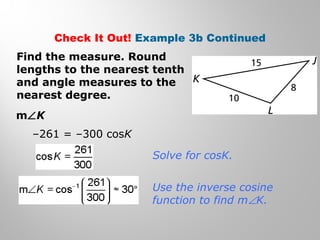
mÐK 
–261 = –300 cosK 
Solve for cosK. 
Use the inverse cosine 
function to find mÐK.
Check It Out! Example 3c 
Find the measure. Round 
lengths to the nearest tenth 
and angle measures to the 
nearest degree. 
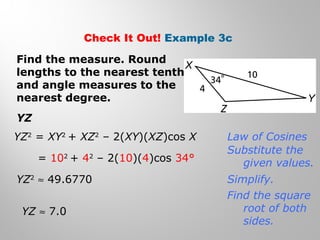
YZ 
YZ2 = XY2 + XZ2 – 2(XY)(XZ)cos X 
= 102 + 42 – 2(10)(4)cos 34° 
YZ2 » 49.6770 
YZ » 7.0 
Law of Cosines 
Substitute the 
given values. 
Simplify. 
Find the square 
root of both 
sides.
Check It Out! Example 3d 
Find the measure. Round 
lengths to the nearest tenth and 
angle measures to the nearest 
degree. 
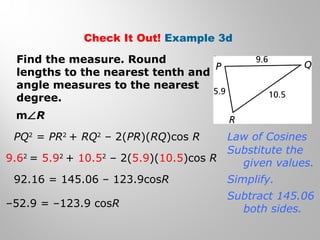
mÐR 
PQ2 = PR2 + RQ2 – 2(PR)(RQ)cos R 
9.62 = 5.92 + 10.52 – 2(5.9)(10.5)cos R 
92.16 = 145.06 – 123.9cosR 
–52.9 = –123.9 cosR 
Law of Cosines 
Substitute the 
given values. 
Simplify. 
Subtract 145.06 
both sides.
Check It Out! Example 3d Continued 
Find the measure. Round 
lengths to the nearest tenth and 
angle measures to the nearest 
degree. 
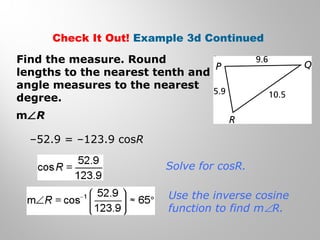
mÐR 
–52.9 = –123.9 cosR 
Solve for cosR. 
Use the inverse cosine 
function to find mÐR.
Helpful Hint 
Do not round your answer until the final step of 
the computation. If a problem has multiple steps, 
store the calculated answers to each part in your 
calculator.
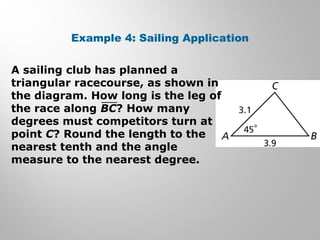
Example 4: Sailing Application 
A sailing club has planned a 
triangular racecourse, as shown in 
the diagram. How long is the leg of 
the race along BC? How many 
degrees must competitors turn at 
point C? Round the length to the 
nearest tenth and the angle 
measure to the nearest degree.
Example 4 Continued 
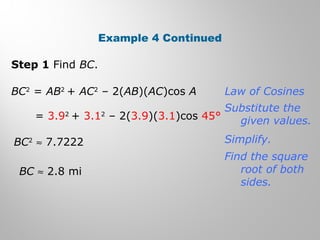
Step 1 Find BC. 
BC2 = AB2 + AC2 – 2(AB)(AC)cos A 
= 3.92 + 3.12 – 2(3.9)(3.1)cos 45° 
BC2 » 7.7222 
BC » 2.8 mi 
Law of Cosines 
Substitute the 
given values. 
Simplify. 
Find the square 
root of both 
sides.
Example 4 Continued 
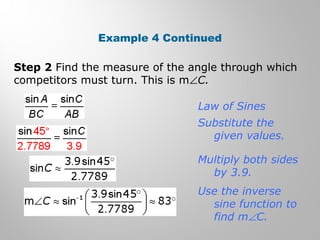
Step 2 Find the measure of the angle through which 
competitors must turn. This is mÐC. 
Law of Sines 
Substitute the 
given values. 
Multiply both sides 
by 3.9. 
Use the inverse 
sine function to 
find mÐC.
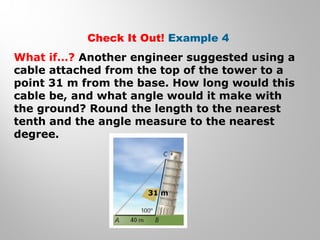
Check It Out! Example 4 
What if…? Another engineer suggested using a 
cable attached from the top of the tower to a 
point 31 m from the base. How long would this 
cable be, and what angle would it make with 
the ground? Round the length to the nearest 
tenth and the angle measure to the nearest 
degree. 
31 m
Check It Out! Example 4 Continued 
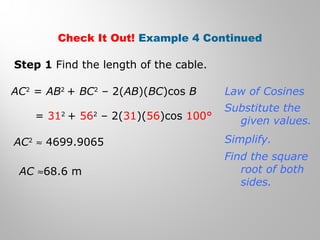
Step 1 Find the length of the cable. 
AC2 = AB2 + BC2 – 2(AB)(BC)cos B 
= 312 + 562 – 2(31)(56)cos 100° 
AC2 » 4699.9065 
AC »68.6 m 
Law of Cosines 
Substitute the 
given values. 
Simplify. 
Find the square 
root of both 
sides.
Check It Out! Example 4 Continued 
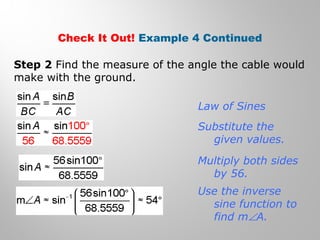
Step 2 Find the measure of the angle the cable would 
make with the ground. 
Law of Sines 
Substitute the 
given values. 
Multiply both sides 
by 56. 
Use the inverse 
sine function to 
find mÐA.
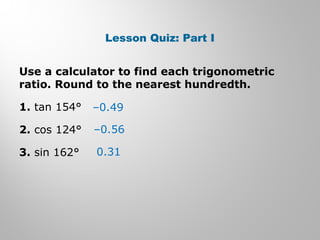
Lesson Quiz: Part I 
Use a calculator to find each trigonometric 
ratio. Round to the nearest hundredth. 
1. tan 154° 
–0.49 
2. cos 124° 
–0.56 
3. sin 162° 
0.31
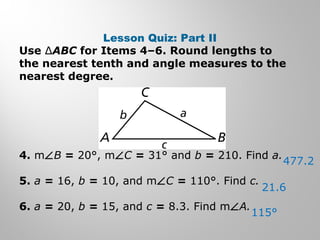
Lesson Quiz: Part II 
Use ΔABC for Items 4–6. Round lengths to 
the nearest tenth and angle measures to the 
nearest degree. 
4. mÐB = 20°, mÐC = 31° and b = 210. Find a. 
5. a = 16, b = 10, and mÐC = 110°. Find c. 
6. a = 20, b = 15, and c = 8.3. Find mÐA. 
477.2 
21.6 
115°
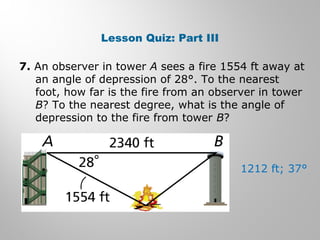
Lesson Quiz: Part III 
7. An observer in tower A sees a fire 1554 ft away at 
an angle of depression of 28°. To the nearest 
foot, how far is the fire from an observer in tower 
B? To the nearest degree, what is the angle of 
depression to the fire from tower B? 
1212 ft; 37°
All rights belong to their 
respective owners. 
Copyright Disclaimer Under 
Section 107 of the Copyright Act 
1976, allowance is made for 
"fair use" for purposes such as 
criticism, comment, news 
reporting, TEACHING, 
scholarship, and research. 
Fair use is a use permitted by 
copyright statute that might 
otherwise be infringing. 
Non-profit, EDUCATIONAL or 
personal use tips the balance in 
favor of fair use.

Geometry unit 8.5

  • 1.
    UUNNIITT 88..55 LLAAWWOOFF SSIINNEESS AANNDD CCOOSSIINNEESS
  • 2.
    Warm Up 1.What is the third angle measure in a triangle with angles measuring 65° and 43°? 72° Find each value. Round trigonometric ratios to the nearest hundredth and angle measures to the nearest degree. 2. sin 73° 3. cos 18° 4. tan 82° 0.96 0.95 7.12 5. sin-1 (0.34) 6. cos-1 (0.63) 7. tan-1 (2.75) 20° 51° 70°
  • 3.
    Objective Use theLaw of Sines and the Law of Cosines to solve triangles.
  • 4.
    In this lesson,you will learn to solve any triangle. To do so, you will need to calculate trigonometric ratios for angle measures up to 180°. You can use a calculator to find these values.
  • 5.
    Example 1: FindingTrigonometric Ratios for Obtuse Angles Use your calculator to find each trigonometric ratio. Round to the nearest hundredth. A. tan 103° B. cos 165° C. sin 93° tan 103° » –4.33 cos 165° » –0.97 sin 93° » 1.00
  • 6.
    Check It Out!Example 1 Use a calculator to find each trigonometric ratio. Round to the nearest hundredth. a. tan 175° tan 175° » –0.09 b. cos 92° c. sin 160° cos 92° » –0.03 sin 160° » 0.34
  • 7.
    You can usethe altitude of a triangle to find a relationship between the triangle’s side lengths. In ΔABC, let h represent the length of the altitude from C to From the diagram, , and By solving for h, you find that h = b sin A and h = a sin B. So b sin A = a sin B, and . You can use another altitude to show that these ratios equal
  • 8.
    You can usethe Law of Sines to solve a triangle if you are given • two angle measures and any side length (ASA or AAS) or • two side lengths and a non-included angle measure (SSA).
  • 9.
    Example 2A: Usingthe Law of Sines Find the measure. Round lengths to the nearest tenth and angle measures to the nearest degree. FG Law of Sines Substitute the given values. Cross Products Property Divide both sides by sin 39°. FG sin 39° = 40 sin 32°
  • 10.
    Example 2B: Usingthe Law of Sines Find the measure. Round lengths to the nearest tenth and angle measures to the nearest degree. mÐQ Law of Sines Substitute the given values. Multiply both sides by 6. Use the inverse sine function to find mÐQ.
  • 11.
    Check It Out!Example 2a Find the measure. Round lengths to the nearest tenth and angle measures to the nearest degree. NP Law of Sines Substitute the given values. Cross Products Property Divide both sides by sin 39°. NP sin 39° = 22 sin 88°
  • 12.
    Check It Out!Example 2b Find the measure. Round lengths to the nearest tenth and angle measures to the nearest degree. mÐL Law of Sines Substitute the given values. Cross Products Property Use the inverse sine function to find mÐL. 10 sin L = 6 sin 125°
  • 13.
    Check It Out!Example 2c Find the measure. Round lengths to the nearest tenth and angle measures to the nearest degree. mÐX Law of Sines Substitute the given values. Cross Products Property Use the inverse sine function to find mÐX. 7.6 sin X = 4.3 sin 50°
  • 14.
    Check It Out!Example 2d Find the measure. Round lengths to the nearest tenth and angle measures to the nearest degree. AC mÐA + mÐB + mÐC = 180° mÐA + 67° + 44° = 180° mÐA = 69° Prop of Δ. Substitute the given values. Simplify.
  • 15.
    Check It Out!Example 2D Continued Find the measure. Round lengths to the nearest tenth and angle measures to the nearest degree. Law of Sines Substitute the given values. Cross Products Property Divide both sides by sin 69°. AC sin 69° = 18 sin 67°
  • 16.
    The Law ofSines cannot be used to solve every triangle. If you know two side lengths and the included angle measure or if you know all three side lengths, you cannot use the Law of Sines. Instead, you can apply the Law of Cosines.
  • 17.
    You can usethe Law of Cosines to solve a triangle if you are given • two side lengths and the included angle measure (SAS) or • three side lengths (SSS).
  • 18.
    Helpful Hint Theangle referenced in the Law of Cosines is across the equal sign from its corresponding side.
  • 19.
    Example 3A: Usingthe Law of Cosines Find the measure. Round lengths to the nearest tenth and angle measures to the nearest degree. XZ XZ2 = XY2 + YZ2 – 2(XY)(YZ)cos Y = 352 + 302 – 2(35)(30)cos 110° XZ2 » 2843.2423 XZ » 53.3 Law of Cosines Substitute the given values. Simplify. Find the square root of both sides.
  • 20.
    Example 3B: Usingthe Law of Cosines Find the measure. Round lengths to the nearest tenth and angle measures to the nearest degree. mÐT RS2 = RT2 + ST2 – 2(RT)(ST)cos T 72 = 132 + 112 – 2(13)(11)cos T 49 = 290 – 286 cosT –241 = –286 cosT Law of Cosines Substitute the given values. Simplify. Subtract 290 both sides.
  • 21.
    Example 3B Continued Find the measure. Round lengths to the nearest tenth and angle measures to the nearest degree. mÐT –241 = –286 cosT Solve for cosT. Use the inverse cosine function to find mÐT.
  • 22.
    Check It Out!Example 3a Find the measure. Round lengths to the nearest tenth and angle measures to the nearest degree. DE DE2 = EF2 + DF2 – 2(EF)(DF)cos F = 182 + 162 – 2(18)(16)cos 21° DE2 » 42.2577 DE » 6.5 Law of Cosines Substitute the given values. Simplify. Find the square root of both sides.
  • 23.
    Check It Out!Example 3b Find the measure. Round lengths to the nearest tenth and angle measures to the nearest degree. mÐK JL2 = LK2 + KJ2 – 2(LK)(KJ)cos K 82 = 152 + 102 – 2(15)(10)cos K 64 = 325 – 300 cosK –261 = –300 cosK Law of Cosines Substitute the given values. Simplify. Subtract 325 both sides.
  • 24.
    Check It Out!Example 3b Continued Find the measure. Round lengths to the nearest tenth and angle measures to the nearest degree. mÐK –261 = –300 cosK Solve for cosK. Use the inverse cosine function to find mÐK.
  • 25.
    Check It Out!Example 3c Find the measure. Round lengths to the nearest tenth and angle measures to the nearest degree. YZ YZ2 = XY2 + XZ2 – 2(XY)(XZ)cos X = 102 + 42 – 2(10)(4)cos 34° YZ2 » 49.6770 YZ » 7.0 Law of Cosines Substitute the given values. Simplify. Find the square root of both sides.
  • 26.
    Check It Out!Example 3d Find the measure. Round lengths to the nearest tenth and angle measures to the nearest degree. mÐR PQ2 = PR2 + RQ2 – 2(PR)(RQ)cos R 9.62 = 5.92 + 10.52 – 2(5.9)(10.5)cos R 92.16 = 145.06 – 123.9cosR –52.9 = –123.9 cosR Law of Cosines Substitute the given values. Simplify. Subtract 145.06 both sides.
  • 27.
    Check It Out!Example 3d Continued Find the measure. Round lengths to the nearest tenth and angle measures to the nearest degree. mÐR –52.9 = –123.9 cosR Solve for cosR. Use the inverse cosine function to find mÐR.
  • 28.
    Helpful Hint Donot round your answer until the final step of the computation. If a problem has multiple steps, store the calculated answers to each part in your calculator.
  • 29.
    Example 4: SailingApplication A sailing club has planned a triangular racecourse, as shown in the diagram. How long is the leg of the race along BC? How many degrees must competitors turn at point C? Round the length to the nearest tenth and the angle measure to the nearest degree.
  • 30.
    Example 4 Continued Step 1 Find BC. BC2 = AB2 + AC2 – 2(AB)(AC)cos A = 3.92 + 3.12 – 2(3.9)(3.1)cos 45° BC2 » 7.7222 BC » 2.8 mi Law of Cosines Substitute the given values. Simplify. Find the square root of both sides.
  • 31.
    Example 4 Continued Step 2 Find the measure of the angle through which competitors must turn. This is mÐC. Law of Sines Substitute the given values. Multiply both sides by 3.9. Use the inverse sine function to find mÐC.
  • 32.
    Check It Out!Example 4 What if…? Another engineer suggested using a cable attached from the top of the tower to a point 31 m from the base. How long would this cable be, and what angle would it make with the ground? Round the length to the nearest tenth and the angle measure to the nearest degree. 31 m
  • 33.
    Check It Out!Example 4 Continued Step 1 Find the length of the cable. AC2 = AB2 + BC2 – 2(AB)(BC)cos B = 312 + 562 – 2(31)(56)cos 100° AC2 » 4699.9065 AC »68.6 m Law of Cosines Substitute the given values. Simplify. Find the square root of both sides.
  • 34.
    Check It Out!Example 4 Continued Step 2 Find the measure of the angle the cable would make with the ground. Law of Sines Substitute the given values. Multiply both sides by 56. Use the inverse sine function to find mÐA.
  • 35.
    Lesson Quiz: PartI Use a calculator to find each trigonometric ratio. Round to the nearest hundredth. 1. tan 154° –0.49 2. cos 124° –0.56 3. sin 162° 0.31
  • 36.
    Lesson Quiz: PartII Use ΔABC for Items 4–6. Round lengths to the nearest tenth and angle measures to the nearest degree. 4. mÐB = 20°, mÐC = 31° and b = 210. Find a. 5. a = 16, b = 10, and mÐC = 110°. Find c. 6. a = 20, b = 15, and c = 8.3. Find mÐA. 477.2 21.6 115°
  • 37.
    Lesson Quiz: PartIII 7. An observer in tower A sees a fire 1554 ft away at an angle of depression of 28°. To the nearest foot, how far is the fire from an observer in tower B? To the nearest degree, what is the angle of depression to the fire from tower B? 1212 ft; 37°
  • 38.
    All rights belongto their respective owners. Copyright Disclaimer Under Section 107 of the Copyright Act 1976, allowance is made for "fair use" for purposes such as criticism, comment, news reporting, TEACHING, scholarship, and research. Fair use is a use permitted by copyright statute that might otherwise be infringing. Non-profit, EDUCATIONAL or personal use tips the balance in favor of fair use.