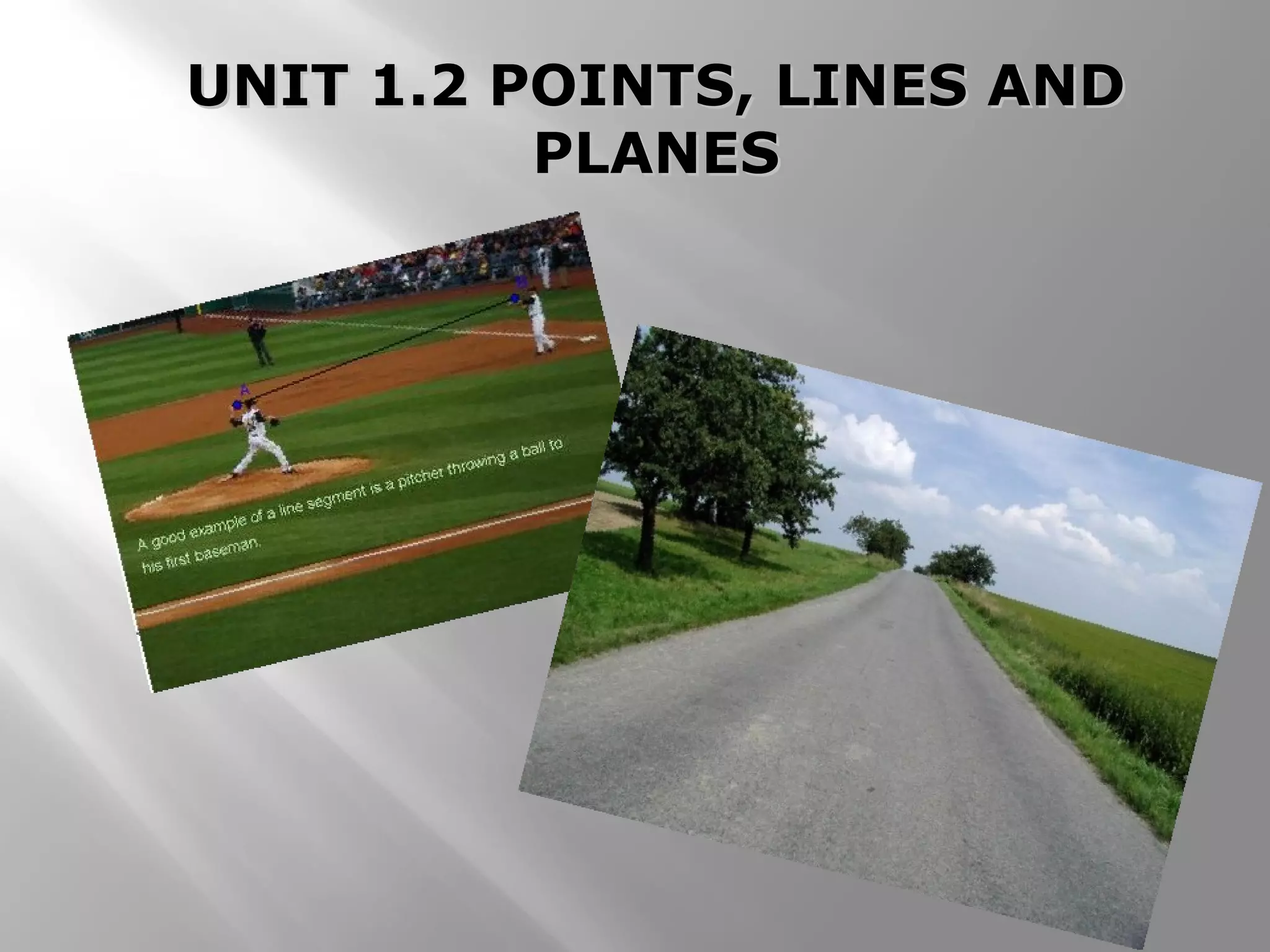

UUNNIITT 11..22 PPOOIINNTTSS,, LLIINNEESS AANNDD 
PPLLAANNEESS
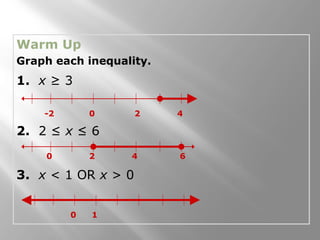
Warm Up 
Graph each inequality. 
1. x ≥ 3 
-2 0 2 4 
2. 2 ≤ x ≤ 6 
0 2 4 6 
3. x < 1 OR x > 0 
0 1
Objective 
Identify, name, and draw points, lines, 
segments, rays, and planes and apply 
basic facts about them.
Vocabulary 
undefined term point 
line plane 
collinear coplanar 
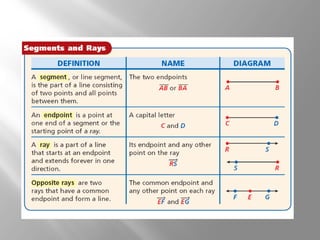
segment endpoint 
ray opposite rays 
postulate
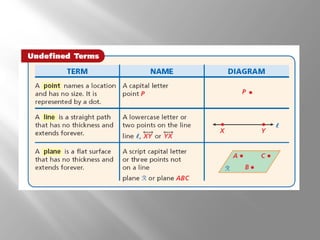
The most basic figures in 
geometry are undefined terms, 
which cannot be defined by using 
other figures. The undefined 
terms point, line, and plane are 
the building blocks of geometry.
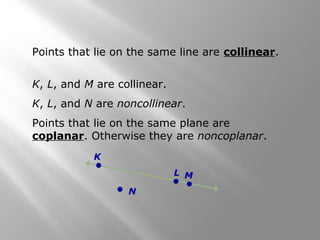
Points that lie on the same line are collinear. 
K, L, and M are collinear. 
K, L, and N are noncollinear. 
Points that lie on the same plane are 
coplanar. Otherwise they are noncoplanar. 
M 
K 
L 
N
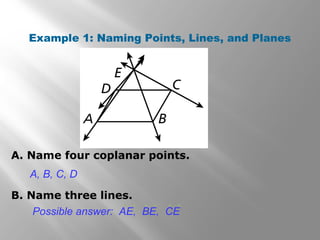
Example 1: Naming Points, Lines, and Planes 
A. Name four coplanar points. 
A, B, C, D 
B. Name three lines. 
Possible answer: AE, BE, CE
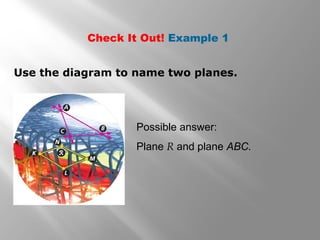
Check It Out! Example 1 
Use the diagram to name two planes. 
Possible answer: 
Plane R and plane ABC.
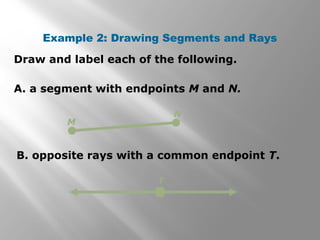
Example 2: Drawing Segments and Rays 
Draw and label each of the following. 
A. a segment with endpoints M and N. 
M 
N 
B. opposite rays with a common endpoint T. 
T
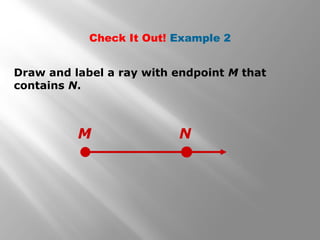
Check It Out! Example 2 
Draw and label a ray with endpoint M that 
contains N. 
M N
A postulate is a statement that is 
accepted as true without proof.
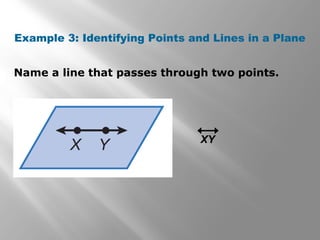
Example 3: Identifying Points and Lines in a Plane 
Name a line that passes through two points. 
XY
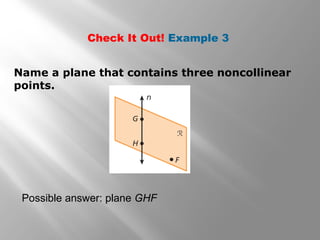
Check It Out! Example 3 
Name a plane that contains three noncollinear 
points. 
Possible answer: plane GHF
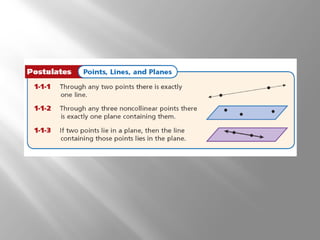
Recall that a system of equations is a set of 
two or more equations containing two or 
more of the same variables. The coordinates 
of the solution of the system satisfy all 
equations in the system. These coordinates 
also locate the point where all the graphs of 
the equations in the system intersect. 
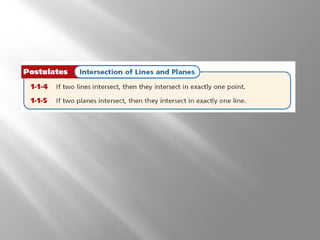
An intersection is the set of all points that two 
or more figures have in common. The next 
two postulates describe intersections 
involving lines and planes.
Use a dashed line to show the 
hidden parts of any figure that 
you are drawing. A dashed line 
will indicate the part of the figure 
that is not seen.
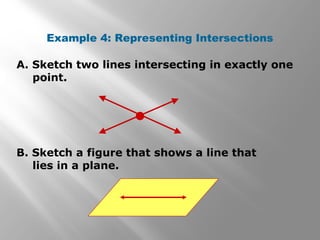
Example 4: Representing Intersections 
A. Sketch two lines intersecting in exactly one 
point. 
B. Sketch a figure that shows a line that 
lies in a plane.
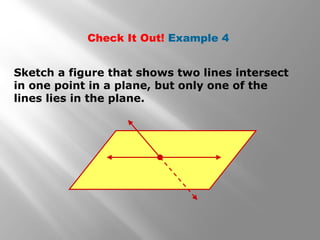
Check It Out! Example 4 
Sketch a figure that shows two lines intersect 
in one point in a plane, but only one of the 
lines lies in the plane.
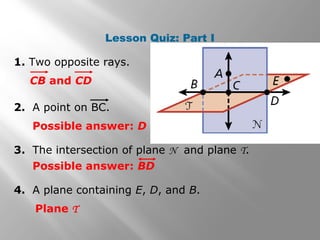
Lesson Quiz: Part I 
1. Two opposite rays. 
CB and CD 
2. A point on BC. 
Possible answer: D 
3. The intersection of plane N and plane T. 
Possible answer: BD 
4. A plane containing E, D, and B. 
Plane T
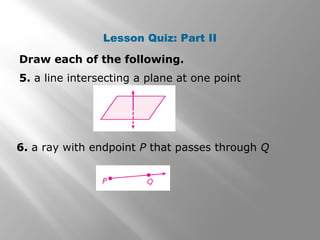
Lesson Quiz: Part II 
Draw each of the following. 
5. a line intersecting a plane at one point 
6. a ray with endpoint P that passes through Q
All rights belong to their 
respective owners. 
Copyright Disclaimer Under 
Section 107 of the Copyright Act 
1976, allowance is made for "fair 
use" for purposes such as 
criticism, comment, news 
reporting, TEACHING, 
scholarship, and research. 
Fair use is a use permitted by 
copyright statute that might 
otherwise be infringing. 
Non-profit, EDUCATIONAL or 
personal use tips the balance in 
favor of fair use.

Geometry unit 1.2

  • 1.
    UUNNIITT 11..22 PPOOIINNTTSS,,LLIINNEESS AANNDD PPLLAANNEESS
  • 2.
    Warm Up Grapheach inequality. 1. x ≥ 3 -2 0 2 4 2. 2 ≤ x ≤ 6 0 2 4 6 3. x < 1 OR x > 0 0 1
  • 3.
    Objective Identify, name,and draw points, lines, segments, rays, and planes and apply basic facts about them.
  • 4.
    Vocabulary undefined termpoint line plane collinear coplanar segment endpoint ray opposite rays postulate
  • 5.
    The most basicfigures in geometry are undefined terms, which cannot be defined by using other figures. The undefined terms point, line, and plane are the building blocks of geometry.
  • 7.
    Points that lieon the same line are collinear. K, L, and M are collinear. K, L, and N are noncollinear. Points that lie on the same plane are coplanar. Otherwise they are noncoplanar. M K L N
  • 8.
    Example 1: NamingPoints, Lines, and Planes A. Name four coplanar points. A, B, C, D B. Name three lines. Possible answer: AE, BE, CE
  • 9.
    Check It Out!Example 1 Use the diagram to name two planes. Possible answer: Plane R and plane ABC.
  • 11.
    Example 2: DrawingSegments and Rays Draw and label each of the following. A. a segment with endpoints M and N. M N B. opposite rays with a common endpoint T. T
  • 12.
    Check It Out!Example 2 Draw and label a ray with endpoint M that contains N. M N
  • 13.
    A postulate isa statement that is accepted as true without proof.
  • 15.
    Example 3: IdentifyingPoints and Lines in a Plane Name a line that passes through two points. XY
  • 16.
    Check It Out!Example 3 Name a plane that contains three noncollinear points. Possible answer: plane GHF
  • 17.
    Recall that asystem of equations is a set of two or more equations containing two or more of the same variables. The coordinates of the solution of the system satisfy all equations in the system. These coordinates also locate the point where all the graphs of the equations in the system intersect. An intersection is the set of all points that two or more figures have in common. The next two postulates describe intersections involving lines and planes.
  • 19.
    Use a dashedline to show the hidden parts of any figure that you are drawing. A dashed line will indicate the part of the figure that is not seen.
  • 20.
    Example 4: RepresentingIntersections A. Sketch two lines intersecting in exactly one point. B. Sketch a figure that shows a line that lies in a plane.
  • 21.
    Check It Out!Example 4 Sketch a figure that shows two lines intersect in one point in a plane, but only one of the lines lies in the plane.
  • 22.
    Lesson Quiz: PartI 1. Two opposite rays. CB and CD 2. A point on BC. Possible answer: D 3. The intersection of plane N and plane T. Possible answer: BD 4. A plane containing E, D, and B. Plane T
  • 23.
    Lesson Quiz: PartII Draw each of the following. 5. a line intersecting a plane at one point 6. a ray with endpoint P that passes through Q
  • 24.
    All rights belongto their respective owners. Copyright Disclaimer Under Section 107 of the Copyright Act 1976, allowance is made for "fair use" for purposes such as criticism, comment, news reporting, TEACHING, scholarship, and research. Fair use is a use permitted by copyright statute that might otherwise be infringing. Non-profit, EDUCATIONAL or personal use tips the balance in favor of fair use.