

Language of
Geometry
GOALS
 Identify and draw representations of points,
lines and planes
 Use undefined terms to define some basic
geometric terms
PROBLEM POSING:
When you look at the night sky how many stars do
you see?
INVESTIGATION…
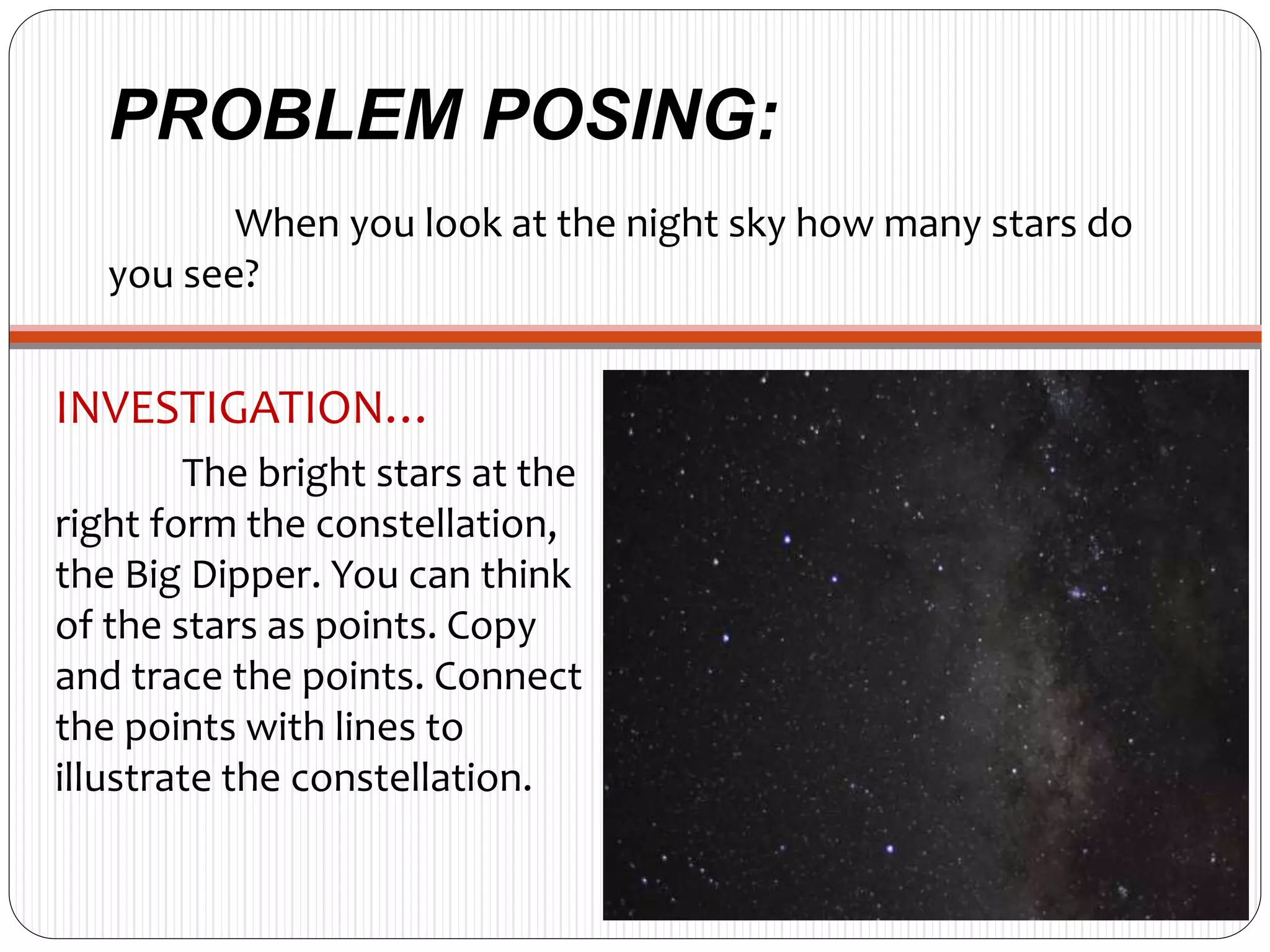
The bright stars at the
right form the constellation,
the Big Dipper. You can think
of the stars as points. Copy
and trace the points. Connect
the points with lines to
illustrate the constellation.
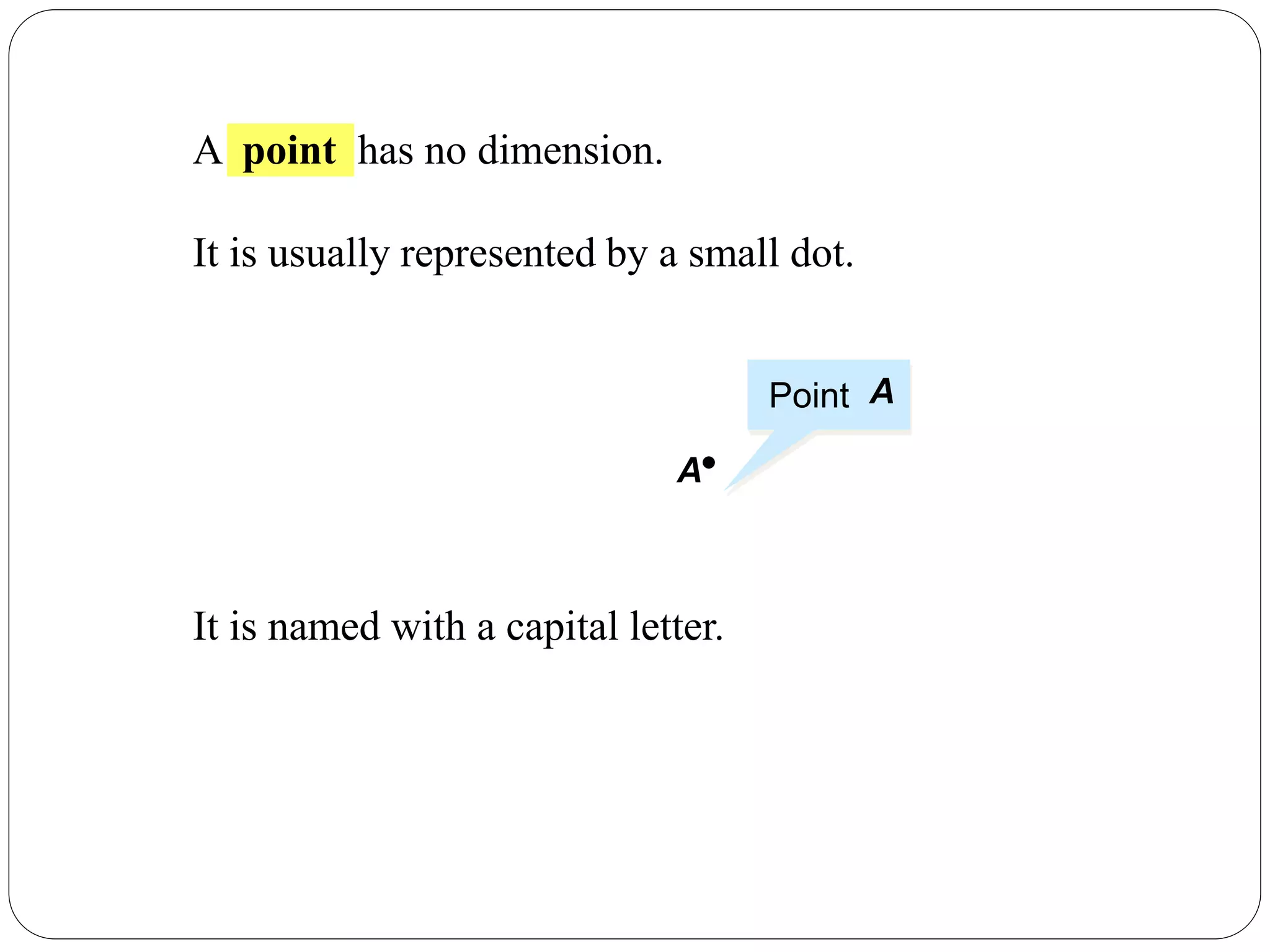
A point has no dimension.
It is usually represented by a small dot.
•A
Point A
It is named with a capital letter.
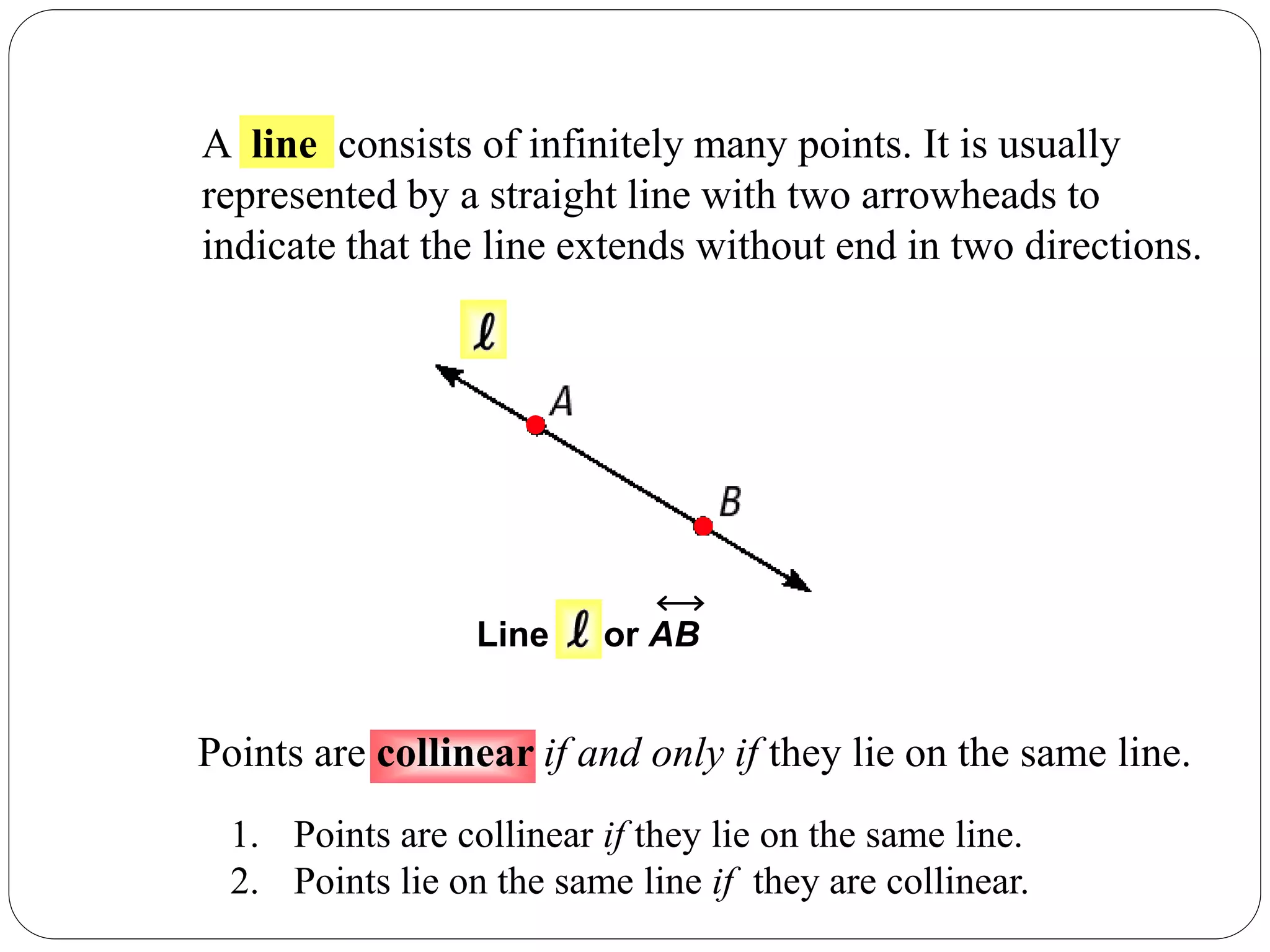
A line consists of infinitely many points. It is usually
represented by a straight line with two arrowheads to
indicate that the line extends without end in two directions.
Line or AB
Points are collinear if and only if they lie on the same line.
1. Points are collinear if they lie on the same line.
2. Points lie on the same line if they are collinear.
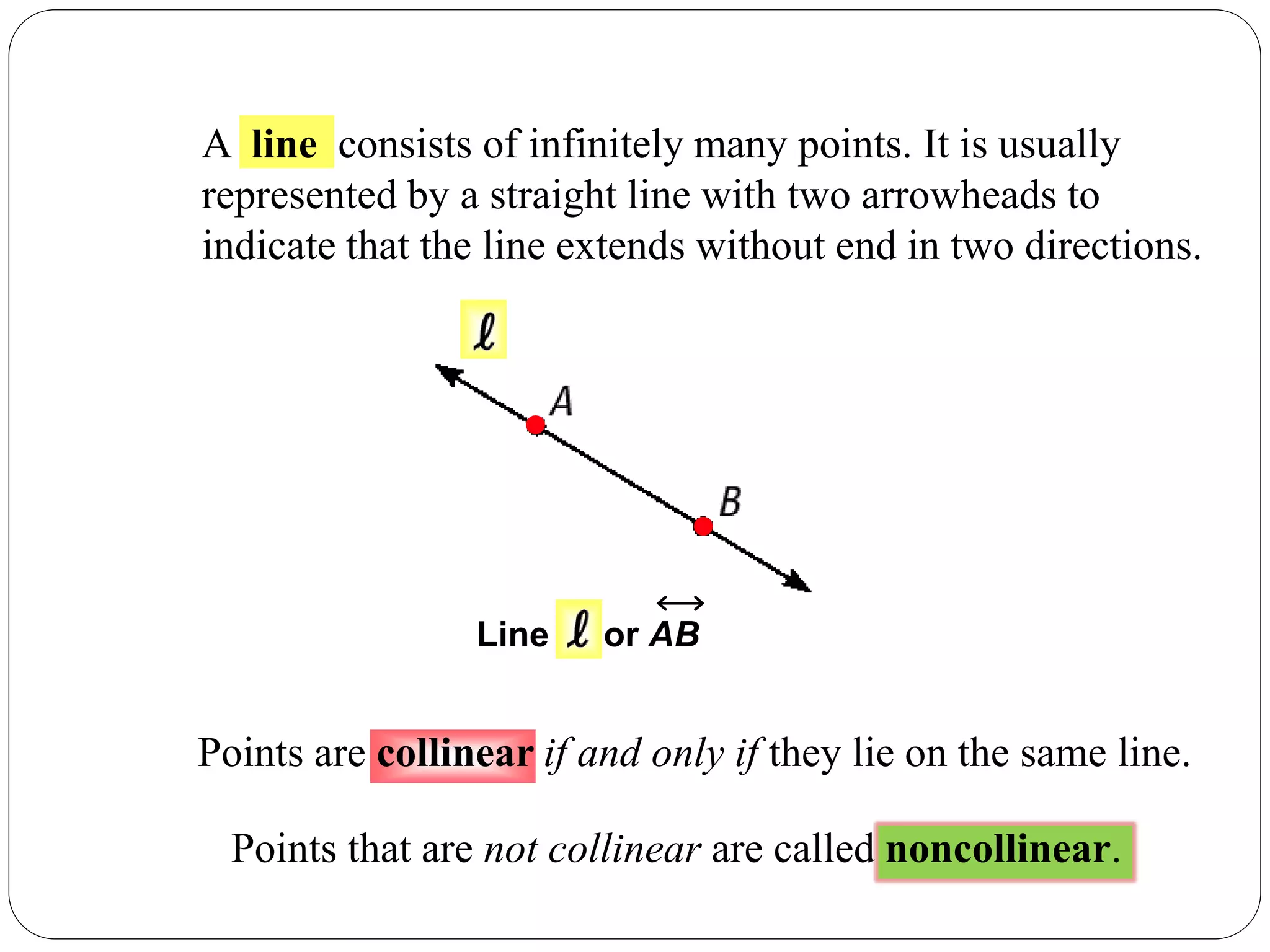
A line consists of infinitely many points. It is usually
represented by a straight line with two arrowheads to
indicate that the line extends without end in two directions.
Line or AB
Points are collinear if and only if they lie on the same line.
Points that are not collinear are called noncollinear.
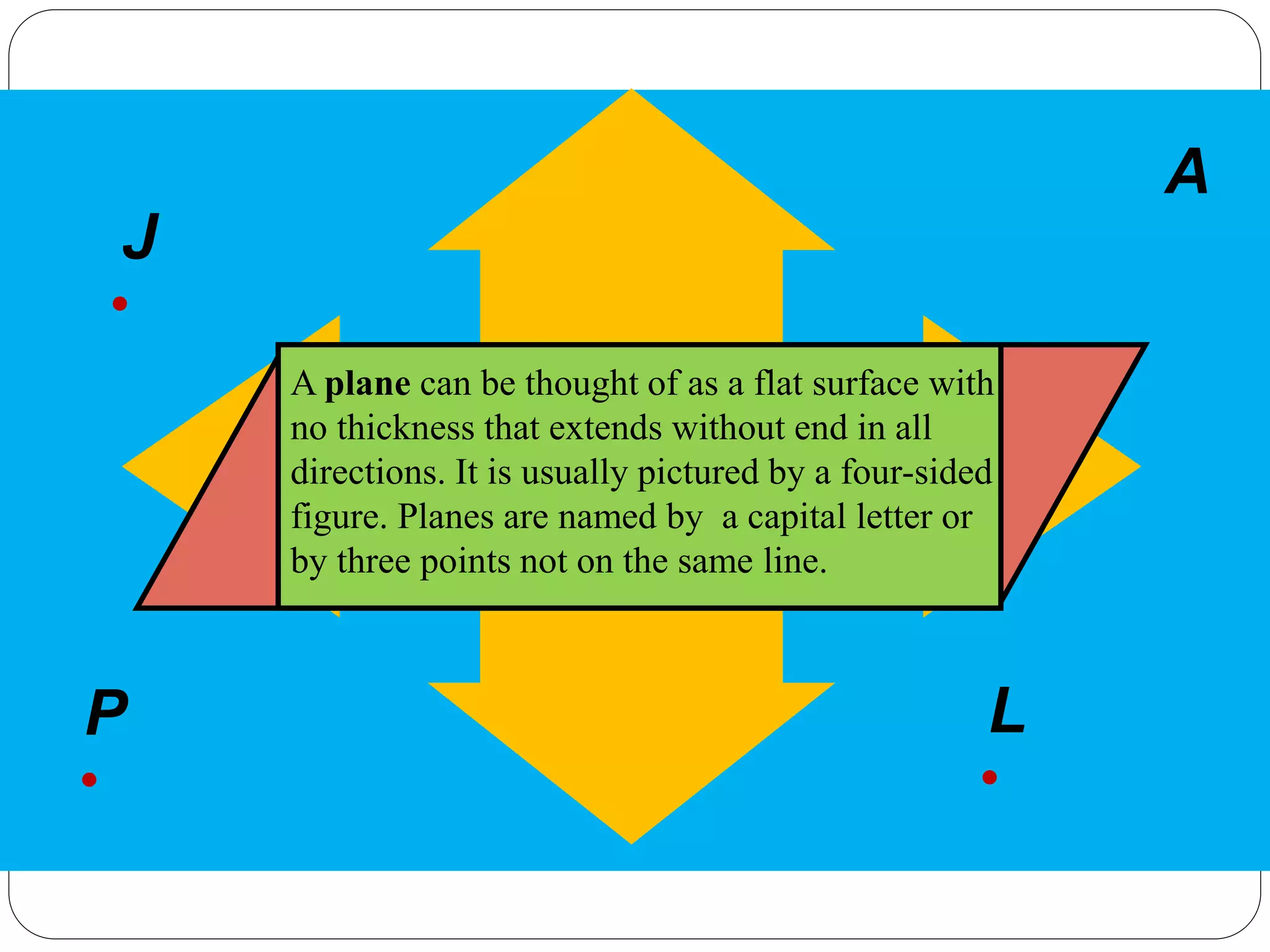
A plane can be thought of as a flat surface with
no thickness that extends without end in all
directions. It is usually pictured by a four-sided
figure. Planes are named by a capital letter or
by three points not on the same line.
J
•
P
•
L
•
A
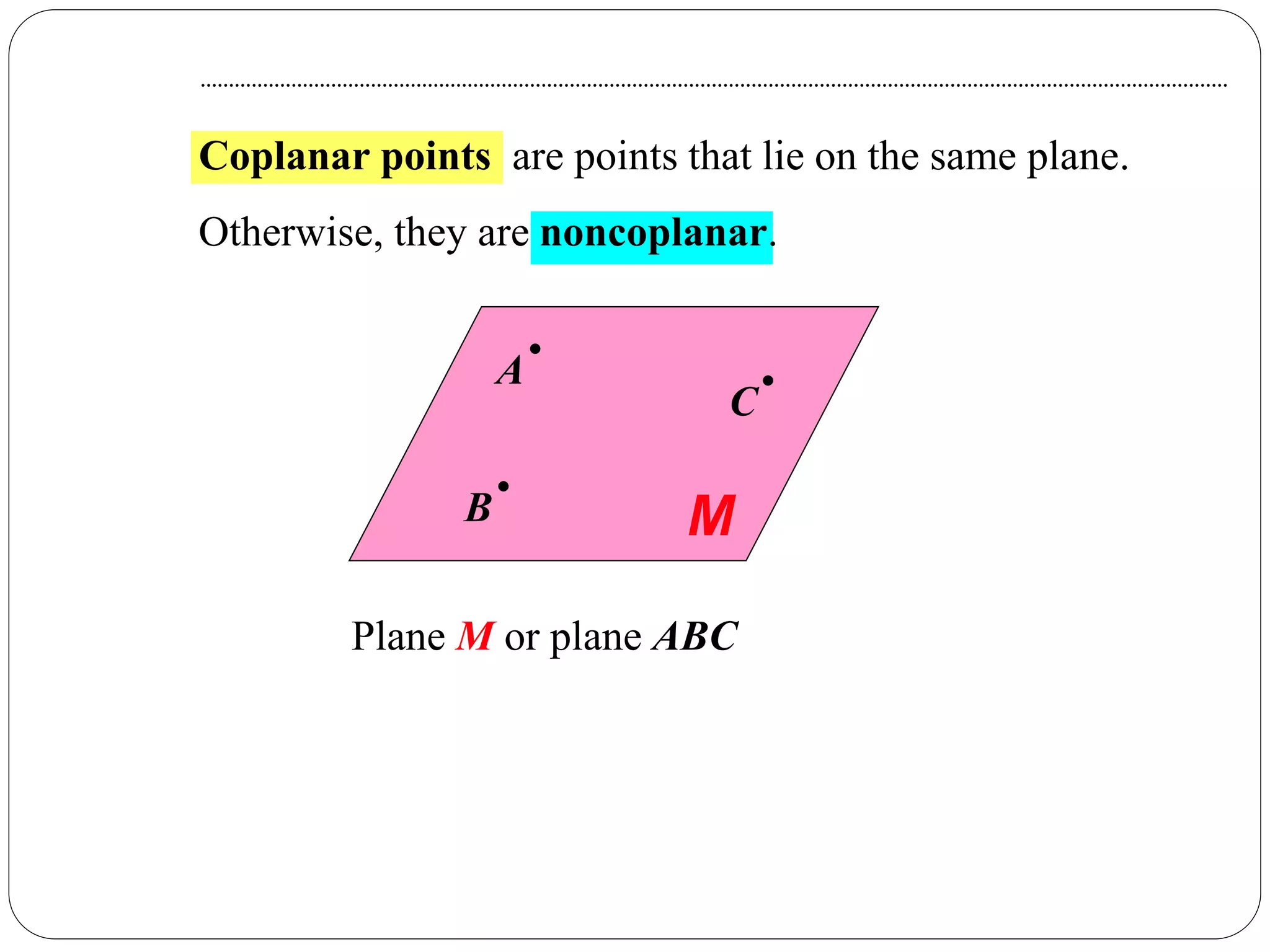
Coplanar points are points that lie on the same plane.
Otherwise, they are noncoplanar.
Plane M or plane ABC
A
C
MB
Space is the set of all points. A set of points is
the intersection of two figures if and only if the
points lie in both figures. The figures intersect at
that point or set of points.
Sketching Intersections
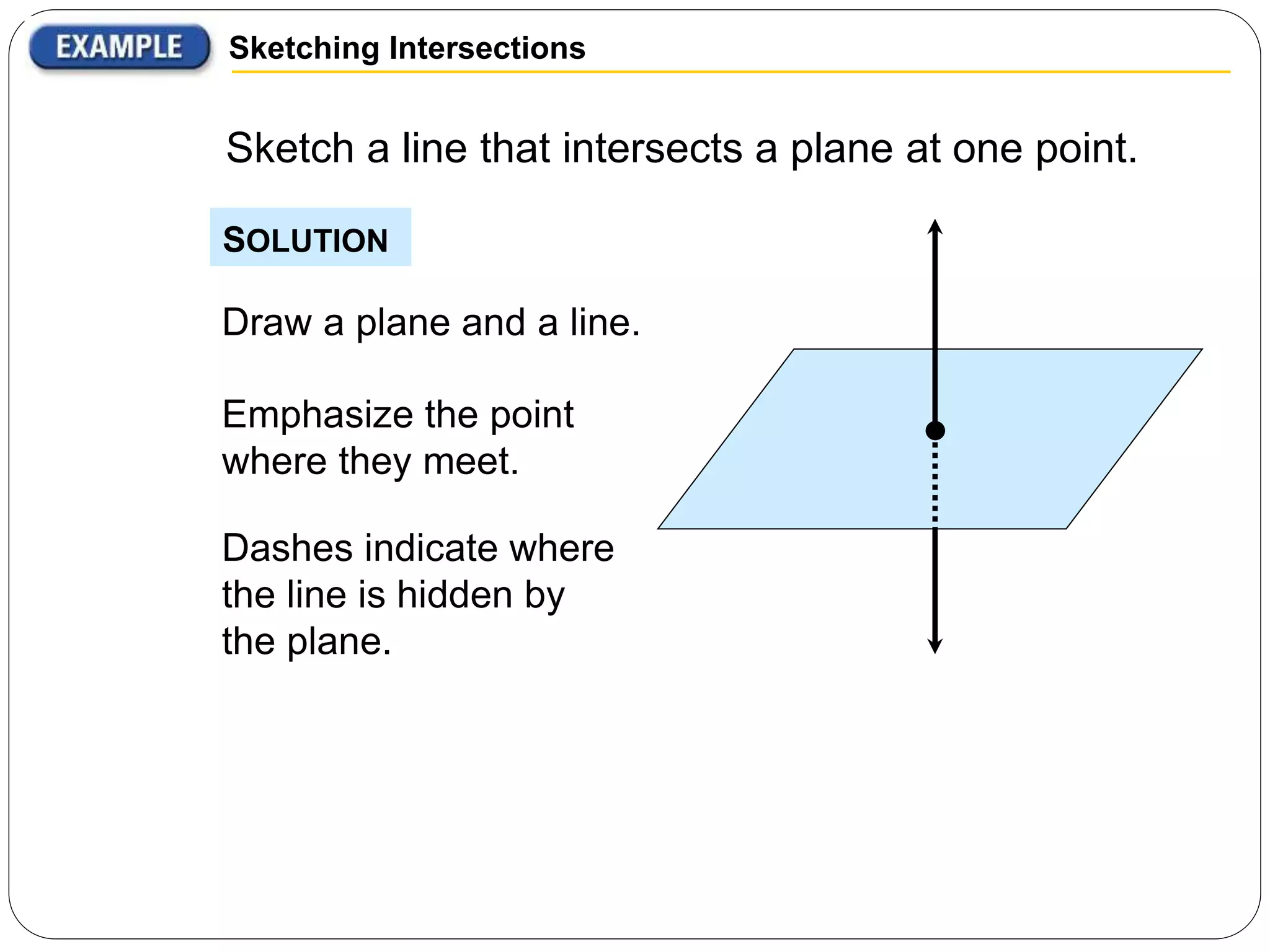
Sketch a line that intersects a plane at one point.
SOLUTION
Draw a plane and a line.
Emphasize the point
where they meet.
Dashes indicate where
the line is hidden by
the plane.
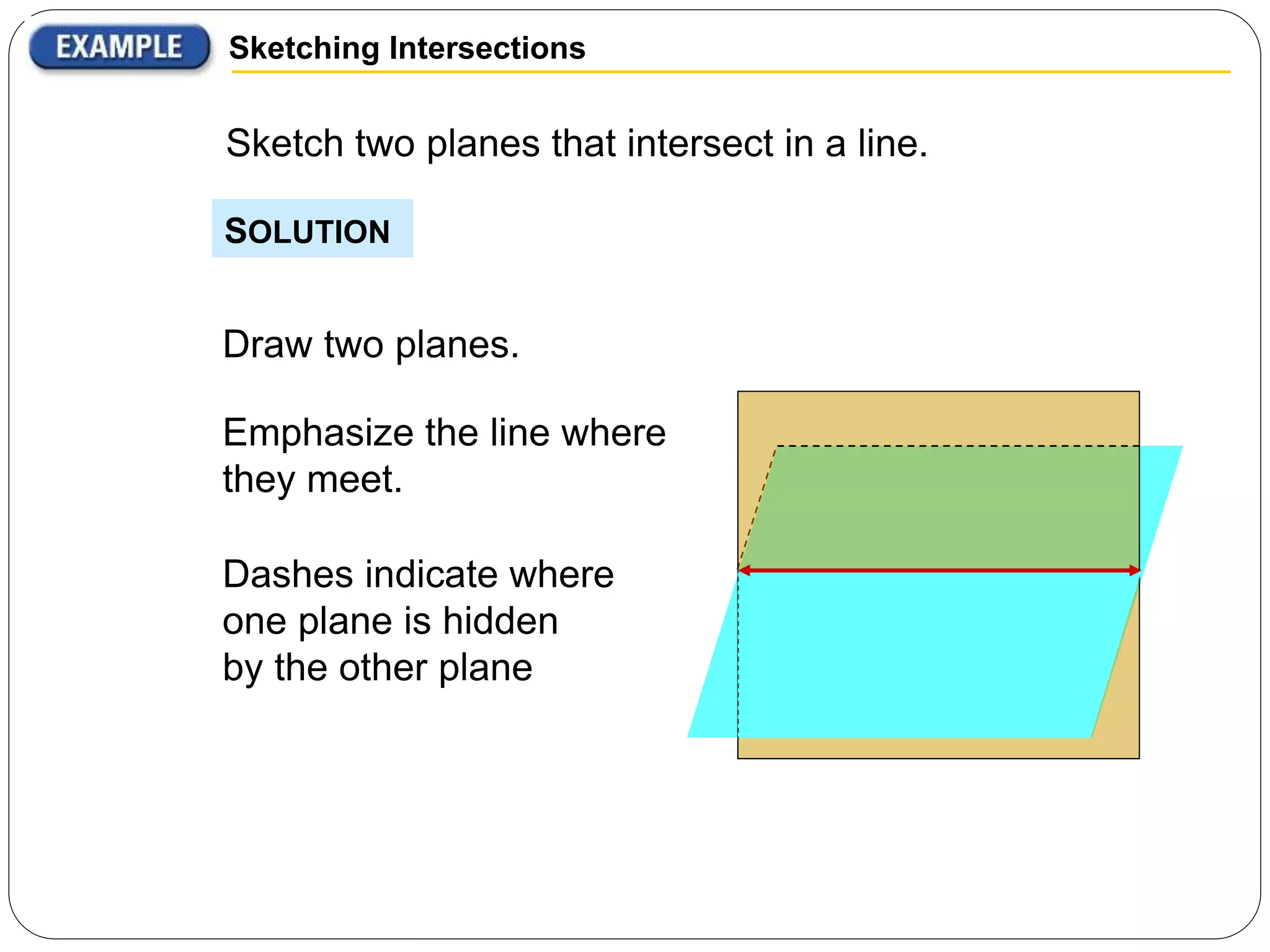
Sketch two planes that intersect in a line.
Sketching Intersections
SOLUTION
Draw two planes.
Emphasize the line where
they meet.
Dashes indicate where
one plane is hidden
by the other plane
Naming Collinear and Coplanar Points
SOLUTION
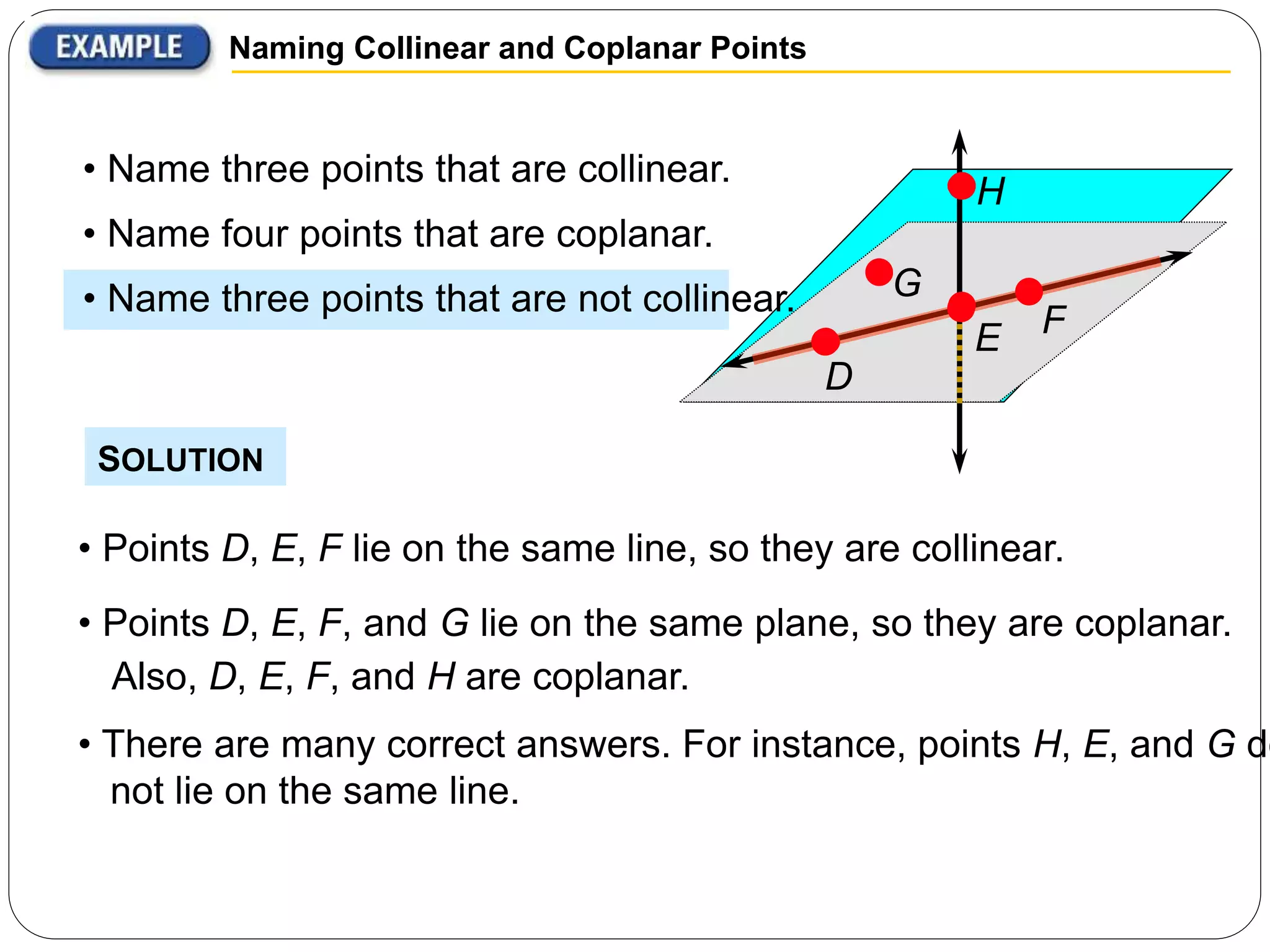
• Points D, E, F lie on the same line, so they are collinear.
• There are many correct answers. For instance, points H, E, and G do
not lie on the same line.
• Points D, E, F, and G lie on the same plane, so they are coplanar.
Also, D, E, F, and H are coplanar.
G
H
FE
D
• Name three points that are collinear.
• Name four points that are coplanar.
• Name three points that are not collinear.
D
l
k
G
H
I
F
JE
m
P
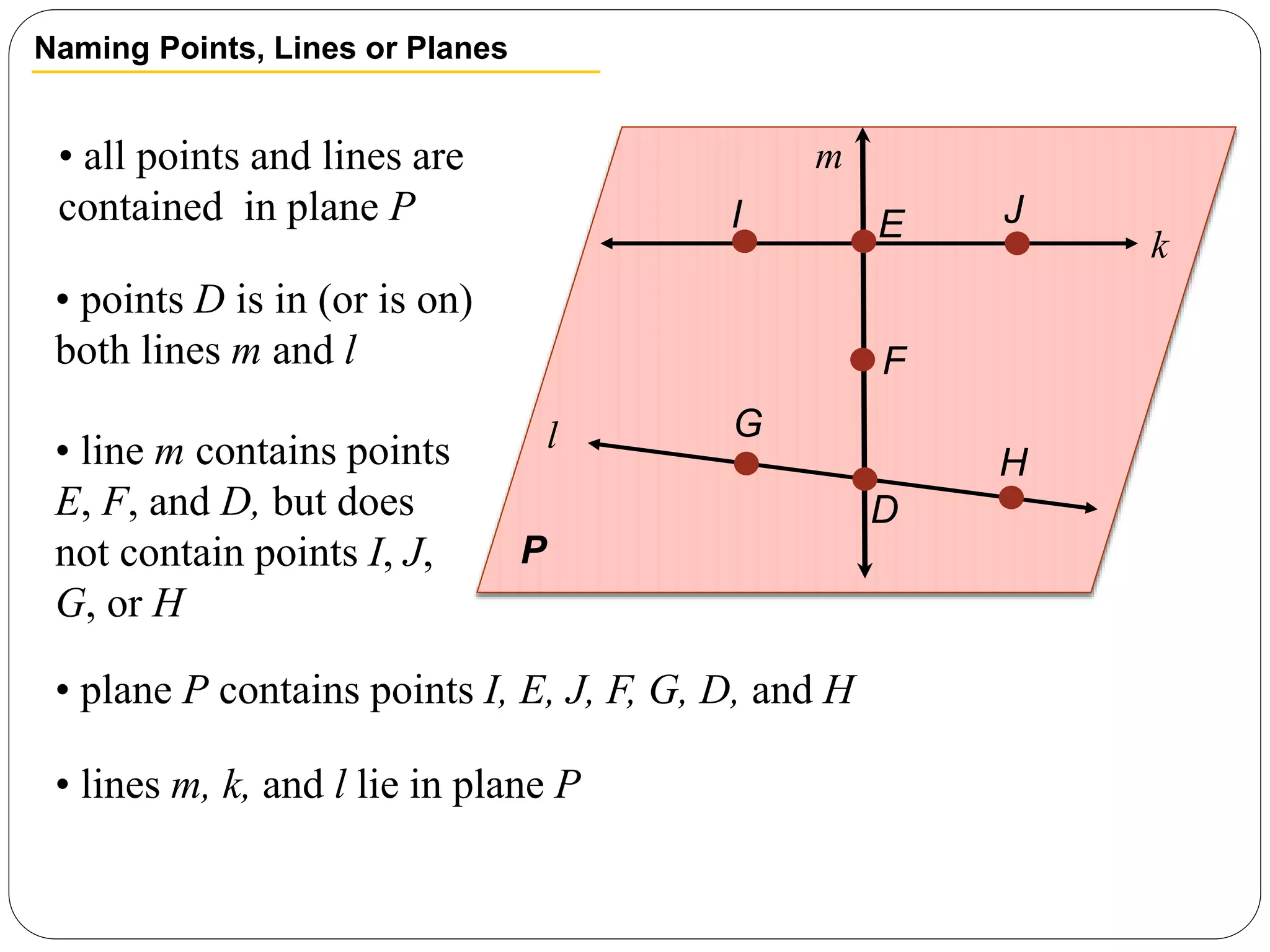
Naming Points, Lines or Planes
• all points and lines are
contained in plane P
• points D is in (or is on)
both lines m and l
• line m contains points
E, F, and D, but does
not contain points I, J,
G, or H
• plane P contains points I, E, J, F, G, D, and H
• lines m, k, and l lie in plane P
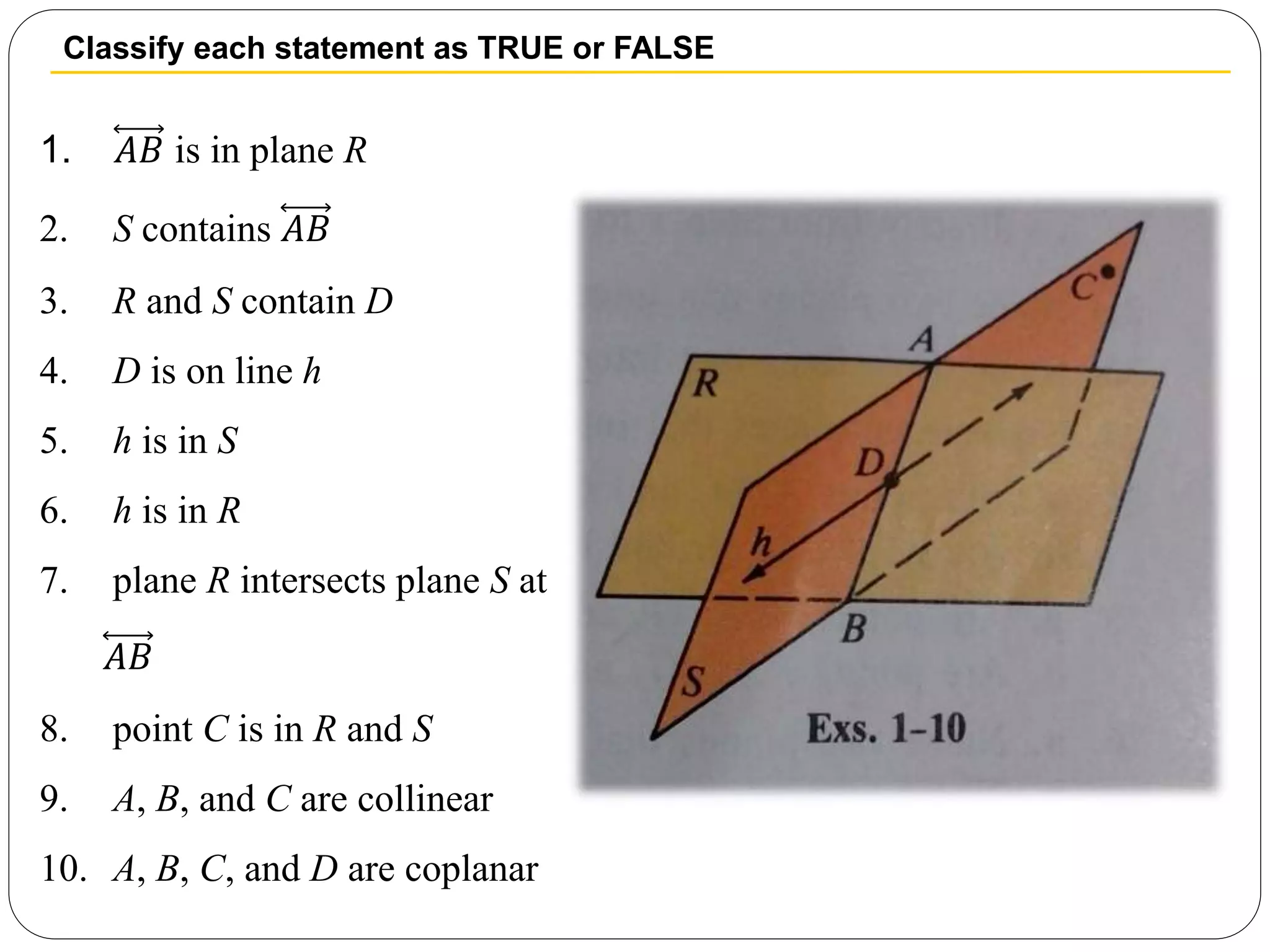
Classify each statement as TRUE or FALSE
1. 𝐴𝐵 is in plane R
2. S contains 𝐴𝐵
3. R and S contain D
4. D is on line h
5. h is in S
6. h is in R
7. plane R intersects plane S at
𝐴𝐵
8. point C is in R and S
9. A, B, and C are collinear
10. A, B, C, and D are coplanar
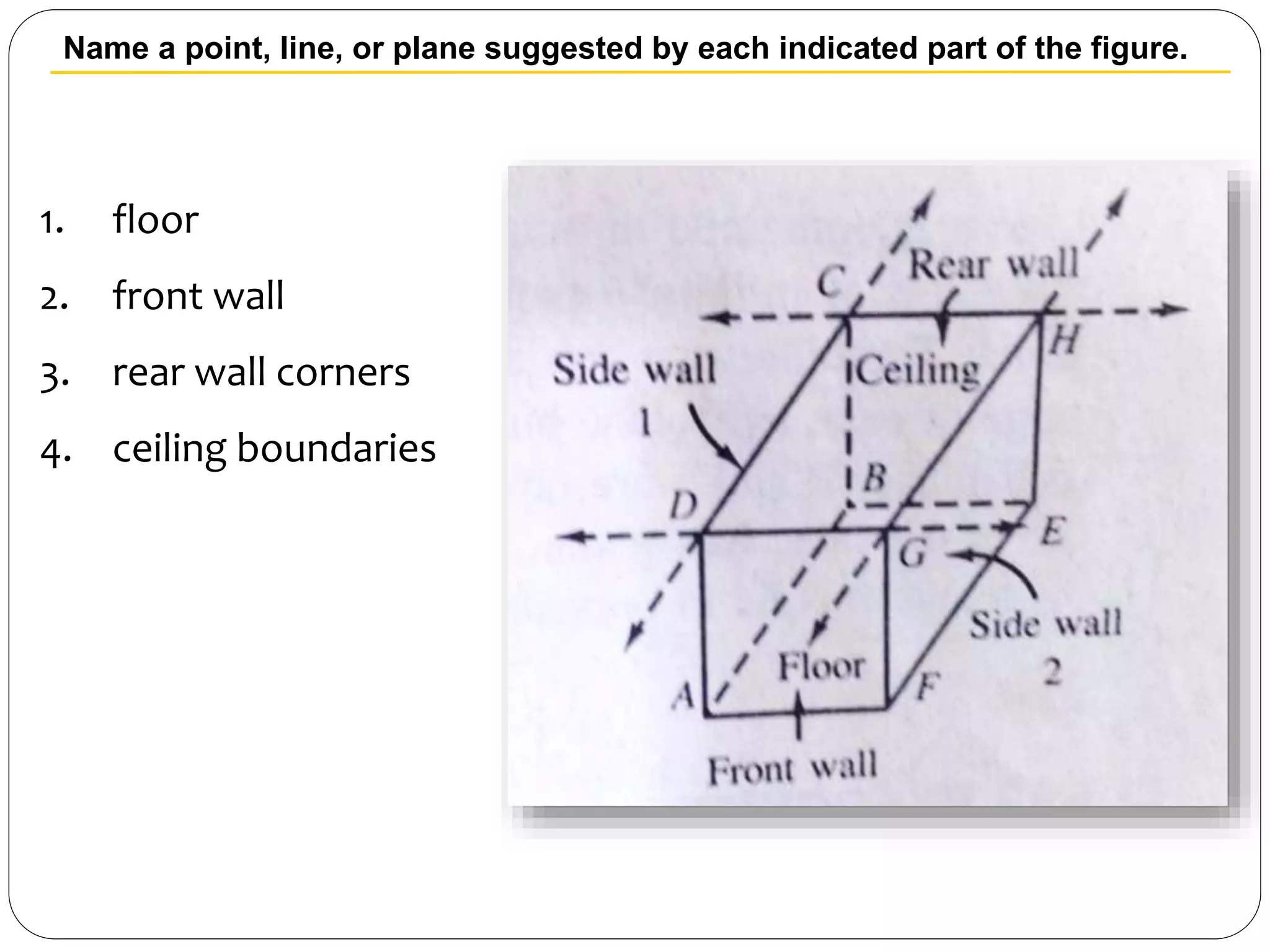
Name a point, line, or plane suggested by each indicated part of the figure.
1. floor
2. front wall
3. rear wall corners
4. ceiling boundaries
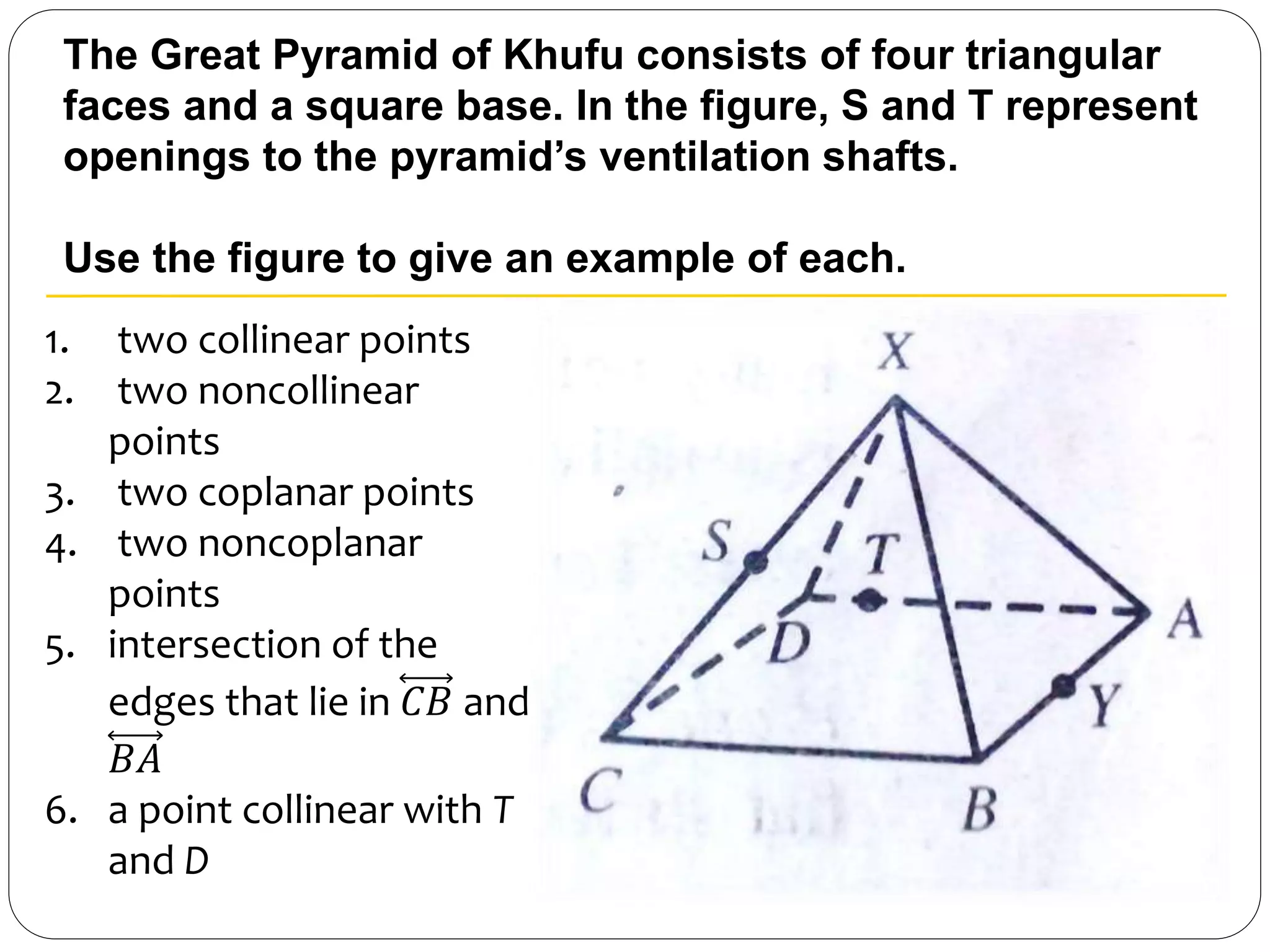
The Great Pyramid of Khufu consists of four triangular
faces and a square base. In the figure, S and T represent
openings to the pyramid’s ventilation shafts.
Use the figure to give an example of each.
1. two collinear points
2. two noncollinear
points
3. two coplanar points
4. two noncoplanar
points
5. intersection of the
edges that lie in 𝐶𝐵 and
𝐵𝐴
6. a point collinear with T
and D
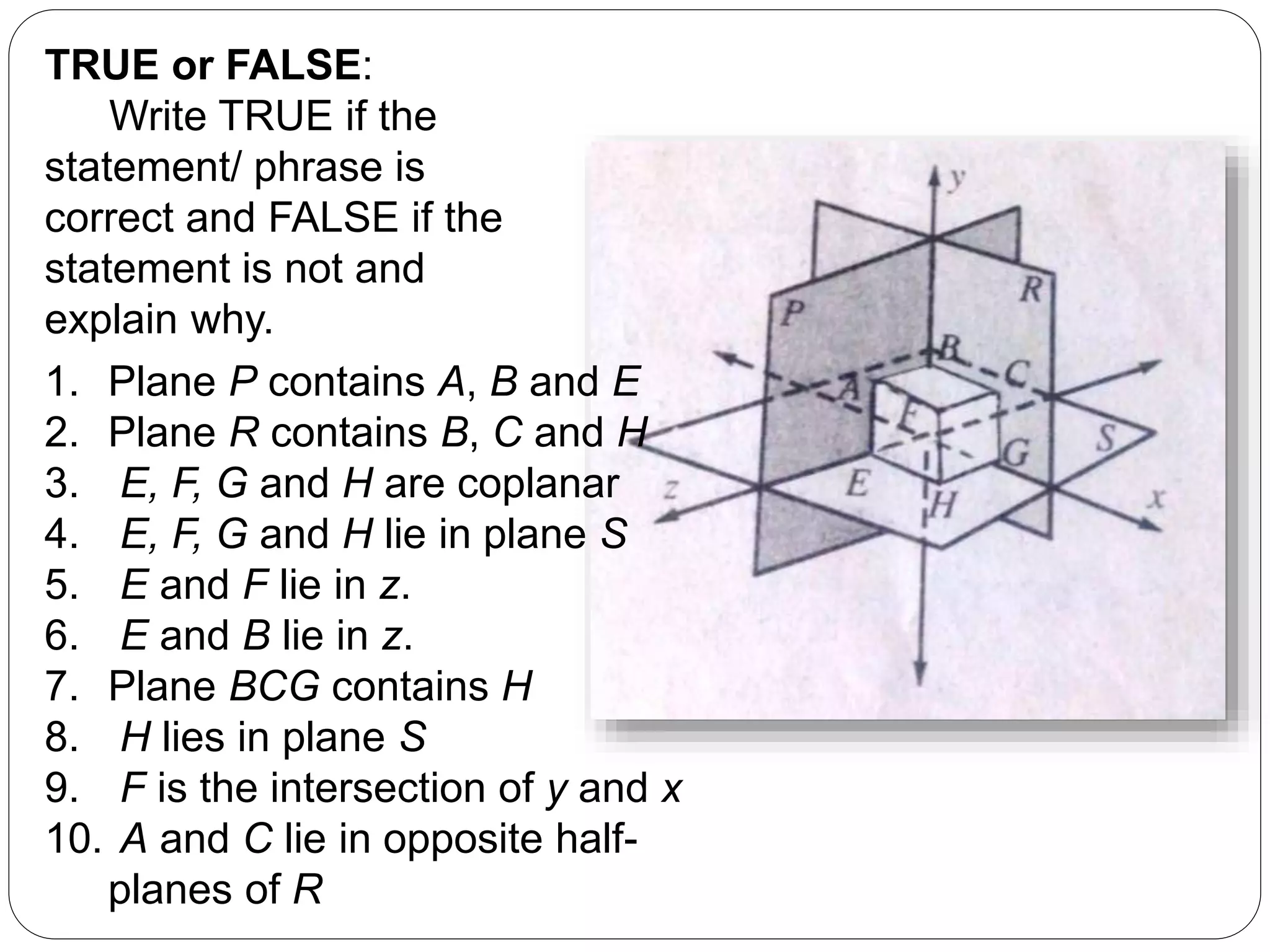
TRUE or FALSE:
Write TRUE if the
statement/ phrase is
correct and FALSE if the
statement is not and
explain why.
1. Plane P contains A, B and E
2. Plane R contains B, C and H
3. E, F, G and H are coplanar
4. E, F, G and H lie in plane S
5. E and F lie in z.
6. E and B lie in z.
7. Plane BCG contains H
8. H lies in plane S
9. F is the intersection of y and x
10. A and C lie in opposite half-
planes of R

Language of Geometry

  • 1.
  • 2.
    GOALS  Identify anddraw representations of points, lines and planes  Use undefined terms to define some basic geometric terms
  • 3.
    PROBLEM POSING: When youlook at the night sky how many stars do you see? INVESTIGATION… The bright stars at the right form the constellation, the Big Dipper. You can think of the stars as points. Copy and trace the points. Connect the points with lines to illustrate the constellation.
  • 4.
    A point hasno dimension. It is usually represented by a small dot. •A Point A It is named with a capital letter.
  • 5.
    A line consistsof infinitely many points. It is usually represented by a straight line with two arrowheads to indicate that the line extends without end in two directions. Line or AB Points are collinear if and only if they lie on the same line. 1. Points are collinear if they lie on the same line. 2. Points lie on the same line if they are collinear.
  • 6.
    A line consistsof infinitely many points. It is usually represented by a straight line with two arrowheads to indicate that the line extends without end in two directions. Line or AB Points are collinear if and only if they lie on the same line. Points that are not collinear are called noncollinear.
  • 7.
    A plane canbe thought of as a flat surface with no thickness that extends without end in all directions. It is usually pictured by a four-sided figure. Planes are named by a capital letter or by three points not on the same line. J • P • L • A
  • 8.
    Coplanar points arepoints that lie on the same plane. Otherwise, they are noncoplanar. Plane M or plane ABC A C MB
  • 9.
    Space is theset of all points. A set of points is the intersection of two figures if and only if the points lie in both figures. The figures intersect at that point or set of points.
  • 10.
    Sketching Intersections Sketch aline that intersects a plane at one point. SOLUTION Draw a plane and a line. Emphasize the point where they meet. Dashes indicate where the line is hidden by the plane.
  • 11.
    Sketch two planesthat intersect in a line. Sketching Intersections SOLUTION Draw two planes. Emphasize the line where they meet. Dashes indicate where one plane is hidden by the other plane
  • 12.
    Naming Collinear andCoplanar Points SOLUTION • Points D, E, F lie on the same line, so they are collinear. • There are many correct answers. For instance, points H, E, and G do not lie on the same line. • Points D, E, F, and G lie on the same plane, so they are coplanar. Also, D, E, F, and H are coplanar. G H FE D • Name three points that are collinear. • Name four points that are coplanar. • Name three points that are not collinear.
  • 13.
    D l k G H I F JE m P Naming Points, Linesor Planes • all points and lines are contained in plane P • points D is in (or is on) both lines m and l • line m contains points E, F, and D, but does not contain points I, J, G, or H • plane P contains points I, E, J, F, G, D, and H • lines m, k, and l lie in plane P
  • 14.
    Classify each statementas TRUE or FALSE 1. 𝐴𝐵 is in plane R 2. S contains 𝐴𝐵 3. R and S contain D 4. D is on line h 5. h is in S 6. h is in R 7. plane R intersects plane S at 𝐴𝐵 8. point C is in R and S 9. A, B, and C are collinear 10. A, B, C, and D are coplanar
  • 16.
    Name a point,line, or plane suggested by each indicated part of the figure. 1. floor 2. front wall 3. rear wall corners 4. ceiling boundaries
  • 17.
    The Great Pyramidof Khufu consists of four triangular faces and a square base. In the figure, S and T represent openings to the pyramid’s ventilation shafts. Use the figure to give an example of each. 1. two collinear points 2. two noncollinear points 3. two coplanar points 4. two noncoplanar points 5. intersection of the edges that lie in 𝐶𝐵 and 𝐵𝐴 6. a point collinear with T and D
  • 19.
    TRUE or FALSE: WriteTRUE if the statement/ phrase is correct and FALSE if the statement is not and explain why. 1. Plane P contains A, B and E 2. Plane R contains B, C and H 3. E, F, G and H are coplanar 4. E, F, G and H lie in plane S 5. E and F lie in z. 6. E and B lie in z. 7. Plane BCG contains H 8. H lies in plane S 9. F is the intersection of y and x 10. A and C lie in opposite half- planes of R