Mathematics
Perimeter and
Area of Polygons
Standard 3
Objectives
Polygons
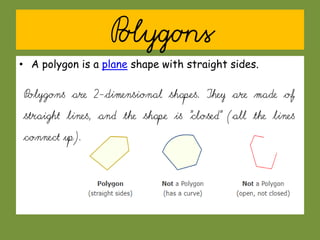
• A polygon is a plane shape with straight sides.
Polygons are 2-dimensional shapes. They are made of
straight lines, and the shape is "closed" (all the lines
connect up).
Polygons
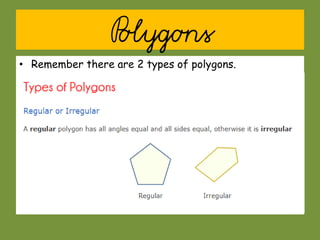
• Remember there are 2 types of polygons.
Non Regular Polygons
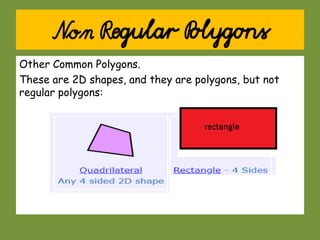
Other Common Polygons.
These are 2D shapes, and they are polygons, but not
regular polygons:
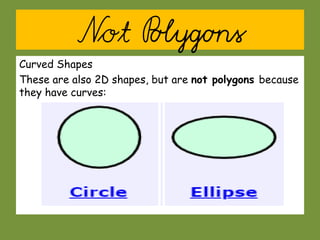
Not Polygons
Curved Shapes
These are also 2D shapes, but are not polygons because
they have curves:
Perimeter
The perimeter of a two-dimensional shape is the distance around the shape. You
can think of wrapping a string around a triangle. The length of this string would be
the perimeter of the triangle. Or walking around the outside of a park, you walk the
distance of the park’s perimeter.
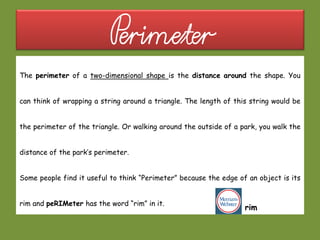
Some people find it useful to think “Perimeter” because the edge of an object is its
rim and peRIMeter has the word “rim” in it.
rim
Perimeter
If the shape is a polygon, then you can add up all the lengths of the sides
to find the perimeter.
Be careful to make sure that all the lengths are measured in the same
units. You measure perimeter in linear units, which is one dimensional.
Examples of units of measure for length are inches, centimeters, or
feet.
Perimeter examples
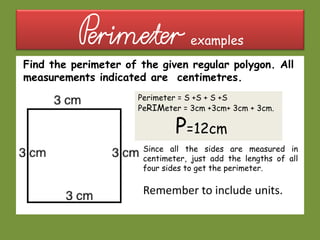
Find the perimeter of the given regular polygon. All
measurements indicated are centimetres.
Perimeter = S +S + S +S
PeRIMeter = 3cm +3cm+ 3cm + 3cm.
P=12cm
Since all the sides are measured in
centimeter, just add the lengths of all
four sides to get the perimeter.
Remember to include units.
Perimeter examples
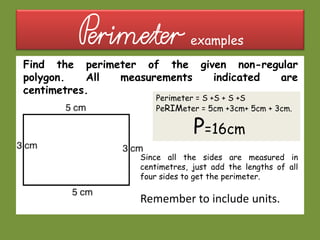
Find the perimeter of the given non-regular
polygon. All measurements indicated are
centimetres.
Perimeter = S +S + S +S
PeRIMeter = 5cm +3cm+ 5cm + 3cm.
P=16cm
Since all the sides are measured in
centimetres, just add the lengths of all
four sides to get the perimeter.
Remember to include units.
Perimeter examples
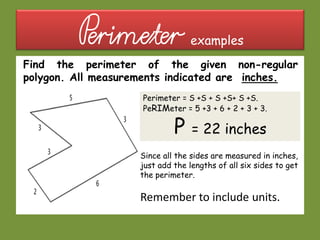
Find the perimeter of the given non-regular
polygon. All measurements indicated are inches.
Perimeter = S +S + S +S+ S +S.
PeRIMeter = 5 +3 + 6 + 2 + 3 + 3.
P = 22 inches
Since all the sides are measured in inches,
just add the lengths of all six sides to get
the perimeter.
Remember to include units.
Perimeter examples
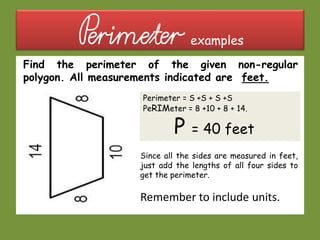
Find the perimeter of the given non-regular
polygon. All measurements indicated are feet.
Perimeter = S +S + S +S
PeRIMeter = 8 +10 + 8 + 14.
P = 40 feet
Since all the sides are measured in feet,
just add the lengths of all four sides to
get the perimeter.
Remember to include units.
AreaThe area of a two-dimensional figure describes the amount of surface
the shape covers.
You measure area in square units of a fixed size.
Examples of square units of measure are square inches, square
centimeters, or square miles.
When finding the area of a polygon, you count how many squares of a
certain size will cover the region inside the polygon.
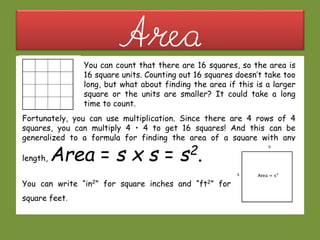
AreaYou can count that there are 16 squares, so the area is
16 square units. Counting out 16 squares doesn’t take too
long, but what about finding the area if this is a larger
square or the units are smaller? It could take a long
time to count.
Fortunately, you can use multiplication. Since there are 4 rows of 4
squares, you can multiply 4 • 4 to get 16 squares! And this can be
generalized to a formula for finding the area of a square with any
length, Area = s x s = s2.
You can write “in2” for square inches and “ft2” for
square feet.
AreaTo help you find the area of the many different
categories of polygons, mathematicians have developed
formulas. These formulas help you find the
measurement more quickly than by simply counting.
The formulas you are going to look at are all developed
from the understanding that you are counting the
number of square units inside the polygon. Let’s look at
a rectangle.
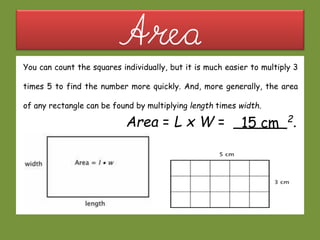
AreaYou can count the squares individually, but it is much easier to multiply 3
times 5 to find the number more quickly. And, more generally, the area
of any rectangle can be found by multiplying length times width.
Area = L x W = ______2.15 cm
Area examples
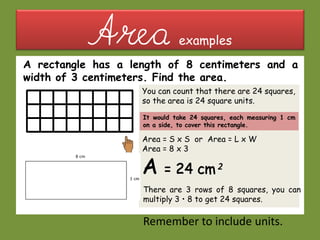
A rectangle has a length of 8 centimeters and a
width of 3 centimeters. Find the area.
You can count that there are 24 squares,
so the area is 24 square units.
Area = S x S or Area = L x W
Area = 8 x 3
There are 3 rows of 8 squares, you can
multiply 3 • 8 to get 24 squares.
Remember to include units.
It would take 24 squares, each measuring 1 cm
on a side, to cover this rectangle.
Area examples
A rectangle has a length of 12 centimeters and a
width of 2 centimeters. Find the area.
You can count that there are 24 squares, so the area is 24 square
units.
It would take 24 squares, each measuring 1 cm on a side, to cover this rectangle.
Area examples
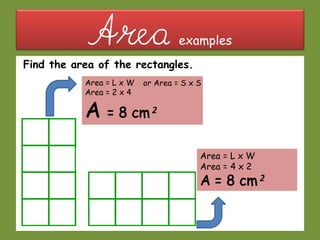
Find the area of the rectangles.
Area = L x W
Area = 4 x 2
Area = L x W
Area = 2 x 4
or Area = S x S
Area examples
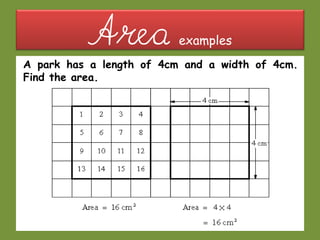
A park has a length of 4cm and a width of 4cm.
Find the area.

Mathematics: Perimeter and Area Lesson

  • 1.
    Mathematics Perimeter and Area ofPolygons Standard 3 Objectives
  • 2.
    Polygons • A polygonis a plane shape with straight sides. Polygons are 2-dimensional shapes. They are made of straight lines, and the shape is "closed" (all the lines connect up).
  • 3.
    Polygons • Remember thereare 2 types of polygons.
  • 4.
    Non Regular Polygons OtherCommon Polygons. These are 2D shapes, and they are polygons, but not regular polygons:
  • 5.
    Not Polygons Curved Shapes Theseare also 2D shapes, but are not polygons because they have curves:
  • 6.
    Perimeter The perimeter ofa two-dimensional shape is the distance around the shape. You can think of wrapping a string around a triangle. The length of this string would be the perimeter of the triangle. Or walking around the outside of a park, you walk the distance of the park’s perimeter. Some people find it useful to think “Perimeter” because the edge of an object is its rim and peRIMeter has the word “rim” in it. rim
  • 7.
    Perimeter If the shapeis a polygon, then you can add up all the lengths of the sides to find the perimeter. Be careful to make sure that all the lengths are measured in the same units. You measure perimeter in linear units, which is one dimensional. Examples of units of measure for length are inches, centimeters, or feet.
  • 8.
    Perimeter examples Find theperimeter of the given regular polygon. All measurements indicated are centimetres. Perimeter = S +S + S +S PeRIMeter = 3cm +3cm+ 3cm + 3cm. P=12cm Since all the sides are measured in centimeter, just add the lengths of all four sides to get the perimeter. Remember to include units.
  • 9.
    Perimeter examples Find theperimeter of the given non-regular polygon. All measurements indicated are centimetres. Perimeter = S +S + S +S PeRIMeter = 5cm +3cm+ 5cm + 3cm. P=16cm Since all the sides are measured in centimetres, just add the lengths of all four sides to get the perimeter. Remember to include units.
  • 10.
    Perimeter examples Find theperimeter of the given non-regular polygon. All measurements indicated are inches. Perimeter = S +S + S +S+ S +S. PeRIMeter = 5 +3 + 6 + 2 + 3 + 3. P = 22 inches Since all the sides are measured in inches, just add the lengths of all six sides to get the perimeter. Remember to include units.
  • 11.
    Perimeter examples Find theperimeter of the given non-regular polygon. All measurements indicated are feet. Perimeter = S +S + S +S PeRIMeter = 8 +10 + 8 + 14. P = 40 feet Since all the sides are measured in feet, just add the lengths of all four sides to get the perimeter. Remember to include units.
  • 12.
    AreaThe area ofa two-dimensional figure describes the amount of surface the shape covers. You measure area in square units of a fixed size. Examples of square units of measure are square inches, square centimeters, or square miles. When finding the area of a polygon, you count how many squares of a certain size will cover the region inside the polygon.
  • 13.
    AreaYou can countthat there are 16 squares, so the area is 16 square units. Counting out 16 squares doesn’t take too long, but what about finding the area if this is a larger square or the units are smaller? It could take a long time to count. Fortunately, you can use multiplication. Since there are 4 rows of 4 squares, you can multiply 4 • 4 to get 16 squares! And this can be generalized to a formula for finding the area of a square with any length, Area = s x s = s2. You can write “in2” for square inches and “ft2” for square feet.
  • 14.
    AreaTo help youfind the area of the many different categories of polygons, mathematicians have developed formulas. These formulas help you find the measurement more quickly than by simply counting. The formulas you are going to look at are all developed from the understanding that you are counting the number of square units inside the polygon. Let’s look at a rectangle.
  • 15.
    AreaYou can countthe squares individually, but it is much easier to multiply 3 times 5 to find the number more quickly. And, more generally, the area of any rectangle can be found by multiplying length times width. Area = L x W = ______2.15 cm
  • 16.
    Area examples A rectanglehas a length of 8 centimeters and a width of 3 centimeters. Find the area. You can count that there are 24 squares, so the area is 24 square units. Area = S x S or Area = L x W Area = 8 x 3 There are 3 rows of 8 squares, you can multiply 3 • 8 to get 24 squares. Remember to include units. It would take 24 squares, each measuring 1 cm on a side, to cover this rectangle.
  • 17.
    Area examples A rectanglehas a length of 12 centimeters and a width of 2 centimeters. Find the area. You can count that there are 24 squares, so the area is 24 square units. It would take 24 squares, each measuring 1 cm on a side, to cover this rectangle.
  • 18.
    Area examples Find thearea of the rectangles. Area = L x W Area = 4 x 2 Area = L x W Area = 2 x 4 or Area = S x S
  • 19.
    Area examples A parkhas a length of 4cm and a width of 4cm. Find the area.