Genomeorganization
In EukaryotesIn Eukaryotes
Arun Viswanathan
IInd Sem, M.Sc.BMB
© Arun Viswanathan
40 km wire in a tennis ball !
• Each cell has approximately 2meters of DNA
• Nucleus is only about 6µm in diameter
• In eukaryotes DNA occurs as highly condensed form during
cell division as Chromosomes.
• 3.2x 10⁹ nucleotides is packed into 24 different
chromosomes
• DNA is highly negative in charge. How it is possibly wind
over another without repulsion?
• How can genomic processes like replication and
transcription is possible in such tightly winded structures?
• the Disentanglement time for the transition from
interphase to metaphase chromosomes of size 100 Mb is in
the order of 500 years
• Each cell has approximately 2meters of DNA
• Nucleus is only about 6µm in diameter
• In eukaryotes DNA occurs as highly condensed form during
cell division as Chromosomes.
• 3.2x 10⁹ nucleotides is packed into 24 different
chromosomes
• DNA is highly negative in charge. How it is possibly wind
over another without repulsion?
• How can genomic processes like replication and
transcription is possible in such tightly winded structures?
• the Disentanglement time for the transition from
interphase to metaphase chromosomes of size 100 Mb is in
the order of 500 years
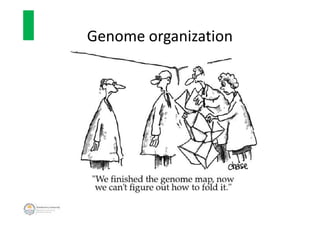
Genome organization
Chemical composition of chromatin
• DNA (20-40%)
most important chemical
constituent of chromatin
• RNA (05-10%)
associated with chromatin as;
rRNA, mRNA, tRNA
• Proteins (55-60%)
Histones: very basic proteins,
constitute about 60% of total
protein, almost 1:1 ratio with
DNA.
Five Types: H1, H2a, H2b, H3
and H4
• Non-Histones: They are 20%
of total chromatin protein:
• Nucleosomal Assembly
Proteins (NAP), Other Histone
chaperones Chromosome
remodeling complexes
• Structural (actin, L & B tubulin
& myosin) contractile
proteins, function during
chromosome condensation &
in movement of chromosomes.
• all enzymes and cofactors –
involved in replication,
transcription and its
regulation
• DNA (20-40%)
most important chemical
constituent of chromatin
• RNA (05-10%)
associated with chromatin as;
rRNA, mRNA, tRNA
• Proteins (55-60%)
Histones: very basic proteins,
constitute about 60% of total
protein, almost 1:1 ratio with
DNA.
Five Types: H1, H2a, H2b, H3
and H4
• Non-Histones: They are 20%
of total chromatin protein:
• Nucleosomal Assembly
Proteins (NAP), Other Histone
chaperones Chromosome
remodeling complexes
• Structural (actin, L & B tubulin
& myosin) contractile
proteins, function during
chromosome condensation &
in movement of chromosomes.
• all enzymes and cofactors –
involved in replication,
transcription and its
regulation
Beads on a String
• Beads on a string structure is the primary level of DNA packaging
• They are often called as 11nm fibre
• The diameter of “beads” is 11nm
• The beads are made of proteins called as Histones
© Lehninger Principle of Biochemistry, Michael M.Cox, David L. Nelson, Fifth Edition W.H. Freeman And Company, New York
Beads on a String
• Histone are highly basic (+ve charged),
• Rich in basic amino acids Arginine and Lysine
• Five Major class: H1, H2A, H2B, H3, H4
• Amino acid sequence of H3 and H4 are highly conserved
• Histones and DNA along with NAP form a condensed structure called
Nucleosome. It is the fundamental structural unit of chromatin.
• The highly basic nature of Histones, aside from facilitating DNA Histone
interactions, contributes to their water solubility.
• H1 is present in half the amount of the other four histones.
• Histone are highly basic (+ve charged),
• Rich in basic amino acids Arginine and Lysine
• Five Major class: H1, H2A, H2B, H3, H4
• Amino acid sequence of H3 and H4 are highly conserved
• Histones and DNA along with NAP form a condensed structure called
Nucleosome. It is the fundamental structural unit of chromatin.
• The highly basic nature of Histones, aside from facilitating DNA Histone
interactions, contributes to their water solubility.
• H1 is present in half the amount of the other four histones.
Content of basic amino acids
Histones
Molecular
Weight
Number of
AA residue
Lys % Arg % Total %
H1 21,130 223 29.5 11.3 40.8
H2A 13,960 129 10.9 19.3 30.2
H2B 13,774 125 16 16.4 32.4
H3 15,273 135 19.6 13.3 32.9
H4 11,236 102 10.8 13.7 24.5
Histones
A 147bp segment of DNA then wraps around the histone octamer 1.65 times. Each
Nucleosome particle are separated from each other by a linker DNA, which can be of
fewer nucleotides up to about 80. The term nucleosome refers to a nucleosome core
particle plus an adjacent linker DNA. On an average, nucleosome repeat at intervals of
about 200 nucleotides.
A diploid Human cell contains about 30 million nucleotides !!
Nucleosomal Assembly
Histones are predominantly basic proteins but also contain hydrophobic and
acidic patches. They repel each other at physiological pH and form non-
nucleosomal aggregates with DNA. Histone chaperones prevent these
nonspecific interactions and can direct the productive assembly and
disassembly of nucleosomes by facilitating histone deposition and exchange.
Histone-DNA interactions
1. Electrostatic Interactions:
Helix-dipoles form α
helixes in H2B, H3, and H4
cause a net +ve charge to
accumulate at the point of
interaction with -vely
charged phosphate groups
on DNA
2. Hydrogen bonds: between
the DNA backbone and
the amide group on the
main chain of Histone
proteins
3. Non-polar interactions:
between the Histones
and sugars on DNA
4. Salt bridges and hydrogen
bonds: between side chains
of basic AA
(especially lys and arg) &
phosphate oxygens on DNA
5. Non-specific minor groove
insertions: of the H3 and
H2B N-terminal tails into
two minor grooves each on
the DNA molecule
1. Electrostatic Interactions:
Helix-dipoles form α
helixes in H2B, H3, and H4
cause a net +ve charge to
accumulate at the point of
interaction with -vely
charged phosphate groups
on DNA
2. Hydrogen bonds: between
the DNA backbone and
the amide group on the
main chain of Histone
proteins
3. Non-polar interactions:
between the Histones
and sugars on DNA
4. Salt bridges and hydrogen
bonds: between side chains
of basic AA
(especially lys and arg) &
phosphate oxygens on DNA
5. Non-specific minor groove
insertions: of the H3 and
H2B N-terminal tails into
two minor grooves each on
the DNA molecule
Histone tail, Histone code & Epigenetics
• There are eight N-terminal domain/Tail domain in histone core.
• These tail domains are heavily modified.
•These modifications include:
 acetylation
 methylation
 ubiquitylation
 phosphorylation
 sumoylation
 ribosylation
 citrullination
• There are eight N-terminal domain/Tail domain in histone core.
• These tail domains are heavily modified.
•These modifications include:
 acetylation
 methylation
 ubiquitylation
 phosphorylation
 sumoylation
 ribosylation
 citrullination
The idea that multiple dynamic modifications regulate gene transcription in a
systematic and reproducible way is called the histone code and is heritable.
Mechanisms of heritability of histone state are not well understood. However it is
predicted that it must be working same as DNA methylation; a histone previously
modified may possess a inherent tendency to get modify as previous. This is one of
the way how epigenetics works
The 30nm fiber
• With the help of H1 the 11nm fiber compress to form
more compact 30nm fiber. H1 primarily is in contact with
15-20bp of linker DNA and helps in contracting linker
DNA. H1 histone is often called as ‘linker histone’
• There exist different models to explain the structure of
30nm fiber. Solenoid model and Zig-Zag model are two
main models.
• However recent studies demonstrates intermediate 30
nm fibers contain both the solenoid and zigzag
conformations, suggesting instead that observations
made in in vitro experiments might be an isolation
artifact due to strictly cationic low-salt environment or
chemical cross-linking (e.g., glutaraldehyde fixation).
• With the help of H1 the 11nm fiber compress to form
more compact 30nm fiber. H1 primarily is in contact with
15-20bp of linker DNA and helps in contracting linker
DNA. H1 histone is often called as ‘linker histone’
• There exist different models to explain the structure of
30nm fiber. Solenoid model and Zig-Zag model are two
main models.
• However recent studies demonstrates intermediate 30
nm fibers contain both the solenoid and zigzag
conformations, suggesting instead that observations
made in in vitro experiments might be an isolation
artifact due to strictly cationic low-salt environment or
chemical cross-linking (e.g., glutaraldehyde fixation).
The 30nm fiber
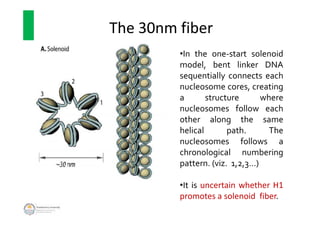
•In the one-start solenoid
model, bent linker DNA
sequentially connects each
nucleosome cores, creating
a structure where
nucleosomes follow each
other along the same
helical path. The
nucleosomes follows a
chronological numbering
pattern. (viz. 1,2,3…)
•It is uncertain whether H1
promotes a solenoid fiber.
•In the one-start solenoid
model, bent linker DNA
sequentially connects each
nucleosome cores, creating
a structure where
nucleosomes follow each
other along the same
helical path. The
nucleosomes follows a
chronological numbering
pattern. (viz. 1,2,3…)
•It is uncertain whether H1
promotes a solenoid fiber.
The 30nm fiber
In the two-start zigzag
model, straight linker DNA
connects two opposing
nucleosome cores, creating
the opposing rows of
nucleosomes that form so
called “two-start” helix.
In zigzag model, alternate
nucleosomes become
interacting partners. (Viz.
1,3,2,4…)
In the two-start zigzag
model, straight linker DNA
connects two opposing
nucleosome cores, creating
the opposing rows of
nucleosomes that form so
called “two-start” helix.
In zigzag model, alternate
nucleosomes become
interacting partners. (Viz.
1,3,2,4…)
‘One-start’ Helix
(Solenoid)
‘Two-start’ Helix
(ZigZag)
Intermediate 30 nm fibers
Four proposed structures of the 30 nm chromatin filament for DNA
repeat length per nucleosomes ranging from 177 to 207 bp.
Linker DNA in yellow and nucleosomal DNA in pink
Higher chromatin organizations
(Metaphase Chromosome)
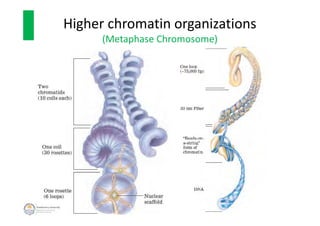
• We know very less about higher chromosomal
levels of genome organization
• However in Histone genes it is shown that the
30nm fiber supercoils itself into six loops
attached to a protein called nuclear scaffold(NS).
• Even though the actual composition of the NS is
not known it is shown that Topo II is a major
component and is needed for the attachment of
supercoiled 30nm fiber to the NS.
• Several cancer chemotheraputic drugs, which are
Topo II inhibitors allows strand breakage through
this mechanism.
• More hierarchies are also proposed.
• We know very less about higher chromosomal
levels of genome organization
• However in Histone genes it is shown that the
30nm fiber supercoils itself into six loops
attached to a protein called nuclear scaffold(NS).
• Even though the actual composition of the NS is
not known it is shown that Topo II is a major
component and is needed for the attachment of
supercoiled 30nm fiber to the NS.
• Several cancer chemotheraputic drugs, which are
Topo II inhibitors allows strand breakage through
this mechanism.
• More hierarchies are also proposed.
Higher chromatin organizations
(Metaphase Chromosome)
Higher chromatin organizations
(Metaphase Chromosome)
Higher chromatin organizations
(Metaphase Chromosome)
Higher chromatin organizations
(Interphase Chromosome)
• Determining how the Interphase chromosome is packed
was a great deal to biologist. Since all the visual
technologies failed to create an image of chromosome
at interphase nucleus so that it explains its nature.
• Two main models:
• chromosome territory model, proposed by Carl Rabl in
1885. According to this model, the DNA of each
chromosome occupies a defined volume of the nucleus
and only overlaps with its immediate neighbors
• "spaghetti" model, the DNA fiber of multiple
chromosomes meanders through the nucleus in a
largely random fashion, and the chromosomes are
therefore intermingled and entangled with each other
• Determining how the Interphase chromosome is packed
was a great deal to biologist. Since all the visual
technologies failed to create an image of chromosome
at interphase nucleus so that it explains its nature.
• Two main models:
• chromosome territory model, proposed by Carl Rabl in
1885. According to this model, the DNA of each
chromosome occupies a defined volume of the nucleus
and only overlaps with its immediate neighbors
• "spaghetti" model, the DNA fiber of multiple
chromosomes meanders through the nucleus in a
largely random fashion, and the chromosomes are
therefore intermingled and entangled with each other
Higher chromatin organizations
(Interphase Chromosome)
• The key experiment to
distinguish between two
models was carried out in
the early 1980s by Thomas
Cremer, a German cell
biologist, and his physicist
brother, Christoph Cremer.
• The Cremer brothers found
experimental evidence
that strongly supported
the chromosome
territory model.
• The key experiment to
distinguish between two
models was carried out in
the early 1980s by Thomas
Cremer, a German cell
biologist, and his physicist
brother, Christoph Cremer.
• The Cremer brothers found
experimental evidence
that strongly supported
the chromosome
territory model.
• During interphase, each chromosome occupies a spatially limited, roughly
elliptical domain which is known as a chromosome territory (CT).
• Each CT is comprised of higher order chromatin units of ~1 Mb each.
• built up from smaller loop domains.
• CT are known to be arranged radially around the nucleus.
• This arrangement is both cell and tissue-type specific and is also
evolutionary conserved.
• The radial organization of CT was shown to correlate with their gene density
and size. The gene-rich chromosomes occupy interior positions, whereas
larger, gene-poor chromosomes, tend to be located around the periphery.
• CT are also dynamic structures, with genes able to relocate from the
periphery towards the interior once they have been “switched on”.
• CT may exist either as discrete unit without intermingling or may have
overlapping on each other
Chromosome Territory (CT)
• During interphase, each chromosome occupies a spatially limited, roughly
elliptical domain which is known as a chromosome territory (CT).
• Each CT is comprised of higher order chromatin units of ~1 Mb each.
• built up from smaller loop domains.
• CT are known to be arranged radially around the nucleus.
• This arrangement is both cell and tissue-type specific and is also
evolutionary conserved.
• The radial organization of CT was shown to correlate with their gene density
and size. The gene-rich chromosomes occupy interior positions, whereas
larger, gene-poor chromosomes, tend to be located around the periphery.
• CT are also dynamic structures, with genes able to relocate from the
periphery towards the interior once they have been “switched on”.
• CT may exist either as discrete unit without intermingling or may have
overlapping on each other
Chromosome Territory (CT)
Recurrent Clusters
A) Chromosome territories (green) in liver cell nuclei (blue). B) Visualization
of multiple chromosomes reveals spatial patterns of organization.
Chromosomes 12 (red), 14 (blue), and 15 (green) form a triplet cluster in
mouse lymphocytes.
Part A: © 2004 Parada, L. A. et al. Tissue-specific spatial organization of genomes. Genome Biology 5:R44
doi:10.1186/gb-2004-5-7-r44. Part B: © 2002 Cell Press/Elsevier Inc. Parada, L. A. et al. Conservation of relative
chromosome positioning in normal and cancer cells. Current Biology 12, 1692–1697 (2002).
Chromosome Territory (CT)
• Large areas of chromosomal identity between different
species that have been maintained throughout evolution.
These areas of identity maintain their positions in different
species (Tanabe et al., 2002).
• CT can reposition in disease, which might provide novel
insights into disease mechanisms and why genes are incorrectly
expressed in disease.
• Scientists have manipulated the localization of chromosomes
and seen some changes in gene expression as a result, thus
suggesting a possible mechanism for the connection between
CT and disease (Finlan et al., 2008).
• No proteins have been identified that either anchor
chromosomes in the nucleus or link multiple chromosomes to
each other to establish chromosome clusters.
• Large areas of chromosomal identity between different
species that have been maintained throughout evolution.
These areas of identity maintain their positions in different
species (Tanabe et al., 2002).
• CT can reposition in disease, which might provide novel
insights into disease mechanisms and why genes are incorrectly
expressed in disease.
• Scientists have manipulated the localization of chromosomes
and seen some changes in gene expression as a result, thus
suggesting a possible mechanism for the connection between
CT and disease (Finlan et al., 2008).
• No proteins have been identified that either anchor
chromosomes in the nucleus or link multiple chromosomes to
each other to establish chromosome clusters.
Chromosome Territory (CT)
Movement of CT
GENE OFF GENE ON
Chromosome Territory (CT)
FISH of Human interphase nucleus
10µm
Other domains in nucleus
• Transcription factories
– transcription is spatially organized into discernable
nuclear structures in which multiple RNA
polymerases and active genes dynamically localize
into nuclear bodies termed transcription factories.
• Transcription factories
– transcription is spatially organized into discernable
nuclear structures in which multiple RNA
polymerases and active genes dynamically localize
into nuclear bodies termed transcription factories.
Molecular Models of looping
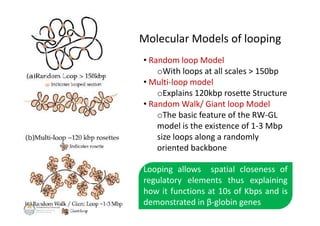
• Random loop Model
oWith loops at all scales > 150bp
• Multi-loop model
oExplains 120kbp rosette Structure
• Random Walk/ Giant loop Model
oThe basic feature of the RW-GL
model is the existence of 1-3 Mbp
size loops along a randomly
oriented backbone
• Random loop Model
oWith loops at all scales > 150bp
• Multi-loop model
oExplains 120kbp rosette Structure
• Random Walk/ Giant loop Model
oThe basic feature of the RW-GL
model is the existence of 1-3 Mbp
size loops along a randomly
oriented backbone
Looping allows spatial closeness of
regulatory elements thus explaining
how it functions at 10s of Kbps and is
demonstrated in β-globin genes
Sequential organization
Tandem repeats
Microsatellite DNA
• Unit - 2-4 bp (most 2).
• Repeat - on the order of 10-
100 times.
• Location - Generally
euchromatic.
• Examples - Most useful
marker for population level
studies..
Minisatellite DNA
• Unit - 15-400 bp (average
about 20).
• Repeat - Generally 20-50 times
(1000-5000 bp long).
• Location - Generally
euchromatic.
• Examples - DNA fingerprints.
Tandemly repeated but often
in dispersed clusters. Also
called VNTR’s (variable
number tandem repeats).
• Tandem repeats occur in DNA when a pattern of two or more nucleotides is
repeated and the repetitions are adjacent to each other
• Form different density band on density gradient centrifugation (from bulk
DNA) -satellite
• Unit - 2-4 bp (most 2).
• Repeat - on the order of 10-
100 times.
• Location - Generally
euchromatic.
• Examples - Most useful
marker for population level
studies..
• Unit - 15-400 bp (average
about 20).
• Repeat - Generally 20-50 times
(1000-5000 bp long).
• Location - Generally
euchromatic.
• Examples - DNA fingerprints.
Tandemly repeated but often
in dispersed clusters. Also
called VNTR’s (variable
number tandem repeats).
Interspersed Repetitive DNA
• Interspersed repetitive DNA accounts for 25–40 % of mammalian DNA.
• They are scattered randomly throughout the genome.
• The units are 100 – 1000 base pairs long.
• Copies are similar but not identical to each other.
• Interspersed repetitive genes are not stably integrated in the genome; they
move from place to place.
• They can sometimes mess up good genes
These are:
• Retrotransposons (class I transposable elements) (copy and paste),
copy themselves to RNA and then back to DNA (using reverse
transcriptase) to integrate into the genome.
• Transposons (Class II TEs) (cut and paste) uses transposases to make
makes a staggered sticky cut.
Interspersed Repetitive DNA
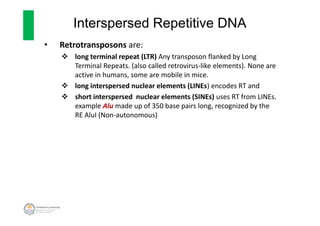
• Retrotransposons are:
 long terminal repeat (LTR) Any transposon flanked by Long
Terminal Repeats. (also called retrovirus-like elements). None are
active in humans, some are mobile in mice.
 long interspersed nuclear elements (LINEs) encodes RT and
 short interspersed nuclear elements (SINEs) uses RT from LINEs.
example Alu made up of 350 base pairs long, recognized by the
RE AluI (Non-autonomous)
• Retrotransposons are:
 long terminal repeat (LTR) Any transposon flanked by Long
Terminal Repeats. (also called retrovirus-like elements). None are
active in humans, some are mobile in mice.
 long interspersed nuclear elements (LINEs) encodes RT and
 short interspersed nuclear elements (SINEs) uses RT from LINEs.
example Alu made up of 350 base pairs long, recognized by the
RE AluI (Non-autonomous)
Gene rich regions have been
visualized with a fluorescent probe
that hybridizes to the Alu
interspersed repeat, which is
present in more than a million
copies in human genome. For
unknown reasons, these sequences
cluster in chromosomal regions rich
in genes(GREEN). In this picture
regions depleted for these
sequence are RED, while the
average regions are YELLOW. The
gene rich regions are seen to be
depleted in the DNA near the
nuclear envelope.
A. Bolzer et. al, PLoS Biol. 3:826-
842, 2005
Linking sequential organization and Genome Organization
Gene rich regions have been
visualized with a fluorescent probe
that hybridizes to the Alu
interspersed repeat, which is
present in more than a million
copies in human genome. For
unknown reasons, these sequences
cluster in chromosomal regions rich
in genes(GREEN). In this picture
regions depleted for these
sequence are RED, while the
average regions are YELLOW. The
gene rich regions are seen to be
depleted in the DNA near the
nuclear envelope.
A. Bolzer et. al, PLoS Biol. 3:826-
842, 2005 5µm
Thank youThank you

Genome organisation

  • 1.
    Genomeorganization In EukaryotesIn Eukaryotes ArunViswanathan IInd Sem, M.Sc.BMB © Arun Viswanathan
  • 2.
    40 km wirein a tennis ball ! • Each cell has approximately 2meters of DNA • Nucleus is only about 6µm in diameter • In eukaryotes DNA occurs as highly condensed form during cell division as Chromosomes. • 3.2x 10⁹ nucleotides is packed into 24 different chromosomes • DNA is highly negative in charge. How it is possibly wind over another without repulsion? • How can genomic processes like replication and transcription is possible in such tightly winded structures? • the Disentanglement time for the transition from interphase to metaphase chromosomes of size 100 Mb is in the order of 500 years • Each cell has approximately 2meters of DNA • Nucleus is only about 6µm in diameter • In eukaryotes DNA occurs as highly condensed form during cell division as Chromosomes. • 3.2x 10⁹ nucleotides is packed into 24 different chromosomes • DNA is highly negative in charge. How it is possibly wind over another without repulsion? • How can genomic processes like replication and transcription is possible in such tightly winded structures? • the Disentanglement time for the transition from interphase to metaphase chromosomes of size 100 Mb is in the order of 500 years
  • 3.
  • 4.
    Chemical composition ofchromatin • DNA (20-40%) most important chemical constituent of chromatin • RNA (05-10%) associated with chromatin as; rRNA, mRNA, tRNA • Proteins (55-60%) Histones: very basic proteins, constitute about 60% of total protein, almost 1:1 ratio with DNA. Five Types: H1, H2a, H2b, H3 and H4 • Non-Histones: They are 20% of total chromatin protein: • Nucleosomal Assembly Proteins (NAP), Other Histone chaperones Chromosome remodeling complexes • Structural (actin, L & B tubulin & myosin) contractile proteins, function during chromosome condensation & in movement of chromosomes. • all enzymes and cofactors – involved in replication, transcription and its regulation • DNA (20-40%) most important chemical constituent of chromatin • RNA (05-10%) associated with chromatin as; rRNA, mRNA, tRNA • Proteins (55-60%) Histones: very basic proteins, constitute about 60% of total protein, almost 1:1 ratio with DNA. Five Types: H1, H2a, H2b, H3 and H4 • Non-Histones: They are 20% of total chromatin protein: • Nucleosomal Assembly Proteins (NAP), Other Histone chaperones Chromosome remodeling complexes • Structural (actin, L & B tubulin & myosin) contractile proteins, function during chromosome condensation & in movement of chromosomes. • all enzymes and cofactors – involved in replication, transcription and its regulation
  • 5.
    Beads on aString • Beads on a string structure is the primary level of DNA packaging • They are often called as 11nm fibre • The diameter of “beads” is 11nm • The beads are made of proteins called as Histones © Lehninger Principle of Biochemistry, Michael M.Cox, David L. Nelson, Fifth Edition W.H. Freeman And Company, New York
  • 6.
    Beads on aString • Histone are highly basic (+ve charged), • Rich in basic amino acids Arginine and Lysine • Five Major class: H1, H2A, H2B, H3, H4 • Amino acid sequence of H3 and H4 are highly conserved • Histones and DNA along with NAP form a condensed structure called Nucleosome. It is the fundamental structural unit of chromatin. • The highly basic nature of Histones, aside from facilitating DNA Histone interactions, contributes to their water solubility. • H1 is present in half the amount of the other four histones. • Histone are highly basic (+ve charged), • Rich in basic amino acids Arginine and Lysine • Five Major class: H1, H2A, H2B, H3, H4 • Amino acid sequence of H3 and H4 are highly conserved • Histones and DNA along with NAP form a condensed structure called Nucleosome. It is the fundamental structural unit of chromatin. • The highly basic nature of Histones, aside from facilitating DNA Histone interactions, contributes to their water solubility. • H1 is present in half the amount of the other four histones. Content of basic amino acids Histones Molecular Weight Number of AA residue Lys % Arg % Total % H1 21,130 223 29.5 11.3 40.8 H2A 13,960 129 10.9 19.3 30.2 H2B 13,774 125 16 16.4 32.4 H3 15,273 135 19.6 13.3 32.9 H4 11,236 102 10.8 13.7 24.5
  • 7.
    Histones A 147bp segmentof DNA then wraps around the histone octamer 1.65 times. Each Nucleosome particle are separated from each other by a linker DNA, which can be of fewer nucleotides up to about 80. The term nucleosome refers to a nucleosome core particle plus an adjacent linker DNA. On an average, nucleosome repeat at intervals of about 200 nucleotides. A diploid Human cell contains about 30 million nucleotides !!
  • 8.
    Nucleosomal Assembly Histones arepredominantly basic proteins but also contain hydrophobic and acidic patches. They repel each other at physiological pH and form non- nucleosomal aggregates with DNA. Histone chaperones prevent these nonspecific interactions and can direct the productive assembly and disassembly of nucleosomes by facilitating histone deposition and exchange.
  • 9.
    Histone-DNA interactions 1. ElectrostaticInteractions: Helix-dipoles form α helixes in H2B, H3, and H4 cause a net +ve charge to accumulate at the point of interaction with -vely charged phosphate groups on DNA 2. Hydrogen bonds: between the DNA backbone and the amide group on the main chain of Histone proteins 3. Non-polar interactions: between the Histones and sugars on DNA 4. Salt bridges and hydrogen bonds: between side chains of basic AA (especially lys and arg) & phosphate oxygens on DNA 5. Non-specific minor groove insertions: of the H3 and H2B N-terminal tails into two minor grooves each on the DNA molecule 1. Electrostatic Interactions: Helix-dipoles form α helixes in H2B, H3, and H4 cause a net +ve charge to accumulate at the point of interaction with -vely charged phosphate groups on DNA 2. Hydrogen bonds: between the DNA backbone and the amide group on the main chain of Histone proteins 3. Non-polar interactions: between the Histones and sugars on DNA 4. Salt bridges and hydrogen bonds: between side chains of basic AA (especially lys and arg) & phosphate oxygens on DNA 5. Non-specific minor groove insertions: of the H3 and H2B N-terminal tails into two minor grooves each on the DNA molecule
  • 10.
    Histone tail, Histonecode & Epigenetics • There are eight N-terminal domain/Tail domain in histone core. • These tail domains are heavily modified. •These modifications include:  acetylation  methylation  ubiquitylation  phosphorylation  sumoylation  ribosylation  citrullination • There are eight N-terminal domain/Tail domain in histone core. • These tail domains are heavily modified. •These modifications include:  acetylation  methylation  ubiquitylation  phosphorylation  sumoylation  ribosylation  citrullination The idea that multiple dynamic modifications regulate gene transcription in a systematic and reproducible way is called the histone code and is heritable. Mechanisms of heritability of histone state are not well understood. However it is predicted that it must be working same as DNA methylation; a histone previously modified may possess a inherent tendency to get modify as previous. This is one of the way how epigenetics works
  • 11.
    The 30nm fiber •With the help of H1 the 11nm fiber compress to form more compact 30nm fiber. H1 primarily is in contact with 15-20bp of linker DNA and helps in contracting linker DNA. H1 histone is often called as ‘linker histone’ • There exist different models to explain the structure of 30nm fiber. Solenoid model and Zig-Zag model are two main models. • However recent studies demonstrates intermediate 30 nm fibers contain both the solenoid and zigzag conformations, suggesting instead that observations made in in vitro experiments might be an isolation artifact due to strictly cationic low-salt environment or chemical cross-linking (e.g., glutaraldehyde fixation). • With the help of H1 the 11nm fiber compress to form more compact 30nm fiber. H1 primarily is in contact with 15-20bp of linker DNA and helps in contracting linker DNA. H1 histone is often called as ‘linker histone’ • There exist different models to explain the structure of 30nm fiber. Solenoid model and Zig-Zag model are two main models. • However recent studies demonstrates intermediate 30 nm fibers contain both the solenoid and zigzag conformations, suggesting instead that observations made in in vitro experiments might be an isolation artifact due to strictly cationic low-salt environment or chemical cross-linking (e.g., glutaraldehyde fixation).
  • 12.
    The 30nm fiber •Inthe one-start solenoid model, bent linker DNA sequentially connects each nucleosome cores, creating a structure where nucleosomes follow each other along the same helical path. The nucleosomes follows a chronological numbering pattern. (viz. 1,2,3…) •It is uncertain whether H1 promotes a solenoid fiber. •In the one-start solenoid model, bent linker DNA sequentially connects each nucleosome cores, creating a structure where nucleosomes follow each other along the same helical path. The nucleosomes follows a chronological numbering pattern. (viz. 1,2,3…) •It is uncertain whether H1 promotes a solenoid fiber.
  • 13.
    The 30nm fiber Inthe two-start zigzag model, straight linker DNA connects two opposing nucleosome cores, creating the opposing rows of nucleosomes that form so called “two-start” helix. In zigzag model, alternate nucleosomes become interacting partners. (Viz. 1,3,2,4…) In the two-start zigzag model, straight linker DNA connects two opposing nucleosome cores, creating the opposing rows of nucleosomes that form so called “two-start” helix. In zigzag model, alternate nucleosomes become interacting partners. (Viz. 1,3,2,4…)
  • 14.
  • 15.
  • 16.
    Intermediate 30 nmfibers Four proposed structures of the 30 nm chromatin filament for DNA repeat length per nucleosomes ranging from 177 to 207 bp. Linker DNA in yellow and nucleosomal DNA in pink
  • 17.
    Higher chromatin organizations (MetaphaseChromosome) • We know very less about higher chromosomal levels of genome organization • However in Histone genes it is shown that the 30nm fiber supercoils itself into six loops attached to a protein called nuclear scaffold(NS). • Even though the actual composition of the NS is not known it is shown that Topo II is a major component and is needed for the attachment of supercoiled 30nm fiber to the NS. • Several cancer chemotheraputic drugs, which are Topo II inhibitors allows strand breakage through this mechanism. • More hierarchies are also proposed. • We know very less about higher chromosomal levels of genome organization • However in Histone genes it is shown that the 30nm fiber supercoils itself into six loops attached to a protein called nuclear scaffold(NS). • Even though the actual composition of the NS is not known it is shown that Topo II is a major component and is needed for the attachment of supercoiled 30nm fiber to the NS. • Several cancer chemotheraputic drugs, which are Topo II inhibitors allows strand breakage through this mechanism. • More hierarchies are also proposed.
  • 18.
  • 19.
    Higher chromatin organizations (MetaphaseChromosome) Higher chromatin organizations (Metaphase Chromosome)
  • 20.
    Higher chromatin organizations (InterphaseChromosome) • Determining how the Interphase chromosome is packed was a great deal to biologist. Since all the visual technologies failed to create an image of chromosome at interphase nucleus so that it explains its nature. • Two main models: • chromosome territory model, proposed by Carl Rabl in 1885. According to this model, the DNA of each chromosome occupies a defined volume of the nucleus and only overlaps with its immediate neighbors • "spaghetti" model, the DNA fiber of multiple chromosomes meanders through the nucleus in a largely random fashion, and the chromosomes are therefore intermingled and entangled with each other • Determining how the Interphase chromosome is packed was a great deal to biologist. Since all the visual technologies failed to create an image of chromosome at interphase nucleus so that it explains its nature. • Two main models: • chromosome territory model, proposed by Carl Rabl in 1885. According to this model, the DNA of each chromosome occupies a defined volume of the nucleus and only overlaps with its immediate neighbors • "spaghetti" model, the DNA fiber of multiple chromosomes meanders through the nucleus in a largely random fashion, and the chromosomes are therefore intermingled and entangled with each other
  • 21.
    Higher chromatin organizations (InterphaseChromosome) • The key experiment to distinguish between two models was carried out in the early 1980s by Thomas Cremer, a German cell biologist, and his physicist brother, Christoph Cremer. • The Cremer brothers found experimental evidence that strongly supported the chromosome territory model. • The key experiment to distinguish between two models was carried out in the early 1980s by Thomas Cremer, a German cell biologist, and his physicist brother, Christoph Cremer. • The Cremer brothers found experimental evidence that strongly supported the chromosome territory model.
  • 22.
    • During interphase,each chromosome occupies a spatially limited, roughly elliptical domain which is known as a chromosome territory (CT). • Each CT is comprised of higher order chromatin units of ~1 Mb each. • built up from smaller loop domains. • CT are known to be arranged radially around the nucleus. • This arrangement is both cell and tissue-type specific and is also evolutionary conserved. • The radial organization of CT was shown to correlate with their gene density and size. The gene-rich chromosomes occupy interior positions, whereas larger, gene-poor chromosomes, tend to be located around the periphery. • CT are also dynamic structures, with genes able to relocate from the periphery towards the interior once they have been “switched on”. • CT may exist either as discrete unit without intermingling or may have overlapping on each other Chromosome Territory (CT) • During interphase, each chromosome occupies a spatially limited, roughly elliptical domain which is known as a chromosome territory (CT). • Each CT is comprised of higher order chromatin units of ~1 Mb each. • built up from smaller loop domains. • CT are known to be arranged radially around the nucleus. • This arrangement is both cell and tissue-type specific and is also evolutionary conserved. • The radial organization of CT was shown to correlate with their gene density and size. The gene-rich chromosomes occupy interior positions, whereas larger, gene-poor chromosomes, tend to be located around the periphery. • CT are also dynamic structures, with genes able to relocate from the periphery towards the interior once they have been “switched on”. • CT may exist either as discrete unit without intermingling or may have overlapping on each other
  • 23.
    Chromosome Territory (CT) RecurrentClusters A) Chromosome territories (green) in liver cell nuclei (blue). B) Visualization of multiple chromosomes reveals spatial patterns of organization. Chromosomes 12 (red), 14 (blue), and 15 (green) form a triplet cluster in mouse lymphocytes. Part A: © 2004 Parada, L. A. et al. Tissue-specific spatial organization of genomes. Genome Biology 5:R44 doi:10.1186/gb-2004-5-7-r44. Part B: © 2002 Cell Press/Elsevier Inc. Parada, L. A. et al. Conservation of relative chromosome positioning in normal and cancer cells. Current Biology 12, 1692–1697 (2002).
  • 24.
    Chromosome Territory (CT) •Large areas of chromosomal identity between different species that have been maintained throughout evolution. These areas of identity maintain their positions in different species (Tanabe et al., 2002). • CT can reposition in disease, which might provide novel insights into disease mechanisms and why genes are incorrectly expressed in disease. • Scientists have manipulated the localization of chromosomes and seen some changes in gene expression as a result, thus suggesting a possible mechanism for the connection between CT and disease (Finlan et al., 2008). • No proteins have been identified that either anchor chromosomes in the nucleus or link multiple chromosomes to each other to establish chromosome clusters. • Large areas of chromosomal identity between different species that have been maintained throughout evolution. These areas of identity maintain their positions in different species (Tanabe et al., 2002). • CT can reposition in disease, which might provide novel insights into disease mechanisms and why genes are incorrectly expressed in disease. • Scientists have manipulated the localization of chromosomes and seen some changes in gene expression as a result, thus suggesting a possible mechanism for the connection between CT and disease (Finlan et al., 2008). • No proteins have been identified that either anchor chromosomes in the nucleus or link multiple chromosomes to each other to establish chromosome clusters.
  • 25.
    Chromosome Territory (CT) Movementof CT GENE OFF GENE ON
  • 26.
    Chromosome Territory (CT) FISHof Human interphase nucleus 10µm
  • 27.
    Other domains innucleus • Transcription factories – transcription is spatially organized into discernable nuclear structures in which multiple RNA polymerases and active genes dynamically localize into nuclear bodies termed transcription factories. • Transcription factories – transcription is spatially organized into discernable nuclear structures in which multiple RNA polymerases and active genes dynamically localize into nuclear bodies termed transcription factories.
  • 28.
    Molecular Models oflooping • Random loop Model oWith loops at all scales > 150bp • Multi-loop model oExplains 120kbp rosette Structure • Random Walk/ Giant loop Model oThe basic feature of the RW-GL model is the existence of 1-3 Mbp size loops along a randomly oriented backbone • Random loop Model oWith loops at all scales > 150bp • Multi-loop model oExplains 120kbp rosette Structure • Random Walk/ Giant loop Model oThe basic feature of the RW-GL model is the existence of 1-3 Mbp size loops along a randomly oriented backbone Looping allows spatial closeness of regulatory elements thus explaining how it functions at 10s of Kbps and is demonstrated in β-globin genes
  • 29.
  • 30.
  • 31.
    Tandem repeats Microsatellite DNA •Unit - 2-4 bp (most 2). • Repeat - on the order of 10- 100 times. • Location - Generally euchromatic. • Examples - Most useful marker for population level studies.. Minisatellite DNA • Unit - 15-400 bp (average about 20). • Repeat - Generally 20-50 times (1000-5000 bp long). • Location - Generally euchromatic. • Examples - DNA fingerprints. Tandemly repeated but often in dispersed clusters. Also called VNTR’s (variable number tandem repeats). • Tandem repeats occur in DNA when a pattern of two or more nucleotides is repeated and the repetitions are adjacent to each other • Form different density band on density gradient centrifugation (from bulk DNA) -satellite • Unit - 2-4 bp (most 2). • Repeat - on the order of 10- 100 times. • Location - Generally euchromatic. • Examples - Most useful marker for population level studies.. • Unit - 15-400 bp (average about 20). • Repeat - Generally 20-50 times (1000-5000 bp long). • Location - Generally euchromatic. • Examples - DNA fingerprints. Tandemly repeated but often in dispersed clusters. Also called VNTR’s (variable number tandem repeats).
  • 32.
    Interspersed Repetitive DNA •Interspersed repetitive DNA accounts for 25–40 % of mammalian DNA. • They are scattered randomly throughout the genome. • The units are 100 – 1000 base pairs long. • Copies are similar but not identical to each other. • Interspersed repetitive genes are not stably integrated in the genome; they move from place to place. • They can sometimes mess up good genes These are: • Retrotransposons (class I transposable elements) (copy and paste), copy themselves to RNA and then back to DNA (using reverse transcriptase) to integrate into the genome. • Transposons (Class II TEs) (cut and paste) uses transposases to make makes a staggered sticky cut.
  • 33.
    Interspersed Repetitive DNA •Retrotransposons are:  long terminal repeat (LTR) Any transposon flanked by Long Terminal Repeats. (also called retrovirus-like elements). None are active in humans, some are mobile in mice.  long interspersed nuclear elements (LINEs) encodes RT and  short interspersed nuclear elements (SINEs) uses RT from LINEs. example Alu made up of 350 base pairs long, recognized by the RE AluI (Non-autonomous) • Retrotransposons are:  long terminal repeat (LTR) Any transposon flanked by Long Terminal Repeats. (also called retrovirus-like elements). None are active in humans, some are mobile in mice.  long interspersed nuclear elements (LINEs) encodes RT and  short interspersed nuclear elements (SINEs) uses RT from LINEs. example Alu made up of 350 base pairs long, recognized by the RE AluI (Non-autonomous)
  • 34.
    Gene rich regionshave been visualized with a fluorescent probe that hybridizes to the Alu interspersed repeat, which is present in more than a million copies in human genome. For unknown reasons, these sequences cluster in chromosomal regions rich in genes(GREEN). In this picture regions depleted for these sequence are RED, while the average regions are YELLOW. The gene rich regions are seen to be depleted in the DNA near the nuclear envelope. A. Bolzer et. al, PLoS Biol. 3:826- 842, 2005 Linking sequential organization and Genome Organization Gene rich regions have been visualized with a fluorescent probe that hybridizes to the Alu interspersed repeat, which is present in more than a million copies in human genome. For unknown reasons, these sequences cluster in chromosomal regions rich in genes(GREEN). In this picture regions depleted for these sequence are RED, while the average regions are YELLOW. The gene rich regions are seen to be depleted in the DNA near the nuclear envelope. A. Bolzer et. al, PLoS Biol. 3:826- 842, 2005 5µm
  • 35.