ANTISENSE TECHNOLOGY

        Presented By
    Desh Bandhu Gangwar
     M.Tech Biotech (2 year)


      Concerned Faculty
       Dr. Gunjan Garg
      Assistant Professor
    School of Biotechnology
INTRODUCTION


What is Antisense
Technology ?
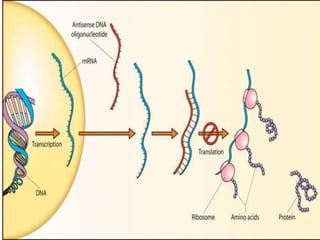
In this technique Short segments
 of single stranded DNA called
 oligo de oxy nucleotides are
 introduced.

These   oligonucleotides are
 complementary to the mRNA,
 which physically bind to the
 mRNA.
Antisense   technology prevent
 the synthesis of specific protein.


Antisense    technologies are a
 suite of techniques that, together
 form a very powerful weapon for
 studying gene function and for
 discovering      more      specific
 treatments of disease.
Antisense Oligonucleotides


What are Antisense
Oligonucleotides?
The    antisense effect of a
 oligonucleotide sequence was
 first demonstrated in 1970s by
 Zamecnik and Stephenson, in
 Rous sarcoma virus.

AS-ONs usually consist of 15–
 20 nucleotides, which are
 complementary to their target
 mRNA.
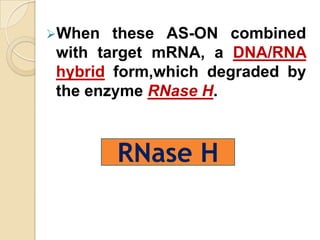
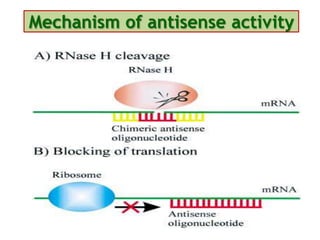
When  these AS-ON combined
with target mRNA, a DNA/RNA
hybrid form,which degraded by
the enzyme RNase H.


        RNase H
RNase  H is a non-specific
endonuclease, catalyzes the
cleavage of RNA via hydrolytic
mechanism.


RNase    H has ribonuclease
activity cleaves the 3’-O-P bond
of RNA in a DNA/RNA duplex.
Mechanism of antisense activity
Types Of AS-ON

First   generation AS-ON

Second    generation AS-ON

Third   generation AS-ON
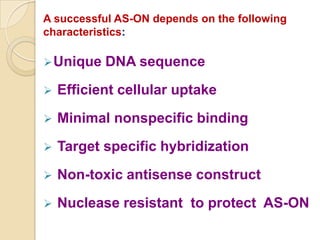
A successful AS-ON depends on the following
characteristics:

 Unique   DNA sequence
   Efficient cellular uptake
   Minimal nonspecific binding
   Target specific hybridization
   Non-toxic antisense construct
   Nuclease resistant to protect AS-ON
First generation AS-ON
Firstsynthesized by Eckstein and
 colleagues.

Phosphorothioate   - oligo deoxy
 nucleotides    are     the   major
 representatives of first generation
 DNA analogs that are the best
 known.
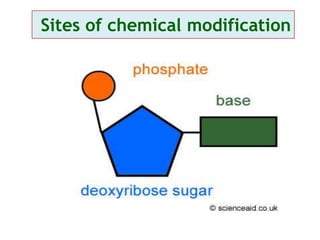
Sites of chemical modification
Phosphorothioate  linkages in Ons
 primarily used to enhance their
 nuclease resistance.

Inthis class of ONs, non bridging
 oxygen atoms in phopho-diester
 bond is replaced by sulfur.


They  first used as AS-ONs for the
 inhibition of HIV.
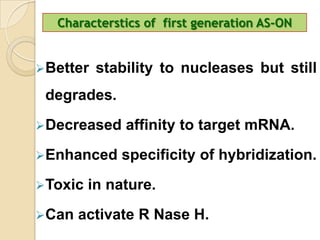
Characterstics of first generation AS-ON


Better   stability to nucleases but still
 degrades.
Decreased    affinity to target mRNA.
Enhanced    specificity of hybridization.
Toxic   in nature.
Can   activate R Nase H.
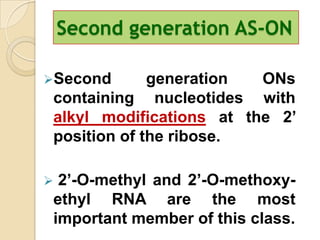
Second generation AS-ON

Second       generation  ONs
 containing nucleotides with
 alkyl modifications at the 2’
 position of the ribose.

 2’-O-methyl and 2’-O-methoxy-
 ethyl RNA are the most
 important member of this class.
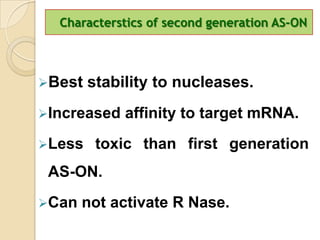
Characterstics of second generation AS-ON


Best   stability to nucleases.
Increased   affinity to target mRNA.
Less    toxic than first generation
 AS-ON.
Can   not activate R Nase.
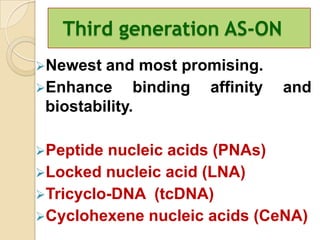
Third generation AS-ON
Newest  and most promising.
Enhance      binding affinity   and
 biostability.

Peptide nucleic acids (PNAs)
Locked nucleic acid (LNA)
Tricyclo-DNA (tcDNA)
Cyclohexene nucleic acids (CeNA)
Peptide nucleic acids


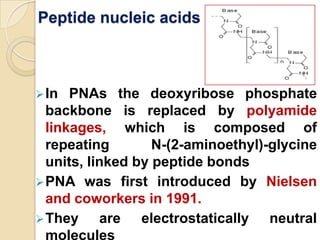
 In  PNAs the deoxyribose phosphate
  backbone is replaced by polyamide
  linkages, which is composed of
  repeating        N-(2-aminoethyl)-glycine
  units, linked by peptide bonds
 PNA was first introduced by Nielsen
  and coworkers in 1991.
 They     are electrostatically neutral
  molecules
Locked nucleic acid


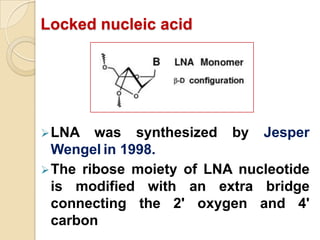
 LNA   was synthesized by Jesper
  Wengel in 1998.
 The ribose moiety of LNA nucleotide
  is modified with an extra bridge
  connecting the 2' oxygen and 4'
  carbon
Ribozymes
Thomas   and coworkers coined the
 term ‘ribozymes.
Ribozymes are RNA molecules
 that have catalytic activity.
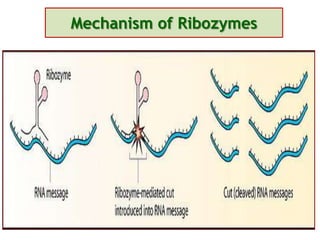
Ribozyme Bind to the target RNA
 moiety and inactivate it by
 cleaving    the     phosphodiester
 backbone at a specific cutting
 site.
Mechanism of Ribozymes
Types Of Ribozymes

Tetrahymena      group I intron
   RNase P
Hammer      head ribozyme
Hairpin   ribozyme
Hepatitis    delta virus ribozyme
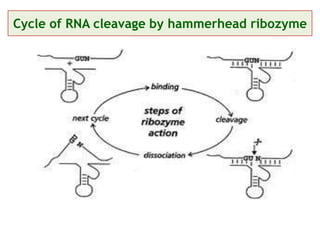
Cycle of RNA cleavage by hammerhead ribozyme
Ribozymes in clinical trials


ANGIOZYME    - VEGF-receptor1

HERZYME      -   HER-2

HEPTAZYM
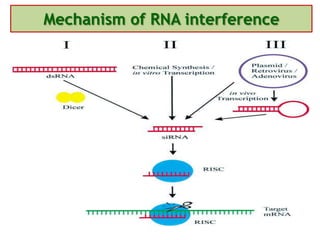
RNA interference
 RNA interference (RNAi) is a system
 within living cells that takes part in
 controlling genes activity.

 Twotypes of small RNA molecules –
 (miRNA) and (siRNA) are central to
 RNA interference.

 Melloand Fire named the process
 RNAi, were awarded the Nobel Prize.
Mechanism of RNA interference
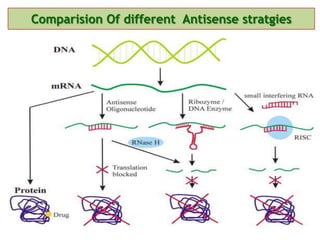
Comparision Of different Antisense stratgies
Applications Of Antisense technologies


 Story      of Flavr Savr…
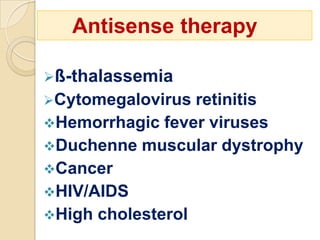
Antisense therapy

ß-thalassemia
Cytomegalovirus  retinitis
Hemorrhagic fever viruses
Duchenne muscular dystrophy
Cancer
HIV/AIDS
High cholesterol
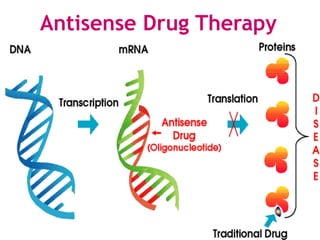
Antisense Drug Therapy
REFERENCE
 Gene   cloning and DNA analysis, Fifth edition
  By T.A Brown Page no. 235
 Walton, S. P., Roth, C. M., Yarmush, M. L.
  “Antisense Technology.”The Biomedical
  Engineering Handbook: Second Edition.
 Indian journal of chemistry vol. 48 B
  December 2009, pp. 1721-1726
 Indian journal of biotechnology vol 4,JUL
  2005,pp. 316 -322
 Eur. J. Biochem. 270,1628–1644
 Clinical and Experimental Pharmacology and
  Physiology (2006) 33, 533–540
QUERIES?
THANK YOU

antisense technology

  • 1.
    ANTISENSE TECHNOLOGY Presented By Desh Bandhu Gangwar M.Tech Biotech (2 year) Concerned Faculty Dr. Gunjan Garg Assistant Professor School of Biotechnology
  • 2.
  • 4.
    In this techniqueShort segments of single stranded DNA called oligo de oxy nucleotides are introduced. These oligonucleotides are complementary to the mRNA, which physically bind to the mRNA.
  • 5.
    Antisense technology prevent the synthesis of specific protein. Antisense technologies are a suite of techniques that, together form a very powerful weapon for studying gene function and for discovering more specific treatments of disease.
  • 6.
    Antisense Oligonucleotides What areAntisense Oligonucleotides?
  • 7.
    The antisense effect of a oligonucleotide sequence was first demonstrated in 1970s by Zamecnik and Stephenson, in Rous sarcoma virus. AS-ONs usually consist of 15– 20 nucleotides, which are complementary to their target mRNA.
  • 8.
    When theseAS-ON combined with target mRNA, a DNA/RNA hybrid form,which degraded by the enzyme RNase H. RNase H
  • 9.
    RNase His a non-specific endonuclease, catalyzes the cleavage of RNA via hydrolytic mechanism. RNase H has ribonuclease activity cleaves the 3’-O-P bond of RNA in a DNA/RNA duplex.
  • 10.
  • 11.
    Types Of AS-ON First generation AS-ON Second generation AS-ON Third generation AS-ON
  • 12.
    A successful AS-ONdepends on the following characteristics:  Unique DNA sequence  Efficient cellular uptake  Minimal nonspecific binding  Target specific hybridization  Non-toxic antisense construct  Nuclease resistant to protect AS-ON
  • 13.
    First generation AS-ON Firstsynthesizedby Eckstein and colleagues. Phosphorothioate - oligo deoxy nucleotides are the major representatives of first generation DNA analogs that are the best known.
  • 14.
    Sites of chemicalmodification
  • 15.
    Phosphorothioate linkagesin Ons primarily used to enhance their nuclease resistance. Inthis class of ONs, non bridging oxygen atoms in phopho-diester bond is replaced by sulfur. They first used as AS-ONs for the inhibition of HIV.
  • 16.
    Characterstics of firstgeneration AS-ON Better stability to nucleases but still degrades. Decreased affinity to target mRNA. Enhanced specificity of hybridization. Toxic in nature. Can activate R Nase H.
  • 17.
    Second generation AS-ON Second generation ONs containing nucleotides with alkyl modifications at the 2’ position of the ribose.  2’-O-methyl and 2’-O-methoxy- ethyl RNA are the most important member of this class.
  • 18.
    Characterstics of secondgeneration AS-ON Best stability to nucleases. Increased affinity to target mRNA. Less toxic than first generation AS-ON. Can not activate R Nase.
  • 19.
    Third generation AS-ON Newest and most promising. Enhance binding affinity and biostability. Peptide nucleic acids (PNAs) Locked nucleic acid (LNA) Tricyclo-DNA (tcDNA) Cyclohexene nucleic acids (CeNA)
  • 20.
    Peptide nucleic acids In PNAs the deoxyribose phosphate backbone is replaced by polyamide linkages, which is composed of repeating N-(2-aminoethyl)-glycine units, linked by peptide bonds  PNA was first introduced by Nielsen and coworkers in 1991.  They are electrostatically neutral molecules
  • 21.
    Locked nucleic acid LNA was synthesized by Jesper Wengel in 1998.  The ribose moiety of LNA nucleotide is modified with an extra bridge connecting the 2' oxygen and 4' carbon
  • 22.
    Ribozymes Thomas and coworkers coined the term ‘ribozymes. Ribozymes are RNA molecules that have catalytic activity. Ribozyme Bind to the target RNA moiety and inactivate it by cleaving the phosphodiester backbone at a specific cutting site.
  • 23.
  • 24.
    Types Of Ribozymes Tetrahymena group I intron  RNase P Hammer head ribozyme Hairpin ribozyme Hepatitis delta virus ribozyme
  • 25.
    Cycle of RNAcleavage by hammerhead ribozyme
  • 26.
    Ribozymes in clinicaltrials ANGIOZYME - VEGF-receptor1 HERZYME - HER-2 HEPTAZYM
  • 27.
    RNA interference  RNAinterference (RNAi) is a system within living cells that takes part in controlling genes activity.  Twotypes of small RNA molecules – (miRNA) and (siRNA) are central to RNA interference.  Melloand Fire named the process RNAi, were awarded the Nobel Prize.
  • 28.
    Mechanism of RNAinterference
  • 29.
    Comparision Of differentAntisense stratgies
  • 30.
    Applications Of Antisensetechnologies Story of Flavr Savr…
  • 31.
    Antisense therapy ß-thalassemia Cytomegalovirus retinitis Hemorrhagic fever viruses Duchenne muscular dystrophy Cancer HIV/AIDS High cholesterol
  • 32.
  • 33.
    REFERENCE  Gene cloning and DNA analysis, Fifth edition By T.A Brown Page no. 235  Walton, S. P., Roth, C. M., Yarmush, M. L. “Antisense Technology.”The Biomedical Engineering Handbook: Second Edition.  Indian journal of chemistry vol. 48 B December 2009, pp. 1721-1726  Indian journal of biotechnology vol 4,JUL 2005,pp. 316 -322  Eur. J. Biochem. 270,1628–1644  Clinical and Experimental Pharmacology and Physiology (2006) 33, 533–540
  • 34.
  • 35.