Genetic Engineering:
 Genetic Engineering involves changing
the genetic material in an organism to
alter its traits or product.
 A recombinant DNA molecules contains
DNA fragment splice together from 2 or
more organisms.
Element Of Genetic
Engineering:
Genetic Engineering required the
following element:
1. Vectors.
2. Restriction Enzymes.
3. Mechanism in joining the fragment.
4. Selection or detection of successful
cloning.
1.Vectors:
 It must be able to replicate.
 There must be some way to introduce
vector DNA into the cell.
 Most common vectors are plasmid,
phaged and virus
2.Restriction Enzymes:
 Enzyme that cuts and recognize specific
base sequence in a DNA molecules.
 R.E are also called molecular scissor.
 They cut the phosphodiester bond
between the two nucleotides.
 Cutting Patterns:
1. Blunt End
2. Sticky End
3. Joining Fragment:
 Joining may be in cohesive or sticky end
and blunt end which required
homopolymer tailing or synthesis of
linker molecules.
 Increasing the DNA concentration and
addition of ligas.
4.Selection And Detection:
 Selection may be done in antibiotic
resistance gene and colony or plaque
hybridization technique.
Gene Transfer methods Used
with several Commercially
Important Microorganism:
Type of organism
Aspergillus
Bacillus
Corynebacterium
Industrial
application
Food
fermentations
Industrial
enzymes
Antibiotics
Amino Acids
Gene transfer
Method
Protoplast
transformation
Electroporation
Protoplast
transformation
Conjugation
Electroporation
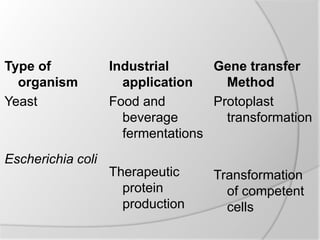
Type of
organism
Yeast
Escherichia coli
Industrial
application
Food and
beverage
fermentations
Therapeutic
protein
production
Gene transfer
Method
Protoplast
transformation
Transformation
of competent
cells
Approaches To Enhancing
Product Yield:
 Usually production levels of metabolite
of commercial value such as amino acid
Vitamins and antibiotics by un altered
natural producing micro organism are
unite low enhancing metabolite yield is
therefore essential for meeting the
product demand and for maintaining an
economically viable process
 Several approaches have been applied
to increase the production rate:
1.Over coming Rate Limiting
Steps:
 Rate limiting step refer to the step in a
biosynthetic pathway that restrain the
flow of intermediates and thereby limit
the overall production of the final
products
 The classical approach to identify rate
limiting steps is to feed pathway
intermediate to the producing strain.
 If the intermediate is not converted to
the final product assuming it is
transferred into the cell.
 One or more steps between the
intermediate and the final products are
limiting.
2. ELIMINATING FEEDBACK
REGULATION:
 One mechanism by which
microorganism control the production of
essential metabolite
 Such as Amino acid is feedback
regulation
 An essential example is isolucine an
amino acid produced by c-glutamicum
 In c-glutamicum theronine dehydrates
the first commited enzyme
 Isolucine production was increased by
releiving the feed back inhibition
 either by amplifying the native gene
encoding the enzyme or by expressing
the E coli gene.
Some genetically Engineered
Microbe And Their Industrial
Use:
1.Food Industry:
Enzyme manufactured by genetic
engineer are used in food industry.
Well known example include the use of
Chymosin for cheese making and
pectinases for fruit and beverage
processing.
2. Textile Industry:
 Microbial enzyme have been used in the
textile industry.
 Conventional method for production
include optimizing medium, composition
growth condition and fermentation
process.
 Genetic engineering offers a possibility
in which high level enzyme production is
achieved
 Amylase have been used for many
years to remove starch sizes from
fabrics known as desizing originally
amylase from plant or animal source
were used.
 Later they were replaced by amylase of
bacterial origin.
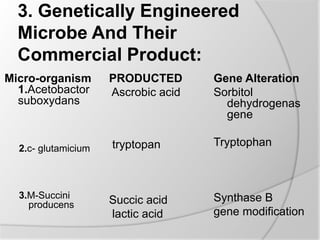
3. Genetically Engineered
Microbe And Their
Commercial Product:
Micro-organism
1.Acetobactor
suboxydans
2.c- glutamicium
3.M-Succini
producens
PRODUCTED
Ascrobic acid
tryptopan
Succic acid
lactic acid
Gene Alteration
Sorbitol
dehydrogenas
gene
Tryptophan
Synthase B
gene modification
Micro-organism
4.Penicillin
crysogenum
5.Asperigillus
niger
PRODUCTED
penicillin
citric acid
Gene Alteration
Strain
improvement
CONCLUSION:
 Genetically Engineered Microbe have
been developed to benefit human
health, agriculture and the environment.
 Advanced in functional genomics and
bioinformatics tools combined with
recombinant DNA technology.
 We help us better understand the
physiology and metabolic potential of
the organism.
 We study and in turn will lead to the
development of genetically engineered
microbe best suited to our needs.
The END

Geneticatly modified microbs

  • 1.
    Genetic Engineering:  GeneticEngineering involves changing the genetic material in an organism to alter its traits or product.  A recombinant DNA molecules contains DNA fragment splice together from 2 or more organisms.
  • 2.
    Element Of Genetic Engineering: GeneticEngineering required the following element: 1. Vectors. 2. Restriction Enzymes. 3. Mechanism in joining the fragment. 4. Selection or detection of successful cloning.
  • 3.
    1.Vectors:  It mustbe able to replicate.  There must be some way to introduce vector DNA into the cell.  Most common vectors are plasmid, phaged and virus
  • 4.
    2.Restriction Enzymes:  Enzymethat cuts and recognize specific base sequence in a DNA molecules.  R.E are also called molecular scissor.  They cut the phosphodiester bond between the two nucleotides.  Cutting Patterns: 1. Blunt End 2. Sticky End
  • 5.
    3. Joining Fragment: Joining may be in cohesive or sticky end and blunt end which required homopolymer tailing or synthesis of linker molecules.  Increasing the DNA concentration and addition of ligas.
  • 6.
    4.Selection And Detection: Selection may be done in antibiotic resistance gene and colony or plaque hybridization technique.
  • 7.
    Gene Transfer methodsUsed with several Commercially Important Microorganism: Type of organism Aspergillus Bacillus Corynebacterium Industrial application Food fermentations Industrial enzymes Antibiotics Amino Acids Gene transfer Method Protoplast transformation Electroporation Protoplast transformation Conjugation Electroporation
  • 8.
    Type of organism Yeast Escherichia coli Industrial application Foodand beverage fermentations Therapeutic protein production Gene transfer Method Protoplast transformation Transformation of competent cells
  • 9.
    Approaches To Enhancing ProductYield:  Usually production levels of metabolite of commercial value such as amino acid Vitamins and antibiotics by un altered natural producing micro organism are unite low enhancing metabolite yield is therefore essential for meeting the product demand and for maintaining an economically viable process  Several approaches have been applied to increase the production rate:
  • 10.
    1.Over coming RateLimiting Steps:  Rate limiting step refer to the step in a biosynthetic pathway that restrain the flow of intermediates and thereby limit the overall production of the final products  The classical approach to identify rate limiting steps is to feed pathway intermediate to the producing strain.
  • 11.
     If theintermediate is not converted to the final product assuming it is transferred into the cell.  One or more steps between the intermediate and the final products are limiting.
  • 12.
    2. ELIMINATING FEEDBACK REGULATION: One mechanism by which microorganism control the production of essential metabolite  Such as Amino acid is feedback regulation  An essential example is isolucine an amino acid produced by c-glutamicum  In c-glutamicum theronine dehydrates the first commited enzyme
  • 13.
     Isolucine productionwas increased by releiving the feed back inhibition  either by amplifying the native gene encoding the enzyme or by expressing the E coli gene.
  • 14.
    Some genetically Engineered MicrobeAnd Their Industrial Use: 1.Food Industry: Enzyme manufactured by genetic engineer are used in food industry. Well known example include the use of Chymosin for cheese making and pectinases for fruit and beverage processing.
  • 15.
    2. Textile Industry: Microbial enzyme have been used in the textile industry.  Conventional method for production include optimizing medium, composition growth condition and fermentation process.  Genetic engineering offers a possibility in which high level enzyme production is achieved
  • 16.
     Amylase havebeen used for many years to remove starch sizes from fabrics known as desizing originally amylase from plant or animal source were used.  Later they were replaced by amylase of bacterial origin.
  • 17.
    3. Genetically Engineered MicrobeAnd Their Commercial Product: Micro-organism 1.Acetobactor suboxydans 2.c- glutamicium 3.M-Succini producens PRODUCTED Ascrobic acid tryptopan Succic acid lactic acid Gene Alteration Sorbitol dehydrogenas gene Tryptophan Synthase B gene modification
  • 18.
  • 19.
    CONCLUSION:  Genetically EngineeredMicrobe have been developed to benefit human health, agriculture and the environment.  Advanced in functional genomics and bioinformatics tools combined with recombinant DNA technology.  We help us better understand the physiology and metabolic potential of the organism.
  • 20.
     We studyand in turn will lead to the development of genetically engineered microbe best suited to our needs.
  • 21.