http://www.thedailysheeple.com/wp-content/uploads/2015/05/DNA-Strand.jpg
Introduction
History
Levels of gene silencing
Transcriptional gene silencing
Post transcriptional gene silencing
Salient features of RNAi
Mechanism of RNAi
Applications
Advantages and disadvantages
Future perspectives
Case study
Conclusion
References
http://www.jurassicworld.com/media/creation-lab/mrdna/2-sequencing-mr-dna.png
 Antisense RNA Technology > tool used for inhibition
of gene expression.
 In this technique Short segments of single stranded
DNA called oligo de oxy nucleotides are introduced.
 These oligonucleotides are complementary to the mRNA,
which physically bind to the mRNA.
 This technique prevents the synthesis of specific protein.
 Powerful weapon for Studying gene function and for
discovering more specific treatments of diseases.
 Gene silencing =Antisense RNA technology = Ribozyme
technology.
https://lh6.ggpht.com/unnamed.jpg
1990- Richard Jorgenson gave the phenomenon of ‘cosupression of gene
expression’.
1992- Romano and Macino gave the phenomenon of as Virus Induced Gene
Silencing , set of such phenomenon was termed as post transcriptional gene
silencing.
1995-RNA silencing was first documented in animals by Guo and
Kemphues, and for this phenomenon they coined the term antisense mediated
silencing.
1998-Andrew Fire and Craig C.Mello coined the term RNA interference
(RNAi) .
http://bgiamericas.com/wp-content/uploads/2011/08/Cropped-DNA-01.jpg
2001-Thomas Tuschl, discovered with his colleagues that RNAi could
be prompted through the use of shorter pieces of RNA known as small
interfering RNAs (siRNAs).
2001-Gregory Hannon identified, described, and named the "Dicer"
enzyme, which chops dsRNA into siRNAs, as well as the RNA-
induced silencing complex (RISC), which mediates the silencing
process by degrading the homologous mRNA7.
2002-Effect named "short hairpin-activated gene silencing" or
SHAGging was introduced.
2004 Morris et al. Observed that siRNA silences genes at the
transcriptional level.
History Contd….
http://bgiamericas.com/wp-content/uploads/2011/08/Cropped-DNA-01.jpg
1. Transcriptional gene silencing (TGS)
It Causes gene silencing by:
• DNA methylation.
• Heterochromatin formation.
• Programmed DNA elimination.
2. Post transcriptional gene silencing (PTGS)
It is known commonly as RNA interference
(RNAi). It causes silencing by destruction of
the mRNA of the gene to which the siRNA
shows perfect complementarity.
http://cdn01.wallconvert.com/_media/wallpapers_1680x1050/1/1/dna-strand-3111.jpg
 Transcriptional gene silencing - Result of modifications
of either the histones or DNA.
Gene silencing by modification of Histones and DNA
 Modification of nucleosomes alter the accessibility of the gene to the
transcriptional machinery and regulatory proteins
 Heterochromatin is commonly involved in gene silencing, and
affects large sections of DNA.
 Methylation of particular DNA sequences can also silence
transcription in many eukaryotes.
https://lh6.ggpht.com/unnamed.jpg
RNA interference (RNAi) is a molecular mechanism in
which fragments of double stranded nucleic acid (dsRNA)
interfere with the expression of a particular gene .
The dsRNA can be either, MicroRNA (miRNA) or Small
interference RNA (siRNA)
https://lh6.ggpht.com/unnamed.jpg
Double stranded RNA rather than single–stranded
antisense RNA is the interfering agent.
High degree of specific gene silencing with less effort.
Highly potent and effective, only a few double stranded
RNA molecules per cell are required for effective
interference.
Silencing can be introduced in different developmental
stages
Systemic silencing
Avoids problems with abnormalities caused by a knocked
out gene in early stages which could mask desired
observations.
Silencing effects passed through generations
https://lh6.ggpht.com/unnamed.jpg
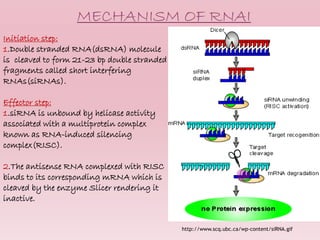
Initiation step:
1.Double stranded RNA(dsRNA) molecule
is cleaved to form 21-23 bp double stranded
fragments called short interfering
RNAs(siRNAs).
Effector step:
1.siRNA is unbound by helicase activity
associated with a multiprotein complex
known as RNA-induced silencing
complex(RISC).
2.The antisense RNA complexed with RISC
binds to its corresponding mRNA which is
cleaved by the enzyme Slicer rendering it
inactive.
http://www.scq.ubc.ca/wp-content/siRNA.gif
 In biological functions
>immunity
>downregulation of genes
>upregulation of genes
>evolution
 In technology
>gene knockdown
>functional genomics
>medicines
>biotechnology
http://www.jurassicworld.com/media/creation-lab/mrdna/3-assembly-mr-dna.png
This process is able to affect
only selected genes which the
RNAi is complementary to.
RNAi will bind to most of the
complementary genes it
encounters, making it
highly efficient as well as
robust
Shown to work in the
laboratory and shows
potential in mammalian cell
Able to be used on a large
scale
Delivery, i.e., getting those
exquisitely specific siRNAs to
the appropriate sites in the
appropriate amounts to ensure
appropriate uptake and the
intended silencing remains a
considerable challenge
Off-target effects i.e., when
siRNA can affect unintended
genes in the organism which
may be vital
advantages disadvantages
http://bgiamericas.com/wp-content/uploads/2011/08/Cropped-DNA-01.jpg
 Since 1998 ,RNAi discovery has been touted as a technical
breakthrough in biological research.
 Even with RNAi's rapid development over the years, it is still
in its infancy stage. A better understanding of the
mechanisms that take place will help reduce problems such as
off-target effects.

 In 2001 RNAi was used to treat hepatitis in mice
 With further knowledge about the mechanisms of RNAi it
may be the gateway for other emerging technologies such as
transgenic studies, gene therapy and gene-wide screening..
 Whilst still in process, it opens the doors of what can be
achieved, and infact realises a small part of the hope - that
nothing is untreatable.
http://www.godandscience.org/images/dna-helix.gif
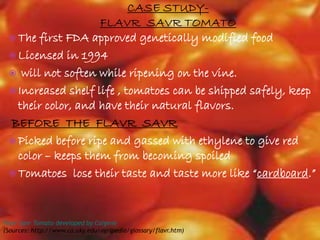
 The first FDA approved genetically modified food
 Licensed in 1994
 will not soften while ripening on the vine.
 Increased shelf life , tomatoes can be shipped safely, keep
their color, and have their natural flavors.
BEFORE THE FLAVR SAVR
 Picked before ripe and gassed with ethylene to give red
color – keeps them from becoming spoiled
 Tomatoes lose their taste and taste more like “cardboard.”
Flavr Savr Tomato developed by Calgene
(Sources: http://www.ca.uky.edu/agripedia/glossary/flavr.htm)
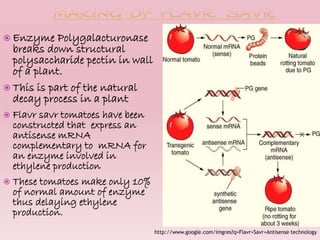
 Enzyme Polygalacturonase
breaks down structural
polysaccharide pectin in wall
of a plant.
 This is part of the natural
decay process in a plant
 Flavr savr tomatoes have been
constructed that express an
antisense mRNA
complementary to mRNA for
an enzyme involved in
ethylene production
 These tomatoes make only 10%
of normal amount of enzyme
thus delaying ethylene
production.
http://www.google.com/imgres?q=Flavr+Savr+Antisense technology
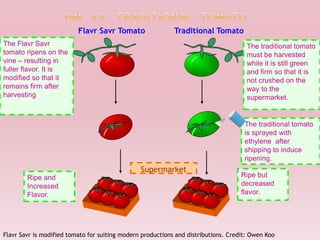
Flavr Savr Tomato Traditional Tomato
The Flavr Savr
tomato ripens on the
vine – resulting in
fuller flavor. It is
modified so that it
remains firm after
harvesting
The traditional tomato
must be harvested
while it is still green
and firm so that it is
not crushed on the
way to the
supermarket.
The traditional tomato
is sprayed with
ethylene after
shipping to induce
ripening.
Ripe and
Increased
Flavor.
Ripe but
decreased
flavor.
Supermarket
Flavr Savr is modified tomato for suiting modern productions and distributions. Credit: Owen Koo
 Basically, the gene in the tomato
stops the tomato from softening
during ripening so that it is easier
to ship but keeps its natural
flavors too.
 The tomato also has a much longer
shelf life and keeps from spoiling
quickly.
PROBLEMS WITH FLAVR SAVR:
 Safety- health risks, some
environmental risks
 Possible monopolies for businesses
 Ethical concerns
 Only rich countries can afford it
http://www.jurassicworld.com/media/creation-lab/mrdna/1-extraction-mr-dna.png
The Antisense RNA technology shows the potential for
diverse applications to basic research and therapy.
Antisense technology offers almost unlimited scope for
the development of new methods of drug design and one
of the most approved approaches among several others,
for inactivating a single chosen gene.
However, the full commitment of this promise is yet to be
established.
http://blogs-images.forbes.com/daviddisalvo/files/2011/11/DNA.jpg
Syed M Shah, N Saini , S Ashraf, G Ravi Kumar, ‘Gene Silencing,
Mechanism and Applications ’,DHR International Journal Of Biomedical and
Life Sciences (DHR-IJBLS) ISSN: 2278-8301, Vol. 3(1), 2012
Stuti Gupta, Ravindra Pal Singh, Nirav Rabadia, Gaurang Patel, Hiten
Panchal, ‘ANTISENSE TECHNOLOGY’, Volume 9, Issue 2, July – August
2011; Article-007, ISSN 0976 – 044X
https://cellbiology.med.unsw.edu.au/cellbiology/index.php?title=Group_2_Proje
ct_RNA_Interference&oldid=2374
Lu Tian,(November 25, 2014),’ The Flavr Savr Tomato’, www.slideshare.com
Kirti Khuntwal,’gene silencing’, www.authorstream.com
Ashok Singamsetti, 19th April, 2014,’Transgenics Production and Bio-Safety
concerns’, Department of Genetics and Plant Breeding
George L. Sen and Helen M. Blau,’A brief history of RNAi: the silence of the
genes’, doi: 10.1096/fj.06-6014rev July 2006 The FASEB Journal vol. 20 no.
9 1293-1299
Antisense RNA Technology

Antisense RNA Technology

  • 1.
  • 2.
    Introduction History Levels of genesilencing Transcriptional gene silencing Post transcriptional gene silencing Salient features of RNAi Mechanism of RNAi Applications Advantages and disadvantages Future perspectives Case study Conclusion References http://www.jurassicworld.com/media/creation-lab/mrdna/2-sequencing-mr-dna.png
  • 3.
     Antisense RNATechnology > tool used for inhibition of gene expression.  In this technique Short segments of single stranded DNA called oligo de oxy nucleotides are introduced.  These oligonucleotides are complementary to the mRNA, which physically bind to the mRNA.  This technique prevents the synthesis of specific protein.  Powerful weapon for Studying gene function and for discovering more specific treatments of diseases.  Gene silencing =Antisense RNA technology = Ribozyme technology. https://lh6.ggpht.com/unnamed.jpg
  • 4.
    1990- Richard Jorgensongave the phenomenon of ‘cosupression of gene expression’. 1992- Romano and Macino gave the phenomenon of as Virus Induced Gene Silencing , set of such phenomenon was termed as post transcriptional gene silencing. 1995-RNA silencing was first documented in animals by Guo and Kemphues, and for this phenomenon they coined the term antisense mediated silencing. 1998-Andrew Fire and Craig C.Mello coined the term RNA interference (RNAi) . http://bgiamericas.com/wp-content/uploads/2011/08/Cropped-DNA-01.jpg
  • 5.
    2001-Thomas Tuschl, discoveredwith his colleagues that RNAi could be prompted through the use of shorter pieces of RNA known as small interfering RNAs (siRNAs). 2001-Gregory Hannon identified, described, and named the "Dicer" enzyme, which chops dsRNA into siRNAs, as well as the RNA- induced silencing complex (RISC), which mediates the silencing process by degrading the homologous mRNA7. 2002-Effect named "short hairpin-activated gene silencing" or SHAGging was introduced. 2004 Morris et al. Observed that siRNA silences genes at the transcriptional level. History Contd…. http://bgiamericas.com/wp-content/uploads/2011/08/Cropped-DNA-01.jpg
  • 6.
    1. Transcriptional genesilencing (TGS) It Causes gene silencing by: • DNA methylation. • Heterochromatin formation. • Programmed DNA elimination. 2. Post transcriptional gene silencing (PTGS) It is known commonly as RNA interference (RNAi). It causes silencing by destruction of the mRNA of the gene to which the siRNA shows perfect complementarity. http://cdn01.wallconvert.com/_media/wallpapers_1680x1050/1/1/dna-strand-3111.jpg
  • 7.
     Transcriptional genesilencing - Result of modifications of either the histones or DNA. Gene silencing by modification of Histones and DNA  Modification of nucleosomes alter the accessibility of the gene to the transcriptional machinery and regulatory proteins  Heterochromatin is commonly involved in gene silencing, and affects large sections of DNA.  Methylation of particular DNA sequences can also silence transcription in many eukaryotes. https://lh6.ggpht.com/unnamed.jpg
  • 8.
    RNA interference (RNAi)is a molecular mechanism in which fragments of double stranded nucleic acid (dsRNA) interfere with the expression of a particular gene . The dsRNA can be either, MicroRNA (miRNA) or Small interference RNA (siRNA) https://lh6.ggpht.com/unnamed.jpg
  • 9.
    Double stranded RNArather than single–stranded antisense RNA is the interfering agent. High degree of specific gene silencing with less effort. Highly potent and effective, only a few double stranded RNA molecules per cell are required for effective interference. Silencing can be introduced in different developmental stages Systemic silencing Avoids problems with abnormalities caused by a knocked out gene in early stages which could mask desired observations. Silencing effects passed through generations https://lh6.ggpht.com/unnamed.jpg
  • 10.
    Initiation step: 1.Double strandedRNA(dsRNA) molecule is cleaved to form 21-23 bp double stranded fragments called short interfering RNAs(siRNAs). Effector step: 1.siRNA is unbound by helicase activity associated with a multiprotein complex known as RNA-induced silencing complex(RISC). 2.The antisense RNA complexed with RISC binds to its corresponding mRNA which is cleaved by the enzyme Slicer rendering it inactive. http://www.scq.ubc.ca/wp-content/siRNA.gif
  • 11.
     In biologicalfunctions >immunity >downregulation of genes >upregulation of genes >evolution  In technology >gene knockdown >functional genomics >medicines >biotechnology http://www.jurassicworld.com/media/creation-lab/mrdna/3-assembly-mr-dna.png
  • 12.
    This process isable to affect only selected genes which the RNAi is complementary to. RNAi will bind to most of the complementary genes it encounters, making it highly efficient as well as robust Shown to work in the laboratory and shows potential in mammalian cell Able to be used on a large scale Delivery, i.e., getting those exquisitely specific siRNAs to the appropriate sites in the appropriate amounts to ensure appropriate uptake and the intended silencing remains a considerable challenge Off-target effects i.e., when siRNA can affect unintended genes in the organism which may be vital advantages disadvantages http://bgiamericas.com/wp-content/uploads/2011/08/Cropped-DNA-01.jpg
  • 13.
     Since 1998,RNAi discovery has been touted as a technical breakthrough in biological research.  Even with RNAi's rapid development over the years, it is still in its infancy stage. A better understanding of the mechanisms that take place will help reduce problems such as off-target effects.  In 2001 RNAi was used to treat hepatitis in mice  With further knowledge about the mechanisms of RNAi it may be the gateway for other emerging technologies such as transgenic studies, gene therapy and gene-wide screening..  Whilst still in process, it opens the doors of what can be achieved, and infact realises a small part of the hope - that nothing is untreatable. http://www.godandscience.org/images/dna-helix.gif

  • 14.
     The firstFDA approved genetically modified food  Licensed in 1994  will not soften while ripening on the vine.  Increased shelf life , tomatoes can be shipped safely, keep their color, and have their natural flavors. BEFORE THE FLAVR SAVR  Picked before ripe and gassed with ethylene to give red color – keeps them from becoming spoiled  Tomatoes lose their taste and taste more like “cardboard.” Flavr Savr Tomato developed by Calgene (Sources: http://www.ca.uky.edu/agripedia/glossary/flavr.htm)
  • 15.
     Enzyme Polygalacturonase breaksdown structural polysaccharide pectin in wall of a plant.  This is part of the natural decay process in a plant  Flavr savr tomatoes have been constructed that express an antisense mRNA complementary to mRNA for an enzyme involved in ethylene production  These tomatoes make only 10% of normal amount of enzyme thus delaying ethylene production. http://www.google.com/imgres?q=Flavr+Savr+Antisense technology
  • 16.
    Flavr Savr TomatoTraditional Tomato The Flavr Savr tomato ripens on the vine – resulting in fuller flavor. It is modified so that it remains firm after harvesting The traditional tomato must be harvested while it is still green and firm so that it is not crushed on the way to the supermarket. The traditional tomato is sprayed with ethylene after shipping to induce ripening. Ripe and Increased Flavor. Ripe but decreased flavor. Supermarket Flavr Savr is modified tomato for suiting modern productions and distributions. Credit: Owen Koo
  • 17.
     Basically, thegene in the tomato stops the tomato from softening during ripening so that it is easier to ship but keeps its natural flavors too.  The tomato also has a much longer shelf life and keeps from spoiling quickly. PROBLEMS WITH FLAVR SAVR:  Safety- health risks, some environmental risks  Possible monopolies for businesses  Ethical concerns  Only rich countries can afford it http://www.jurassicworld.com/media/creation-lab/mrdna/1-extraction-mr-dna.png
  • 18.
    The Antisense RNAtechnology shows the potential for diverse applications to basic research and therapy. Antisense technology offers almost unlimited scope for the development of new methods of drug design and one of the most approved approaches among several others, for inactivating a single chosen gene. However, the full commitment of this promise is yet to be established. http://blogs-images.forbes.com/daviddisalvo/files/2011/11/DNA.jpg
  • 19.
    Syed M Shah,N Saini , S Ashraf, G Ravi Kumar, ‘Gene Silencing, Mechanism and Applications ’,DHR International Journal Of Biomedical and Life Sciences (DHR-IJBLS) ISSN: 2278-8301, Vol. 3(1), 2012 Stuti Gupta, Ravindra Pal Singh, Nirav Rabadia, Gaurang Patel, Hiten Panchal, ‘ANTISENSE TECHNOLOGY’, Volume 9, Issue 2, July – August 2011; Article-007, ISSN 0976 – 044X https://cellbiology.med.unsw.edu.au/cellbiology/index.php?title=Group_2_Proje ct_RNA_Interference&oldid=2374 Lu Tian,(November 25, 2014),’ The Flavr Savr Tomato’, www.slideshare.com Kirti Khuntwal,’gene silencing’, www.authorstream.com Ashok Singamsetti, 19th April, 2014,’Transgenics Production and Bio-Safety concerns’, Department of Genetics and Plant Breeding George L. Sen and Helen M. Blau,’A brief history of RNAi: the silence of the genes’, doi: 10.1096/fj.06-6014rev July 2006 The FASEB Journal vol. 20 no. 9 1293-1299