• Bio technology : 
• Bio technology deals with the techniques of using live 
organisms or enzymes to produce products and 
processes useful to humans. 
• The term Bio technology was coined by Karl Ereky in 
1919. 
• Principles of Biotechnology: 
• Two imp techniques that used in modern 
biotechnology are, 
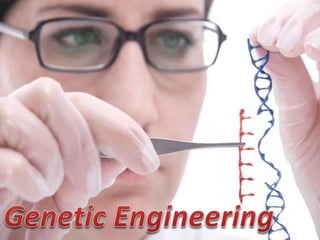
– Genetic engineering: Techniques to modification of 
chemistry of genetic material (DNA and RNA) and to 
introduce them into host organisms to change the 
phenotypic character of the host. 
– Maintenance of sterile: (microbial contamination-free): It is 
the processes to enable growth of only the desired 
microbe/eukaryotic cell in large quantities.
• The three basic steps involved in Genetic engineering 
are, 
1. Identification of DNA with desirable genes. 
2. Introduction of indentified DNA in to the host. 
3. Maintenance of introduced DNA in the host and 
transfer of that DNA in to its progeny. 
• The techniques of genetic engineering include 
creation of recombinant DNA. 
• r-DNA is used in gene cloning and gene transfer. It 
helps to introduce desirable genes into the target 
organism. 
• It also helps to avoid undesired genes getting 
multiplied along with the desired genes.
• The tools of recombinant DNA technology . 
1. Restriction enzymes. 
2. Polymerase enzymes. 
3. DNA - Desired gene. 
4. Ligases. 
5. Vectors. 
6. Host organism. 
7. Bioreactors.
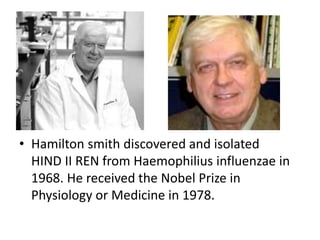
• Hamilton smith discovered and isolated 
HIND II REN from Haemophilius influenzae in 
1968. He received the Nobel Prize in 
Physiology or Medicine in 1978.
• Restriction enzymes: 
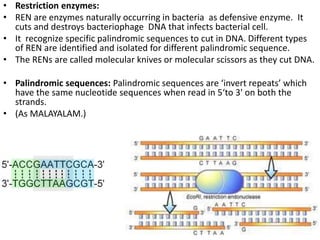
• REN are enzymes naturally occurring in bacteria as defensive enzyme. It 
cuts and destroys bacteriophage DNA that infects bacterial cell. 
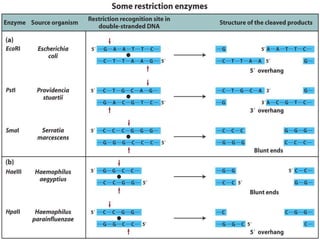
• It recognize specific palindromic sequences to cut in DNA. Different types 
of REN are identified and isolated for different palindromic sequence. 
• The RENs are called molecular knives or molecular scissors as they cut DNA. 
• Palindromic sequences: Palindromic sequences are ‘invert repeats’ which 
have the same nucleotide sequences when read in 5‘to 3' on both the 
strands. 
• (As MALAYALAM.)
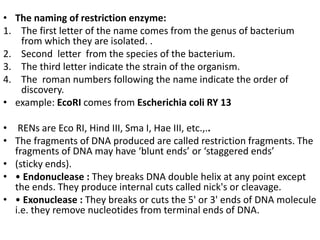
• The naming of restriction enzyme: 
1. The first letter of the name comes from the genus of bacterium 
from which they are isolated. . 
2. Second letter from the species of the bacterium. 
3. The third letter indicate the strain of the organism. 
4. The roman numbers following the name indicate the order of 
discovery. 
• example: EcoRI comes from Escherichia coli RY 13 
• RENs are Eco RI, Hind III, Sma I, Hae III, etc.,.. 
• The fragments of DNA produced are called restriction fragments. The 
fragments of DNA may have ‘blunt ends’ or ‘staggered ends’ 
• (sticky ends). 
• • Endonuclease : They breaks DNA double helix at any point except 
the ends. They produce internal cuts called nick's or cleavage. 
• • Exonuclease : They breaks or cuts the 5' or 3' ends of DNA molecule 
i.e. they remove nucleotides from terminal ends of DNA.
• Desired gene: The functional or normal gene of 
our interest taken from donor cell. 
It is also known as foreign gene or trans 
gene. 
•Polymerase enzymes: 
1. DNA Polymerase I. 
2. DNA Polymerase II 
3. DNA Polymerase III.
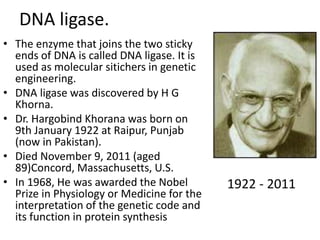
DNA ligase. 
• The enzyme that joins the two sticky 
ends of DNA is called DNA ligase. It is 
used as molecular sitichers in genetic 
engineering. 
• DNA ligase was discovered by H G 
Khorna. 
• Dr. Hargobind Khorana was born on 
9th January 1922 at Raipur, Punjab 
(now in Pakistan). 
• Died November 9, 2011 (aged 
89)Concord, Massachusetts, U.S. 
• In 1968, He was awarded the Nobel 
Prize in Physiology or Medicine for the 
interpretation of the genetic code and 
its function in protein synthesis 
1922 - 2011
• Vector: The carrier DNA that act as vehicle to carry 
desired gene to the host cell is called vector. 
• The imp vectors used in Genetic engineering are, 
1. Plasmid. 
2. Phages. 
3. Plant virus. 
4. Animal virus. 
5. Cosmids. 
6. Artificial chromosomes. 
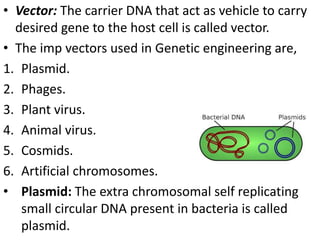
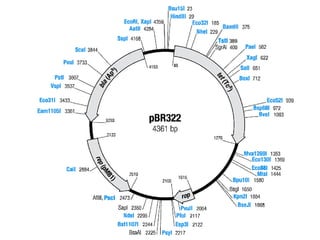
• Plasmid: The extra chromosomal self replicating 
small circular DNA present in bacteria is called 
plasmid.
• Cloning vectors: 
• The plasmid and bacteriophages are used as cloning vectrors. 
Bcoz it has the ability to replicate within bacterial cells 
independentlly. 
• Features of cloning vector: 
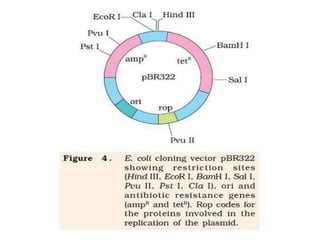
• vector should contain three features for gene cloning. They 
are 
• 1) Ori site. 2) Cloning sites..3) selectable markers. 
• Ori site: - Origin of replication 
• The sequence of DNA where the replication starts is 
called ori site. 
• It helps the desired DNA linked with vector also replicates. 
• Cloning sites: 
• The vector contains the recognition site or palindromic for 
the commonly used REN to insert desired gene.
• Host cell: The cell to which desired new gene is 
introduced is called host cell. Any living cell can be 
used as host cell. 
• Commonly E.coli bacterial cell is used as host cell 
in genetic engineering. Because, 
1. It is a simple prokaryotic cell. 
2. It is a non-pathogenic bacteria. 
3. It can be cultured easily in laboratory condition. 
4. It has very short life span. 
5. It contains self replicating plasmid. 
6. The plasmid of E.coli can be easily handled as 
vector.
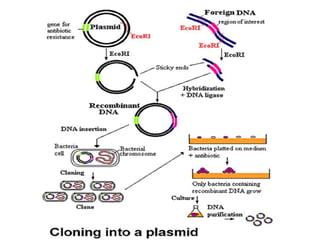
• The steps involved in recombinant DNA 
terchnology. 
1. Isolation of desired DNA . 
2. fragmentation of DNA by restriction 
endonucleases. 
3. Isolation of a desired DNA fragment. 
4. Ligation of DNA fragment in to vector. 
5. Transferring the recombinant DNA in to host. 
6. culturing the host cell and extraction of desired 
product.
Extraction of DNA or isolation of gene: 
1. The cells of organism that contains 
desired gene are collected. 
2. The DNA of these cells is extracted by 
using refrigerated centrifuge technology. 
3. The contents of the cell is treated with 
enzymes like chitinase, lysozymes, 
cellulase , ribonuclease and proteases. 
4. Finally chilled ethnol is added to get 
purified DNA. 
5. The isolation of gene is done by shoot 
gun method. In this specific REN is used 
to cut and isolate desired gene. The 
isolated gene contains two sticky ends. 
6. The desired gene is isolated by using gel 
electrophoresis.
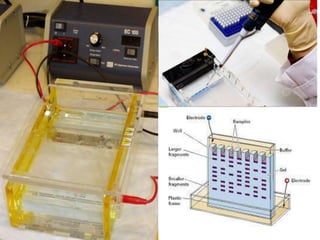
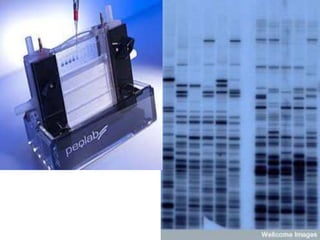
• Gel Electrophoresis. 
1. The fragments obtained after cutting with restriction 
enzymes are separated by using gel electrophoresis. 
2. Electric field is applied to the electrophoresis matrix 
(commonly agarose gel). 
3. The negatively charged DNA fragments move towards the 
anode. 
4. Fragments are separate according to their size due to the 
sieving properties of agarose gel. Smaller the fragment move 
faster than larger one. 
5. Staining dye ethidium bromide followed by exposure to UV 
radiations are used to visualise the DNA fragments. 
6. DNA fragments are visible as bright orange coloured bands 
in the agarose matrix. 
7. These bands are cut from the agarose gel and extracted 
from the gel piece (elution). 
8. DNA fragments are purified and used in constructing 
recombinant DNAs.
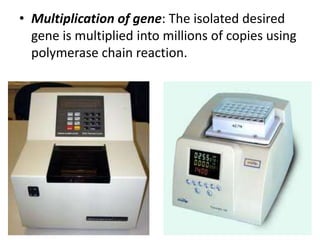
• Multiplication of gene: The isolated desired 
gene is multiplied into millions of copies using 
polymerase chain reaction.
• Ligation of desired gene in to vector. 
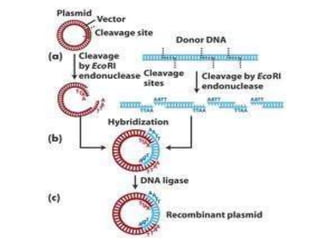
• A suitable plasmid is selected. It is treated with the 
same restriction enzyme to break and open the 
plasmid at specific sites with sticky ends. 
• Now the desired gene and the plasmid are mixed 
and enzyme DNA Ligase is added . 
• The desired gene gets incorporated in to the 
plasmid . 
• Transferring of recombinant plasmid in to the host 
cell. (transformation) 
• The recombinant plasmid is transfered in to the 
host cell by cold calcium chloride method or by 
micro-injection.
• The bacterial cell ( host cell) and r-DNA are 
made to suspend in cold (5-6 0C ) calcium 
chloride solution. After some interval of time, 
the temp of solution is suddenly raised to 42 
0C and again cooled. 
• The increase in temperature increases the 
pore size of bacterial membrane. Through this 
pore r-DNA enters the bacterial cell .
• Micro-injection: 
• Method of introducing r-DNA directly by injecting in 
to the host cell using fine needle is called 
microinjection. 
• Biolastics or gene gun: 
• Method of introducing recombinant DNA in to host 
cell by bombarding high velocity microparticles of 
gold or tungsten coated with DNA.
• Culturing the host cell and extraction of desired 
product: 
• The r-DNA is made to express under appropriate 
conditions. 
• The host cells are cultrured in a vessel called 
Bioreactor. 
• The desired protein is extracted and purified by 
using different separation techniques called down 
stream processing.
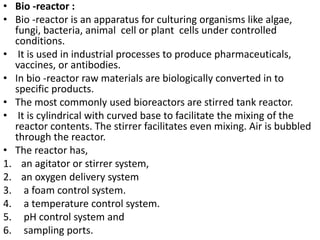
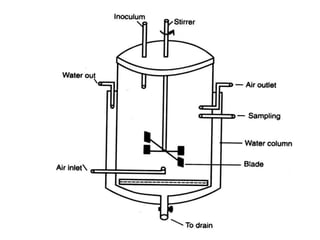
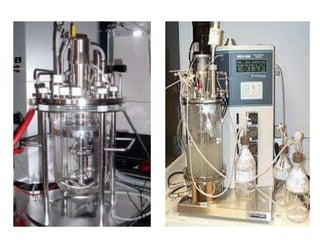
• Bio -reactor : 
• Bio -reactor is an apparatus for culturing organisms like algae, 
fungi, bacteria, animal cell or plant cells under controlled 
conditions. 
• It is used in industrial processes to produce pharmaceuticals, 
vaccines, or antibodies. 
• In bio -reactor raw materials are biologically converted in to 
specific products. 
• The most commonly used bioreactors are stirred tank reactor. 
• It is cylindrical with curved base to facilitate the mixing of the 
reactor contents. The stirrer facilitates even mixing. Air is bubbled 
through the reactor. 
• The reactor has, 
1. an agitator or stirrer system, 
2. an oxygen delivery system 
3. a foam control system. 
4. a temperature control system. 
5. pH control system and 
6. sampling ports.
• Downstream processing: 
• Separation, purification of the products obtained 
from recombinant DNA technique is called 
downstream processing (DSP). 
• The product has to be formulated with suitable 
preservatives . 
• Clinical trials and strict quality control testing is also 
conducted before marketing of the product.
• Vectors used for cloning genes in plants. 
• Ti plasmid: Tumour inducing Ti plasmid of 
`Agrobactrium tumifaciens , used as cloning vector. 
It is nonpathiogenic to the plants. It can be used to 
deliver genes of our interest in to variety of plants. 
• Vectors used for cloning genes in animals. 
• Retroviruses. The trimmed non pathogenic 
retrovirus are used to deliver desirable genes into 
animal cells.

Chapter 11 biotechnology by mohanbio

  • 2.
    • Bio technology: • Bio technology deals with the techniques of using live organisms or enzymes to produce products and processes useful to humans. • The term Bio technology was coined by Karl Ereky in 1919. • Principles of Biotechnology: • Two imp techniques that used in modern biotechnology are, – Genetic engineering: Techniques to modification of chemistry of genetic material (DNA and RNA) and to introduce them into host organisms to change the phenotypic character of the host. – Maintenance of sterile: (microbial contamination-free): It is the processes to enable growth of only the desired microbe/eukaryotic cell in large quantities.
  • 5.
    • The threebasic steps involved in Genetic engineering are, 1. Identification of DNA with desirable genes. 2. Introduction of indentified DNA in to the host. 3. Maintenance of introduced DNA in the host and transfer of that DNA in to its progeny. • The techniques of genetic engineering include creation of recombinant DNA. • r-DNA is used in gene cloning and gene transfer. It helps to introduce desirable genes into the target organism. • It also helps to avoid undesired genes getting multiplied along with the desired genes.
  • 6.
    • The toolsof recombinant DNA technology . 1. Restriction enzymes. 2. Polymerase enzymes. 3. DNA - Desired gene. 4. Ligases. 5. Vectors. 6. Host organism. 7. Bioreactors.
  • 7.
    • Hamilton smithdiscovered and isolated HIND II REN from Haemophilius influenzae in 1968. He received the Nobel Prize in Physiology or Medicine in 1978.
  • 8.
    • Restriction enzymes: • REN are enzymes naturally occurring in bacteria as defensive enzyme. It cuts and destroys bacteriophage DNA that infects bacterial cell. • It recognize specific palindromic sequences to cut in DNA. Different types of REN are identified and isolated for different palindromic sequence. • The RENs are called molecular knives or molecular scissors as they cut DNA. • Palindromic sequences: Palindromic sequences are ‘invert repeats’ which have the same nucleotide sequences when read in 5‘to 3' on both the strands. • (As MALAYALAM.)
  • 10.
    • The namingof restriction enzyme: 1. The first letter of the name comes from the genus of bacterium from which they are isolated. . 2. Second letter from the species of the bacterium. 3. The third letter indicate the strain of the organism. 4. The roman numbers following the name indicate the order of discovery. • example: EcoRI comes from Escherichia coli RY 13 • RENs are Eco RI, Hind III, Sma I, Hae III, etc.,.. • The fragments of DNA produced are called restriction fragments. The fragments of DNA may have ‘blunt ends’ or ‘staggered ends’ • (sticky ends). • • Endonuclease : They breaks DNA double helix at any point except the ends. They produce internal cuts called nick's or cleavage. • • Exonuclease : They breaks or cuts the 5' or 3' ends of DNA molecule i.e. they remove nucleotides from terminal ends of DNA.
  • 11.
    • Desired gene:The functional or normal gene of our interest taken from donor cell. It is also known as foreign gene or trans gene. •Polymerase enzymes: 1. DNA Polymerase I. 2. DNA Polymerase II 3. DNA Polymerase III.
  • 12.
    DNA ligase. •The enzyme that joins the two sticky ends of DNA is called DNA ligase. It is used as molecular sitichers in genetic engineering. • DNA ligase was discovered by H G Khorna. • Dr. Hargobind Khorana was born on 9th January 1922 at Raipur, Punjab (now in Pakistan). • Died November 9, 2011 (aged 89)Concord, Massachusetts, U.S. • In 1968, He was awarded the Nobel Prize in Physiology or Medicine for the interpretation of the genetic code and its function in protein synthesis 1922 - 2011
  • 13.
    • Vector: Thecarrier DNA that act as vehicle to carry desired gene to the host cell is called vector. • The imp vectors used in Genetic engineering are, 1. Plasmid. 2. Phages. 3. Plant virus. 4. Animal virus. 5. Cosmids. 6. Artificial chromosomes. • Plasmid: The extra chromosomal self replicating small circular DNA present in bacteria is called plasmid.
  • 14.
    • Cloning vectors: • The plasmid and bacteriophages are used as cloning vectrors. Bcoz it has the ability to replicate within bacterial cells independentlly. • Features of cloning vector: • vector should contain three features for gene cloning. They are • 1) Ori site. 2) Cloning sites..3) selectable markers. • Ori site: - Origin of replication • The sequence of DNA where the replication starts is called ori site. • It helps the desired DNA linked with vector also replicates. • Cloning sites: • The vector contains the recognition site or palindromic for the commonly used REN to insert desired gene.
  • 17.
    • Host cell:The cell to which desired new gene is introduced is called host cell. Any living cell can be used as host cell. • Commonly E.coli bacterial cell is used as host cell in genetic engineering. Because, 1. It is a simple prokaryotic cell. 2. It is a non-pathogenic bacteria. 3. It can be cultured easily in laboratory condition. 4. It has very short life span. 5. It contains self replicating plasmid. 6. The plasmid of E.coli can be easily handled as vector.
  • 18.
    • The stepsinvolved in recombinant DNA terchnology. 1. Isolation of desired DNA . 2. fragmentation of DNA by restriction endonucleases. 3. Isolation of a desired DNA fragment. 4. Ligation of DNA fragment in to vector. 5. Transferring the recombinant DNA in to host. 6. culturing the host cell and extraction of desired product.
  • 21.
    Extraction of DNAor isolation of gene: 1. The cells of organism that contains desired gene are collected. 2. The DNA of these cells is extracted by using refrigerated centrifuge technology. 3. The contents of the cell is treated with enzymes like chitinase, lysozymes, cellulase , ribonuclease and proteases. 4. Finally chilled ethnol is added to get purified DNA. 5. The isolation of gene is done by shoot gun method. In this specific REN is used to cut and isolate desired gene. The isolated gene contains two sticky ends. 6. The desired gene is isolated by using gel electrophoresis.
  • 22.
    • Gel Electrophoresis. 1. The fragments obtained after cutting with restriction enzymes are separated by using gel electrophoresis. 2. Electric field is applied to the electrophoresis matrix (commonly agarose gel). 3. The negatively charged DNA fragments move towards the anode. 4. Fragments are separate according to their size due to the sieving properties of agarose gel. Smaller the fragment move faster than larger one. 5. Staining dye ethidium bromide followed by exposure to UV radiations are used to visualise the DNA fragments. 6. DNA fragments are visible as bright orange coloured bands in the agarose matrix. 7. These bands are cut from the agarose gel and extracted from the gel piece (elution). 8. DNA fragments are purified and used in constructing recombinant DNAs.
  • 25.
    • Multiplication ofgene: The isolated desired gene is multiplied into millions of copies using polymerase chain reaction.
  • 26.
    • Ligation ofdesired gene in to vector. • A suitable plasmid is selected. It is treated with the same restriction enzyme to break and open the plasmid at specific sites with sticky ends. • Now the desired gene and the plasmid are mixed and enzyme DNA Ligase is added . • The desired gene gets incorporated in to the plasmid . • Transferring of recombinant plasmid in to the host cell. (transformation) • The recombinant plasmid is transfered in to the host cell by cold calcium chloride method or by micro-injection.
  • 27.
    • The bacterialcell ( host cell) and r-DNA are made to suspend in cold (5-6 0C ) calcium chloride solution. After some interval of time, the temp of solution is suddenly raised to 42 0C and again cooled. • The increase in temperature increases the pore size of bacterial membrane. Through this pore r-DNA enters the bacterial cell .
  • 28.
    • Micro-injection: •Method of introducing r-DNA directly by injecting in to the host cell using fine needle is called microinjection. • Biolastics or gene gun: • Method of introducing recombinant DNA in to host cell by bombarding high velocity microparticles of gold or tungsten coated with DNA.
  • 29.
    • Culturing thehost cell and extraction of desired product: • The r-DNA is made to express under appropriate conditions. • The host cells are cultrured in a vessel called Bioreactor. • The desired protein is extracted and purified by using different separation techniques called down stream processing.
  • 31.
    • Bio -reactor: • Bio -reactor is an apparatus for culturing organisms like algae, fungi, bacteria, animal cell or plant cells under controlled conditions. • It is used in industrial processes to produce pharmaceuticals, vaccines, or antibodies. • In bio -reactor raw materials are biologically converted in to specific products. • The most commonly used bioreactors are stirred tank reactor. • It is cylindrical with curved base to facilitate the mixing of the reactor contents. The stirrer facilitates even mixing. Air is bubbled through the reactor. • The reactor has, 1. an agitator or stirrer system, 2. an oxygen delivery system 3. a foam control system. 4. a temperature control system. 5. pH control system and 6. sampling ports.
  • 34.
    • Downstream processing: • Separation, purification of the products obtained from recombinant DNA technique is called downstream processing (DSP). • The product has to be formulated with suitable preservatives . • Clinical trials and strict quality control testing is also conducted before marketing of the product.
  • 35.
    • Vectors usedfor cloning genes in plants. • Ti plasmid: Tumour inducing Ti plasmid of `Agrobactrium tumifaciens , used as cloning vector. It is nonpathiogenic to the plants. It can be used to deliver genes of our interest in to variety of plants. • Vectors used for cloning genes in animals. • Retroviruses. The trimmed non pathogenic retrovirus are used to deliver desirable genes into animal cells.