Enzymes
Introduction
Enzymes are biocatalysts-the catalysts of life
A catalyst is defined as a substance that increases the
velocity or rate of chemical reaction without itself
undergoing any change in the overall process
Enzyme
Enzyme may be defined as biocatalysts synthesized by
living cells.
They are protein in nature (except ribozyme), colloidal
and thermo liable in character and specific in their
action
Historical background
• Berzelius in 1836 coined the term catalysis (Greek-to dissolve)
• In 1878, Kuhne used the word enzyme (Greek-in yeast) to
indicate the catalysis taking place in the biological systems.
• Isolation of enzyme system from cell free extract of yeast was
achieved in 1883 by Buchner. He named the active principle as
zymase which could convert sugar into alcohol
• In 1926, James Sumner first achieved the isolation and
crystallization of the enzyme urease from lack bean and
identified it as a protein
Nomenclature and classification
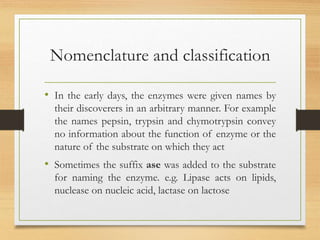
• In the early days, the enzymes were given names by
their discoverers in an arbitrary manner. For example
the names pepsin, trypsin and chymotrypsin convey
no information about the function of enzyme or the
nature of the substrate on which they act
• Sometimes the suffix ase was added to the substrate
for naming the enzyme. e.g. Lipase acts on lipids,
nuclease on nucleic acid, lactase on lactose
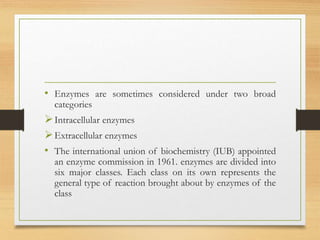
• Enzymes are sometimes considered under two broad
categories
Intracellular enzymes
Extracellular enzymes
• The international union of biochemistry (IUB) appointed
an enzyme commission in 1961. enzymes are divided into
six major classes. Each class on its own represents the
general type of reaction brought about by enzymes of the
class
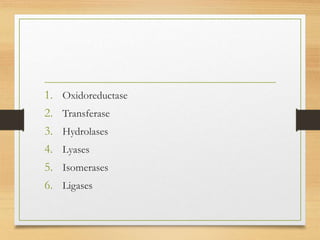
1. Oxidoreductase
2. Transferase
3. Hydrolases
4. Lyases
5. Isomerases
6. Ligases
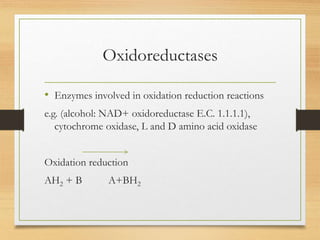
Oxidoreductases
• Enzymes involved in oxidation reduction reactions
e.g. (alcohol: NAD+ oxidoreductase E.C. 1.1.1.1),
cytochrome oxidase, L and D amino acid oxidase
Oxidation reduction
AH2 + B A+BH2
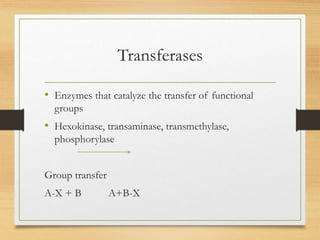
Transferases
• Enzymes that catalyze the transfer of functional
groups
• Hexokinase, transaminase, transmethylase,
phosphorylase
Group transfer
A-X + B A+B-X
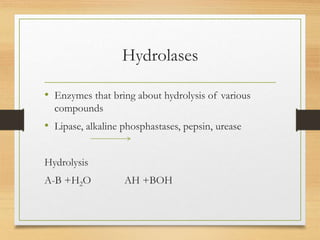
Hydrolases
• Enzymes that bring about hydrolysis of various
compounds
• Lipase, alkaline phosphastases, pepsin, urease
Hydrolysis
A-B +H2O AH +BOH
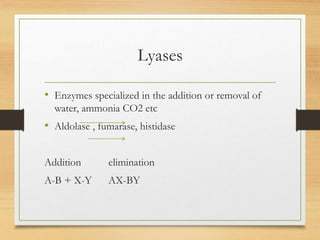
Lyases
• Enzymes specialized in the addition or removal of
water, ammonia CO2 etc
• Aldolase , fumarase, histidase
Addition elimination
A-B + X-Y AX-BY
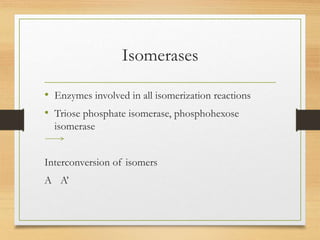
Isomerases
• Enzymes involved in all isomerization reactions
• Triose phosphate isomerase, phosphohexose
isomerase
Interconversion of isomers
A A’
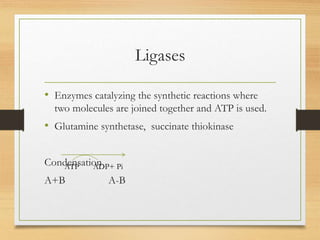
Ligases
• Enzymes catalyzing the synthetic reactions where
two molecules are joined together and ATP is used.
• Glutamine synthetase, succinate thiokinase
Condensation
A+B A-B
ATP ADP+ Pi
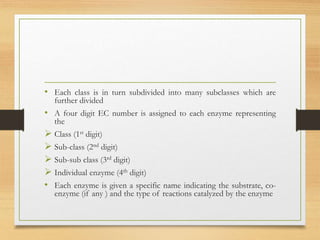
• Each class is in turn subdivided into many subclasses which are
further divided
• A four digit EC number is assigned to each enzyme representing
the
 Class (1st digit)
 Sub-class (2nd digit)
 Sub-sub class (3rd digit)
 Individual enzyme (4th digit)
• Each enzyme is given a specific name indicating the substrate, co-
enzyme (if any ) and the type of reactions catalyzed by the enzyme
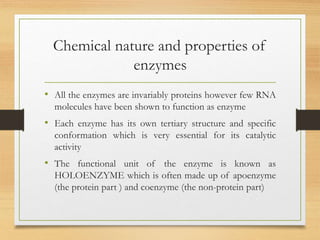
Chemical nature and properties of
enzymes
• All the enzymes are invariably proteins however few RNA
molecules have been shown to function as enzyme
• Each enzyme has its own tertiary structure and specific
conformation which is very essential for its catalytic
activity
• The functional unit of the enzyme is known as
HOLOENZYME which is often made up of apoenzyme
(the protein part ) and coenzyme (the non-protein part)
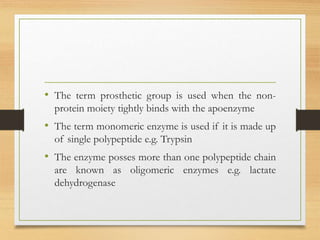
• The term prosthetic group is used when the non-
protein moiety tightly binds with the apoenzyme
• The term monomeric enzyme is used if it is made up
of single polypeptide e.g. Trypsin
• The enzyme posses more than one polypeptide chain
are known as oligomeric enzymes e.g. lactate
dehydrogenase

Enzyme ppt

  • 1.
  • 2.
    Introduction Enzymes are biocatalysts-thecatalysts of life A catalyst is defined as a substance that increases the velocity or rate of chemical reaction without itself undergoing any change in the overall process
  • 3.
    Enzyme Enzyme may bedefined as biocatalysts synthesized by living cells. They are protein in nature (except ribozyme), colloidal and thermo liable in character and specific in their action
  • 4.
    Historical background • Berzeliusin 1836 coined the term catalysis (Greek-to dissolve) • In 1878, Kuhne used the word enzyme (Greek-in yeast) to indicate the catalysis taking place in the biological systems. • Isolation of enzyme system from cell free extract of yeast was achieved in 1883 by Buchner. He named the active principle as zymase which could convert sugar into alcohol • In 1926, James Sumner first achieved the isolation and crystallization of the enzyme urease from lack bean and identified it as a protein
  • 5.
    Nomenclature and classification •In the early days, the enzymes were given names by their discoverers in an arbitrary manner. For example the names pepsin, trypsin and chymotrypsin convey no information about the function of enzyme or the nature of the substrate on which they act • Sometimes the suffix ase was added to the substrate for naming the enzyme. e.g. Lipase acts on lipids, nuclease on nucleic acid, lactase on lactose
  • 6.
    • Enzymes aresometimes considered under two broad categories Intracellular enzymes Extracellular enzymes • The international union of biochemistry (IUB) appointed an enzyme commission in 1961. enzymes are divided into six major classes. Each class on its own represents the general type of reaction brought about by enzymes of the class
  • 7.
    1. Oxidoreductase 2. Transferase 3.Hydrolases 4. Lyases 5. Isomerases 6. Ligases
  • 8.
    Oxidoreductases • Enzymes involvedin oxidation reduction reactions e.g. (alcohol: NAD+ oxidoreductase E.C. 1.1.1.1), cytochrome oxidase, L and D amino acid oxidase Oxidation reduction AH2 + B A+BH2
  • 9.
    Transferases • Enzymes thatcatalyze the transfer of functional groups • Hexokinase, transaminase, transmethylase, phosphorylase Group transfer A-X + B A+B-X
  • 10.
    Hydrolases • Enzymes thatbring about hydrolysis of various compounds • Lipase, alkaline phosphastases, pepsin, urease Hydrolysis A-B +H2O AH +BOH
  • 11.
    Lyases • Enzymes specializedin the addition or removal of water, ammonia CO2 etc • Aldolase , fumarase, histidase Addition elimination A-B + X-Y AX-BY
  • 12.
    Isomerases • Enzymes involvedin all isomerization reactions • Triose phosphate isomerase, phosphohexose isomerase Interconversion of isomers A A’
  • 13.
    Ligases • Enzymes catalyzingthe synthetic reactions where two molecules are joined together and ATP is used. • Glutamine synthetase, succinate thiokinase Condensation A+B A-B ATP ADP+ Pi
  • 14.
    • Each classis in turn subdivided into many subclasses which are further divided • A four digit EC number is assigned to each enzyme representing the  Class (1st digit)  Sub-class (2nd digit)  Sub-sub class (3rd digit)  Individual enzyme (4th digit) • Each enzyme is given a specific name indicating the substrate, co- enzyme (if any ) and the type of reactions catalyzed by the enzyme
  • 15.
    Chemical nature andproperties of enzymes • All the enzymes are invariably proteins however few RNA molecules have been shown to function as enzyme • Each enzyme has its own tertiary structure and specific conformation which is very essential for its catalytic activity • The functional unit of the enzyme is known as HOLOENZYME which is often made up of apoenzyme (the protein part ) and coenzyme (the non-protein part)
  • 16.
    • The termprosthetic group is used when the non- protein moiety tightly binds with the apoenzyme • The term monomeric enzyme is used if it is made up of single polypeptide e.g. Trypsin • The enzyme posses more than one polypeptide chain are known as oligomeric enzymes e.g. lactate dehydrogenase