•By
•TEJASWINI L . ASAWE
•ASSISTANT PROFESSOR
•SIDHHIS INSTITUTE OF PHAMACY
•THANE .
 Genetic engineering is the modification of an
organism's by manipulating its genetic material.
 Some genetic engineering uses the principle of
recombination.
 Recombination is the process through which a
new gene is inserted into a bacterial DNA "The
plasmid".
 The DNA needs to be cut with an enzyme called
a restriction enzyme.
 The restriction enzyme used must have a specific
shape that allows it to move along the DNA that
is to be cut.
 The restriction enzyme looks for a specific point
in the DNA sequence at which to cut the DNA.
 When the restriction enzyme cuts, it leaves a
"Sticky end" which helps a new gene to attach at
that point.
 Another enzyme is used to attach the new DNA
segment; this is called "DNA ligase".
 Genetically engineered bacterium is cultured and
many new copies of the bacteria with the new
gene are grown.
 Genetic modifications can be made to both
plants and animals.
 The genetic engineering involves change in
DNA of an organism usually by
 Deleting
 Inserting
 Substituting
 Resultant (gene) DNA produce desired
characteristics.
Desired gene from DNA
Cut DNA
Bacterial DNA/RNA
Cut Bacterial DNA
Recombine DNA
With desired
characteristics
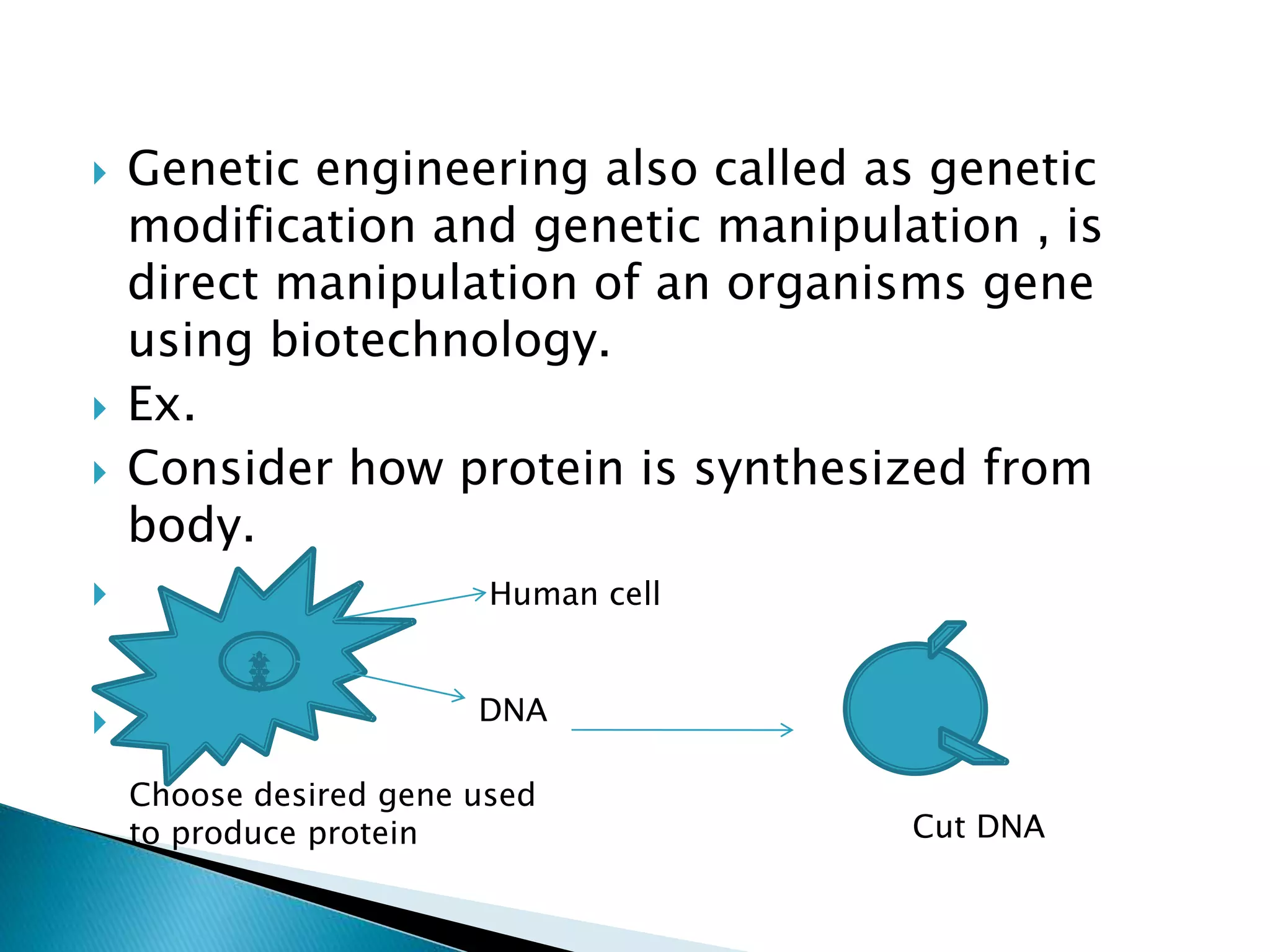
 Genetic engineering also called as genetic
modification and genetic manipulation , is
direct manipulation of an organisms gene
using biotechnology.
 Ex.
 Consider how protein is synthesized from
body.


Human cell
DNA
Cut DNA
Choose desired gene used
to produce protein
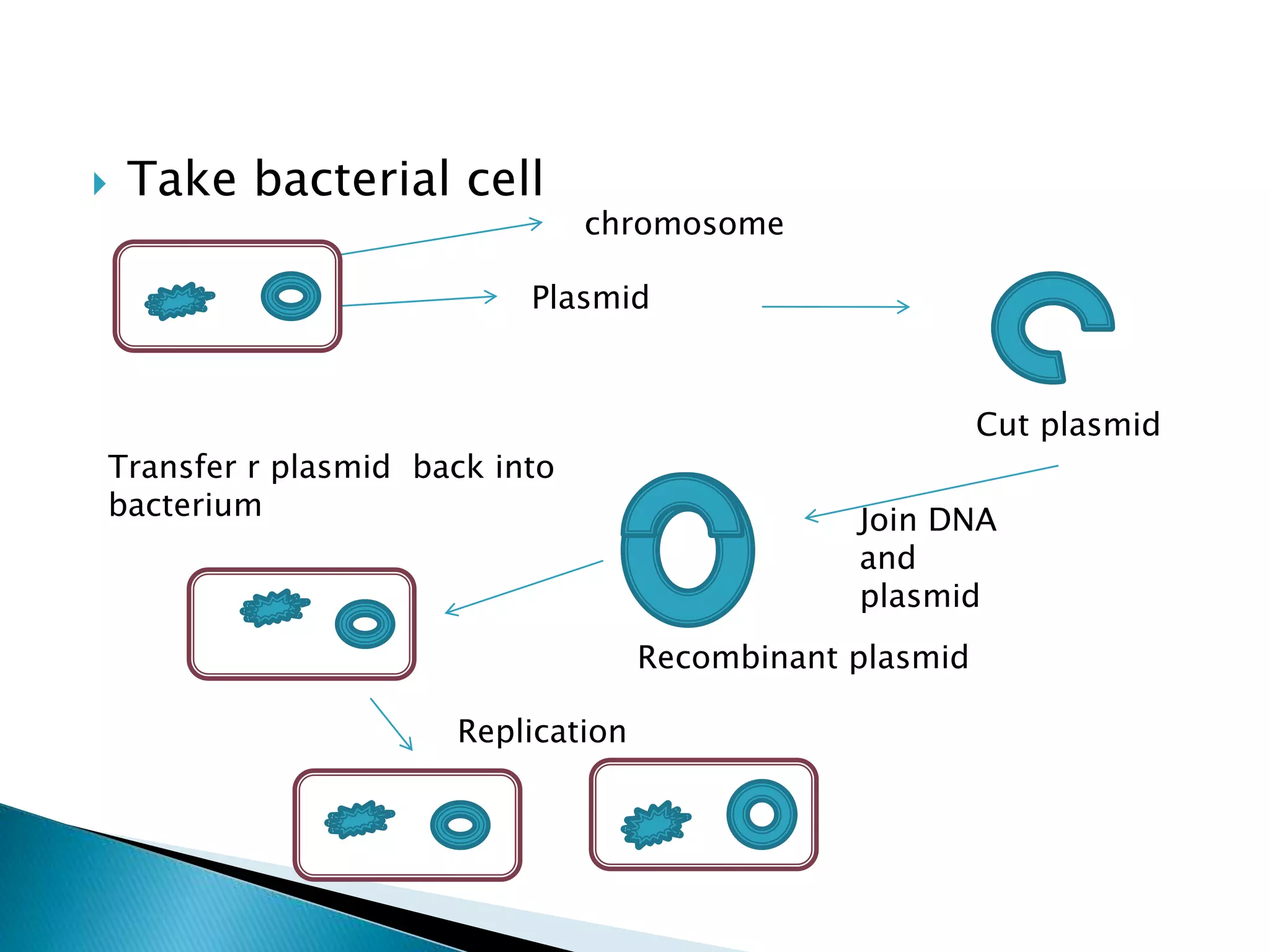
 Take bacterial cell
chromosome
Plasmid
Cut plasmid
Join DNA
and
plasmid
Recombinant plasmid
Transfer r plasmid back into
bacterium
Replication
 The isolation (choose essential DNA
fragment) of DNA fragment from a donor
organism.
 The insertion of an isolated donor DNA
fragment into a vector genome
 The growth of recombinant vector in
appropriate host .
1. Production of pharmaceutical products-
 The recombinant DNA technology can be employed to produce
human proteins that can be used for treatment of genetic
diseases.
 Human insulin ( humulin) is the first therapeutic produced by r
DNA technology by Eli Lilly in 1980 .
 Shreya life sciences,pune has started producing the second
generation r DNA based insulin name Recosulin .
 the second generation recombinant proteins (muteins) are
produced by site directed mutagenesis and protein
enginnering.
 Human growth hormones(hGH) can be synthesized by genetic
engineering.
 Alpha interferon and beta interferon were successfully
produced from genetically engineered E-coli cells.
 The yeast saccharomyses cerevisiae is more suitable for
production of recombinant interferons.
 Vaccines are another group of pharmaceutical
products of r DNA technology.
 Recombinant vaccines may be classified as subunit
recombinant vaccines, attenuated recombinant
vaccines &vector recombinant vaccine.
 Recombinant hepatitis B vaccine( subunit vaccine) is
produced by cloning hepatitis B surface antigen
(HBsAg) in yeast cell.
 It was marketed by trade names Recombivax &
Engerix – B .
 Transgenic plants (tomato ,potato) have been
developed for expressing antigens derived from
animal viruses.
 Genetic engineering has solved the problem of
diagnosis of disease by using DNA probe,
monoclonal antibodies & antenatal diagnosis.
 DNA probes used for diagnosis of pathogens
contains DNA sequence of genetic material of
parasite.
 Monoclonal antibodies are produced against a
variety of proteins, glycoprotein's, glycolipids,
nucleic acid etc.
 These antibodies are useful in diagnosis of
cancer, viral diseases, pregnancy, ABO blood
groups and certain hormones.
 Gene therapy is the process of inserting
genes into cells to treat diseases.
 The newly introduced genes will encode
proteins and correct the deficiencies that
occur in genetic disease.
 Plants and animals are the best source of foods
and pharmaceuticals.
 Crop improvement by genetic engineering helps
for improvement of yield or disease resistance.
 Agrobacterium tumifactions can be used as a
vector for transferring the desired genes into
plant cells.
 Transgenic animals serves as good model for
understanding the human diseases.
 Transgenesis is important for improving the
quality and quantity of milk ,meat , eggs and
wool production.
 The Golden Rice Technology
 A japonica variety of rice was engineered with three genes
necessary for the rice grain to produce and store beta-
carotene.
 These included two genes from the daffodil plant and a
third from a bacterium.
 Researchers used a plant microbe to ferry in the genes into
the plant cells.
 The incorporation of these genes allows the rice plant to
modify certain metabolic pathways in its cells to produce
precursors of Vitamin A, which was previously not
possible.
 This was considered a technical milestone, as most
agronomic traits engineered to date have only required the
introduction of a single gene.
 A four-step process:
 Agrobacterium is bacteria that uses a
Horizontal gene transfer (HGT) to cause
tumers in plants .
 Agrobacterium used in biotechnology for
plant improvemet.
 HGT is the transfer of DNA between different
genomes
 [Pop up: A genome is the complete set of
genetic material present in an organism].
 HGT can occur in bacteria through
transformation, conjugation and
Transduction. .
 Bacteria have three ways of transferring bacteria between cells:
 Transformation: The uptake and incorporation of external DNA
into the cell thereby resulting in the alteration of the genome
 Conjugation: The exchange of genetic material through cell-to-
cell contact of two bacterial cells. A strand of plasmid DNA is
transferred to the recipient cell and the donor cell then synthesis
DNA to replace the strand that was transferred to the recipient
cell.
 Transduction: A segment of bacterial DNA is carried from one
bacterial cell to another by a bacteriophage. The bacteriophage
infects a bacterial cell and takes up bacterial DNA. When this
phage infects another cell, it transfers the bacterial DNA to the
new cell. The bacteria can then become a part of the new host
cell.
 Agrobacterium also has the ability to transfer DNA between itself
and plants and is therefore commonly used in genetic
engineering. The process of using Agrobacterium for genetic
engineering is illustrated in the diagram below.
GENETIC ENGINEERING.pptx

GENETIC ENGINEERING.pptx

  • 1.
    •By •TEJASWINI L .ASAWE •ASSISTANT PROFESSOR •SIDHHIS INSTITUTE OF PHAMACY •THANE .
  • 2.
     Genetic engineeringis the modification of an organism's by manipulating its genetic material.  Some genetic engineering uses the principle of recombination.  Recombination is the process through which a new gene is inserted into a bacterial DNA "The plasmid".  The DNA needs to be cut with an enzyme called a restriction enzyme.  The restriction enzyme used must have a specific shape that allows it to move along the DNA that is to be cut.
  • 3.
     The restrictionenzyme looks for a specific point in the DNA sequence at which to cut the DNA.  When the restriction enzyme cuts, it leaves a "Sticky end" which helps a new gene to attach at that point.  Another enzyme is used to attach the new DNA segment; this is called "DNA ligase".  Genetically engineered bacterium is cultured and many new copies of the bacteria with the new gene are grown.  Genetic modifications can be made to both plants and animals.
  • 4.
     The geneticengineering involves change in DNA of an organism usually by  Deleting  Inserting  Substituting  Resultant (gene) DNA produce desired characteristics.
  • 5.
    Desired gene fromDNA Cut DNA Bacterial DNA/RNA Cut Bacterial DNA Recombine DNA With desired characteristics
  • 6.
     Genetic engineeringalso called as genetic modification and genetic manipulation , is direct manipulation of an organisms gene using biotechnology.  Ex.  Consider how protein is synthesized from body.   Human cell DNA Cut DNA Choose desired gene used to produce protein
  • 7.
     Take bacterialcell chromosome Plasmid Cut plasmid Join DNA and plasmid Recombinant plasmid Transfer r plasmid back into bacterium Replication
  • 8.
     The isolation(choose essential DNA fragment) of DNA fragment from a donor organism.  The insertion of an isolated donor DNA fragment into a vector genome  The growth of recombinant vector in appropriate host .
  • 9.
    1. Production ofpharmaceutical products-  The recombinant DNA technology can be employed to produce human proteins that can be used for treatment of genetic diseases.  Human insulin ( humulin) is the first therapeutic produced by r DNA technology by Eli Lilly in 1980 .  Shreya life sciences,pune has started producing the second generation r DNA based insulin name Recosulin .  the second generation recombinant proteins (muteins) are produced by site directed mutagenesis and protein enginnering.  Human growth hormones(hGH) can be synthesized by genetic engineering.  Alpha interferon and beta interferon were successfully produced from genetically engineered E-coli cells.  The yeast saccharomyses cerevisiae is more suitable for production of recombinant interferons.
  • 10.
     Vaccines areanother group of pharmaceutical products of r DNA technology.  Recombinant vaccines may be classified as subunit recombinant vaccines, attenuated recombinant vaccines &vector recombinant vaccine.  Recombinant hepatitis B vaccine( subunit vaccine) is produced by cloning hepatitis B surface antigen (HBsAg) in yeast cell.  It was marketed by trade names Recombivax & Engerix – B .  Transgenic plants (tomato ,potato) have been developed for expressing antigens derived from animal viruses.
  • 11.
     Genetic engineeringhas solved the problem of diagnosis of disease by using DNA probe, monoclonal antibodies & antenatal diagnosis.  DNA probes used for diagnosis of pathogens contains DNA sequence of genetic material of parasite.  Monoclonal antibodies are produced against a variety of proteins, glycoprotein's, glycolipids, nucleic acid etc.  These antibodies are useful in diagnosis of cancer, viral diseases, pregnancy, ABO blood groups and certain hormones.
  • 12.
     Gene therapyis the process of inserting genes into cells to treat diseases.  The newly introduced genes will encode proteins and correct the deficiencies that occur in genetic disease.
  • 13.
     Plants andanimals are the best source of foods and pharmaceuticals.  Crop improvement by genetic engineering helps for improvement of yield or disease resistance.  Agrobacterium tumifactions can be used as a vector for transferring the desired genes into plant cells.  Transgenic animals serves as good model for understanding the human diseases.  Transgenesis is important for improving the quality and quantity of milk ,meat , eggs and wool production.
  • 14.
     The GoldenRice Technology  A japonica variety of rice was engineered with three genes necessary for the rice grain to produce and store beta- carotene.  These included two genes from the daffodil plant and a third from a bacterium.  Researchers used a plant microbe to ferry in the genes into the plant cells.  The incorporation of these genes allows the rice plant to modify certain metabolic pathways in its cells to produce precursors of Vitamin A, which was previously not possible.  This was considered a technical milestone, as most agronomic traits engineered to date have only required the introduction of a single gene.  A four-step process:
  • 16.
     Agrobacterium isbacteria that uses a Horizontal gene transfer (HGT) to cause tumers in plants .  Agrobacterium used in biotechnology for plant improvemet.  HGT is the transfer of DNA between different genomes  [Pop up: A genome is the complete set of genetic material present in an organism].  HGT can occur in bacteria through transformation, conjugation and Transduction. .
  • 17.
     Bacteria havethree ways of transferring bacteria between cells:  Transformation: The uptake and incorporation of external DNA into the cell thereby resulting in the alteration of the genome  Conjugation: The exchange of genetic material through cell-to- cell contact of two bacterial cells. A strand of plasmid DNA is transferred to the recipient cell and the donor cell then synthesis DNA to replace the strand that was transferred to the recipient cell.  Transduction: A segment of bacterial DNA is carried from one bacterial cell to another by a bacteriophage. The bacteriophage infects a bacterial cell and takes up bacterial DNA. When this phage infects another cell, it transfers the bacterial DNA to the new cell. The bacteria can then become a part of the new host cell.  Agrobacterium also has the ability to transfer DNA between itself and plants and is therefore commonly used in genetic engineering. The process of using Agrobacterium for genetic engineering is illustrated in the diagram below.