AGROBACTERIUM MEDIATED GENE TRANSFER
Transformation:
 Uptake of foreign DNA by plant cells or Altering the
genome of plant cells is called transformation and these techniques
are known as Transformation techniques.
Techniques for plant genetic transformation:
Indirect method :
 1.Agrobacterium mediated gene transfer
Direct method :
 1.Particle bombardment method (biolistics).
 2 .Electroporation .
 3. PEG ( Polyethylene glycol method ).
 4. Microinjection.
 5. Silicon carbide fibres.
Agrobacterium tumefaciens :
 It is a rod shaped ,Gram negative, wide-spread soil inhabiting
bacterium and has Ti(Tumor inducing) plasmid.
 This bacterium invades crops such as tomato , sunflower ,
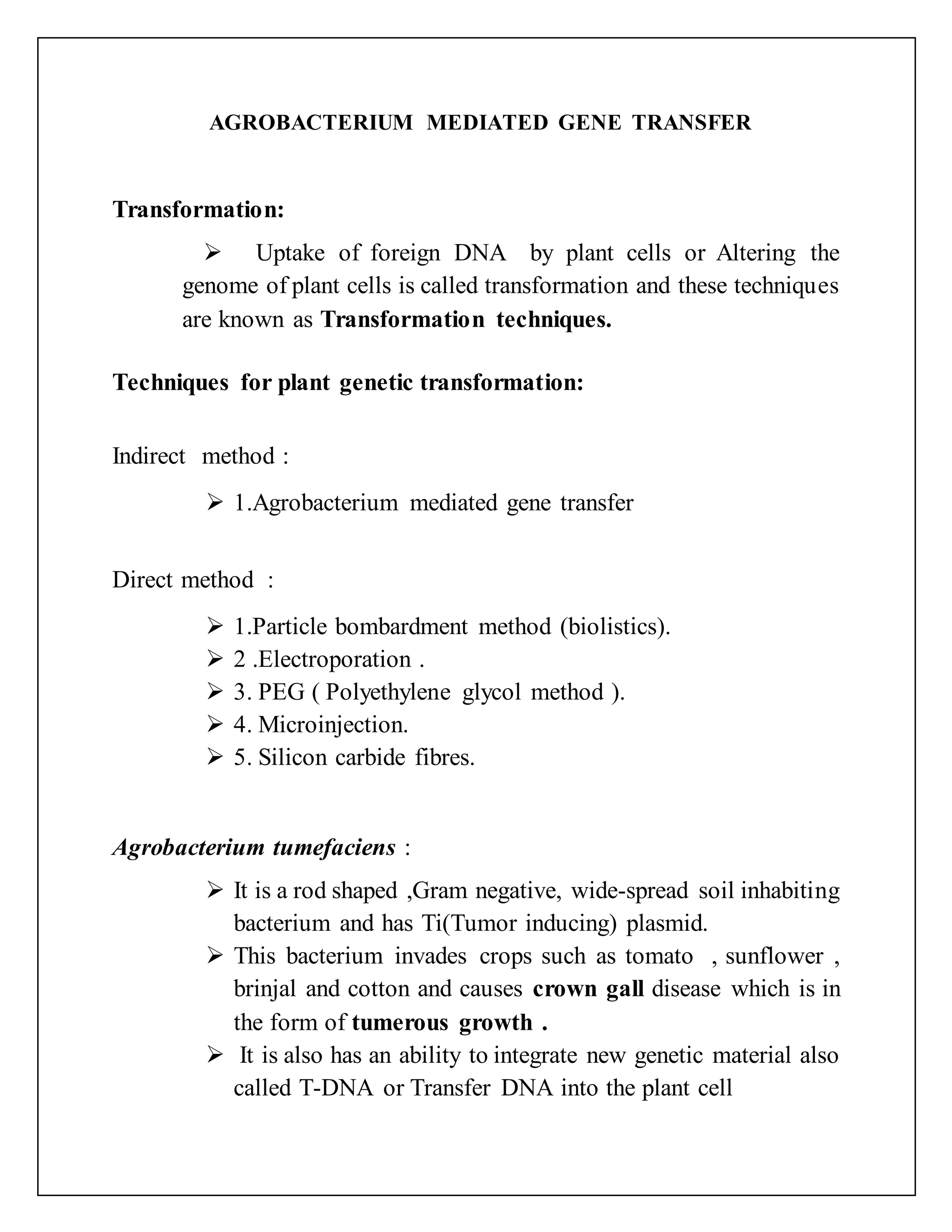
brinjal and cotton and causes crown gall disease which is in
the form of tumerous growth .
 It is also has an ability to integrate new genetic material also
called T-DNA or Transfer DNA into the plant cell
 It is also called “Natural Genetic Engineer”.
Crown gall disease:
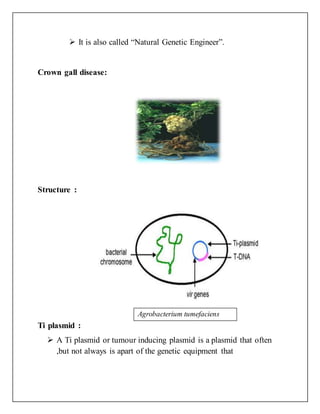
Structure :
Ti plasmid :
 A Ti plasmid or tumour inducing plasmid is a plasmid that often
,but not always is apart of the genetic equipment that
Agrobacterium tumefaciens
Agrobacterium tumefaciens use to transduce its genetic material to
plants
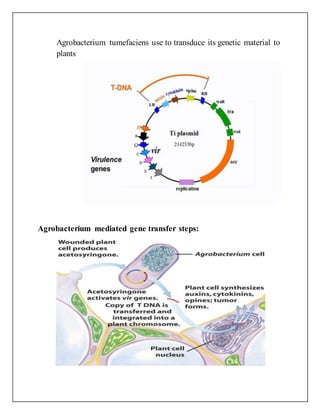
Agrobacterium mediated gene transfer steps:
 Wounded plant cell produced actosyringone
 Acetosyringone is a small molecule and it is one of the plant derived
compounds that induce vir(virulence) genes.
 Virulence proteins synthesize the single stranded T-DNA ( Transfer
DNA).
 Then, Single stranded T-DNA only intermediate and transfer to
plant cells .This T-DNA complex import to nucleus and integrated.
 After integrating to the nucleus T-DNA have auxin , cytokinin ,
opines enzymes .First cytokinin and auxin synthesized promotes to
the tumor formation in Agrobacterium infected plant cells.
Important Requirements:
 The explants of the plant must produce phenolic compounds
(e.g.acetosringone) for activation of virulence genes
 Transformed cells/Tissues should be capable to regenerate into
whole plants.
Advantages :
 This is a natural method of gene transfer.
 Agrobacterium can conveniently infect any explant
(cells/tissues/organs)
 Even large fragments of DNA can be efficiently transferred.
 Stability of transferred DNA is reasonably good.
 Transformed plants can be regenerated effectively.
Limitations:
 There is a limitation of host plants for Agrobacterium , since many
crop plants (monocotyledons e.g. cereals ) are not infected by it. In
recent years, virulent strains of Agrobacterium that can infect a wide
range of plants have been developed.
 The cells that regenerate more efficiently are often difficult to
transform. E.g. embryonic cells lie in deep layers which are not easy
targets for Agrobacterium.

Agrobacterium mediated gene transfer

  • 1.
    AGROBACTERIUM MEDIATED GENETRANSFER Transformation:  Uptake of foreign DNA by plant cells or Altering the genome of plant cells is called transformation and these techniques are known as Transformation techniques. Techniques for plant genetic transformation: Indirect method :  1.Agrobacterium mediated gene transfer Direct method :  1.Particle bombardment method (biolistics).  2 .Electroporation .  3. PEG ( Polyethylene glycol method ).  4. Microinjection.  5. Silicon carbide fibres. Agrobacterium tumefaciens :  It is a rod shaped ,Gram negative, wide-spread soil inhabiting bacterium and has Ti(Tumor inducing) plasmid.  This bacterium invades crops such as tomato , sunflower , brinjal and cotton and causes crown gall disease which is in the form of tumerous growth .  It is also has an ability to integrate new genetic material also called T-DNA or Transfer DNA into the plant cell
  • 2.
     It isalso called “Natural Genetic Engineer”. Crown gall disease: Structure : Ti plasmid :  A Ti plasmid or tumour inducing plasmid is a plasmid that often ,but not always is apart of the genetic equipment that Agrobacterium tumefaciens
  • 3.
    Agrobacterium tumefaciens useto transduce its genetic material to plants Agrobacterium mediated gene transfer steps:
  • 4.
     Wounded plantcell produced actosyringone  Acetosyringone is a small molecule and it is one of the plant derived compounds that induce vir(virulence) genes.  Virulence proteins synthesize the single stranded T-DNA ( Transfer DNA).  Then, Single stranded T-DNA only intermediate and transfer to plant cells .This T-DNA complex import to nucleus and integrated.  After integrating to the nucleus T-DNA have auxin , cytokinin , opines enzymes .First cytokinin and auxin synthesized promotes to the tumor formation in Agrobacterium infected plant cells. Important Requirements:  The explants of the plant must produce phenolic compounds (e.g.acetosringone) for activation of virulence genes  Transformed cells/Tissues should be capable to regenerate into whole plants. Advantages :  This is a natural method of gene transfer.  Agrobacterium can conveniently infect any explant (cells/tissues/organs)  Even large fragments of DNA can be efficiently transferred.  Stability of transferred DNA is reasonably good.  Transformed plants can be regenerated effectively.
  • 5.
    Limitations:  There isa limitation of host plants for Agrobacterium , since many crop plants (monocotyledons e.g. cereals ) are not infected by it. In recent years, virulent strains of Agrobacterium that can infect a wide range of plants have been developed.  The cells that regenerate more efficiently are often difficult to transform. E.g. embryonic cells lie in deep layers which are not easy targets for Agrobacterium.