The document discusses recombinant DNA technology and its ability to introduce genes into microorganisms for the production of valuable metabolites, such as insulin and vaccines. It highlights various genetic engineering techniques, including gene transfer methods and cloning vectors, as well as applications in human health, agriculture, and bioremediation. Genetically modified microorganisms (GMMs) have significant roles across several industries, contributing to more environmentally friendly methods of production and enhanced yields of desired products.
Introduction
Recombinant DNAtechnology uses genetic engineering to introduce
genes into microorganisms & other cells
Then help produce metabolites of commercial or medical importance
such as insulin,vitamin,aminoacids or enzymes.
Most reason to prefer microbes because microorganisms grow rapidly &
in most cases are easy to cultivate.
Using microorganisms is much environmentally friendly than
conventional chemical synthetic method; they use less energy & use
renewable resources.
3.
Today, geneticallymodified microorganisms (GMMs) have found
applications in human health, agriculture, and bioremediation and in
industries such as food, paper, and textiles.
genetic engineering offers sufficient supplies of desired products,
cheaper product production, and safe handling of otherwise dangerous
agents.
4.
Molecular tools forgenetic engineering
of microorganisms
To manipulate microorganisms for the expression of desired traits
1.Gene transfer method
to deliver the selected genes into desired hosts.
2.Cloning vector
3.Promoters
to control the expression of desired genes
4.Selectable marker genes to identify recombinant microorganisms
5.
1.Gene transfer method
Transformation
In this process uptake of plasmid DNA by recipient microorganisms is accomplished
when they are in a physiological stage of competence.
Electroporation
Alternative method to transform DNA in to microorganisms. This method originally
used to transform eukaryotic cells. High voltage pulses make recipient cells
electrocompetant. Transient pores are formed in the cell membrane as a result of an
electroshock, there by allowing DNA uptake
6.
Conjugation
This methodinvolves a donor strain that contains both the gene of interest & the
origin of transfer (Ori T) on a plasmid & the gene encoding transfer function. The contact
between donor & recipient DNA transform occurs.
Vectors
Cloning vectors to carry out genetic modifications depend upon choice of the gene
transfer
7.
Promoters
Promoter isa segment of DNA that regulates the expression of the gene under its
control
1.Constitutive promoters : continuously active
2.Inducible promoters : activate only certain condition –
presence of inducer
Selectable marker genes
Which often encodes proteins conferring resistance to antibiotics for identifying
transformants.
8.
Strategies for geneticengineering of
microorganisms
1. Disruption or complete removal of undesired genes or their pathways
2. Over expression of target gene
high expression its an drawbacks, it leads to segregation of desirable genes &
loss of desired traits.
3. Improving protein production properties.
Applications of GMMsderived products
1. Human health
* Recombinant therapeutics proteins
1.Human insulin - Herbert Boyer 1978 -1st recombinant therapeutic protein
approved by the FDA in 1982.was produced by genetically engineered E.coli containing
human insulin genes
2.Human growth hormone (hGH) approved by FDA in 1985.was produced by
modified E.coli strain containing native human growth hormone gene.
11.
* Recombinant vaccines
1.Saccharomycescerevisiae common baker’s yeast produce Hepatitis
B virus against vaccine based on the hepatitis B surface antigen. Trade
name Engerix-B
12.
Animal health
1.Recombinant vaccines
toeradicate Rabies - antirabies ϒ globulin treatment
Textile industry
α-amylase of Bacillus stearothermophilus
Amylases have been used for many years to remove starch sizes from fabrics, known
as desizing. Originally, amylases from plant or animal sources were used. Later, they
were replaced by amylases of bacterial origin.
13.
Agriculture
Nitrogen fixinggenes nif L & nif A can be inserted inti Rhizobium
meliloti strain of bacteria ,there by increase the amount of nitrogen
fixed by these bacteria
Indigo a commercially blue pigment that is used to dye both cotton &
& wool, was originally isolated from plants.-------- rec E.coli bacteria
with plasmid NAH7 is used for producing indigo by biotechnological
method.
14.
Insecticidal
Toxin genefrom Bacillus thuringensis israelensis is inserted into
Synechocystis & Synecho coccus spp ( photosynthetic
cyanobacteria that are food source of the mosquito larvae)
Caucobacter crescentus an aquatic bacterium
The insecticidal protein is highly toxic when ingested by mosquito
larvae
15.
Bioremediation
Using microbesto clean up pollution
Genetically engineered bacteria capable of cleaning oil spills.
Oil contain four main group of Hydrocarbons present in oil
(Xylenes,naphthalenes,octanes,camphor)
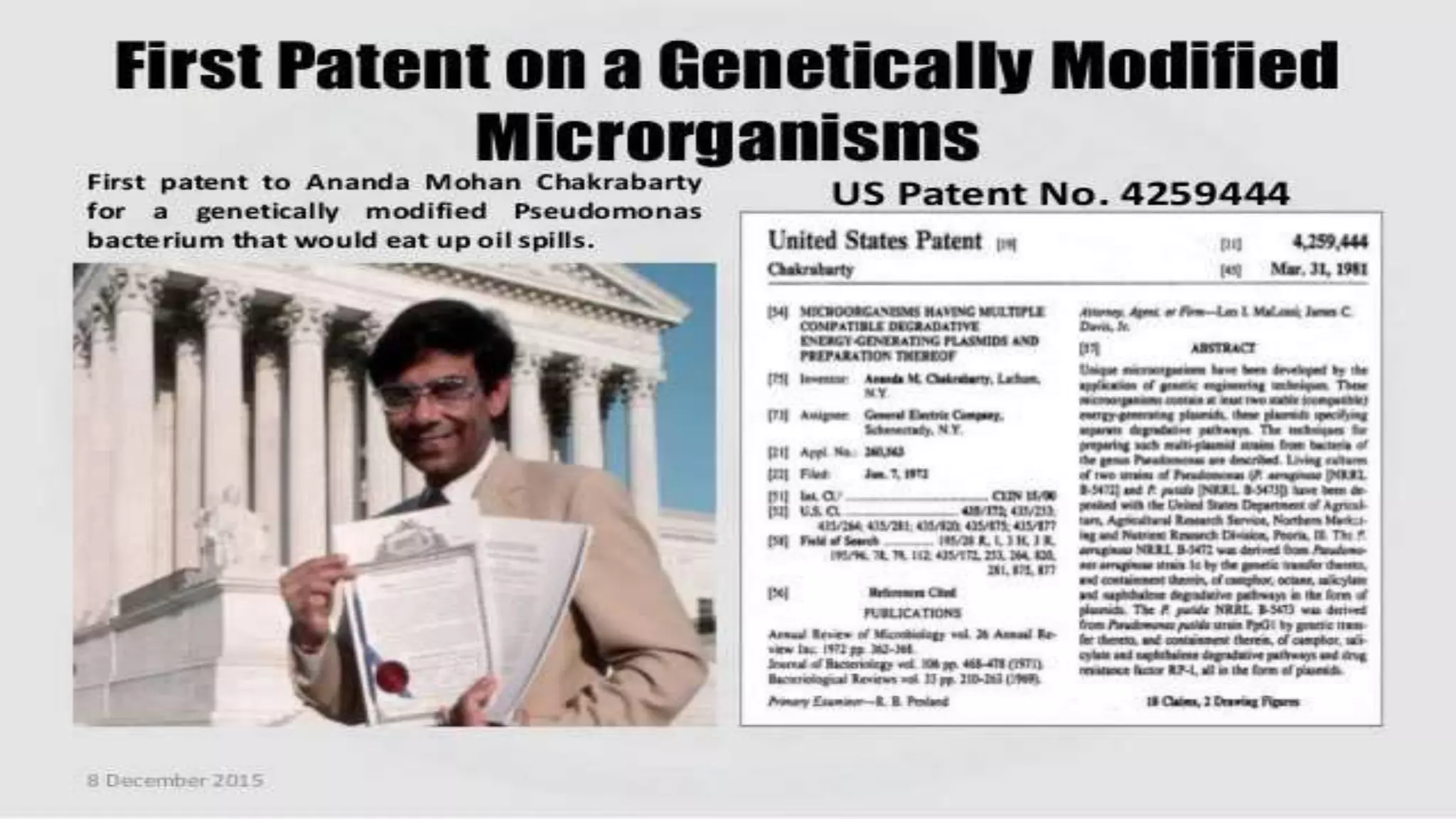
The oil eating super bug was developed at Generic Electric in 1975 by Ananda mohan
chakrabarty
1980 he received a patent on a genetically modified Pseudomonas putida bacterium that
would eat up oil spills.
He was the first person to win patent on a living organism
Food production
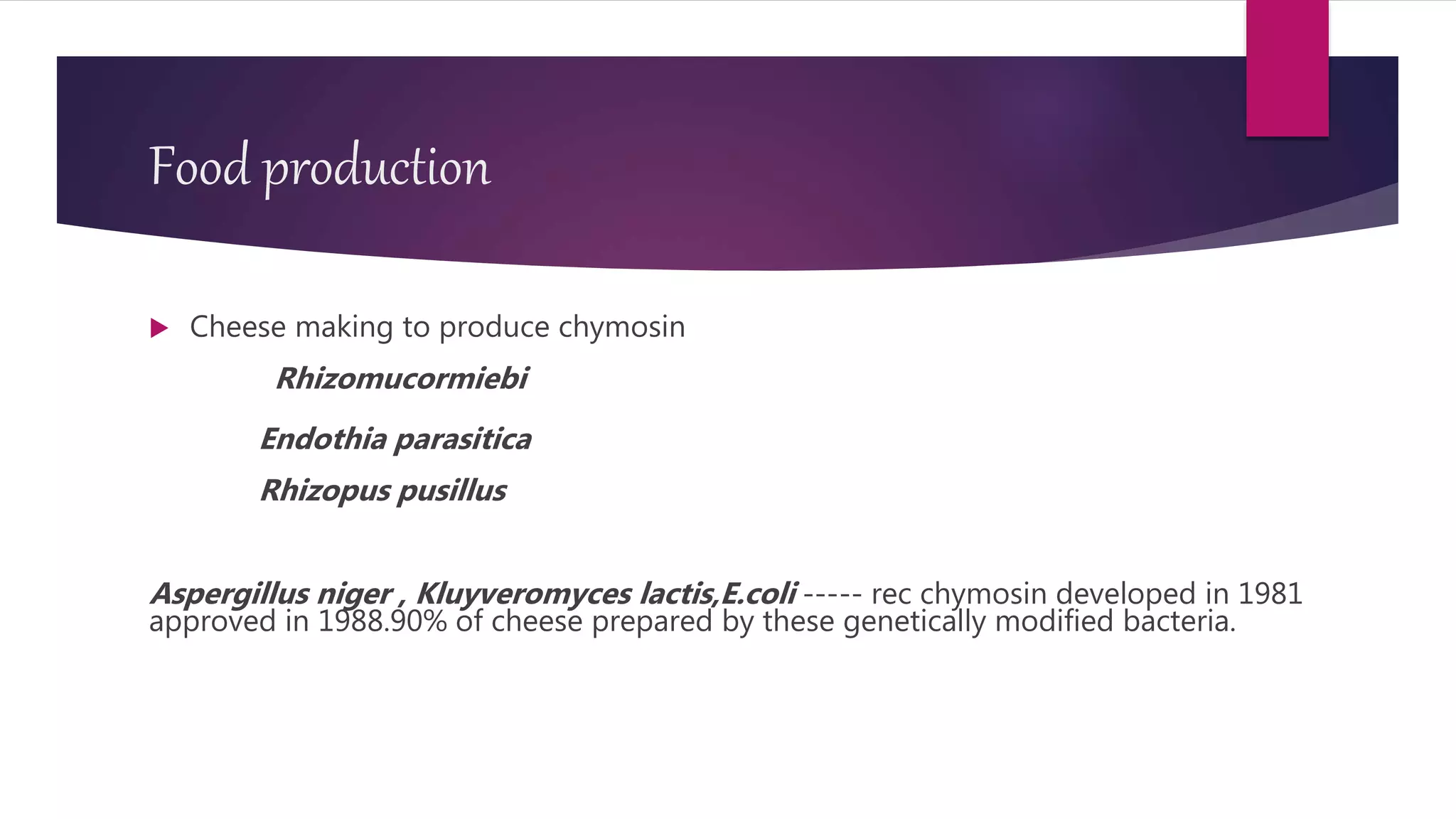
Cheesemaking to produce chymosin
Rhizomucormiebi
Endothia parasitica
Rhizopus pusillus
Aspergillus niger , Kluyveromyces lactis,E.coli ----- rec chymosin developed in 1981
approved in 1988.90% of cheese prepared by these genetically modified bacteria.
Reference
– Biotechnology microbiologyimmunology
A T Thomas,P Cyril,Boby jose – Manjusha publication
– Genetically Modified Microorganisms
Development and Applications -Lei Han