Absorption of Proteins
Learning Objectives
 What are Proteins?
 Composition of Proteins.
 Digestion of Proteins.
 Absorption of Proteins.
 Absorption of Amino acids.
What are Proteins?
• Proteins are the most abundant
organic molecule of the living
system.
• It forms the fundamental basis of
structure and function of life.
• They are macromolecules.
 They constitute about 50% of the
cellular dry weight.
 They are not only the cell building
blocks; they also execute all the cell
functions.
 Proteins are the polymers of amino
acid.
Function of Proteins
Protein performs a very great variety of
specialized and essential functions in the
living cells.
These functions may be broadly grouped
as Static (Structural) and Dynamic
functions.
Composition
 Carbon = 50-55%
 Oxygen = 19-24%
 Nitrogen = 13%
 Hydrogen = 6-7%
 Sulfur = 4%
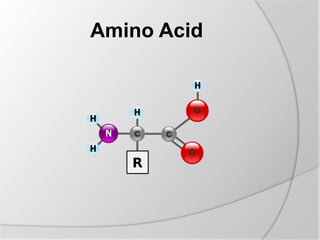
Amino Acid
Rashid Minhas
#30
Digestion and Absorption
Digestion:
In chemical digestion, enzymes break
down food into the small molecules the
body can use. (Chemical Digestion)
In the human digestive system, food
enters the mouth and mechanical
digestion of the food starts by the action of
mastication (chewing), a form of
mechanical digestion, and the wetting
contact of saliva. (Physical Digestion).
Digestion in Mouth
 There is no digestion of protein in mouth
because no proteolytic enzymes present
in the saliva.
 Saliva only lubricate the food, this helps
in making food soluble for the action of
proteolytic enzymes.
Sana Khan
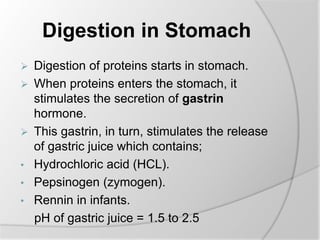
Digestion in Stomach
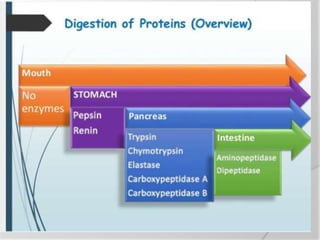
 Digestion of proteins starts in stomach.
 When proteins enters the stomach, it
stimulates the secretion of gastrin
hormone.
 This gastrin, in turn, stimulates the release
of gastric juice which contains;
• Hydrochloric acid (HCL).
• Pepsinogen (zymogen).
• Rennin in infants.
pH of gastric juice = 1.5 to 2.5
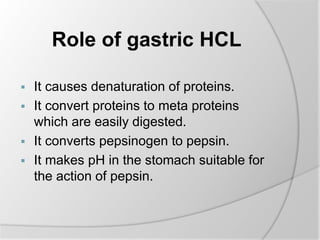
Role of gastric HCL
 It causes denaturation of proteins.
 It convert proteins to meta proteins
which are easily digested.
 It converts pepsinogen to pepsin.
 It makes pH in the stomach suitable for
the action of pepsin.
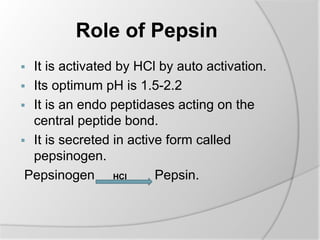
Role of Pepsin
 It is activated by HCl by auto activation.
 Its optimum pH is 1.5-2.2
 It is an endo peptidases acting on the
central peptide bond.
 It is secreted in active form called
pepsinogen.
Pepsinogen HCl Pepsin.
Role of Rennin
 It is a milk-clotting enzyme.
 It is present in the stomach of infants
and young animals.
 Its optimum pH is 4.
 It converts casein of milk into
paracasein.
 It combines with calcium forming
calcium paracaseinate.
Syed Farooq
Digestion in Pancrease
Trypsin:
• It is an endopeptidases and secreted in
an inactive form called trypsinogen.
• Its optimum pH is 8.
• It is activated by entero-kinases.
• It hydrolyze central peptide bond in
which the carboxylic group belongs to
basic amino acid.
• Trypsinogen enterokinases Trypsin
Chymotrypsin
 It is the endopeptidase and secreted in
an
 inactive form.
 Its optimum pH is 8.
 It is activated by trypsin.
 It hydrolyze the central peptide bond in
which the carboxylic group belongs to
aromatic amino acid.
Elastase
 It is also endopeptidases and secreted
in an inactive form called proelastase.
 Its optimum pH is 8.
 It is activated by trypsin.
 It digests elastin and collagen.
 It hydrolyze the central peptide bond in
which the carboxylic group belongs to
aromatic amino acid.
Mohsin Khan
#26
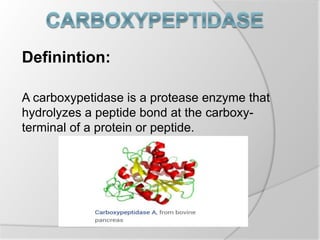
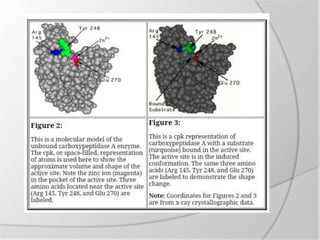
Definintion:
A carboxypetidase is a protease enzyme that
hydrolyzes a peptide bond at the carboxy-
terminal of a protein or peptide.
Funtions
 The first carboxypeptidases studied were
those involved in the digestion of foods.
e.g. Pancreatic Carboxypeptidases A₁,A₂,
and B.
 However, most of the known
carboxypeptidases is not involved in
catabolism; they help to mature protein.
e.g. the biosynthesis of neuroendocrine
peptides such as insulin requires a
carboxypeptidase.
Classfication by Substrate
Preference
This classification system for
carboxypeptidases refers to their substrate
preference.
Carboxypeptidase A:
Pancreatic exocarboxypeptidases that
have a stronger preference for those amino
acids containing aromatic or branched
hydrocarbon chains are called
carboxypeptidases A (A for aromatic or
aliphatic).
Carboxypeptidase B:
 Those carboxypeptidases that cleave
positively charged amino acids are called
carboxypeptidase B (B for basic).
e.g. arginine, lysine
Eishma
Digestion in Intestine
Aminopeptidases:
It is an exopeptidases.
It acts on the terminal peptide bond at
the amino terminal of the peptide chain.
Dipeptidases:
It acts on dipeptide.
It releases two amino acids.
Tripeptidases:
It act on tripeptide.
It releases single amino acid and dipeptide.
Absorption of Proteins
 It is an active process that needs
energy.
 Energy needed is derived from
hydrolysis
 From ATP.
 This process occurs in small intestine.
 Absorption of amino acids is rapid in the
 Duodenum and jejunum but slow in the
 Ileum.
Mechanism of Amino Acids
Absorption
There are two mechanisms of amino acids
absorption.
1. Carrier Protein Transport System.
2. Glutathione Transport System
(Glutamyl Cycle).
Sobia
Carrier Protein Transport
System
 It is the main system for amino acid
absorption.
 It is an active process that needs
energy.
 The energy needed is derived from ATP
molecule.
 There are seven carrier proteins, one for
each group of amino acids.
 Each carrier protein has two sides.
 One for amino acid and another one for
sodium.
 It co-transport s amino acids and sodium
from intestinal lumem to cytosol of
intestinal mucosa cells.
 The absorbed amino acid passes to the
portal circulation, while sodium is
extruded out of the cell with exchange
with potassium (K+) by Sodum (Na+).
Bushra Rahman
Glutathione Transport
System
 It is also known as Glutamyl Cycle.
 Glutathione is used to transport amino
acids from intestinal lumen to cytosol of
intestinal mucosa cells.
 It is an active process that needs
energy.
 The energy needed is derived from ATP.
 Absorption of one amino acid molecule
need 3 ATP.
 Glutathione reacts with amino acid in the
presence of glutacyl.
 Glutamyl amino acid releases amino
acid in the cytosol of intestinal mucosa
cell with formation of 5-oxoproline that is
used for regeneration of glutathione to
begin another turn of the cycle.
Oxoprolinuria:
 It is a disease caused by a defect in
glutathione synthetase enzyme.
 It is characterised by accumulation of
5-oxoproline in blood and hence
excreted in urine.
 It is associated with mental
retardation.
Haseeba
#28
Absorption of Intact Proteins
and polypeptides
 This period is short period, immediately
after birth.
 The small intestine of infants can absorb
intact prroteins and polypeptide by
endocytosis or pioncytosis.
 Intact proteins and polypeptides are not
absorbed by the adult intestine.
 Macromolecular absorption in certain
individuals appears to be responsible for
antibody formation that often causes
food allergy.
Absorption of Amino
Acids
 The absorption occurs mainly in the
small intestine.
 It is an energy requiring process.
 The di- and tripeptidases, after being
absorbed are hydrolyzed into free amino
acids in the cytosol of epithilial cells.
 The activities of dipeptidases are high in
these cells.
 L-Amino acids are more rapidly
absorbed than D-amino acids.
 The transport of L-amino acids occurs
by an active process.
 D-amino acids by a simple diffusion.
Mechanism of absorption of
amino acids
 Na+ dependant active process and
requires ATP.
 Na+ diffuses along the concentration
gradient. The amino acid also enters
the intestinal cell.
 Na+ and amino acids share a common
carrier and transported together.
 The compound ‘cytochlasin’ inhibits Na+
independent transport system.
Abbas Khan
#33
Summary
Digestion of Proteins.
Absorption of Proteins.
The END

Absorption of proteins ppt

  • 1.
  • 2.
    Learning Objectives  Whatare Proteins?  Composition of Proteins.  Digestion of Proteins.  Absorption of Proteins.  Absorption of Amino acids.
  • 3.
    What are Proteins? •Proteins are the most abundant organic molecule of the living system. • It forms the fundamental basis of structure and function of life. • They are macromolecules.
  • 4.
     They constituteabout 50% of the cellular dry weight.  They are not only the cell building blocks; they also execute all the cell functions.  Proteins are the polymers of amino acid.
  • 5.
    Function of Proteins Proteinperforms a very great variety of specialized and essential functions in the living cells. These functions may be broadly grouped as Static (Structural) and Dynamic functions.
  • 6.
    Composition  Carbon =50-55%  Oxygen = 19-24%  Nitrogen = 13%  Hydrogen = 6-7%  Sulfur = 4%
  • 7.
  • 8.
  • 9.
    Digestion and Absorption Digestion: Inchemical digestion, enzymes break down food into the small molecules the body can use. (Chemical Digestion)
  • 10.
    In the humandigestive system, food enters the mouth and mechanical digestion of the food starts by the action of mastication (chewing), a form of mechanical digestion, and the wetting contact of saliva. (Physical Digestion).
  • 11.
    Digestion in Mouth There is no digestion of protein in mouth because no proteolytic enzymes present in the saliva.  Saliva only lubricate the food, this helps in making food soluble for the action of proteolytic enzymes.
  • 12.
  • 13.
    Digestion in Stomach Digestion of proteins starts in stomach.  When proteins enters the stomach, it stimulates the secretion of gastrin hormone.  This gastrin, in turn, stimulates the release of gastric juice which contains; • Hydrochloric acid (HCL). • Pepsinogen (zymogen). • Rennin in infants. pH of gastric juice = 1.5 to 2.5
  • 14.
    Role of gastricHCL  It causes denaturation of proteins.  It convert proteins to meta proteins which are easily digested.  It converts pepsinogen to pepsin.  It makes pH in the stomach suitable for the action of pepsin.
  • 15.
    Role of Pepsin It is activated by HCl by auto activation.  Its optimum pH is 1.5-2.2  It is an endo peptidases acting on the central peptide bond.  It is secreted in active form called pepsinogen. Pepsinogen HCl Pepsin.
  • 16.
    Role of Rennin It is a milk-clotting enzyme.  It is present in the stomach of infants and young animals.  Its optimum pH is 4.  It converts casein of milk into paracasein.  It combines with calcium forming calcium paracaseinate.
  • 17.
  • 18.
    Digestion in Pancrease Trypsin: •It is an endopeptidases and secreted in an inactive form called trypsinogen. • Its optimum pH is 8. • It is activated by entero-kinases. • It hydrolyze central peptide bond in which the carboxylic group belongs to basic amino acid. • Trypsinogen enterokinases Trypsin
  • 19.
    Chymotrypsin  It isthe endopeptidase and secreted in an  inactive form.  Its optimum pH is 8.  It is activated by trypsin.  It hydrolyze the central peptide bond in which the carboxylic group belongs to aromatic amino acid.
  • 20.
    Elastase  It isalso endopeptidases and secreted in an inactive form called proelastase.  Its optimum pH is 8.  It is activated by trypsin.  It digests elastin and collagen.  It hydrolyze the central peptide bond in which the carboxylic group belongs to aromatic amino acid.
  • 21.
  • 22.
    Definintion: A carboxypetidase isa protease enzyme that hydrolyzes a peptide bond at the carboxy- terminal of a protein or peptide.
  • 23.
    Funtions  The firstcarboxypeptidases studied were those involved in the digestion of foods. e.g. Pancreatic Carboxypeptidases A₁,A₂, and B.  However, most of the known carboxypeptidases is not involved in catabolism; they help to mature protein. e.g. the biosynthesis of neuroendocrine peptides such as insulin requires a carboxypeptidase.
  • 24.
    Classfication by Substrate Preference Thisclassification system for carboxypeptidases refers to their substrate preference. Carboxypeptidase A: Pancreatic exocarboxypeptidases that have a stronger preference for those amino acids containing aromatic or branched hydrocarbon chains are called carboxypeptidases A (A for aromatic or aliphatic).
  • 26.
    Carboxypeptidase B:  Thosecarboxypeptidases that cleave positively charged amino acids are called carboxypeptidase B (B for basic). e.g. arginine, lysine
  • 27.
  • 28.
    Digestion in Intestine Aminopeptidases: Itis an exopeptidases. It acts on the terminal peptide bond at the amino terminal of the peptide chain. Dipeptidases: It acts on dipeptide. It releases two amino acids. Tripeptidases: It act on tripeptide. It releases single amino acid and dipeptide.
  • 29.
    Absorption of Proteins It is an active process that needs energy.  Energy needed is derived from hydrolysis  From ATP.  This process occurs in small intestine.  Absorption of amino acids is rapid in the  Duodenum and jejunum but slow in the  Ileum.
  • 30.
    Mechanism of AminoAcids Absorption There are two mechanisms of amino acids absorption. 1. Carrier Protein Transport System. 2. Glutathione Transport System (Glutamyl Cycle).
  • 31.
  • 32.
    Carrier Protein Transport System It is the main system for amino acid absorption.  It is an active process that needs energy.  The energy needed is derived from ATP molecule.  There are seven carrier proteins, one for each group of amino acids.
  • 33.
     Each carrierprotein has two sides.  One for amino acid and another one for sodium.  It co-transport s amino acids and sodium from intestinal lumem to cytosol of intestinal mucosa cells.  The absorbed amino acid passes to the portal circulation, while sodium is extruded out of the cell with exchange with potassium (K+) by Sodum (Na+).
  • 34.
  • 35.
    Glutathione Transport System  Itis also known as Glutamyl Cycle.  Glutathione is used to transport amino acids from intestinal lumen to cytosol of intestinal mucosa cells.  It is an active process that needs energy.  The energy needed is derived from ATP.  Absorption of one amino acid molecule need 3 ATP.
  • 36.
     Glutathione reactswith amino acid in the presence of glutacyl.  Glutamyl amino acid releases amino acid in the cytosol of intestinal mucosa cell with formation of 5-oxoproline that is used for regeneration of glutathione to begin another turn of the cycle.
  • 37.
    Oxoprolinuria:  It isa disease caused by a defect in glutathione synthetase enzyme.  It is characterised by accumulation of 5-oxoproline in blood and hence excreted in urine.  It is associated with mental retardation.
  • 38.
  • 39.
    Absorption of IntactProteins and polypeptides  This period is short period, immediately after birth.  The small intestine of infants can absorb intact prroteins and polypeptide by endocytosis or pioncytosis.
  • 40.
     Intact proteinsand polypeptides are not absorbed by the adult intestine.  Macromolecular absorption in certain individuals appears to be responsible for antibody formation that often causes food allergy.
  • 41.
    Absorption of Amino Acids The absorption occurs mainly in the small intestine.  It is an energy requiring process.  The di- and tripeptidases, after being absorbed are hydrolyzed into free amino acids in the cytosol of epithilial cells.  The activities of dipeptidases are high in these cells.
  • 42.
     L-Amino acidsare more rapidly absorbed than D-amino acids.  The transport of L-amino acids occurs by an active process.  D-amino acids by a simple diffusion.
  • 43.
    Mechanism of absorptionof amino acids  Na+ dependant active process and requires ATP.  Na+ diffuses along the concentration gradient. The amino acid also enters the intestinal cell.  Na+ and amino acids share a common carrier and transported together.  The compound ‘cytochlasin’ inhibits Na+ independent transport system.
  • 44.
  • 45.
  • 47.