Genetic Engineering
Recombinant DNA
Hala Abuzied
MS Human Genetics
Pharmacist/ Research Fellow
Alexandria University Cancer Research Cluster
Genetic Engineering
โ€ข Also called Genetic modification or Genetic manipulation
โ€ข It is the process of altering of an organism's genes using
biotechnology. It is a set of technologies used to change the
genetic makeup of cells.
โ€ข This may mean:
- Changing one base pair (A-T or C-G)
- Deleting a whole region of DNA
- Introducing an additional copy of a gene.
- Extracting DNA from another organismโ€™s genome and combining it
with the DNA of another individual.
โ€ข Genetic Engineering can be applied to any organism, from a virus
to a sheep.
โ€ข Genetic Engineering is of value in many Research and medical
areas
Genetic Engineering
โ€ข The term genetic engineering is often thought to be rather
vague term, yet it is probably the label that most people
would recognize.
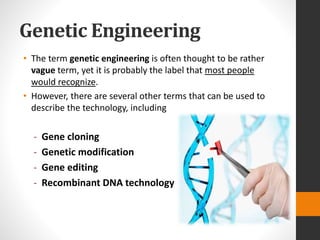
โ€ข However, there are several other terms that can be used to
describe the technology, including
- Gene cloning
- Genetic modification
- Gene editing
- Recombinant DNA technology
Genetic Engineering
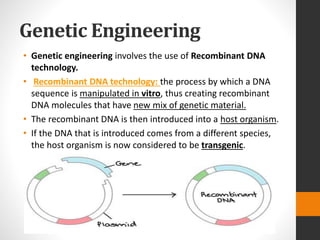
โ€ข Genetic engineering involves the use of Recombinant DNA
technology.
โ€ข Recombinant DNA technology: the process by which a DNA
sequence is manipulated in vitro, thus creating recombinant
DNA molecules that have new mix of genetic material.
โ€ข The recombinant DNA is then introduced into a host organism.
โ€ข If the DNA that is introduced comes from a different species,
the host organism is now considered to be transgenic.
Genetic Engineering
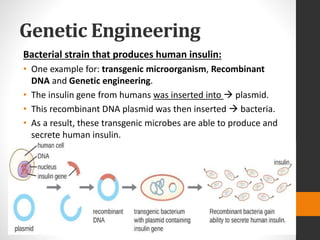
Bacterial strain that produces human insulin:
โ€ข One example for: transgenic microorganism, Recombinant
DNA and Genetic engineering.
โ€ข The insulin gene from humans was inserted into ๏ƒ  plasmid.
โ€ข This recombinant DNA plasmid was then inserted ๏ƒ  bacteria.
โ€ข As a result, these transgenic microbes are able to produce and
secrete human insulin.
Genetic Engineering
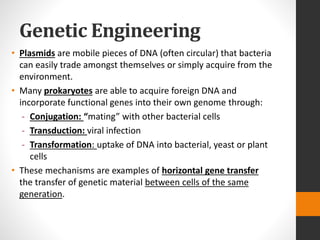
โ€ข Plasmids are mobile pieces of DNA (often circular) that bacteria
can easily trade amongst themselves or simply acquire from the
environment.
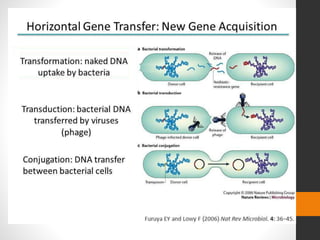
โ€ข Many prokaryotes are able to acquire foreign DNA and
incorporate functional genes into their own genome through:
- Conjugation: โ€œmatingโ€ with other bacterial cells
- Transduction: viral infection
- Transformation: uptake of DNA into bacterial, yeast or plant
cells
โ€ข These mechanisms are examples of horizontal gene transfer
the transfer of genetic material between cells of the same
generation.
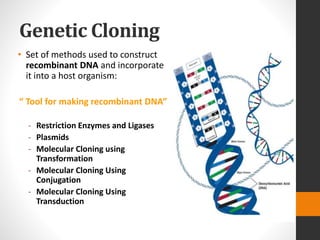
Genetic Cloning
โ€ข Set of methods used to construct
recombinant DNA and incorporate
it into a host organism:
โ€œ Tool for making recombinant DNAโ€
- Restriction Enzymes and Ligases
- Plasmids
- Molecular Cloning using
Transformation
- Molecular Cloning Using
Conjugation
- Molecular Cloning Using
Transduction
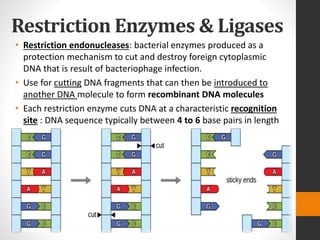
Restriction Enzymes & Ligases
โ€ข Restriction endonucleases: bacterial enzymes produced as a
protection mechanism to cut and destroy foreign cytoplasmic
DNA that is result of bacteriophage infection.
โ€ข Use for cutting DNA fragments that can then be introduced to
another DNA molecule to form recombinant DNA molecules
โ€ข Each restriction enzyme cuts DNA at a characteristic recognition
site : DNA sequence typically between 4 to 6 base pairs in length
Restriction Enzymes & Ligases
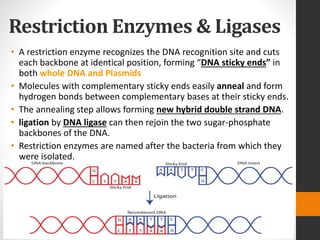
โ€ข A restriction enzyme recognizes the DNA recognition site and cuts
each backbone at identical position, forming โ€œDNA sticky endsโ€ in
both whole DNA and Plasmids
โ€ข Molecules with complementary sticky ends easily anneal and form
hydrogen bonds between complementary bases at their sticky ends.
โ€ข The annealing step allows forming new hybrid double strand DNA.
โ€ข ligation by DNA ligase can then rejoin the two sugar-phosphate
backbones of the DNA.
โ€ข Restriction enzymes are named after the bacteria from which they
were isolated.
Restriction Enzymes
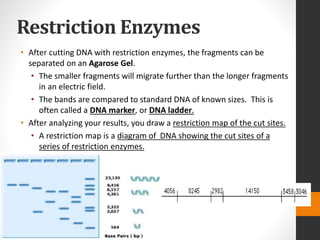
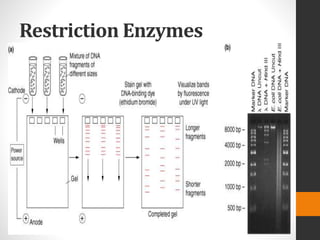
โ€ข After cutting DNA with restriction enzymes, the fragments can be
separated on an Agarose Gel.
โ€ข The smaller fragments will migrate further than the longer fragments
in an electric field.
โ€ข The bands are compared to standard DNA of known sizes. This is
often called a DNA marker, or DNA ladder.
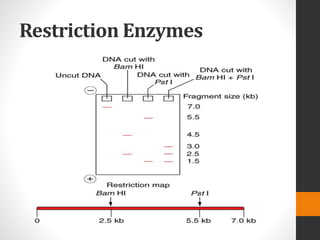
โ€ข After analyzing your results, you draw a restriction map of the cut sites.
โ€ข A restriction map is a diagram of DNA showing the cut sites of a
series of restriction enzymes.
Restriction Enzymes
Restriction Enzymes
Plasmids
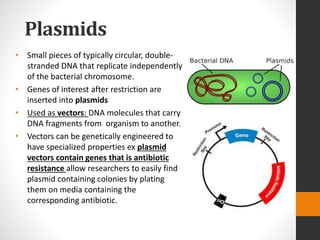
โ€ข Small pieces of typically circular, double-
stranded DNA that replicate independently
of the bacterial chromosome.
โ€ข Genes of interest after restriction are
inserted into plasmids
โ€ข Used as vectors: DNA molecules that carry
DNA fragments from organism to another.
โ€ข Vectors can be genetically engineered to
have specialized properties ex plasmid
vectors contain genes that is antibiotic
resistance allow researchers to easily find
plasmid containing colonies by plating
them on media containing the
corresponding antibiotic.
Plasmids
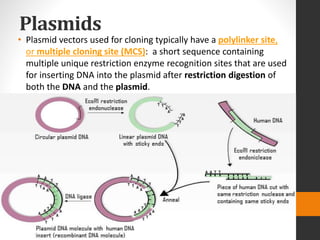
โ€ข Plasmid vectors used for cloning typically have a polylinker site,
or multiple cloning site (MCS): a short sequence containing
multiple unique restriction enzyme recognition sites that are used
for inserting DNA into the plasmid after restriction digestion of
both the DNA and the plasmid.
Molecular Cloning using
Transformation
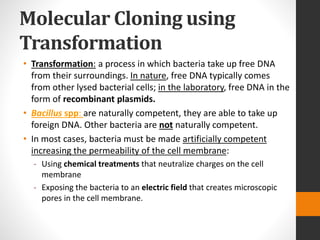
โ€ข Transformation: a process in which bacteria take up free DNA
from their surroundings. In nature, free DNA typically comes
from other lysed bacterial cells; in the laboratory, free DNA in the
form of recombinant plasmids.
โ€ข Bacillus spp: are naturally competent, they are able to take up
foreign DNA. Other bacteria are not naturally competent.
โ€ข In most cases, bacteria must be made artificially competent
increasing the permeability of the cell membrane:
- Using chemical treatments that neutralize charges on the cell
membrane
- Exposing the bacteria to an electric field that creates microscopic
pores in the cell membrane.
Molecular Cloning using
Transformation
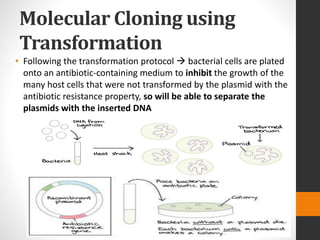
โ€ข Following the transformation protocol ๏ƒ  bacterial cells are plated
onto an antibiotic-containing medium to inhibit the growth of the
many host cells that were not transformed by the plasmid with the
antibiotic resistance property, so will be able to separate the
plasmids with the inserted DNA
Molecular Cloning Using
Conjugation
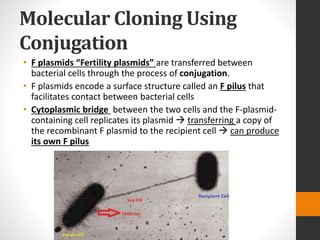
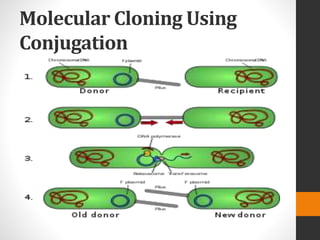
โ€ข F plasmids โ€œFertility plasmidsโ€ are transferred between
bacterial cells through the process of conjugation.
โ€ข F plasmids encode a surface structure called an F pilus that
facilitates contact between bacterial cells
โ€ข Cytoplasmic bridge between the two cells and the F-plasmid-
containing cell replicates its plasmid ๏ƒ  transferring a copy of
the recombinant F plasmid to the recipient cell ๏ƒ  can produce
its own F pilus
Molecular Cloning Using
Conjugation
Molecular Cloning Using
Transduction
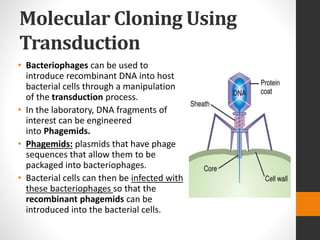
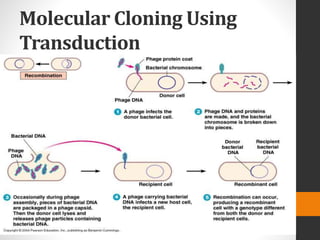
โ€ข Bacteriophages can be used to
introduce recombinant DNA into host
bacterial cells through a manipulation
of the transduction process.
โ€ข In the laboratory, DNA fragments of
interest can be engineered
into Phagemids.
โ€ข Phagemids: plasmids that have phage
sequences that allow them to be
packaged into bacteriophages.
โ€ข Bacterial cells can then be infected with
these bacteriophages so that the
recombinant phagemids can be
introduced into the bacterial cells.
Molecular Cloning Using
Transduction
Genomic Libraries
โ€ข The library is a nearly complete copy of an
organismโ€™s genome contained as
recombinant DNA plasmids engineered into
unique clones of bacteria.
โ€ข Having such a library allows a researcher to
create large quantities of each fragment by
growing the bacterial host for that fragment.
โ€ข Genomic Libraries can be used to
determine:
- Sequence of the DNA
- Function of any genes present
Genomic Libraries (DNA)
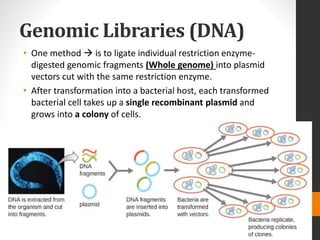
โ€ข One method ๏ƒ  is to ligate individual restriction enzyme-
digested genomic fragments (Whole genome) into plasmid
vectors cut with the same restriction enzyme.
โ€ข After transformation into a bacterial host, each transformed
bacterial cell takes up a single recombinant plasmid and
grows into a colony of cells.
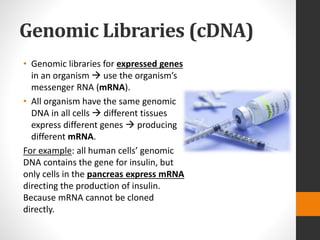
Genomic Libraries (cDNA)
โ€ข Genomic libraries for expressed genes
in an organism ๏ƒ  use the organismโ€™s
messenger RNA (mRNA).
โ€ข All organism have the same genomic
DNA in all cells ๏ƒ  different tissues
express different genes ๏ƒ  producing
different mRNA.
For example: all human cellsโ€™ genomic
DNA contains the gene for insulin, but
only cells in the pancreas express mRNA
directing the production of insulin.
Because mRNA cannot be cloned
directly.
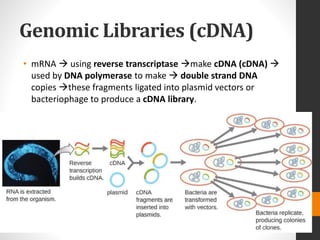
Genomic Libraries (cDNA)
โ€ข mRNA ๏ƒ  using reverse transcriptase ๏ƒ make cDNA (cDNA) ๏ƒ 
used by DNA polymerase to make ๏ƒ  double strand DNA
copies ๏ƒ these fragments ligated into plasmid vectors or
bacteriophage to produce a cDNA library.
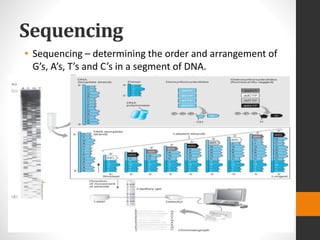
Sequencing
โ€ข Sequencing โ€“ determining the order and arrangement of
Gโ€™s, Aโ€™s, Tโ€™s and Cโ€™s in a segment of DNA.
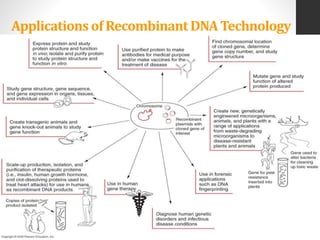
Applications of RecombinantDNATechnology
References:
โ€ข Desmond S. T. Nicholl, โ€œAn Introduction to Genetic
Engineeringโ€volume 2, 3 ed, 2008.
โ€ข Raylene Ramos Moura, Luciana Magalhรฃes Melo, and Vicente
Josรฉ de Figueirรชdo Freitas. "Production of Recombinant
Proteins in Milk of Transgenic and Non-Transgenic
Goats." Brazilian Archives of Biology and Technology 54 no. 5
(2011): 927โ€“938.
โ€ข William S.M. Wold and Karoly Toth. "Adenovirus Vectors for
Gene Therapy, Vaccination and Cancer Gene Therapy." Current
Gene Therapy 13 no. 6 (2013): 421.
Thank You

Genetic engineering and Recombinant DNA

  • 1.
    Genetic Engineering Recombinant DNA HalaAbuzied MS Human Genetics Pharmacist/ Research Fellow Alexandria University Cancer Research Cluster
  • 2.
    Genetic Engineering โ€ข Alsocalled Genetic modification or Genetic manipulation โ€ข It is the process of altering of an organism's genes using biotechnology. It is a set of technologies used to change the genetic makeup of cells. โ€ข This may mean: - Changing one base pair (A-T or C-G) - Deleting a whole region of DNA - Introducing an additional copy of a gene. - Extracting DNA from another organismโ€™s genome and combining it with the DNA of another individual. โ€ข Genetic Engineering can be applied to any organism, from a virus to a sheep. โ€ข Genetic Engineering is of value in many Research and medical areas
  • 3.
    Genetic Engineering โ€ข Theterm genetic engineering is often thought to be rather vague term, yet it is probably the label that most people would recognize. โ€ข However, there are several other terms that can be used to describe the technology, including - Gene cloning - Genetic modification - Gene editing - Recombinant DNA technology
  • 4.
    Genetic Engineering โ€ข Geneticengineering involves the use of Recombinant DNA technology. โ€ข Recombinant DNA technology: the process by which a DNA sequence is manipulated in vitro, thus creating recombinant DNA molecules that have new mix of genetic material. โ€ข The recombinant DNA is then introduced into a host organism. โ€ข If the DNA that is introduced comes from a different species, the host organism is now considered to be transgenic.
  • 5.
    Genetic Engineering Bacterial strainthat produces human insulin: โ€ข One example for: transgenic microorganism, Recombinant DNA and Genetic engineering. โ€ข The insulin gene from humans was inserted into ๏ƒ  plasmid. โ€ข This recombinant DNA plasmid was then inserted ๏ƒ  bacteria. โ€ข As a result, these transgenic microbes are able to produce and secrete human insulin.
  • 6.
    Genetic Engineering โ€ข Plasmidsare mobile pieces of DNA (often circular) that bacteria can easily trade amongst themselves or simply acquire from the environment. โ€ข Many prokaryotes are able to acquire foreign DNA and incorporate functional genes into their own genome through: - Conjugation: โ€œmatingโ€ with other bacterial cells - Transduction: viral infection - Transformation: uptake of DNA into bacterial, yeast or plant cells โ€ข These mechanisms are examples of horizontal gene transfer the transfer of genetic material between cells of the same generation.
  • 8.
    Genetic Cloning โ€ข Setof methods used to construct recombinant DNA and incorporate it into a host organism: โ€œ Tool for making recombinant DNAโ€ - Restriction Enzymes and Ligases - Plasmids - Molecular Cloning using Transformation - Molecular Cloning Using Conjugation - Molecular Cloning Using Transduction
  • 9.
    Restriction Enzymes &Ligases โ€ข Restriction endonucleases: bacterial enzymes produced as a protection mechanism to cut and destroy foreign cytoplasmic DNA that is result of bacteriophage infection. โ€ข Use for cutting DNA fragments that can then be introduced to another DNA molecule to form recombinant DNA molecules โ€ข Each restriction enzyme cuts DNA at a characteristic recognition site : DNA sequence typically between 4 to 6 base pairs in length
  • 10.
    Restriction Enzymes &Ligases โ€ข A restriction enzyme recognizes the DNA recognition site and cuts each backbone at identical position, forming โ€œDNA sticky endsโ€ in both whole DNA and Plasmids โ€ข Molecules with complementary sticky ends easily anneal and form hydrogen bonds between complementary bases at their sticky ends. โ€ข The annealing step allows forming new hybrid double strand DNA. โ€ข ligation by DNA ligase can then rejoin the two sugar-phosphate backbones of the DNA. โ€ข Restriction enzymes are named after the bacteria from which they were isolated.
  • 11.
    Restriction Enzymes โ€ข Aftercutting DNA with restriction enzymes, the fragments can be separated on an Agarose Gel. โ€ข The smaller fragments will migrate further than the longer fragments in an electric field. โ€ข The bands are compared to standard DNA of known sizes. This is often called a DNA marker, or DNA ladder. โ€ข After analyzing your results, you draw a restriction map of the cut sites. โ€ข A restriction map is a diagram of DNA showing the cut sites of a series of restriction enzymes.
  • 12.
  • 13.
  • 14.
    Plasmids โ€ข Small piecesof typically circular, double- stranded DNA that replicate independently of the bacterial chromosome. โ€ข Genes of interest after restriction are inserted into plasmids โ€ข Used as vectors: DNA molecules that carry DNA fragments from organism to another. โ€ข Vectors can be genetically engineered to have specialized properties ex plasmid vectors contain genes that is antibiotic resistance allow researchers to easily find plasmid containing colonies by plating them on media containing the corresponding antibiotic.
  • 15.
    Plasmids โ€ข Plasmid vectorsused for cloning typically have a polylinker site, or multiple cloning site (MCS): a short sequence containing multiple unique restriction enzyme recognition sites that are used for inserting DNA into the plasmid after restriction digestion of both the DNA and the plasmid.
  • 16.
    Molecular Cloning using Transformation โ€ขTransformation: a process in which bacteria take up free DNA from their surroundings. In nature, free DNA typically comes from other lysed bacterial cells; in the laboratory, free DNA in the form of recombinant plasmids. โ€ข Bacillus spp: are naturally competent, they are able to take up foreign DNA. Other bacteria are not naturally competent. โ€ข In most cases, bacteria must be made artificially competent increasing the permeability of the cell membrane: - Using chemical treatments that neutralize charges on the cell membrane - Exposing the bacteria to an electric field that creates microscopic pores in the cell membrane.
  • 17.
    Molecular Cloning using Transformation โ€ขFollowing the transformation protocol ๏ƒ  bacterial cells are plated onto an antibiotic-containing medium to inhibit the growth of the many host cells that were not transformed by the plasmid with the antibiotic resistance property, so will be able to separate the plasmids with the inserted DNA
  • 18.
    Molecular Cloning Using Conjugation โ€ขF plasmids โ€œFertility plasmidsโ€ are transferred between bacterial cells through the process of conjugation. โ€ข F plasmids encode a surface structure called an F pilus that facilitates contact between bacterial cells โ€ข Cytoplasmic bridge between the two cells and the F-plasmid- containing cell replicates its plasmid ๏ƒ  transferring a copy of the recombinant F plasmid to the recipient cell ๏ƒ  can produce its own F pilus
  • 19.
  • 20.
    Molecular Cloning Using Transduction โ€ขBacteriophages can be used to introduce recombinant DNA into host bacterial cells through a manipulation of the transduction process. โ€ข In the laboratory, DNA fragments of interest can be engineered into Phagemids. โ€ข Phagemids: plasmids that have phage sequences that allow them to be packaged into bacteriophages. โ€ข Bacterial cells can then be infected with these bacteriophages so that the recombinant phagemids can be introduced into the bacterial cells.
  • 21.
  • 22.
    Genomic Libraries โ€ข Thelibrary is a nearly complete copy of an organismโ€™s genome contained as recombinant DNA plasmids engineered into unique clones of bacteria. โ€ข Having such a library allows a researcher to create large quantities of each fragment by growing the bacterial host for that fragment. โ€ข Genomic Libraries can be used to determine: - Sequence of the DNA - Function of any genes present
  • 23.
    Genomic Libraries (DNA) โ€ขOne method ๏ƒ  is to ligate individual restriction enzyme- digested genomic fragments (Whole genome) into plasmid vectors cut with the same restriction enzyme. โ€ข After transformation into a bacterial host, each transformed bacterial cell takes up a single recombinant plasmid and grows into a colony of cells.
  • 24.
    Genomic Libraries (cDNA) โ€ขGenomic libraries for expressed genes in an organism ๏ƒ  use the organismโ€™s messenger RNA (mRNA). โ€ข All organism have the same genomic DNA in all cells ๏ƒ  different tissues express different genes ๏ƒ  producing different mRNA. For example: all human cellsโ€™ genomic DNA contains the gene for insulin, but only cells in the pancreas express mRNA directing the production of insulin. Because mRNA cannot be cloned directly.
  • 25.
    Genomic Libraries (cDNA) โ€ขmRNA ๏ƒ  using reverse transcriptase ๏ƒ make cDNA (cDNA) ๏ƒ  used by DNA polymerase to make ๏ƒ  double strand DNA copies ๏ƒ these fragments ligated into plasmid vectors or bacteriophage to produce a cDNA library.
  • 26.
    Sequencing โ€ข Sequencing โ€“determining the order and arrangement of Gโ€™s, Aโ€™s, Tโ€™s and Cโ€™s in a segment of DNA.
  • 27.
  • 28.
    References: โ€ข Desmond S.T. Nicholl, โ€œAn Introduction to Genetic Engineeringโ€volume 2, 3 ed, 2008. โ€ข Raylene Ramos Moura, Luciana Magalhรฃes Melo, and Vicente Josรฉ de Figueirรชdo Freitas. "Production of Recombinant Proteins in Milk of Transgenic and Non-Transgenic Goats." Brazilian Archives of Biology and Technology 54 no. 5 (2011): 927โ€“938. โ€ข William S.M. Wold and Karoly Toth. "Adenovirus Vectors for Gene Therapy, Vaccination and Cancer Gene Therapy." Current Gene Therapy 13 no. 6 (2013): 421.
  • 29.