BASIC PRINCIPLES OF GENETIC
ENGINEERING
PRESENTED BY:-
STEFFITHOMAS
Assistant Professor
School of Pharmacy, LNCTU
Bhopal
Introduction
 Gregor Mendel is known as “the Father of Genetics”
 Erwin Chargaff noticed that there is a pattern in the 4 bases:
Adenine, Guanine, Cytosine and Thymine. (Adenine paired
withThymine and Guanine paired with Cytosine)
 Genetic engineering is the artificial manipulation or
alteration of genes
OR
It is the process by which pieces of DNA are transferred
from one organism to another (i.e. from Human to
Bacterium or from Bacterium to Plant or from Human to
Sheep)
 Genetic engineering involves these steps:-
-removing a gene (target gene) from one organism
-inserting target gene into the DNA of another organism
-”Cut and paste process”
 Genetic engineering allows the DNA from
different species to be joined together.
 Process:-
1.DNA carrying a gene of interest is taken from a
(e.g., a human) cell
2.The gene is inserted into the DNA of another
(host) cell
3.The host cell now contains recombinant DNA
4.The host cell multiplies
 This often results in combinations of DNA that
would never be possible in nature!!! For this
reason genetic engineering is not a natural
process.
 If DNA is transferred from one species to
another the organism that receives the DNA is
said to be transgenic (Genetically Modified
organism).
 Examples of cross-species transfer of genes:
- a human gene inserted into a bacterium
- a human gene inserted into another animal
- a bacterial gene placed in a plant
Important terms
 Recombinant DNA- altered DNA is called
recombinant DNA (recombines after small
section of DNA is inserted into it)
OR
DNA made from 2 different organisms e.g.
human gene and bacterial plasmid
 Genetically Modified Organism (GMO)-
Organism with the altered DNA
Tools Used in Genetic Engineering
 Restriction Enzymes:
- are special enzymes used to cut the DNA at specific
places.
- different enzymes cut DNA at specific base
sequences known as a recognition site. For example
i) One restriction enzyme will always cut DNA at
the base sequence: GAATTC.
ii) Another restriction enzyme only cuts at the
sequence: GATC.
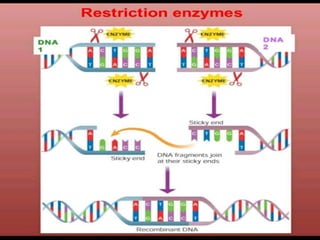
- If DNA from two different organisms is cut with the
same restriction enzyme the cut ends from both
sources will be complementary and can easily stick
together.
 Restriction endonucleases can cut the DNA
crosswise at selected positions
 Has the capability to recognize and cut at the
palindromes
 Can make a blunt cut or a “sticky end”
 The pieces of DNA produced are called as
restriction fragments.
 Differences in the cutting pattern of specific
restriction endonucleases give rise to restriction
fragments of differing lengths- restriction fragment
length polymorphism.
Cont..
 DNA Ligase:
-enzyme which acts like a glue sticking foreign
DNA to DNA of the cloning vector.
-enzyme necessary to seal the sticky ends
together.
-will only work if DNA from the two DNA
sources has been cut with the same restriction
enzyme i.e. sticky ends of cut DNA will be
complementary to each other.
 ReverseTranscriptase:
-enzyme that is required when RNA has to be
converted into DNA
Cont..
 VECTOR - plasmids (A plasmid is a circular piece of
DNA in a bacterium) or viruses are vectors
-A vector is needed to transfer a gene (piece of donor
DNA) into a host cell
-readily accepted by cloning host
-vector such as plasmid or bacteriophage should have
an origin of replication (ORI) which is a sequence
somewhere on the vector from where replication
starts and any piece of DNA when linked to this
sequence can be made to replicate within the host cell
-must accept DNA of desired size
-contain a gene that confers drug resistance to their
cloning host
Process of Genetic Engineering
 Five steps involved in this process:
1. Isolation
2. Cutting
3. Insertion (Ligation)
4.Transformation
5. Expression
Applications of Genetic Engineering
 You must know three applications: one
involving a plant, one animal and one for a
micro-organism.
 PLANTS: “Weed killer-resistant crops”
-many types of crop plants have bacterial genes
added to them.
-these genes make the plants resistant to
certain weed killers (herbicides).
-this means that the weed killers kill the weeds
but do not affect the transgenic plants.
Cont..
 ANIMALS: There is a growing trend to experiment
with inserting human genes into the DNA of other
mammals. The transgenic animals formed in this
way will then produce a human protein and secrete
it into their milk or even into their eggs.
 E.g.:- “Sheep produce human clotting factor”
- A human gene has been inserted into the DNA of
sheep.
- This allows the adult sheep to produce a clotting
chemical needed by haemophiliacs to clot their
blood – produced in the milk of the sheep.
- Pharming: is the production of pharmaceuticals
by genetically modified animals i.e. sheep, cows,
goats etc.
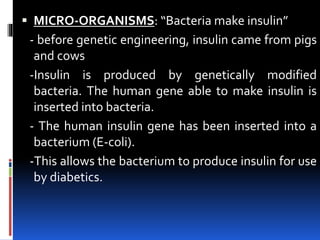
 MICRO-ORGANISMS: “Bacteria make insulin”
- before genetic engineering, insulin came from pigs
and cows
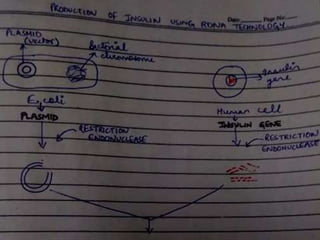
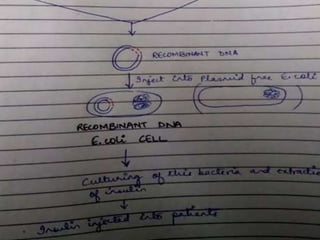
-Insulin is produced by genetically modified
bacteria. The human gene able to make insulin is
inserted into bacteria.
- The human insulin gene has been inserted into a
bacterium (E-coli).
-This allows the bacterium to produce insulin for use
by diabetics.
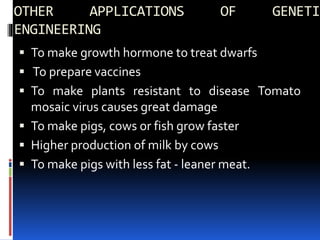
OTHER APPLICATIONS OF GENETIC
ENGINEERING
 To make growth hormone to treat dwarfs
 To prepare vaccines
 To make plants resistant to disease Tomato
mosaic virus causes great damage
 To make pigs, cows or fish grow faster
 Higher production of milk by cows
 To make pigs with less fat - leaner meat.
Cont..
 Gene therapy-when a gene is inserted into a patient to treat a
genetic disease.
- The new DNA usually contains a functioning gene to correct the
effects of a disease-causing mutation.
- It repairs or reconstructs the defective genetic material. In future,
this technique may allow doctors to treat a disorder by inserting a
gene into patient’s cell instead of using drugs or surgery.
- A gene that is directly inserted into the cell usually doesn’t function.
So a vector acting as a carrier is genetically engineered to deliver the
gene.
-Certain viruses are used as vectors because they can deliver the new
gene by infecting the cell. The viruses are modified so they can’t
cause disease when used in people.
-The vector may be directly injected or given intravenously into a
specific tissue in the body, where it is taken up by the individual
cells. Alternatively, a sample of patient’s cells can be removed and
exposed to the vector in lab setting. The cells are then returned to
the patient.
Cont..
 Golden Rice: is genetically modified (rich in vitamin A)
 Drought-Resistant Seeds
 Pest-Resistant Cabbage- Gene that programs poison in
scorpion tails was combined with cabbage. These
genetically modified cabbages produce scorpion
poison that kills caterpillars when they bite leaves —
but the toxin is modified so it isn’t harmful to humans.
 GM Trees Grow faster, yield better wood. Australian
eucalyptus trees have been altered to withstand
freezing temperatures. Loblolly pines have been
created with less lignin – better to make paper.
Possible hazards of genetic
engineering
 Risks for human health, e.g. higher chances for
cancer
 Risks for animal health, e.g. higher chances of
infection
 Risk of creating new microbes that are difficult to
kill by antibiotics
THANKS