Introduction to
Nanobiotechnology
Nanobiotechnology
• Nano
• Bio
• Technology
• Technology used at nanoscale to
address the bio-applications
Nanobiotechnology
What is Nanotechnology?
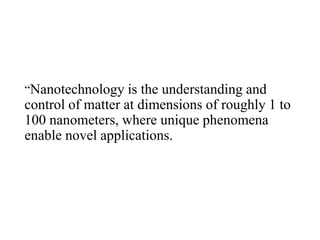
“Nanotechnology is the understanding and
control of matter at dimensions of roughly 1 to
100 nanometers, where unique phenomena
enable novel applications.
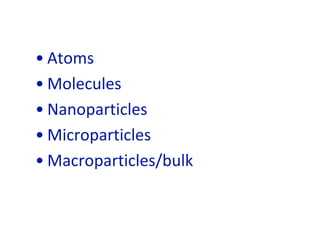
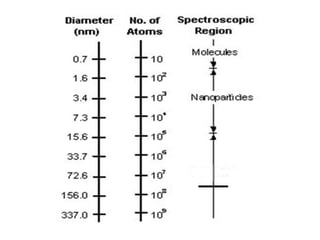
• Atoms
• Molecules
• Nanoparticles
• Microparticles
• Macroparticles/bulk
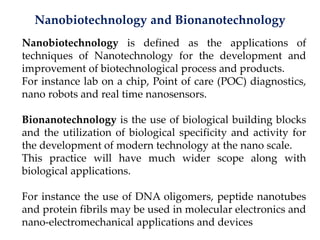
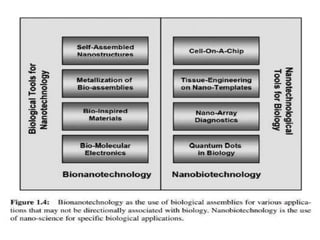
Nanobiotechnology and Bionanotechnology
Nanobiotechnology is defined as the applications of
techniques of Nanotechnology for the development and
improvement of biotechnological process and products.
For instance lab on a chip, Point of care (POC) diagnostics,
nano robots and real time nanosensors.
Bionanotechnology is the use of biological building blocks
and the utilization of biological specificity and activity for
the development of modern technology at the nano scale.
This practice will have much wider scope along with
biological applications.
For instance the use of DNA oligomers, peptide nanotubes
and protein fibrils may be used in molecular electronics and
nano-electromechanical applications and devices
Classical Biotechnology: Industrial Production
using biological systems
According to American Heritage Dictionary Biotechnology
is defined as the use of microorganisms such as bacteria or
yeasts or biological substances such as enzymes to perform
specific industrial or manufacturing process .
The use of biotechnology practice can be trackback into the
early civilization with a variety of food products e.g wine,
beer, cheese, bread etc
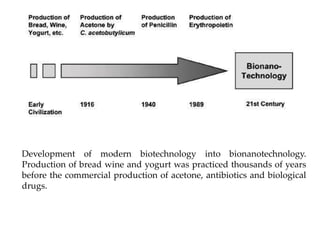
Development of modern biotechnology into bionanotechnology.
Production of bread wine and yogurt was practiced thousands of years
before the commercial production of acetone, antibiotics and biological
drugs.
Modern Biotechnology: from Industrial processes
to novel therapeutics
Over the years the practical definition Biotechnology
became vague .
Modern Biotechnology deals with the activity of
1.Production of biomolecules (functional proteins or
antibodies)
2. Novel diagnostic tools (immunodiagnostic kits. DNA-
array microchip)
The first modern biotechnology product is erythropoietin
by Amgen.
Other products include
1. Recombinant human insulin
2. Human interferon
3. Human and bovine growth hormones
4. Therapeutic antibodies
Therapeutic agents utilize the notable features of antibodies
including affinity and selectivity to block harmful biological
processes.
.
AVASTIN the recombinant monoclonal antibody used to
bind and inhibit the vascular endothelial growth factor,
help in treatment of patients with colon cancer
Thus we can sum up that many more proteins and peptides
have developed as potential drugs
The major bottleneck in use of these potential drugs is their
unavailability in oral formulations.
Proteins and peptides are degraded in digestive tract unlike
many tablets and syrups during their passage. Only these
drugs are prescribed for use through injections which is
difficult in practice outside medical institutions.
Nano-syringes, nano-carriers are used whereby drugs
are safely transferred through digestive tract and
released in intestine.
Nanocarriers are also used to transfer of protein and
peptide drugs through the blood brain barrier (BBB) to
treat brain tumors and neurodegenerative disorders.
Modern Biotechnology: Immunological, Enzymatic
and Nucleic acid based technology
Based on the principle of detection and quantification of
biological materials using the biochemical techniques.
Immunoassays are employed through commercially
available kits that contain antibodies that are used for
detection of hCG (human chorionic gonadotopin) hormone.
HIV or hepatitis virus infections.
Specific high affinity and specific molecular recognition
process facilitates the diagnostic process.
The increased sensitivity of nano devices will reduce the
amount of blood required for such diagnostic tests from
micro liters to nano liters.
Nano-syringes will significantly reduce the discomfort
associated with collection of blood samples from
patients.
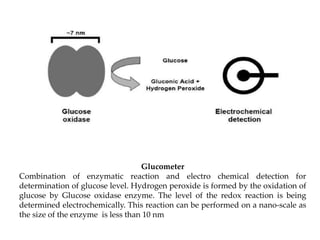
Glucometer
Combination of enzymatic reaction and electro chemical detection for
determination of glucose level. Hydrogen peroxide is formed by the oxidation of
glucose by Glucose oxidase enzyme. The level of the redox reaction is being
determined electrochemically. This reaction can be performed on a nano-scale as
the size of the enzyme is less than 10 nm
DNA based technology
a. PCR
b. DNA microarray chip
Miniaturization of the technologies to lab-on-a-chip
settings.
The interface b/w nanotechnology and
biotechnology; Bio-nanotechnology
Nanotechnology is the application using systems and
devices with the order at nanometer scale .
1 n m= one thousandth of a micrometer or one millionth of
a millimeter.
Its study includes molecular systems, tubular and spherical
nanostructures and well organized self assembled devices
and machines.
In all these simple components at the nanometric scale join
together to form complex machines, devices or instruments
by spontaneous process that involve molecular recognition
and self assembly events
Bio molecules and biological building blocks naturally act
as recognition devices or machines for instance ribosome
the complex protein assembly line.
Complex structures such as plant and animal viruses could
be made by association at the nano scale.
High specificity and spontaneity of biological processes
may lead for the self association of complex organic and
inorganic nao machines and nao devices.
All these processes are govern by bottom-up approach
In top-down approach improvement of the technology is
focused to fabricate the material for achieving nanoscale
applications.
For instance using electromagnetic radiations of shorter
wavelength for fabrication of nano materials.
These two approaches bridge the nanotech with biotech
and provided an interface module for nanobiotech for
development of procedures for miniaturized machines
and devices .
The interface b/w nano and bio technology can offer the
attainment of sensitivities that are orders of magnitude
higher than current techniques.
Medical application, environment and homeland security.
Self assembly: Supramolecular chemistry
Supramolecular chemistry is the study of the structure and
function of the entities formed by association of two or
more chemical species by noncovalent interactions.
These supermolecules are distinct structures different from
regular molecules which are formed through chemical
covalent bonding b/w atoms.
The non covalent structures are called assemblies.
Supramolecular chemistry is the chemistry beyond the
molecule.
Many biological entities can be considered as
supramolecular assemblies e.g functional dimers (Fos-Jun
transcription factor) as simple structure and ribosome as
complex one.
Complex biological functions can be achieved through the
formation of complex molecular structures by non covalent
interactions.
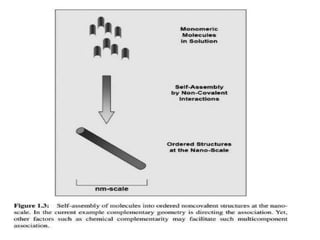
The processes in which large ordered assemblies are formed
through noncovalent asssociation of simpler building blocks
are the essence of bottom up design.
Simple building blocks are joined together to form
supermolecules or assemblies that have a distinct
morphology, specific function and unique physiochemical
properties.
Formation of ordered structures at nano scale
Involves self association of the homocomponent assemblies
at first step followed by formation of heterocomponent
assemblies.
Formation of such structures should be based on the
combination of recognition from geometrical complementary
and chemical recognition.
Aromatic moieties that combine both these properties are
attractive elements in the self association design schemes.
Well ordered structures such as peptide nano tubes could
self assemble by the facilitation of such structures.
Partialy complementary DNA strands can form molecular
junctions, to self assemble into two dimensional nanowires
and three dimensional nanocubes.
Peptide molecules self assemble into tubes, spheres, plates
and hydragels with nanoscale order.
These nano scale peptide assemblies have many
applications in tissue engineering and regeneration, design
of novel antibacterial agents and in fabrication of metallic
nanowires
Nanobionics and Bio-inspired nanotechnology
Bio + (electr)onics is the application of biological principles
and mechanisms to the design and fabrication of engineering
systems.
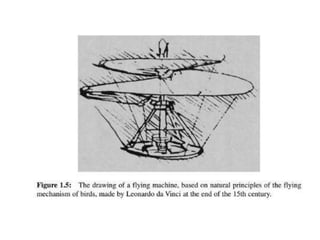
Bionics are to understand the nature and its principles and to
use them as stimulus and motivation for innovations .
This may be comprehensively defines as bio-inspired
technology.
Benefits of Nanotechnology
“The power of nanotechnology is rooted in its
potential to transform and revolutionize multiple
technology and industry sectors, including
aerospace, agriculture, biotechnology, homeland
security and national defense, energy, environmental
improvement, information technology, medicine,
and transportation.
Discovery in some of these areas has advanced to
the point where it is now possible to identify
applications that will impact the world we live in.
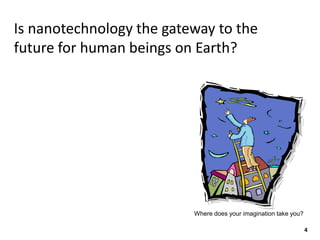
Where does your imagination take you?
Is nanotechnology the gateway to the
future for human beings on Earth?
4
National Science and Technology Council, 2000
Nanoscience will change the
nature of almost every human-
made object in the next century.
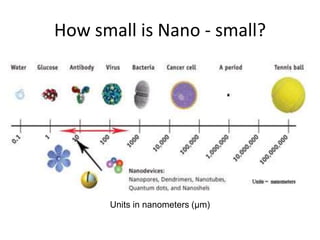
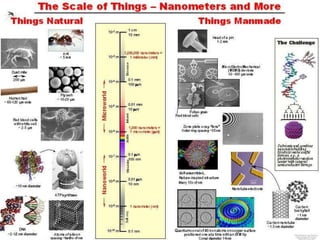
How small is Nano - small?
Units in nanometers (µm)
For Pam Norris- July 2009
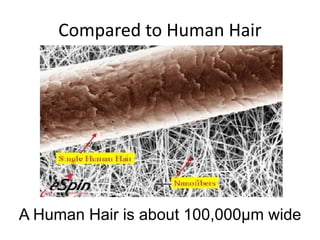
Compared to Human Hair
A Human Hair is about 100,000µm wide
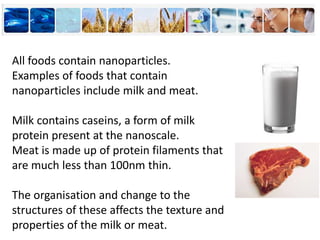
All foods contain nanoparticles.
Examples of foods that contain
nanoparticles include milk and meat.
Milk contains caseins, a form of milk
protein present at the nanoscale.
Meat is made up of protein filaments that
are much less than 100nm thin.
The organisation and change to the
structures of these affects the texture and
properties of the milk or meat.
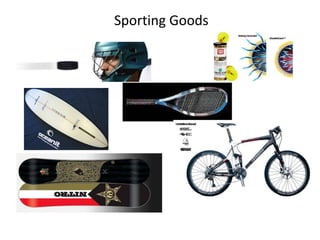
Sporting Goods
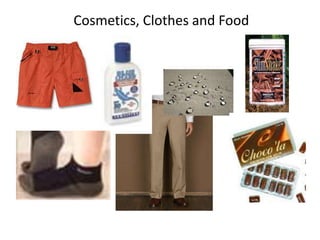
Cosmetics, Clothes and Food
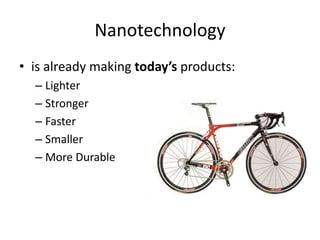
Nanotechnology
• is already making today’s products:
– Lighter
– Stronger
– Faster
– Smaller
– More Durable
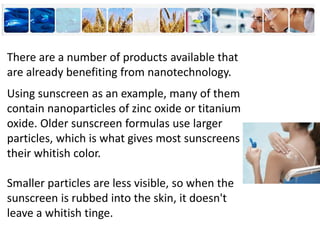
There are a number of products available that
are already benefiting from nanotechnology.
Using sunscreen as an example, many of them
contain nanoparticles of zinc oxide or titanium
oxide. Older sunscreen formulas use larger
particles, which is what gives most sunscreens
their whitish color.
Smaller particles are less visible, so when the
sunscreen is rubbed into the skin, it doesn't
leave a whitish tinge.
What can be done?
• nanocarrier systems for delivery of nutrients and
supplements;
• organic nano-sized additives for food, supplements and
animal feed;
Nanotechnologies are being developed all the time.
Here are some examples that are being used:
• food packaging applications e.g. plastic polymers
containing or coated with nanomaterials for
improved mechanical or functional properties;
• nanocoatings on food contact surfaces for barrier
or antimicrobial properties;
• nano-sized agrochemicals (a chemical used in
agriculture, such as a pesticide or a fertilizer.);
• nanosensors for food labelling.
Nanoparticles are being used to deliver vitamins or
other nutrients in food and drinks without affecting the
taste or appearance. These nanoparticles encapsulate
the nutrients and carry them through the stomach into
the bloodstream.
Food examples
Nanoparticle emulsions are being used in ice cream
and various spreads to improve the texture and
uniformity.
New developments in nanoscience and nanotechnology
will allow more control and have the potential of
increased benefits. These include:
• healthier foods (e.g. lower fat, lower salt) with
desirable sensory properties;
• ingredients with improved properties;
• potential for removal of certain additives without loss
of stability;
• smart-aids for processing foods to remove allergens
such as peanut protein.
Food examples
Packaging examples
Researches have produced smart packages that can tell
consumers about the freshness of milk or meat.
When oxidation occurs in the package, nanoparticles
indicates the colour change and the consumer can see if
the product is fresh or not.
Incorporation of nanoparticles in packaging can increase
the barrier to oxygen and slow down degradation of food
during storage.
Bottles made with nanocomposites minimise the leakage
of carbon dioxide out of the bottle.
This increases the shelf life of fizzy drinks without having
to use heavier glass bottles or more expensive cans.
Food storage bins have silver nanoparticles embedded
in the plastic. The silver nanoparticles kill bacteria from
any food previously stored in the bins, minimising
harmful bacteria.
Packaging examples

Nanobiotechnology lecture 1

  • 1.
  • 2.
  • 3.
    • Technology usedat nanoscale to address the bio-applications Nanobiotechnology
  • 4.
  • 5.
    “Nanotechnology is theunderstanding and control of matter at dimensions of roughly 1 to 100 nanometers, where unique phenomena enable novel applications.
  • 6.
    • Atoms • Molecules •Nanoparticles • Microparticles • Macroparticles/bulk
  • 8.
    Nanobiotechnology and Bionanotechnology Nanobiotechnologyis defined as the applications of techniques of Nanotechnology for the development and improvement of biotechnological process and products. For instance lab on a chip, Point of care (POC) diagnostics, nano robots and real time nanosensors. Bionanotechnology is the use of biological building blocks and the utilization of biological specificity and activity for the development of modern technology at the nano scale. This practice will have much wider scope along with biological applications. For instance the use of DNA oligomers, peptide nanotubes and protein fibrils may be used in molecular electronics and nano-electromechanical applications and devices
  • 9.
    Classical Biotechnology: IndustrialProduction using biological systems According to American Heritage Dictionary Biotechnology is defined as the use of microorganisms such as bacteria or yeasts or biological substances such as enzymes to perform specific industrial or manufacturing process . The use of biotechnology practice can be trackback into the early civilization with a variety of food products e.g wine, beer, cheese, bread etc
  • 10.
    Development of modernbiotechnology into bionanotechnology. Production of bread wine and yogurt was practiced thousands of years before the commercial production of acetone, antibiotics and biological drugs.
  • 11.
    Modern Biotechnology: fromIndustrial processes to novel therapeutics Over the years the practical definition Biotechnology became vague . Modern Biotechnology deals with the activity of 1.Production of biomolecules (functional proteins or antibodies) 2. Novel diagnostic tools (immunodiagnostic kits. DNA- array microchip) The first modern biotechnology product is erythropoietin by Amgen.
  • 12.
    Other products include 1.Recombinant human insulin 2. Human interferon 3. Human and bovine growth hormones 4. Therapeutic antibodies Therapeutic agents utilize the notable features of antibodies including affinity and selectivity to block harmful biological processes. . AVASTIN the recombinant monoclonal antibody used to bind and inhibit the vascular endothelial growth factor, help in treatment of patients with colon cancer
  • 13.
    Thus we cansum up that many more proteins and peptides have developed as potential drugs The major bottleneck in use of these potential drugs is their unavailability in oral formulations. Proteins and peptides are degraded in digestive tract unlike many tablets and syrups during their passage. Only these drugs are prescribed for use through injections which is difficult in practice outside medical institutions.
  • 14.
    Nano-syringes, nano-carriers areused whereby drugs are safely transferred through digestive tract and released in intestine. Nanocarriers are also used to transfer of protein and peptide drugs through the blood brain barrier (BBB) to treat brain tumors and neurodegenerative disorders.
  • 15.
    Modern Biotechnology: Immunological,Enzymatic and Nucleic acid based technology Based on the principle of detection and quantification of biological materials using the biochemical techniques. Immunoassays are employed through commercially available kits that contain antibodies that are used for detection of hCG (human chorionic gonadotopin) hormone. HIV or hepatitis virus infections. Specific high affinity and specific molecular recognition process facilitates the diagnostic process.
  • 16.
    The increased sensitivityof nano devices will reduce the amount of blood required for such diagnostic tests from micro liters to nano liters. Nano-syringes will significantly reduce the discomfort associated with collection of blood samples from patients.
  • 17.
    Glucometer Combination of enzymaticreaction and electro chemical detection for determination of glucose level. Hydrogen peroxide is formed by the oxidation of glucose by Glucose oxidase enzyme. The level of the redox reaction is being determined electrochemically. This reaction can be performed on a nano-scale as the size of the enzyme is less than 10 nm
  • 18.
    DNA based technology a.PCR b. DNA microarray chip Miniaturization of the technologies to lab-on-a-chip settings.
  • 19.
    The interface b/wnanotechnology and biotechnology; Bio-nanotechnology Nanotechnology is the application using systems and devices with the order at nanometer scale . 1 n m= one thousandth of a micrometer or one millionth of a millimeter. Its study includes molecular systems, tubular and spherical nanostructures and well organized self assembled devices and machines. In all these simple components at the nanometric scale join together to form complex machines, devices or instruments by spontaneous process that involve molecular recognition and self assembly events
  • 20.
    Bio molecules andbiological building blocks naturally act as recognition devices or machines for instance ribosome the complex protein assembly line. Complex structures such as plant and animal viruses could be made by association at the nano scale. High specificity and spontaneity of biological processes may lead for the self association of complex organic and inorganic nao machines and nao devices. All these processes are govern by bottom-up approach
  • 21.
    In top-down approachimprovement of the technology is focused to fabricate the material for achieving nanoscale applications. For instance using electromagnetic radiations of shorter wavelength for fabrication of nano materials. These two approaches bridge the nanotech with biotech and provided an interface module for nanobiotech for development of procedures for miniaturized machines and devices .
  • 22.
    The interface b/wnano and bio technology can offer the attainment of sensitivities that are orders of magnitude higher than current techniques. Medical application, environment and homeland security.
  • 23.
    Self assembly: Supramolecularchemistry Supramolecular chemistry is the study of the structure and function of the entities formed by association of two or more chemical species by noncovalent interactions. These supermolecules are distinct structures different from regular molecules which are formed through chemical covalent bonding b/w atoms. The non covalent structures are called assemblies. Supramolecular chemistry is the chemistry beyond the molecule.
  • 24.
    Many biological entitiescan be considered as supramolecular assemblies e.g functional dimers (Fos-Jun transcription factor) as simple structure and ribosome as complex one. Complex biological functions can be achieved through the formation of complex molecular structures by non covalent interactions. The processes in which large ordered assemblies are formed through noncovalent asssociation of simpler building blocks are the essence of bottom up design. Simple building blocks are joined together to form supermolecules or assemblies that have a distinct morphology, specific function and unique physiochemical properties.
  • 25.
    Formation of orderedstructures at nano scale Involves self association of the homocomponent assemblies at first step followed by formation of heterocomponent assemblies. Formation of such structures should be based on the combination of recognition from geometrical complementary and chemical recognition. Aromatic moieties that combine both these properties are attractive elements in the self association design schemes. Well ordered structures such as peptide nano tubes could self assemble by the facilitation of such structures.
  • 26.
    Partialy complementary DNAstrands can form molecular junctions, to self assemble into two dimensional nanowires and three dimensional nanocubes. Peptide molecules self assemble into tubes, spheres, plates and hydragels with nanoscale order. These nano scale peptide assemblies have many applications in tissue engineering and regeneration, design of novel antibacterial agents and in fabrication of metallic nanowires
  • 29.
    Nanobionics and Bio-inspirednanotechnology Bio + (electr)onics is the application of biological principles and mechanisms to the design and fabrication of engineering systems. Bionics are to understand the nature and its principles and to use them as stimulus and motivation for innovations . This may be comprehensively defines as bio-inspired technology.
  • 31.
    Benefits of Nanotechnology “Thepower of nanotechnology is rooted in its potential to transform and revolutionize multiple technology and industry sectors, including aerospace, agriculture, biotechnology, homeland security and national defense, energy, environmental improvement, information technology, medicine, and transportation. Discovery in some of these areas has advanced to the point where it is now possible to identify applications that will impact the world we live in.
  • 32.
    Where does yourimagination take you? Is nanotechnology the gateway to the future for human beings on Earth? 4
  • 33.
    National Science andTechnology Council, 2000 Nanoscience will change the nature of almost every human- made object in the next century.
  • 34.
    How small isNano - small? Units in nanometers (µm)
  • 35.
    For Pam Norris-July 2009
  • 36.
    Compared to HumanHair A Human Hair is about 100,000µm wide
  • 37.
    All foods containnanoparticles. Examples of foods that contain nanoparticles include milk and meat. Milk contains caseins, a form of milk protein present at the nanoscale. Meat is made up of protein filaments that are much less than 100nm thin. The organisation and change to the structures of these affects the texture and properties of the milk or meat.
  • 38.
  • 39.
  • 40.
    Nanotechnology • is alreadymaking today’s products: – Lighter – Stronger – Faster – Smaller – More Durable
  • 41.
    There are anumber of products available that are already benefiting from nanotechnology. Using sunscreen as an example, many of them contain nanoparticles of zinc oxide or titanium oxide. Older sunscreen formulas use larger particles, which is what gives most sunscreens their whitish color. Smaller particles are less visible, so when the sunscreen is rubbed into the skin, it doesn't leave a whitish tinge.
  • 42.
    What can bedone? • nanocarrier systems for delivery of nutrients and supplements; • organic nano-sized additives for food, supplements and animal feed; Nanotechnologies are being developed all the time. Here are some examples that are being used:
  • 43.
    • food packagingapplications e.g. plastic polymers containing or coated with nanomaterials for improved mechanical or functional properties; • nanocoatings on food contact surfaces for barrier or antimicrobial properties; • nano-sized agrochemicals (a chemical used in agriculture, such as a pesticide or a fertilizer.); • nanosensors for food labelling.
  • 44.
    Nanoparticles are beingused to deliver vitamins or other nutrients in food and drinks without affecting the taste or appearance. These nanoparticles encapsulate the nutrients and carry them through the stomach into the bloodstream. Food examples Nanoparticle emulsions are being used in ice cream and various spreads to improve the texture and uniformity.
  • 45.
    New developments innanoscience and nanotechnology will allow more control and have the potential of increased benefits. These include: • healthier foods (e.g. lower fat, lower salt) with desirable sensory properties; • ingredients with improved properties; • potential for removal of certain additives without loss of stability; • smart-aids for processing foods to remove allergens such as peanut protein. Food examples
  • 46.
    Packaging examples Researches haveproduced smart packages that can tell consumers about the freshness of milk or meat. When oxidation occurs in the package, nanoparticles indicates the colour change and the consumer can see if the product is fresh or not. Incorporation of nanoparticles in packaging can increase the barrier to oxygen and slow down degradation of food during storage.
  • 47.
    Bottles made withnanocomposites minimise the leakage of carbon dioxide out of the bottle. This increases the shelf life of fizzy drinks without having to use heavier glass bottles or more expensive cans. Food storage bins have silver nanoparticles embedded in the plastic. The silver nanoparticles kill bacteria from any food previously stored in the bins, minimising harmful bacteria. Packaging examples