Presented by – Aware Swapnil
Registration No- BTN-2012/07
Valuable guidance by- Prof S. A. Belge.
Agrobacterium mediated gene
transformation
1
WEL -COME
2
Contents
 Introduction to genetic transformation.
 Agrobacterium general introduction.
 Classification of Agrobacterium.
 History of Agrobacterium mediated gene
transformation.
 T-DNA.
 Virulence genes.
 Chromosomal genes
 Agrobacterium tumefaciens T-DNA transfer
process.
 Methods of Agrobacterium tumefaciens
 References3
Introduction to genetic
transformation.
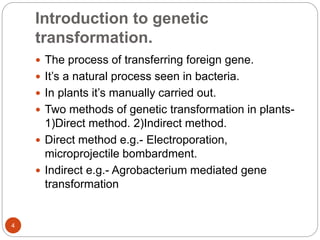
 The process of transferring foreign gene.
 It’s a natural process seen in bacteria.
 In plants it’s manually carried out.
 Two methods of genetic transformation in plants-
1)Direct method. 2)Indirect method.
 Direct method e.g.- Electroporation,
microprojectile bombardment.
 Indirect e.g.- Agrobacterium mediated gene
transformation
4
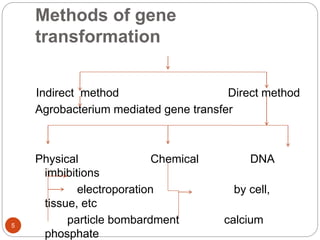
Methods of gene
transformation
Indirect method Direct method
Agrobacterium mediated gene transfer
Physical Chemical DNA
imbibitions
electroporation by cell,
tissue, etc
particle bombardment calcium
phosphate
5
Contn
….
macro Injection PEG mediated
micro injection polication DMSO
liposome mediated
Sonication
DNA transfer via pollen
6
Agrobacterium general
introduction.
 Rod shape gram negative bacterium
 Found in soil
 Causes diseases like crown gall and hair roots in
dicot plants
 The bacteria transfers a tumor-inducing plasmid
 The plasmid incorporates with host genome and
transcribes
7
Classification of
Agrobacterium.
 Two basis of
classification
1. Basis of pathogenicity.
 Agrobacterium
tumefaciens- crown
gall.
 Agrobacterium
rhyzogen- hairy root
 Agrobacterium
radiobacter- Avirulent
Crown gall disease
Hairy root disease
8
Contn
2. On growth pattern
 Biotype I
 Biotype II
 Biotype III
9
History of Agrobacterium
mediated gene transformation.
 Smith & Townsend (1907)- said bacteria caused
crown gall disease
 Brown & Stonier (1958)-proposed that not whole
bacteria but some part of it causes disease
 Zenen et.al (1974)- noted virulent strain-
Agrobacterium tumefaciens
 Chilton et.al (1977)-reported Ti & Ri plasmid
transfer to plant causing disease
10
T-DNA.
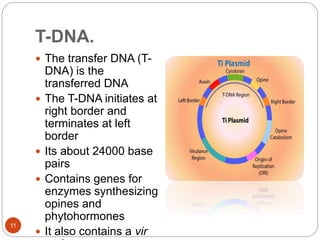
 The transfer DNA (T-
DNA) is the
transferred DNA
 The T-DNA initiates at
right border and
terminates at left
border
 Its about 24000 base
pairs
 Contains genes for
enzymes synthesizing
opines and
phytohormones
 It also contains a vir
11
Virulence genes.
 Virulence region consists of 24 genes in total
 Virulence genes are located in 8 operons from vir A-
vir H
 vir A vir F and vir G are monocistronic operons ,
where as vir B,C,D,E,H are polycistronic
 vir A senses Acitosyringone
 vir G transcriptional activator of vir box
 vir B conjugational pores between plant cell and
bacteria
 vir D1 essential for cleavage of super coiled stranded
substrate
 vir E responsible for gene transfer protein
 vir C helps in DNA transfer
 vir B11 ATPase activity- provides energy for DNA
12
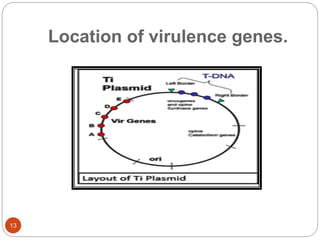
Location of virulence genes.
13
Chromosomal genes
 Chv A& B major role in exopolysaccharide
production
 psc A major role in T-DNA transport
 chv E glucose and galactose transport
 chvD, ilv, miaA,and att, have virulence property.
14
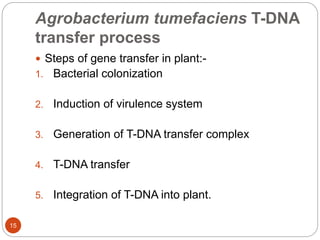
Agrobacterium tumefaciens T-DNA
transfer process
 Steps of gene transfer in plant:-
1. Bacterial colonization
2. Induction of virulence system
3. Generation of T-DNA transfer complex
4. T-DNA transfer
5. Integration of T-DNA into plant.
15
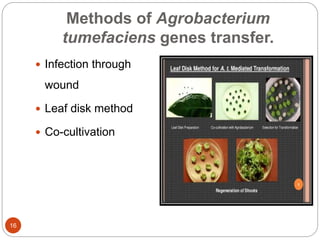
Methods of Agrobacterium
tumefaciens genes transfer.
 Infection through
wound
 Leaf disk method
 Co-cultivation
16
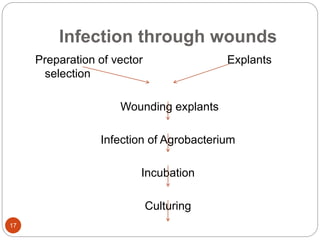
Infection through wounds
Preparation of vector Explants
selection
Wounding explants
Infection of Agrobacterium
Incubation
Culturing
17
Contn
……
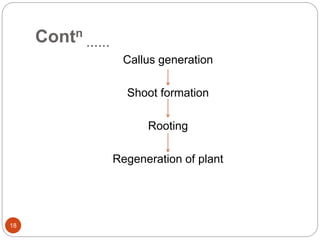
Callus generation
Shoot formation
Rooting
Regeneration of plant
18
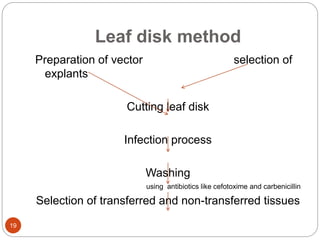
Leaf disk method
Preparation of vector selection of
explants
Cutting leaf disk
Infection process
Washing
using antibiotics like cefotoxime and carbenicillin
Selection of transferred and non-transferred tissues
19
Contn
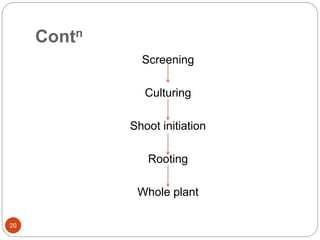
Screening
Culturing
Shoot initiation
Rooting
Whole plant
20
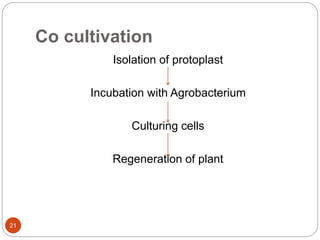
Co cultivation
Isolation of protoplast
Incubation with Agrobacterium
Culturing cells
Regeneration of plant
21
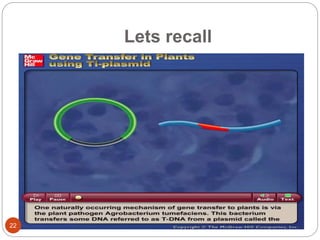
Lets recall
22
References
 Introduction to plant tissue culture.(second
edition) by M.K.Razdan
 Agrobacterium mediated gene transformation.
Google scholars article.
 Gene transfer- Wikipedia the free encyclopedia.
 Plant biotechnology by H.S.chawala.
23
Thank you
24

Agrobacterium mediated gene transformation

  • 1.
    Presented by –Aware Swapnil Registration No- BTN-2012/07 Valuable guidance by- Prof S. A. Belge. Agrobacterium mediated gene transformation 1
  • 2.
  • 3.
    Contents  Introduction togenetic transformation.  Agrobacterium general introduction.  Classification of Agrobacterium.  History of Agrobacterium mediated gene transformation.  T-DNA.  Virulence genes.  Chromosomal genes  Agrobacterium tumefaciens T-DNA transfer process.  Methods of Agrobacterium tumefaciens  References3
  • 4.
    Introduction to genetic transformation. The process of transferring foreign gene.  It’s a natural process seen in bacteria.  In plants it’s manually carried out.  Two methods of genetic transformation in plants- 1)Direct method. 2)Indirect method.  Direct method e.g.- Electroporation, microprojectile bombardment.  Indirect e.g.- Agrobacterium mediated gene transformation 4
  • 5.
    Methods of gene transformation Indirectmethod Direct method Agrobacterium mediated gene transfer Physical Chemical DNA imbibitions electroporation by cell, tissue, etc particle bombardment calcium phosphate 5
  • 6.
    Contn …. macro Injection PEGmediated micro injection polication DMSO liposome mediated Sonication DNA transfer via pollen 6
  • 7.
    Agrobacterium general introduction.  Rodshape gram negative bacterium  Found in soil  Causes diseases like crown gall and hair roots in dicot plants  The bacteria transfers a tumor-inducing plasmid  The plasmid incorporates with host genome and transcribes 7
  • 8.
    Classification of Agrobacterium.  Twobasis of classification 1. Basis of pathogenicity.  Agrobacterium tumefaciens- crown gall.  Agrobacterium rhyzogen- hairy root  Agrobacterium radiobacter- Avirulent Crown gall disease Hairy root disease 8
  • 9.
    Contn 2. On growthpattern  Biotype I  Biotype II  Biotype III 9
  • 10.
    History of Agrobacterium mediatedgene transformation.  Smith & Townsend (1907)- said bacteria caused crown gall disease  Brown & Stonier (1958)-proposed that not whole bacteria but some part of it causes disease  Zenen et.al (1974)- noted virulent strain- Agrobacterium tumefaciens  Chilton et.al (1977)-reported Ti & Ri plasmid transfer to plant causing disease 10
  • 11.
    T-DNA.  The transferDNA (T- DNA) is the transferred DNA  The T-DNA initiates at right border and terminates at left border  Its about 24000 base pairs  Contains genes for enzymes synthesizing opines and phytohormones  It also contains a vir 11
  • 12.
    Virulence genes.  Virulenceregion consists of 24 genes in total  Virulence genes are located in 8 operons from vir A- vir H  vir A vir F and vir G are monocistronic operons , where as vir B,C,D,E,H are polycistronic  vir A senses Acitosyringone  vir G transcriptional activator of vir box  vir B conjugational pores between plant cell and bacteria  vir D1 essential for cleavage of super coiled stranded substrate  vir E responsible for gene transfer protein  vir C helps in DNA transfer  vir B11 ATPase activity- provides energy for DNA 12
  • 13.
  • 14.
    Chromosomal genes  ChvA& B major role in exopolysaccharide production  psc A major role in T-DNA transport  chv E glucose and galactose transport  chvD, ilv, miaA,and att, have virulence property. 14
  • 15.
    Agrobacterium tumefaciens T-DNA transferprocess  Steps of gene transfer in plant:- 1. Bacterial colonization 2. Induction of virulence system 3. Generation of T-DNA transfer complex 4. T-DNA transfer 5. Integration of T-DNA into plant. 15
  • 16.
    Methods of Agrobacterium tumefaciensgenes transfer.  Infection through wound  Leaf disk method  Co-cultivation 16
  • 17.
    Infection through wounds Preparationof vector Explants selection Wounding explants Infection of Agrobacterium Incubation Culturing 17
  • 18.
  • 19.
    Leaf disk method Preparationof vector selection of explants Cutting leaf disk Infection process Washing using antibiotics like cefotoxime and carbenicillin Selection of transferred and non-transferred tissues 19
  • 20.
  • 21.
    Co cultivation Isolation ofprotoplast Incubation with Agrobacterium Culturing cells Regeneration of plant 21
  • 22.
  • 23.
    References  Introduction toplant tissue culture.(second edition) by M.K.Razdan  Agrobacterium mediated gene transformation. Google scholars article.  Gene transfer- Wikipedia the free encyclopedia.  Plant biotechnology by H.S.chawala. 23
  • 24.