CONTENT
1. GENETIC ENGINEERING
2.RECOMBINANT DNA
3. GENE CLONING AND GENE SPLICING
4. GENE SEQUENCE
5. DNA PROBES
6. ENZYMES USED IN GENETIC ENGINEERING
7. APPLICATIONS OF GENETIC ENGINEERING:
8. DANGERS OF GENETIC ENGINEERING
9. METHOD OF GENE TRANSFER
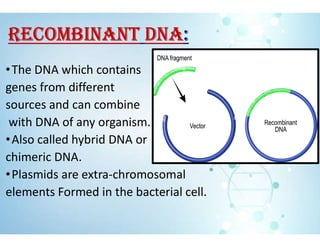
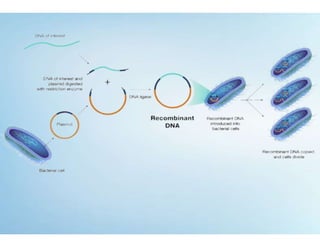
RECOMBINANT DNA:
•The DNAwhich contains
genes from different
sources and can combine
with DNA of any organism.
•Also called hybrid DNA or
chimeric DNA.
•Plasmids are extra-chromosomal
elements Formed in the bacterial cell.
5.
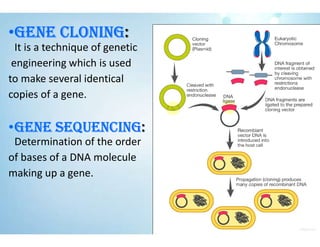
•GENE CLONING:
It isa technique of genetic
engineering which is used
to make several identical
copies of a gene.
•GENE SEQUENCING:
Determination of the order
of bases of a DNA molecule
making up a gene.
6.
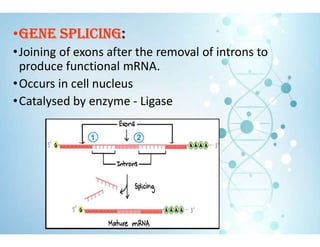
•GENE SPLICING:
•Joining ofexons after the removal of introns to
produce functional mRNA.
•Occurs in cell nucleus
•Catalysed by enzyme - Ligase
7.
• DNA PROBES:
•Small segments of DNA with known base sequences, origin, and
function.
• Helps to determine the nucleotide sequence in living and
nonliving systems.
•BASIC REQUIREMENTS:
VECTOR: Cloning vehicles which carry the gene of interest.
RESTRICTION ENZYMES: Cut or cleave the DNA at specific sites.
8.
•ENZYMES USED INGENETIC
ENGINEERING
•1. Nucleases - cut or cleave the genetic material
(DNA or RNA).
•DNase - cut DNA
•RNase - cut RNA
•Exonucleases - DNases that act on ends or
terminal regions of DNA. These cannot act on DNA
which is circular.
•Endonucleases - DNases that act on any random
site. These can act on circular DNA.
9.
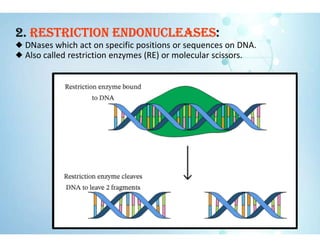
2. RESTRICTION ENDONUCLEASES:
◆DNases which act on specific positions or sequences on DNA.
◆ Also called restriction enzymes (RE) or molecular scissors.
10.
•APPLICATIONS OF GENETICENGINEERING:
I. CROP IMPROVEMENT:
1.Distant Hybridization: Interspecific and intergeneric
gene transfer - transfer of genes between distantly
related species.
2.Development of transgenic plants: Plants which
contain foreign genetic material are called transgenic
plants.
11.
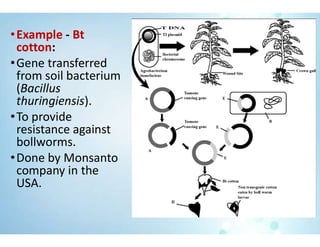
•Example - Bt
cotton:
•Genetransferred
from soil bacterium
(Bacillus
thuringiensis).
•To provide
resistance against
bollworms.
•Done by Monsanto
company in the
USA.
12.
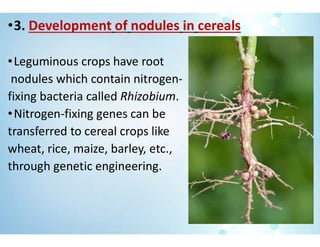
•3. Development ofnodules in cereals
•Leguminous crops have root
nodules which contain nitrogen-
fixing bacteria called Rhizobium.
•Nitrogen-fixing genes can be
transferred to cereal crops like
wheat, rice, maize, barley, etc.,
through genetic engineering.
13.
4. DEvELOPMENT OfC₄ PLANTS
•C₄ plants have a high potential rate of biomass
production and a high photosynthetic rate than
C₃ plants.
•E.g.: Maize, sorghum, sugarcane, maize.
•Photosynthetic rate can be increased by
conversion of C₃ plants to C₄ plants.
•This is achieved by either protoplast fusion or
recombinant DNA technology.
14.
II. MEDICINE
1. Productionof antibiotics:
Penicillin produced by fungus Penicillium
Streptomycin produced by Streptomyces fungus.
• 2. Production of hormone: Insulin
3.Production of vaccines
4.Production of interferon: Interferons: virus-induced
proteins produced by virus-infected cells. They are antiviral
in action. Act as the first line of defense against viruses
such as hepatitis and influenza.
5.Production of enzymes: Urokinase - dissolve blood clots
15.
•DANGERS OF GENETICENGINEERING
☐ Spread of new diseases.
☐ Effect on evolution.
☐ Biological warfare
16.
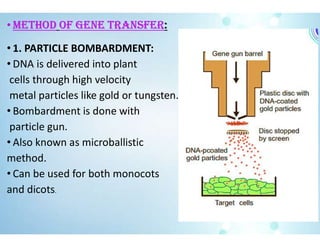
• METhOD OfGENE TRANSfER:
• 1. PARTICLE BOMBARDMENT:
• DNA is delivered into plant
cells through high velocity
metal particles like gold or tungsten.
• Bombardment is done with
particle gun.
• Also known as microballistic
method.
• Can be used for both monocots
and dicots.
17.
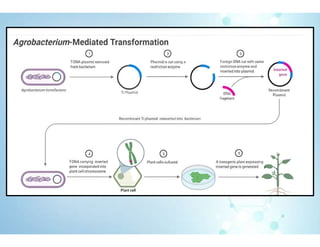
2. vIA PLASMID:
•Plasmids are extrachromosomal elements formed in the bacterial
cell.
• They are not essential for normal growth and function of bacterial
cell.
• Plasmids are used as cloning vectors in genetic engineering.
• This method is mediated by Agrobacterium tumefaciens which
contain Ti genes or oncogenes—tumour producing genes.
• Agrobacterium is known as the natural genetic engineer of plants.
• The foreign gene which has to be used for genetic transformation
is incorporated in place of oncogene for cloning.
• It is usually used for dicot plants.
19.
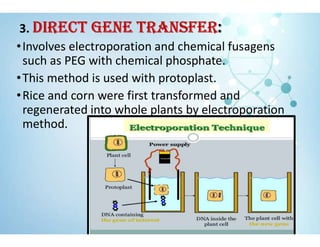
3. DIRECT GENETRANSfER:
•Involves electroporation and chemical fusagens
such as PEG with chemical phosphate.
•This method is used with protoplast.
•Rice and corn were first transformed and
regenerated into whole plants by electroporation
method.




![ANIMAL_CELL_,_TISSUE_AND_ORGAN_CULTURE[1].pptx](https://cdn.slidesharecdn.com/ss_thumbnails/animalcelltissueandorganculture1-260204172026-4462b440-thumbnail.jpg?width=640&height=640&fit=bounds)


