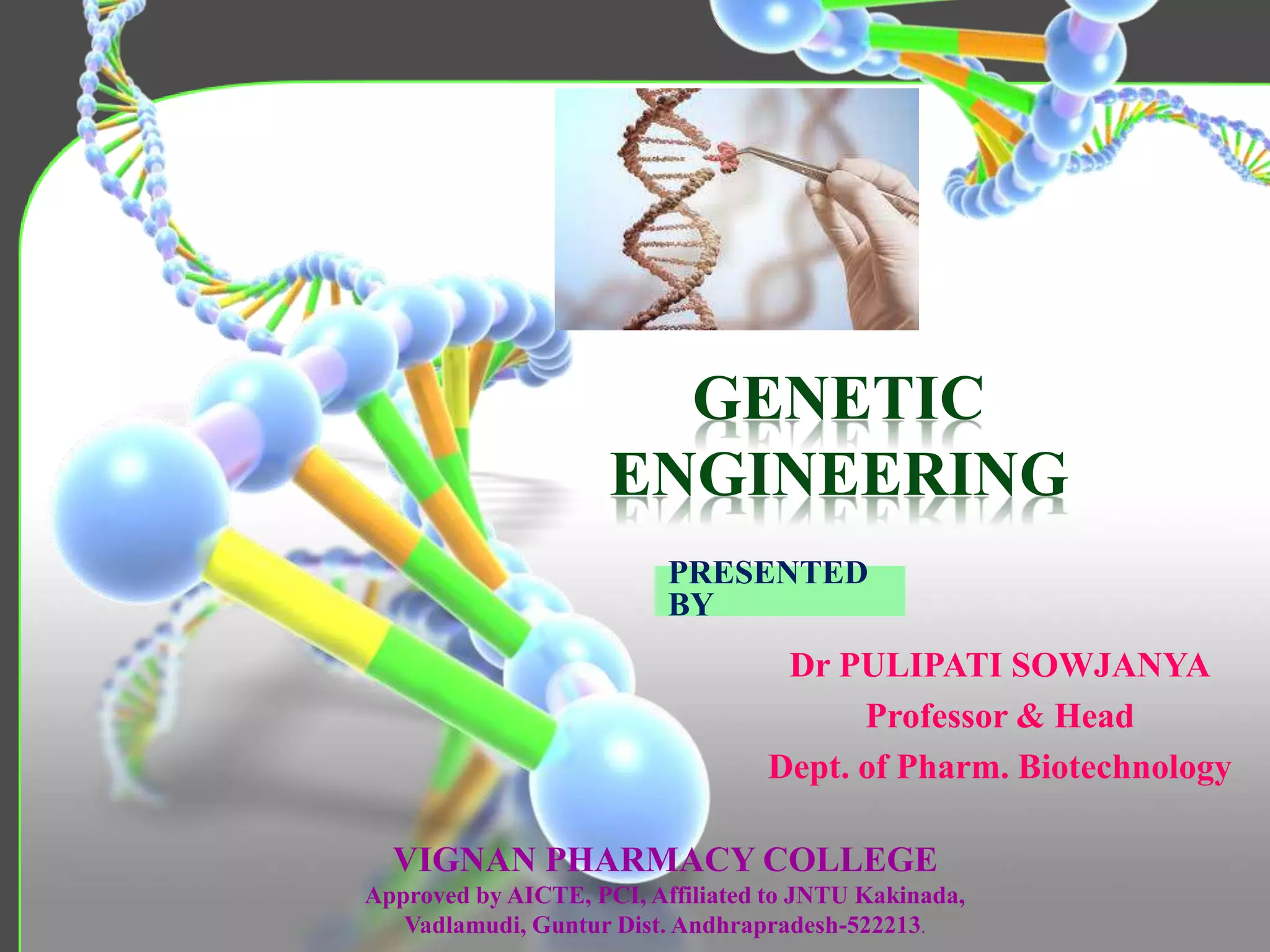
GENETIC
ENGINEERING
Dr PULIPATI SOWJANYA
Professor & Head
Dept. of Pharm. Biotechnology
VIGNAN PHARMACY COLLEGE
Approved by AICTE, PCI, Affiliated to JNTU Kakinada,
Vadlamudi, Guntur Dist. Andhrapradesh-522213.
PRESENTED
BY
• Genetic engineering is the process of using recombinant DNA
(rDNA) technology to alter the genetic makeup of an organism.
• Traditionally, humans have manipulated genomes indirectly by
controlling breeding and selecting offspring with desired traits.
• Genetic engineering involves the direct manipulation of one or
more genes.
• Most often, a gene from another species is added to an
organism's genome to give it a desired phenotype.
GENETIC ENGINEERING
Recombinant DNA (rDNA) is a form of artificial DNA that is
created by combining two or more sequences that would not
normally occur together through the process of gene splicing.
Recombinant DNA technology is a technology which allows
DNA to be produced via artificial means. The procedure has
been used to change DNA in living organisms and may have
even more practical uses in the future.
DEFINITIONS
 r-DNA technology was introduced in
earlier 1960’s, however the techniques
were employed mostly in the academic
investigations related to the basic
mechanisms of cell functions.
 The advent of classical r-DNA technology
provide opportunities for large scale
production of therapeutics or human
derived proteins and peptides.
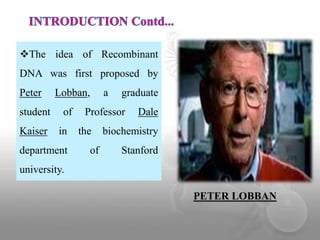
PETER LOBBAN
The idea of Recombinant
DNA was first proposed by
Peter Lobban, a graduate
student of Professor Dale
Kaiser in the biochemistry
department of Stanford
university.
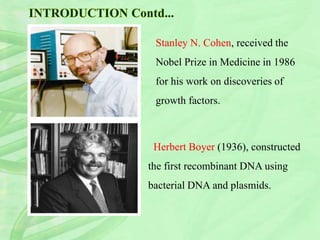
Herbert Boyer (1936), constructed
the first recombinant DNA using
bacterial DNA and plasmids.
Stanley N. Cohen, received the
Nobel Prize in Medicine in 1986
for his work on discoveries of
growth factors.
 The term CLONE means exact copy of the parent.
 A duplicate or a look like carrying the same genetic
signature or genetic map.
 Cloning is the best application of r-DNA
technology and could be applied to something as
simple as DNA fragment or larger, sophisticated
mammalian species such as humans.
Enzymes Involved in Gene Cloning
1. DNA Polymerase I: It is used for its 5’ 3’ exonuclease activities
for synthesizing the complementary strand of DNA or cDNA.
2. Klenow Polymerase: it is the largest fragment of DNA polymerase I
possessing 5’ 3’ polymerase and 3’ 5’ exonuclease activities.
This is also employed for synthesizing cDNA.
3. T4 DNA Polymerase: This polymerase has 5’ 3’ polymerase and
3’ 5’ exonuclease activites like Klenow polymerase. T4 DNA
polymerase has a marked 3’ 5’ exonuclease activity. It is used for
digesting the 3’ overhang formed by restriction endonuclease.
4. Reverse Transcriptase: It is obtained from Avian myeloblastosis
virus. It catalyses the synthesis of copy DNA (cDNA).
5. Alkaline Phosphatase: This is a zinc containing enzyme when it
is isolated from bacteria (E.coli) it is known as bacterial alkaline
phosphatase (BAP) and when isolated from calf intestine it is
known as calf intestine phosphatase (CIP). The enzyme
dephosphorylates i.e. removes 5’ terminal phosphate from nucleic
acid to generate free 5’ OH group. The dephosphorylation
prevents recircularization of vectors so that they remain
linearized.
Enzymes Involved in Gene Cloning
6. DNA Ligase: It’s action is quite opposite to restriction endonuclease
(RE). It is known as molecular suture. It joins two different pieces of
DNA. The source of enzyme is T4 virus or E.coli. The two fragments
are brought together by formation of phosphodiester bond between free
5’ – PO4 group on one strand and 3’ – OH group on the other strand.
7. T4 Polynucleotide Kinase: It possess opposite activity to that of
alkaline phosphatase. This enzyme catalyses the addition of a
phosphate group at free 5’ OH group of nucleic acid.
8. Terminal deoxynucleotidyl transferase: This enzyme catalyses the
addition of a chain of forty or more commonly 20 nucleotides, referred
to as ‘tail’, on to the 3’ end of nucleic acids. It is used to add tail in
cDNA.
Enzymes Involved in Gene Cloning
9. DNase I: It cleaves both ssDNA and dsDNA. It is used to obtain pure
RNA.
10. RNase H : It digests RNA. It is used to obtain pure DNA.
11. Methylases: Transfers methyl group at the recognition site.
12. S1 Nucleases : It is a SSDNA endonuclease that cleaves DNA to
remove 5’ nucleotides from 5’ end.
Enzymes Involved in Gene Cloning
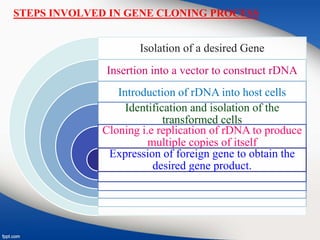
STEPS INVOLVED IN GENE CLONING PROCESS
Isolation of a desired Gene
Insertion into a vector to construct rDNA
Introduction of rDNA into host cells
Identification and isolation of the
transformed cells
Cloning i.e replication of rDNA to produce
multiple copies of itself
Expression of foreign gene to obtain the
desired gene product.
Step-1: Gene of Interest
1. Genomic DNA
2. Complementary/Copy DNA (cDNA)
3. Chemical Synthesis
4. Mechanical Shearing
Isolate whole genomic DNA from organism
DNA extraction easily performed using:
• SDS (detergent) to break up cell membrane and organelles.
• Salt (NaCl) lyses cells and binds the DNA strands together.
• Proteinase K to digest proteins bound to DNA (essential to
remove eukaryotic chromatin).
• Ethanol (EtOH) to precipitate and wash DNA.
• Water to resuspend and store DNA.
Storage - DNA can be stored short-term at room temperature, but
is best stored long-term at -800C or in liquid nitrogen.
*Average size of DNA fragments is important for applications
involving large regions of DNA sequence/less important for
applications involving short regions of DNA sequence.
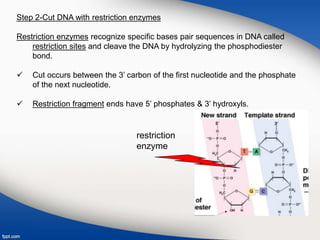
Step 2-Cut DNA with restriction enzymes
Restriction enzymes recognize specific bases pair sequences in DNA called
restriction sites and cleave the DNA by hydrolyzing the phosphodiester
bond.
 Cut occurs between the 3’ carbon of the first nucleotide and the phosphate
of the next nucleotide.
 Restriction fragment ends have 5’ phosphates & 3’ hydroxyls.
restriction
enzyme
RESTRICTION ENDONUCLEASES
o This enzyme is first discovered by Hamellton Smith in
Haemophilus influenzae bacteria.
o This enzyme is also known as ‘ Molecular scissors’.
o These are used to cut DNA within recognition site.
Tools of Recombinant DNA Technology
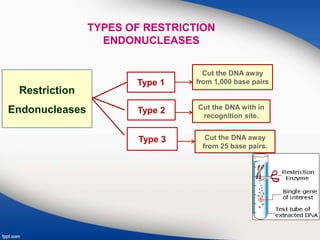
Restriction
Endonucleases
Type 1
Type 2
Type 3
Cut the DNA away
from 1,000 base pairs
Cut the DNA with in
recognition site.
Cut the DNA away
from 25 base pairs.
TYPES OF RESTRICTION
ENDONUCLEASES
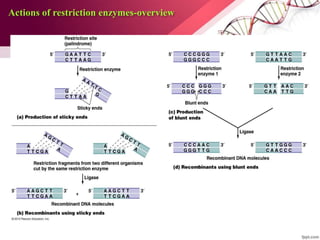
Actions of restriction enzymes-overview
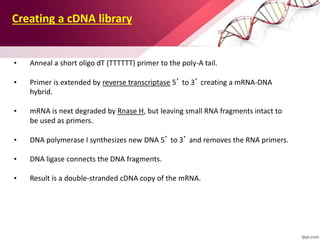
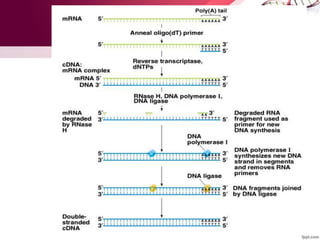
• Anneal a short oligo dT (TTTTTT) primer to the poly-A tail.
• Primer is extended by reverse transcriptase 5’ to 3’ creating a mRNA-DNA
hybrid.
• mRNA is next degraded by Rnase H, but leaving small RNA fragments intact to
be used as primers.
• DNA polymerase I synthesizes new DNA 5’ to 3’ and removes the RNA primers.
• DNA ligase connects the DNA fragments.
• Result is a double-stranded cDNA copy of the mRNA.
Creating a cDNA library
Step-2: Insertion into vector
Vectors
– Nucleic acid molecules that deliver a gene into a cell
– Useful properties
• Small enough to manipulate in a lab
• Survive inside cells
• Contain recognizable genetic marker
• Ensure genetic expression of gene
– Include viral genomes, transposons, and plasmids
Step 3-Splice (or ligate) DNA into some kind of cloning vector to
create a recombinant DNA molecule
Six different types of cloning vectors:
1. Plasmid cloning vector
1. Phage  cloning vector
2. Cosmid cloning vector
3. Shuttle vectors
4. Yeast artificial chromosome (YAC)
5. Bacterial artificial chromosome (BAC)
6. Fosmid cloning vector
7. Zoophaginea
8. Phytophaginea
1. Plasmid Cloning Vectors:
 Bacterial plasmids, naturally occurring small ‘satellite’ chromosome,
circular double-stranded extrachromosomal DNA elements capable of
replicating autonomously.
 Plasmid vectors engineered from bacterial plasmids for use in cloning.
 Features (e.g., E. coli plasmid vectors):
1. Origin sequence (ori) required for replication.
2. Selectable trait that enables E. coli that carry the plasmid to be
separated from E. coli that do not (e.g., antibiotic resistance, grow
cells on antibiotic; only those cells with the anti-biotic resistance grow
in colony).
3. Unique restriction site such that an enzyme cuts the plasmid DNA in
only one place. A fragment of DNA cut with the same enzyme can
then be inserted into the plasmid restriction site.
4. Simple marker that allows you to distinguish plasmids that contain
inserts from those that do not (e.g., lacZ+ gene)
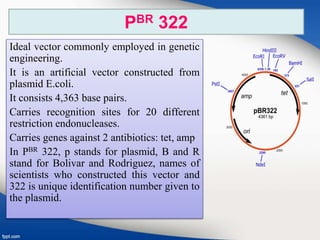
PBR 322
Ideal vector commonly employed in genetic
engineering.
It is an artificial vector constructed from
plasmid E.coli.
It consists 4,363 base pairs.
Carries recognition sites for 20 different
restriction endonucleases.
Carries genes against 2 antibiotics: tet, amp
In PBR 322, p stands for plasmid, B and R
stand for Bolivar and Rodriguez, names of
scientists who constructed this vector and
322 is unique identification number given to
the plasmid.
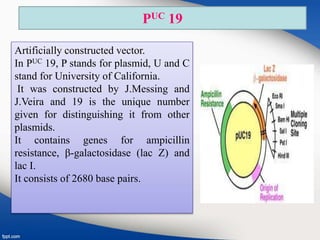
PUC 19
Artificially constructed vector.
In PUC 19, P stands for plasmid, U and C
stand for University of California.
It was constructed by J.Messing and
J.Veira and 19 is the unique number
given for distinguishing it from other
plasmids.
It contains genes for ampicillin
resistance, β-galactosidase (lac Z) and
lac I.
It consists of 2680 base pairs.
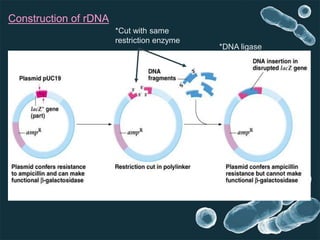
*Cut with same
restriction enzyme
*DNA ligase
Construction of rDNA
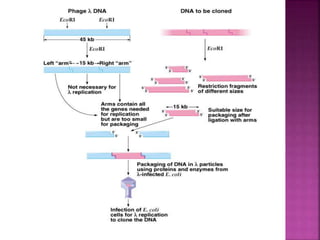
1. Engineered version of bacteriophage  (infects E. coli).
2. Central region of the  chromosome (linear) is cut with a
restriction enzyme and digested DNA is inserted.
3. DNA is packaged in phage heads to form virus particles.
4. Phages with both ends of the  chormosome and a 37-52 kb insert
replicate by infecting E. coli.
5. Phages replicate using E. coli and the lytic cycle
6. Like plasmid vectors, large number of restriction sites available;
phage  cloning vectors useful for larger DNA fragments than
pUC19 plasmid vectors.
2. Bacteriophage  cloning vectors:
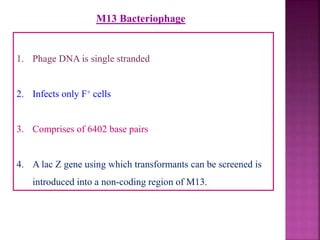
1. Phage DNA is single stranded
2. Infects only F+ cells
3. Comprises of 6402 base pairs
4. A lac Z gene using which transformants can be screened is
introduced into a non-coding region of M13.
M13 Bacteriophage
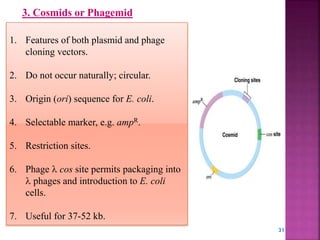
1. Features of both plasmid and phage
cloning vectors.
2. Do not occur naturally; circular.
3. Origin (ori) sequence for E. coli.
4. Selectable marker, e.g. ampR.
5. Restriction sites.
6. Phage  cos site permits packaging into
 phages and introduction to E. coli
cells.
7. Useful for 37-52 kb.
3. Cosmids or Phagemid
31
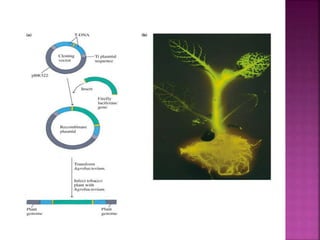
4. Shuttle vectors:
1. Capable of replicating in two or more types of hosts..
2. Replicate autonomously, or integrate into the host genome and
replicate when the host replicates.
3. Commonly used for transporting genes from one organism to
another (i.e., transforming animal and plant cells).
Example:
*Insert firefly luciferase gene
into plasmid and transform Agrobacterium.
*Grow Agrobacterium in large quantities and
infect tobacco plant.
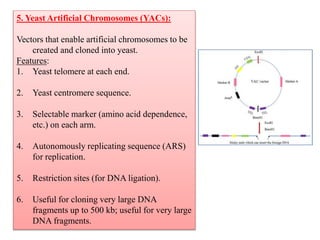
5. Yeast Artificial Chromosomes (YACs):
Vectors that enable artificial chromosomes to be
created and cloned into yeast.
Features:
1. Yeast telomere at each end.
2. Yeast centromere sequence.
3. Selectable marker (amino acid dependence,
etc.) on each arm.
4. Autonomously replicating sequence (ARS)
for replication.
5. Restriction sites (for DNA ligation).
6. Useful for cloning very large DNA
fragments up to 500 kb; useful for very large
DNA fragments.
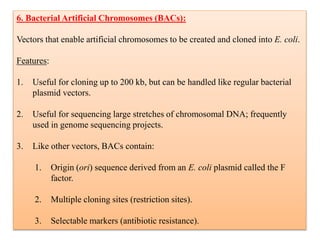
6. Bacterial Artificial Chromosomes (BACs):
Vectors that enable artificial chromosomes to be created and cloned into E. coli.
Features:
1. Useful for cloning up to 200 kb, but can be handled like regular bacterial
plasmid vectors.
2. Useful for sequencing large stretches of chromosomal DNA; frequently
used in genome sequencing projects.
3. Like other vectors, BACs contain:
1. Origin (ori) sequence derived from an E. coli plasmid called the F
factor.
2. Multiple cloning sites (restriction sites).
3. Selectable markers (antibiotic resistance).
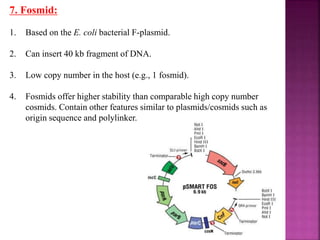
7. Fosmid:
1. Based on the E. coli bacterial F-plasmid.
2. Can insert 40 kb fragment of DNA.
3. Low copy number in the host (e.g., 1 fosmid).
4. Fosmids offer higher stability than comparable high copy number
cosmids. Contain other features similar to plasmids/cosmids such as
origin sequence and polylinker.
8. Zoophaginea
These are viruses that infect animals.
They introduce foreign gene into animal host cells like monkey
cells or insects. It uses vectors such as
(i) SV40:
Simian 40 virus consists of double stranded, circular DNA
It is used to introduce foreign gene into monkey cells.
(ii) Retrovirus: Introduces foreign DNA into mammalian cells.
(iii) Baculovirus: introduces foreign DNA into insect cells.
9. Phytophaginea
These are viruses that infect plants and are
used to introduce foreign DNA into plants for
expression
(i) Tomato golden mosaic virus
(ii)Cauliflower mosaic virus
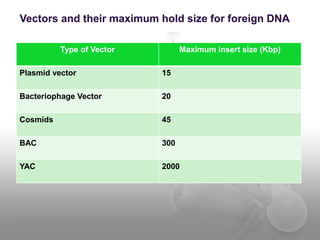
Type of Vector Maximum insert size (Kbp)
Plasmid vector 15
Bacteriophage Vector 20
Cosmids 45
BAC 300
YAC 2000
Vectors and their maximum hold size for foreign DNA
Gene of interest is inserted in vitro into the vector to synthesize
rDNA
1. REs generating cohesive ends: If type II RE is used to generate
cohesive ends of desired gene and the same RE is used to cut the
vector. Then if vector and desired genes are brought together, in
vitro annealing occurs.
The ends of two DNAs can be joined by DNA ligase at temperature
of 4-110C requiring 12-24 hrs.
Step-3: Recombinant DNA
2. RE generating blunt ends: Ligation of desired gee and vector
having blunt ends can be brought about by using a high
concentration of DNA ligase than that of ligating cohesive ends.
It is the T4 DNA ligase that employed rather than Escherichia coli
DNA ligase to join blunt ends
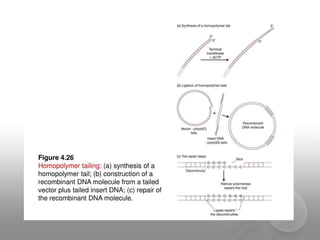
3. Homopolymer Tailing: By using RE, if blunt ends are generated
then the homopolymer tailing technique is useful for inserting the
desired gene into vector. It uses terminal deoxynucleotidyl
transferase.
Recombinant DNA
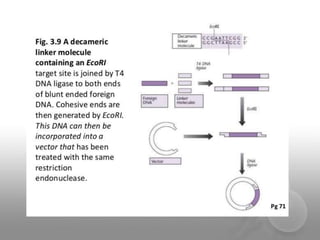
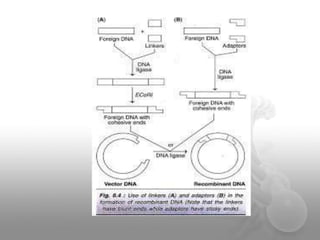
4. Linkers and Adapters: It is another technique to convert blunt ends
to cohesive ends.
Linkers are synthetic oligonucleotides having predetermined
recognition and cleavage sites for particular RE that generates
cohesive ends on cutting.
The linkers are blunt ended on the both sides. First they are
phosphorylated using polynucleotide kinase and then ligated to the
blunt ended DNA fragment using T4 DNA ligase.
Now the desired DNA fragment is treated with the particular RE,
generating the sticky cohesive ends. Then it can be ligated.
Recombinant DNA
5. Incompatible cohesive ends generated by use of different REs:
If both desired gene and vectors are cleaved with RE to generate
cohesive ends incompatible, the pairing up of the bases will not
occur.
To overcome this cohesive ends are converted to blunt ends in two
ways.
1. The protruding end or the overhanging may be removed using
S1 nuclease enzyme.
2. The ss can be filled in complementary to the overhang using
DNA polymerase enzyme.
Recombinant DNA
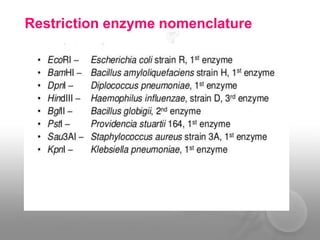
Restriction enzyme nomenclature
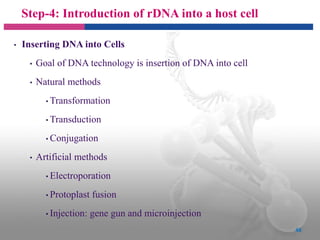
Step-4: Introduction of rDNA into a host cell
• Inserting DNA into Cells
• Goal of DNA technology is insertion of DNA into cell
• Natural methods
• Transformation
• Transduction
• Conjugation
• Artificial methods
• Electroporation
• Protoplast fusion
• Injection: gene gun and microinjection
48
 Certain bacterial species of genera Streptococcus, Bacillus,
Haemophilus, Neisseria and Rhizobium are able to take up
the DNA fragments spontaneously under physiological
conditions.
In some species such as E.coli success rate of
transformation is low. Such cells are chemically treated to
enhance the ability to take up the foreign DNA.
Such treated cells are said to be competent.
Competent cells are prepared by treating with 50mM
calcium chloride ice cold solution and then heat shock
raising the temperature to 42°C to make the movement
of foreign DNA into the competent cell.
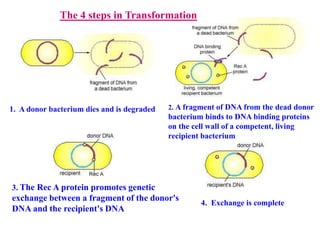
1. A donor bacterium dies and is degraded 2. A fragment of DNA from the dead donor
bacterium binds to DNA binding proteins
on the cell wall of a competent, living
recipient bacterium
3. The Rec A protein promotes genetic
exchange between a fragment of the donor's
DNA and the recipient's DNA
4. Exchange is complete
The 4 steps in Transformation
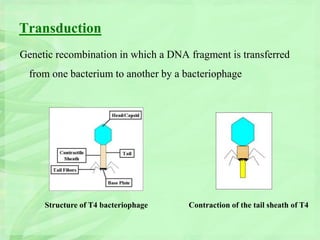
Transduction
Genetic recombination in which a DNA fragment is transferred
from one bacterium to another by a bacteriophage
Structure of T4 bacteriophage Contraction of the tail sheath of T4
Transduction (Contd...)
• There are two types of transduction:
Generalized transduction: A DNA fragment is transferred from one
bacterium to another by a lytic bacteriophage that is now carrying
donor bacterial DNA due to an error in maturation during the lytic
life cycle.
Specialized transduction: A DNA fragment is transferred from one
bacterium to another by a temperate bacteriophage that is now
carrying donor bacterial DNA due to an error in spontaneous
induction during the lysogenic life cycle
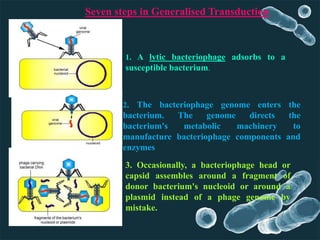
Seven steps in Generalised Transduction
1. A lytic bacteriophage adsorbs to a
susceptible bacterium.
2. The bacteriophage genome enters the
bacterium. The genome directs the
bacterium's metabolic machinery to
manufacture bacteriophage components and
enzymes
3. Occasionally, a bacteriophage head or
capsid assembles around a fragment of
donor bacterium's nucleoid or around a
plasmid instead of a phage genome by
mistake.
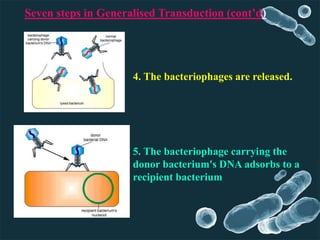
Seven steps in Generalised Transduction (cont’d)
4. The bacteriophages are released.
5. The bacteriophage carrying the
donor bacterium's DNA adsorbs to a
recipient bacterium
Seven steps in Generalised Transduction (contd)
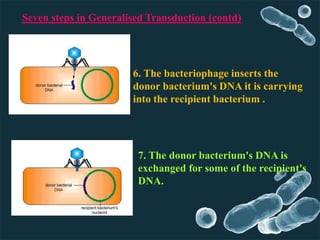
6. The bacteriophage inserts the
donor bacterium's DNA it is carrying
into the recipient bacterium .
7. The donor bacterium's DNA is
exchanged for some of the recipient's
DNA.
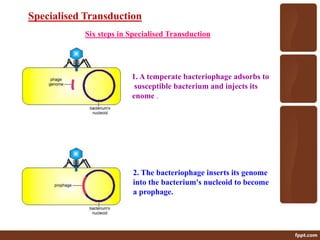
Six steps in Specialised Transduction
11. A temperate bacteriophage adsorbs to
a susceptible bacterium and injects its
genome .
2. The bacteriophage inserts its genome
into the bacterium's nucleoid to become
a prophage.
Specialised Transduction
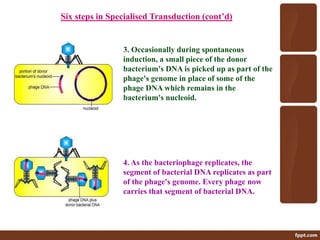
Six steps in Specialised Transduction (cont’d)
3. Occasionally during spontaneous
induction, a small piece of the donor
bacterium's DNA is picked up as part of the
phage's genome in place of some of the
phage DNA which remains in the
bacterium's nucleoid.
4. As the bacteriophage replicates, the
segment of bacterial DNA replicates as part
of the phage's genome. Every phage now
carries that segment of bacterial DNA.
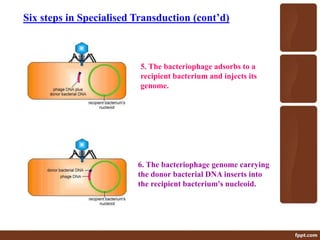
Six steps in Specialised Transduction (cont’d)
5. The bacteriophage adsorbs to a
recipient bacterium and injects its
genome.
6. The bacteriophage genome carrying
the donor bacterial DNA inserts into
the recipient bacterium's nucleoid.
Bacterial Conjugation
Bacterial Conjugation is genetic recombination in which there is
a transfer of DNA from a living donor bacterium to a
recipient bacterium. Often involves a sex pilus.
• The 3 conjugative processes
I. F
+
conjugation
II. Hfr conjugation
III. Resistance plasmid conjugation
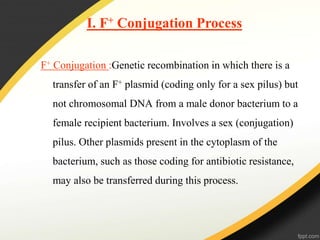
F+ Conjugation :Genetic recombination in which there is a
transfer of an F+ plasmid (coding only for a sex pilus) but
not chromosomal DNA from a male donor bacterium to a
female recipient bacterium. Involves a sex (conjugation)
pilus. Other plasmids present in the cytoplasm of the
bacterium, such as those coding for antibiotic resistance,
may also be transferred during this process.
I. F+ Conjugation Process
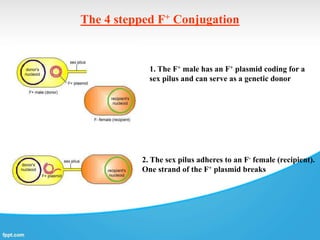
The 4 stepped F+ Conjugation
1. The F+ male has an F+ plasmid coding for a
sex pilus and can serve as a genetic donor
2. The sex pilus adheres to an F- female (recipient).
One strand of the F+ plasmid breaks
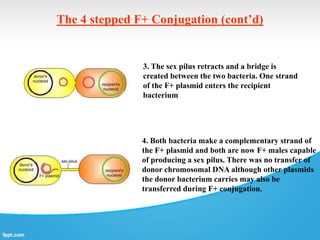
The 4 stepped F+ Conjugation (cont’d)
3. The sex pilus retracts and a bridge is
created between the two bacteria. One strand
of the F+ plasmid enters the recipient
bacterium
4. Both bacteria make a complementary strand of
the F+ plasmid and both are now F+ males capable
of producing a sex pilus. There was no transfer of
donor chromosomal DNA although other plasmids
the donor bacterium carries may also be
transferred during F+ conjugation.
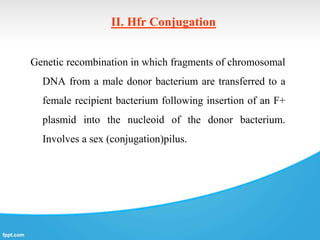
II. Hfr Conjugation
Genetic recombination in which fragments of chromosomal
DNA from a male donor bacterium are transferred to a
female recipient bacterium following insertion of an F+
plasmid into the nucleoid of the donor bacterium.
Involves a sex (conjugation)pilus.
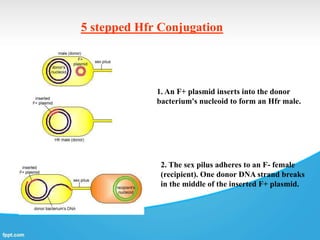
5 stepped Hfr Conjugation
1. An F+ plasmid inserts into the donor
bacterium's nucleoid to form an Hfr male.
2. The sex pilus adheres to an F- female
(recipient). One donor DNA strand breaks
in the middle of the inserted F+ plasmid.
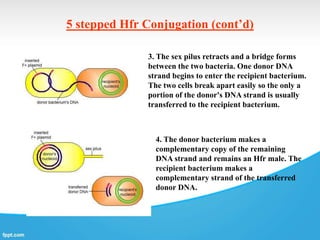
5 stepped Hfr Conjugation (cont’d)
3. The sex pilus retracts and a bridge forms
between the two bacteria. One donor DNA
strand begins to enter the recipient bacterium.
The two cells break apart easily so the only a
portion of the donor's DNA strand is usually
transferred to the recipient bacterium.
4. The donor bacterium makes a
complementary copy of the remaining
DNA strand and remains an Hfr male. The
recipient bacterium makes a
complementary strand of the transferred
donor DNA.
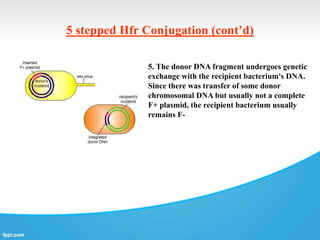
5 stepped Hfr Conjugation (cont’d)
5. The donor DNA fragment undergoes genetic
exchange with the recipient bacterium's DNA.
Since there was transfer of some donor
chromosomal DNA but usually not a complete
F+ plasmid, the recipient bacterium usually
remains F-
III. Resistant Plasmid Conjugation
Genetic recombination in which there is a transfer of
an R plasmid (a plasmid coding for multiple antibiotic
resistance and often a sex pilus) from a male donor
bacterium to a female recipient bacterium. Involves a
sex (conjugation) pilus
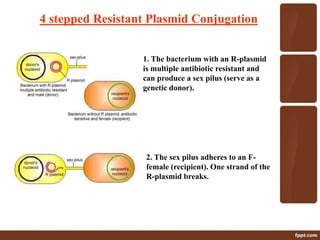
4 stepped Resistant Plasmid Conjugation
1. The bacterium with an R-plasmid
is multiple antibiotic resistant and
can produce a sex pilus (serve as a
genetic donor).
2. The sex pilus adheres to an F-
female (recipient). One strand of the
R-plasmid breaks.
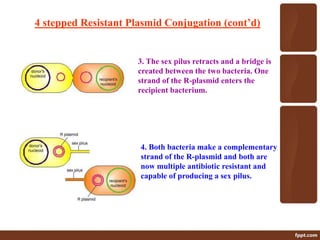
4 stepped Resistant Plasmid Conjugation (cont’d)
3. The sex pilus retracts and a bridge is
created between the two bacteria. One
strand of the R-plasmid enters the
recipient bacterium.
4. Both bacteria make a complementary
strand of the R-plasmid and both are
now multiple antibiotic resistant and
capable of producing a sex pilus.
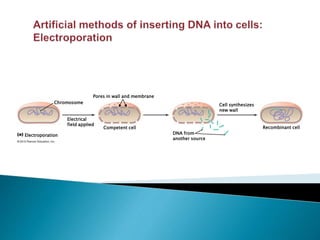
Chromosome
Electroporation
Pores in wall and membrane
Competent cell
Electrical
field applied
DNA from
another source
Cell synthesizes
new wall
Recombinant cell
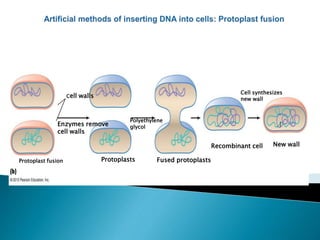
Cell walls
Protoplast fusion
Polyethylene
glycol
Protoplasts
Enzymes remove
cell walls
Fused protoplasts
Recombinant cell New wall
Cell synthesizes
new wall
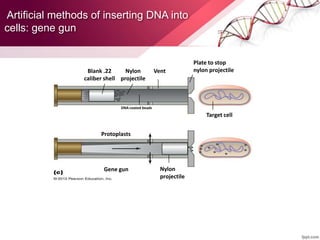
Artificial methods of inserting DNA into
cells: gene gun
Gene gun
Protoplasts
Nylon
projectile
Nylon
projectile
Blank .22
caliber shell
DNA-coated beads
Vent
Target cell
Plate to stop
nylon projectile
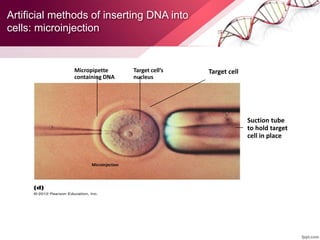
Artificial methods of inserting DNA into
cells: microinjection
Microinjection
Target cell
Suction tube
to hold target
cell in place
Target cell’s
nucleus
Micropipette
containing DNA
Step-5: Identification & Isolation of Transformed
cells
The transformed cells are identified on the basis of some selective
property that has been acquired by the transformed cells.
Most frequently markers coding for specific antibiotic resistance
are used.
 Resistance against antibiotics, heavy metals
 Production of antibiotics, bacteriocins, enterotoxins, H2S
 Metabolism/degradation of aromatic compounds, sugars,
haemoglobin.
 Induction of plant tumour
O
v
e
r
v
i
e
w
o
f
r
D
N
A
t
e
c
h
n
o
l
o
g
y
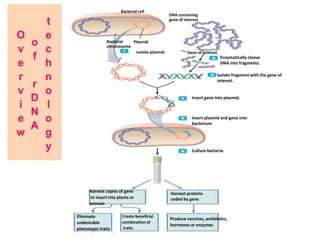
Bacterial cell
Bacterial
chromosome
Plasmid
Gene of interest
DNA containing
gene of interest
Isolate plasmid.
Enzymatically cleave
DNA into fragments.
Isolate fragment with the gene of
interest.
Insert gene into plasmid.
Insert plasmid and gene into
bacterium.
Culture bacteria.
Harvest copies of gene
to insert into plants or
animals
Harvest proteins
coded by gene
Eliminate
undesirable
phenotypic traits
Produce vaccines, antibiotics,
hormones or enzymes
Create beneficial
combination of
traits
Applications of Recombinant DNA
Technology
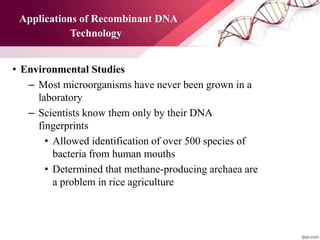
• Environmental Studies
– Most microorganisms have never been grown in a
laboratory
– Scientists know them only by their DNA
fingerprints
• Allowed identification of over 500 species of
bacteria from human mouths
• Determined that methane-producing archaea are
a problem in rice agriculture
Applications of Recombinant DNA
Technology (Contd…)
• Pharmaceutical and Therapeutic Applications
– Protein synthesis
• Creation of synthetic peptides for cloning
– Vaccines
• Production of safer vaccines
• Subunit vaccines
• Genes of pathogens introduced into common
fruits and vegetables
• Injecting humans with plasmid carrying gene
from pathogen
– Humans synthesize pathogen’s proteins
Applications of Recombinant DNA
Technology (Contd…)
• Pharmaceutical and Therapeutic Applications
– Genetic screening
• DNA microarrays used to screen individuals
for inherited disease caused by mutations
• Can also identify pathogen’s DNA in blood
or tissues
– DNA fingerprinting
• Identifying individuals or organisms by their
unique DNA sequence
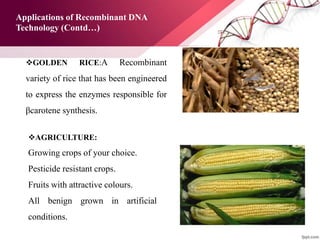
GOLDEN RICE:A Recombinant
variety of rice that has been engineered
to express the enzymes responsible for
βcarotene synthesis.
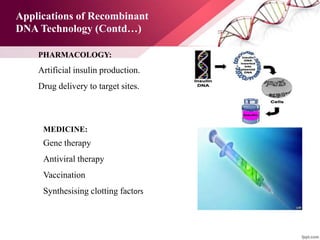
AGRICULTURE:
Growing crops of your choice.
Pesticide resistant crops.
Fruits with attractive colours.
All benign grown in artificial
conditions.
Applications of Recombinant DNA
Technology (Contd…)
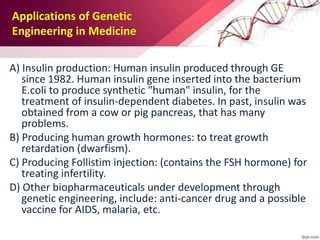
PHARMACOLOGY:
Artificial insulin production.
Drug delivery to target sites.
MEDICINE:
Gene therapy
Antiviral therapy
Vaccination
Synthesising clotting factors
Applications of Recombinant
DNA Technology (Contd…)
Applications of Genetic
Engineering in Medicine
A) Insulin production: Human insulin produced through GE
since 1982. Human insulin gene inserted into the bacterium
E.coli to produce synthetic "human" insulin, for the
treatment of insulin-dependent diabetes. In past, insulin was
obtained from a cow or pig pancreas, that has many
problems.
B) Producing human growth hormones: to treat growth
retardation (dwarfism).
C) Producing Follistim injection: (contains the FSH hormone) for
treating infertility.
D) Other biopharmaceuticals under development through
genetic engineering, include: anti-cancer drug and a possible
vaccine for AIDS, malaria, etc.
E) Making human albumin, anti-hemophilic factors and many
other drugs.
F) GE vaccines may be useful to prevent diseases that have
resistant to traditional vaccination , including HIV,
tuberculosis…etc.
G) Gene therapy has been successfully used to treat Chronic
lymphocytic leukemia (CLL) and Parkinson's disease.
H) Gene therapy is also being tested as a treatment for cystic
fibrosis, skin cancer, breast cancer, brain cancer, and AIDS.
However, most of these treatments are only partially
successful. The major reasons for these failures is
inefficient vectors
Applications of Genetic
Engineering in Medicine
ADVANTAGES:
 Provide substantial quantity.
 No need for natural or organic factors.
 Tailor made product that you can control.
 Unlimited utilisations.
 Cheap
 Resistant to natural inhibitors.
 DISADVANTAGES:
 Commercialised and became big source of income for
business man.
 Effects natural immune system of the body.
 Can destroy natural ecosystem that relies on organic cycle.
 Prone to cause mutation that could have harmful effects.
 Major International concern: Manufacturing of
biological weapons such as botulism and anthrax target
humans with specific genotype.
 Concern of creating super human care.
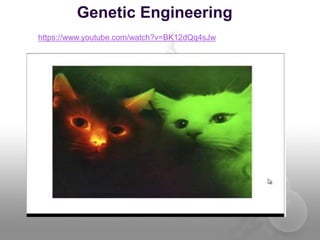
Genetic Engineering
https://www.youtube.com/watch?v=BK12dQq4sJw
THANK YOU

Genetic Engineering

  • 1.
    GENETIC ENGINEERING Dr PULIPATI SOWJANYA Professor& Head Dept. of Pharm. Biotechnology VIGNAN PHARMACY COLLEGE Approved by AICTE, PCI, Affiliated to JNTU Kakinada, Vadlamudi, Guntur Dist. Andhrapradesh-522213. PRESENTED BY
  • 2.
    • Genetic engineeringis the process of using recombinant DNA (rDNA) technology to alter the genetic makeup of an organism. • Traditionally, humans have manipulated genomes indirectly by controlling breeding and selecting offspring with desired traits. • Genetic engineering involves the direct manipulation of one or more genes. • Most often, a gene from another species is added to an organism's genome to give it a desired phenotype. GENETIC ENGINEERING
  • 3.
    Recombinant DNA (rDNA)is a form of artificial DNA that is created by combining two or more sequences that would not normally occur together through the process of gene splicing. Recombinant DNA technology is a technology which allows DNA to be produced via artificial means. The procedure has been used to change DNA in living organisms and may have even more practical uses in the future. DEFINITIONS
  • 4.
     r-DNA technologywas introduced in earlier 1960’s, however the techniques were employed mostly in the academic investigations related to the basic mechanisms of cell functions.  The advent of classical r-DNA technology provide opportunities for large scale production of therapeutics or human derived proteins and peptides.
  • 5.
    PETER LOBBAN The ideaof Recombinant DNA was first proposed by Peter Lobban, a graduate student of Professor Dale Kaiser in the biochemistry department of Stanford university.
  • 6.
    Herbert Boyer (1936),constructed the first recombinant DNA using bacterial DNA and plasmids. Stanley N. Cohen, received the Nobel Prize in Medicine in 1986 for his work on discoveries of growth factors.
  • 7.
     The termCLONE means exact copy of the parent.  A duplicate or a look like carrying the same genetic signature or genetic map.  Cloning is the best application of r-DNA technology and could be applied to something as simple as DNA fragment or larger, sophisticated mammalian species such as humans.
  • 8.
    Enzymes Involved inGene Cloning 1. DNA Polymerase I: It is used for its 5’ 3’ exonuclease activities for synthesizing the complementary strand of DNA or cDNA. 2. Klenow Polymerase: it is the largest fragment of DNA polymerase I possessing 5’ 3’ polymerase and 3’ 5’ exonuclease activities. This is also employed for synthesizing cDNA. 3. T4 DNA Polymerase: This polymerase has 5’ 3’ polymerase and 3’ 5’ exonuclease activites like Klenow polymerase. T4 DNA polymerase has a marked 3’ 5’ exonuclease activity. It is used for digesting the 3’ overhang formed by restriction endonuclease.
  • 9.
    4. Reverse Transcriptase:It is obtained from Avian myeloblastosis virus. It catalyses the synthesis of copy DNA (cDNA). 5. Alkaline Phosphatase: This is a zinc containing enzyme when it is isolated from bacteria (E.coli) it is known as bacterial alkaline phosphatase (BAP) and when isolated from calf intestine it is known as calf intestine phosphatase (CIP). The enzyme dephosphorylates i.e. removes 5’ terminal phosphate from nucleic acid to generate free 5’ OH group. The dephosphorylation prevents recircularization of vectors so that they remain linearized. Enzymes Involved in Gene Cloning
  • 10.
    6. DNA Ligase:It’s action is quite opposite to restriction endonuclease (RE). It is known as molecular suture. It joins two different pieces of DNA. The source of enzyme is T4 virus or E.coli. The two fragments are brought together by formation of phosphodiester bond between free 5’ – PO4 group on one strand and 3’ – OH group on the other strand. 7. T4 Polynucleotide Kinase: It possess opposite activity to that of alkaline phosphatase. This enzyme catalyses the addition of a phosphate group at free 5’ OH group of nucleic acid. 8. Terminal deoxynucleotidyl transferase: This enzyme catalyses the addition of a chain of forty or more commonly 20 nucleotides, referred to as ‘tail’, on to the 3’ end of nucleic acids. It is used to add tail in cDNA. Enzymes Involved in Gene Cloning
  • 11.
    9. DNase I:It cleaves both ssDNA and dsDNA. It is used to obtain pure RNA. 10. RNase H : It digests RNA. It is used to obtain pure DNA. 11. Methylases: Transfers methyl group at the recognition site. 12. S1 Nucleases : It is a SSDNA endonuclease that cleaves DNA to remove 5’ nucleotides from 5’ end. Enzymes Involved in Gene Cloning
  • 12.
    STEPS INVOLVED INGENE CLONING PROCESS Isolation of a desired Gene Insertion into a vector to construct rDNA Introduction of rDNA into host cells Identification and isolation of the transformed cells Cloning i.e replication of rDNA to produce multiple copies of itself Expression of foreign gene to obtain the desired gene product.
  • 13.
    Step-1: Gene ofInterest 1. Genomic DNA 2. Complementary/Copy DNA (cDNA) 3. Chemical Synthesis 4. Mechanical Shearing
  • 14.
    Isolate whole genomicDNA from organism DNA extraction easily performed using: • SDS (detergent) to break up cell membrane and organelles. • Salt (NaCl) lyses cells and binds the DNA strands together. • Proteinase K to digest proteins bound to DNA (essential to remove eukaryotic chromatin). • Ethanol (EtOH) to precipitate and wash DNA. • Water to resuspend and store DNA.
  • 15.
    Storage - DNAcan be stored short-term at room temperature, but is best stored long-term at -800C or in liquid nitrogen. *Average size of DNA fragments is important for applications involving large regions of DNA sequence/less important for applications involving short regions of DNA sequence.
  • 16.
    Step 2-Cut DNAwith restriction enzymes Restriction enzymes recognize specific bases pair sequences in DNA called restriction sites and cleave the DNA by hydrolyzing the phosphodiester bond.  Cut occurs between the 3’ carbon of the first nucleotide and the phosphate of the next nucleotide.  Restriction fragment ends have 5’ phosphates & 3’ hydroxyls. restriction enzyme
  • 17.
    RESTRICTION ENDONUCLEASES o Thisenzyme is first discovered by Hamellton Smith in Haemophilus influenzae bacteria. o This enzyme is also known as ‘ Molecular scissors’. o These are used to cut DNA within recognition site. Tools of Recombinant DNA Technology
  • 18.
    Restriction Endonucleases Type 1 Type 2 Type3 Cut the DNA away from 1,000 base pairs Cut the DNA with in recognition site. Cut the DNA away from 25 base pairs. TYPES OF RESTRICTION ENDONUCLEASES
  • 19.
    Actions of restrictionenzymes-overview
  • 20.
    • Anneal ashort oligo dT (TTTTTT) primer to the poly-A tail. • Primer is extended by reverse transcriptase 5’ to 3’ creating a mRNA-DNA hybrid. • mRNA is next degraded by Rnase H, but leaving small RNA fragments intact to be used as primers. • DNA polymerase I synthesizes new DNA 5’ to 3’ and removes the RNA primers. • DNA ligase connects the DNA fragments. • Result is a double-stranded cDNA copy of the mRNA. Creating a cDNA library
  • 22.
    Step-2: Insertion intovector Vectors – Nucleic acid molecules that deliver a gene into a cell – Useful properties • Small enough to manipulate in a lab • Survive inside cells • Contain recognizable genetic marker • Ensure genetic expression of gene – Include viral genomes, transposons, and plasmids
  • 23.
    Step 3-Splice (orligate) DNA into some kind of cloning vector to create a recombinant DNA molecule Six different types of cloning vectors: 1. Plasmid cloning vector 1. Phage  cloning vector 2. Cosmid cloning vector 3. Shuttle vectors 4. Yeast artificial chromosome (YAC) 5. Bacterial artificial chromosome (BAC) 6. Fosmid cloning vector 7. Zoophaginea 8. Phytophaginea
  • 24.
    1. Plasmid CloningVectors:  Bacterial plasmids, naturally occurring small ‘satellite’ chromosome, circular double-stranded extrachromosomal DNA elements capable of replicating autonomously.  Plasmid vectors engineered from bacterial plasmids for use in cloning.  Features (e.g., E. coli plasmid vectors): 1. Origin sequence (ori) required for replication. 2. Selectable trait that enables E. coli that carry the plasmid to be separated from E. coli that do not (e.g., antibiotic resistance, grow cells on antibiotic; only those cells with the anti-biotic resistance grow in colony). 3. Unique restriction site such that an enzyme cuts the plasmid DNA in only one place. A fragment of DNA cut with the same enzyme can then be inserted into the plasmid restriction site. 4. Simple marker that allows you to distinguish plasmids that contain inserts from those that do not (e.g., lacZ+ gene)
  • 25.
    PBR 322 Ideal vectorcommonly employed in genetic engineering. It is an artificial vector constructed from plasmid E.coli. It consists 4,363 base pairs. Carries recognition sites for 20 different restriction endonucleases. Carries genes against 2 antibiotics: tet, amp In PBR 322, p stands for plasmid, B and R stand for Bolivar and Rodriguez, names of scientists who constructed this vector and 322 is unique identification number given to the plasmid.
  • 26.
    PUC 19 Artificially constructedvector. In PUC 19, P stands for plasmid, U and C stand for University of California. It was constructed by J.Messing and J.Veira and 19 is the unique number given for distinguishing it from other plasmids. It contains genes for ampicillin resistance, β-galactosidase (lac Z) and lac I. It consists of 2680 base pairs.
  • 27.
    *Cut with same restrictionenzyme *DNA ligase Construction of rDNA
  • 28.
    1. Engineered versionof bacteriophage  (infects E. coli). 2. Central region of the  chromosome (linear) is cut with a restriction enzyme and digested DNA is inserted. 3. DNA is packaged in phage heads to form virus particles. 4. Phages with both ends of the  chormosome and a 37-52 kb insert replicate by infecting E. coli. 5. Phages replicate using E. coli and the lytic cycle 6. Like plasmid vectors, large number of restriction sites available; phage  cloning vectors useful for larger DNA fragments than pUC19 plasmid vectors. 2. Bacteriophage  cloning vectors:
  • 30.
    1. Phage DNAis single stranded 2. Infects only F+ cells 3. Comprises of 6402 base pairs 4. A lac Z gene using which transformants can be screened is introduced into a non-coding region of M13. M13 Bacteriophage
  • 31.
    1. Features ofboth plasmid and phage cloning vectors. 2. Do not occur naturally; circular. 3. Origin (ori) sequence for E. coli. 4. Selectable marker, e.g. ampR. 5. Restriction sites. 6. Phage  cos site permits packaging into  phages and introduction to E. coli cells. 7. Useful for 37-52 kb. 3. Cosmids or Phagemid 31
  • 32.
    4. Shuttle vectors: 1.Capable of replicating in two or more types of hosts.. 2. Replicate autonomously, or integrate into the host genome and replicate when the host replicates. 3. Commonly used for transporting genes from one organism to another (i.e., transforming animal and plant cells). Example: *Insert firefly luciferase gene into plasmid and transform Agrobacterium. *Grow Agrobacterium in large quantities and infect tobacco plant.
  • 34.
    5. Yeast ArtificialChromosomes (YACs): Vectors that enable artificial chromosomes to be created and cloned into yeast. Features: 1. Yeast telomere at each end. 2. Yeast centromere sequence. 3. Selectable marker (amino acid dependence, etc.) on each arm. 4. Autonomously replicating sequence (ARS) for replication. 5. Restriction sites (for DNA ligation). 6. Useful for cloning very large DNA fragments up to 500 kb; useful for very large DNA fragments.
  • 35.
    6. Bacterial ArtificialChromosomes (BACs): Vectors that enable artificial chromosomes to be created and cloned into E. coli. Features: 1. Useful for cloning up to 200 kb, but can be handled like regular bacterial plasmid vectors. 2. Useful for sequencing large stretches of chromosomal DNA; frequently used in genome sequencing projects. 3. Like other vectors, BACs contain: 1. Origin (ori) sequence derived from an E. coli plasmid called the F factor. 2. Multiple cloning sites (restriction sites). 3. Selectable markers (antibiotic resistance).
  • 36.
    7. Fosmid: 1. Basedon the E. coli bacterial F-plasmid. 2. Can insert 40 kb fragment of DNA. 3. Low copy number in the host (e.g., 1 fosmid). 4. Fosmids offer higher stability than comparable high copy number cosmids. Contain other features similar to plasmids/cosmids such as origin sequence and polylinker.
  • 37.
    8. Zoophaginea These areviruses that infect animals. They introduce foreign gene into animal host cells like monkey cells or insects. It uses vectors such as (i) SV40: Simian 40 virus consists of double stranded, circular DNA It is used to introduce foreign gene into monkey cells. (ii) Retrovirus: Introduces foreign DNA into mammalian cells. (iii) Baculovirus: introduces foreign DNA into insect cells.
  • 38.
    9. Phytophaginea These areviruses that infect plants and are used to introduce foreign DNA into plants for expression (i) Tomato golden mosaic virus (ii)Cauliflower mosaic virus
  • 39.
    Type of VectorMaximum insert size (Kbp) Plasmid vector 15 Bacteriophage Vector 20 Cosmids 45 BAC 300 YAC 2000 Vectors and their maximum hold size for foreign DNA
  • 40.
    Gene of interestis inserted in vitro into the vector to synthesize rDNA 1. REs generating cohesive ends: If type II RE is used to generate cohesive ends of desired gene and the same RE is used to cut the vector. Then if vector and desired genes are brought together, in vitro annealing occurs. The ends of two DNAs can be joined by DNA ligase at temperature of 4-110C requiring 12-24 hrs. Step-3: Recombinant DNA
  • 41.
    2. RE generatingblunt ends: Ligation of desired gee and vector having blunt ends can be brought about by using a high concentration of DNA ligase than that of ligating cohesive ends. It is the T4 DNA ligase that employed rather than Escherichia coli DNA ligase to join blunt ends 3. Homopolymer Tailing: By using RE, if blunt ends are generated then the homopolymer tailing technique is useful for inserting the desired gene into vector. It uses terminal deoxynucleotidyl transferase. Recombinant DNA
  • 43.
    4. Linkers andAdapters: It is another technique to convert blunt ends to cohesive ends. Linkers are synthetic oligonucleotides having predetermined recognition and cleavage sites for particular RE that generates cohesive ends on cutting. The linkers are blunt ended on the both sides. First they are phosphorylated using polynucleotide kinase and then ligated to the blunt ended DNA fragment using T4 DNA ligase. Now the desired DNA fragment is treated with the particular RE, generating the sticky cohesive ends. Then it can be ligated. Recombinant DNA
  • 46.
    5. Incompatible cohesiveends generated by use of different REs: If both desired gene and vectors are cleaved with RE to generate cohesive ends incompatible, the pairing up of the bases will not occur. To overcome this cohesive ends are converted to blunt ends in two ways. 1. The protruding end or the overhanging may be removed using S1 nuclease enzyme. 2. The ss can be filled in complementary to the overhang using DNA polymerase enzyme. Recombinant DNA
  • 47.
  • 48.
    Step-4: Introduction ofrDNA into a host cell • Inserting DNA into Cells • Goal of DNA technology is insertion of DNA into cell • Natural methods • Transformation • Transduction • Conjugation • Artificial methods • Electroporation • Protoplast fusion • Injection: gene gun and microinjection 48
  • 49.
     Certain bacterialspecies of genera Streptococcus, Bacillus, Haemophilus, Neisseria and Rhizobium are able to take up the DNA fragments spontaneously under physiological conditions. In some species such as E.coli success rate of transformation is low. Such cells are chemically treated to enhance the ability to take up the foreign DNA. Such treated cells are said to be competent.
  • 50.
    Competent cells areprepared by treating with 50mM calcium chloride ice cold solution and then heat shock raising the temperature to 42°C to make the movement of foreign DNA into the competent cell.
  • 51.
    1. A donorbacterium dies and is degraded 2. A fragment of DNA from the dead donor bacterium binds to DNA binding proteins on the cell wall of a competent, living recipient bacterium 3. The Rec A protein promotes genetic exchange between a fragment of the donor's DNA and the recipient's DNA 4. Exchange is complete The 4 steps in Transformation
  • 52.
    Transduction Genetic recombination inwhich a DNA fragment is transferred from one bacterium to another by a bacteriophage Structure of T4 bacteriophage Contraction of the tail sheath of T4
  • 53.
    Transduction (Contd...) • Thereare two types of transduction: Generalized transduction: A DNA fragment is transferred from one bacterium to another by a lytic bacteriophage that is now carrying donor bacterial DNA due to an error in maturation during the lytic life cycle. Specialized transduction: A DNA fragment is transferred from one bacterium to another by a temperate bacteriophage that is now carrying donor bacterial DNA due to an error in spontaneous induction during the lysogenic life cycle
  • 54.
    Seven steps inGeneralised Transduction 1. A lytic bacteriophage adsorbs to a susceptible bacterium. 2. The bacteriophage genome enters the bacterium. The genome directs the bacterium's metabolic machinery to manufacture bacteriophage components and enzymes 3. Occasionally, a bacteriophage head or capsid assembles around a fragment of donor bacterium's nucleoid or around a plasmid instead of a phage genome by mistake.
  • 55.
    Seven steps inGeneralised Transduction (cont’d) 4. The bacteriophages are released. 5. The bacteriophage carrying the donor bacterium's DNA adsorbs to a recipient bacterium
  • 56.
    Seven steps inGeneralised Transduction (contd) 6. The bacteriophage inserts the donor bacterium's DNA it is carrying into the recipient bacterium . 7. The donor bacterium's DNA is exchanged for some of the recipient's DNA.
  • 57.
    Six steps inSpecialised Transduction 11. A temperate bacteriophage adsorbs to a susceptible bacterium and injects its genome . 2. The bacteriophage inserts its genome into the bacterium's nucleoid to become a prophage. Specialised Transduction
  • 58.
    Six steps inSpecialised Transduction (cont’d) 3. Occasionally during spontaneous induction, a small piece of the donor bacterium's DNA is picked up as part of the phage's genome in place of some of the phage DNA which remains in the bacterium's nucleoid. 4. As the bacteriophage replicates, the segment of bacterial DNA replicates as part of the phage's genome. Every phage now carries that segment of bacterial DNA.
  • 59.
    Six steps inSpecialised Transduction (cont’d) 5. The bacteriophage adsorbs to a recipient bacterium and injects its genome. 6. The bacteriophage genome carrying the donor bacterial DNA inserts into the recipient bacterium's nucleoid.
  • 60.
    Bacterial Conjugation Bacterial Conjugationis genetic recombination in which there is a transfer of DNA from a living donor bacterium to a recipient bacterium. Often involves a sex pilus. • The 3 conjugative processes I. F + conjugation II. Hfr conjugation III. Resistance plasmid conjugation
  • 61.
    F+ Conjugation :Geneticrecombination in which there is a transfer of an F+ plasmid (coding only for a sex pilus) but not chromosomal DNA from a male donor bacterium to a female recipient bacterium. Involves a sex (conjugation) pilus. Other plasmids present in the cytoplasm of the bacterium, such as those coding for antibiotic resistance, may also be transferred during this process. I. F+ Conjugation Process
  • 62.
    The 4 steppedF+ Conjugation 1. The F+ male has an F+ plasmid coding for a sex pilus and can serve as a genetic donor 2. The sex pilus adheres to an F- female (recipient). One strand of the F+ plasmid breaks
  • 63.
    The 4 steppedF+ Conjugation (cont’d) 3. The sex pilus retracts and a bridge is created between the two bacteria. One strand of the F+ plasmid enters the recipient bacterium 4. Both bacteria make a complementary strand of the F+ plasmid and both are now F+ males capable of producing a sex pilus. There was no transfer of donor chromosomal DNA although other plasmids the donor bacterium carries may also be transferred during F+ conjugation.
  • 64.
    II. Hfr Conjugation Geneticrecombination in which fragments of chromosomal DNA from a male donor bacterium are transferred to a female recipient bacterium following insertion of an F+ plasmid into the nucleoid of the donor bacterium. Involves a sex (conjugation)pilus.
  • 65.
    5 stepped HfrConjugation 1. An F+ plasmid inserts into the donor bacterium's nucleoid to form an Hfr male. 2. The sex pilus adheres to an F- female (recipient). One donor DNA strand breaks in the middle of the inserted F+ plasmid.
  • 66.
    5 stepped HfrConjugation (cont’d) 3. The sex pilus retracts and a bridge forms between the two bacteria. One donor DNA strand begins to enter the recipient bacterium. The two cells break apart easily so the only a portion of the donor's DNA strand is usually transferred to the recipient bacterium. 4. The donor bacterium makes a complementary copy of the remaining DNA strand and remains an Hfr male. The recipient bacterium makes a complementary strand of the transferred donor DNA.
  • 67.
    5 stepped HfrConjugation (cont’d) 5. The donor DNA fragment undergoes genetic exchange with the recipient bacterium's DNA. Since there was transfer of some donor chromosomal DNA but usually not a complete F+ plasmid, the recipient bacterium usually remains F-
  • 68.
    III. Resistant PlasmidConjugation Genetic recombination in which there is a transfer of an R plasmid (a plasmid coding for multiple antibiotic resistance and often a sex pilus) from a male donor bacterium to a female recipient bacterium. Involves a sex (conjugation) pilus
  • 69.
    4 stepped ResistantPlasmid Conjugation 1. The bacterium with an R-plasmid is multiple antibiotic resistant and can produce a sex pilus (serve as a genetic donor). 2. The sex pilus adheres to an F- female (recipient). One strand of the R-plasmid breaks.
  • 70.
    4 stepped ResistantPlasmid Conjugation (cont’d) 3. The sex pilus retracts and a bridge is created between the two bacteria. One strand of the R-plasmid enters the recipient bacterium. 4. Both bacteria make a complementary strand of the R-plasmid and both are now multiple antibiotic resistant and capable of producing a sex pilus.
  • 71.
    Chromosome Electroporation Pores in walland membrane Competent cell Electrical field applied DNA from another source Cell synthesizes new wall Recombinant cell
  • 72.
    Cell walls Protoplast fusion Polyethylene glycol Protoplasts Enzymesremove cell walls Fused protoplasts Recombinant cell New wall Cell synthesizes new wall
  • 73.
    Artificial methods ofinserting DNA into cells: gene gun Gene gun Protoplasts Nylon projectile Nylon projectile Blank .22 caliber shell DNA-coated beads Vent Target cell Plate to stop nylon projectile
  • 74.
    Artificial methods ofinserting DNA into cells: microinjection Microinjection Target cell Suction tube to hold target cell in place Target cell’s nucleus Micropipette containing DNA
  • 75.
    Step-5: Identification &Isolation of Transformed cells The transformed cells are identified on the basis of some selective property that has been acquired by the transformed cells. Most frequently markers coding for specific antibiotic resistance are used.  Resistance against antibiotics, heavy metals  Production of antibiotics, bacteriocins, enterotoxins, H2S  Metabolism/degradation of aromatic compounds, sugars, haemoglobin.  Induction of plant tumour
  • 76.
    O v e r v i e w o f r D N A t e c h n o l o g y Bacterial cell Bacterial chromosome Plasmid Gene ofinterest DNA containing gene of interest Isolate plasmid. Enzymatically cleave DNA into fragments. Isolate fragment with the gene of interest. Insert gene into plasmid. Insert plasmid and gene into bacterium. Culture bacteria. Harvest copies of gene to insert into plants or animals Harvest proteins coded by gene Eliminate undesirable phenotypic traits Produce vaccines, antibiotics, hormones or enzymes Create beneficial combination of traits
  • 77.
    Applications of RecombinantDNA Technology • Environmental Studies – Most microorganisms have never been grown in a laboratory – Scientists know them only by their DNA fingerprints • Allowed identification of over 500 species of bacteria from human mouths • Determined that methane-producing archaea are a problem in rice agriculture
  • 78.
    Applications of RecombinantDNA Technology (Contd…) • Pharmaceutical and Therapeutic Applications – Protein synthesis • Creation of synthetic peptides for cloning – Vaccines • Production of safer vaccines • Subunit vaccines • Genes of pathogens introduced into common fruits and vegetables • Injecting humans with plasmid carrying gene from pathogen – Humans synthesize pathogen’s proteins
  • 79.
    Applications of RecombinantDNA Technology (Contd…) • Pharmaceutical and Therapeutic Applications – Genetic screening • DNA microarrays used to screen individuals for inherited disease caused by mutations • Can also identify pathogen’s DNA in blood or tissues – DNA fingerprinting • Identifying individuals or organisms by their unique DNA sequence
  • 80.
    GOLDEN RICE:A Recombinant varietyof rice that has been engineered to express the enzymes responsible for βcarotene synthesis. AGRICULTURE: Growing crops of your choice. Pesticide resistant crops. Fruits with attractive colours. All benign grown in artificial conditions. Applications of Recombinant DNA Technology (Contd…)
  • 81.
    PHARMACOLOGY: Artificial insulin production. Drugdelivery to target sites. MEDICINE: Gene therapy Antiviral therapy Vaccination Synthesising clotting factors Applications of Recombinant DNA Technology (Contd…)
  • 82.
    Applications of Genetic Engineeringin Medicine A) Insulin production: Human insulin produced through GE since 1982. Human insulin gene inserted into the bacterium E.coli to produce synthetic "human" insulin, for the treatment of insulin-dependent diabetes. In past, insulin was obtained from a cow or pig pancreas, that has many problems. B) Producing human growth hormones: to treat growth retardation (dwarfism). C) Producing Follistim injection: (contains the FSH hormone) for treating infertility. D) Other biopharmaceuticals under development through genetic engineering, include: anti-cancer drug and a possible vaccine for AIDS, malaria, etc.
  • 83.
    E) Making humanalbumin, anti-hemophilic factors and many other drugs. F) GE vaccines may be useful to prevent diseases that have resistant to traditional vaccination , including HIV, tuberculosis…etc. G) Gene therapy has been successfully used to treat Chronic lymphocytic leukemia (CLL) and Parkinson's disease. H) Gene therapy is also being tested as a treatment for cystic fibrosis, skin cancer, breast cancer, brain cancer, and AIDS. However, most of these treatments are only partially successful. The major reasons for these failures is inefficient vectors Applications of Genetic Engineering in Medicine
  • 84.
    ADVANTAGES:  Provide substantialquantity.  No need for natural or organic factors.  Tailor made product that you can control.  Unlimited utilisations.  Cheap  Resistant to natural inhibitors.
  • 85.
     DISADVANTAGES:  Commercialisedand became big source of income for business man.  Effects natural immune system of the body.  Can destroy natural ecosystem that relies on organic cycle.  Prone to cause mutation that could have harmful effects.  Major International concern: Manufacturing of biological weapons such as botulism and anthrax target humans with specific genotype.  Concern of creating super human care.
  • 86.
  • 87.