GENETIC ENGINEERINGTaking a gene fromonespecies and puttingitintoanotherspecies
9There are several ways in which genes from one organism can be inserted into a different organismThey can be coated on to microscopic gold particles and ‘fired’into the cellsThey can be delivered by virusesThey can be transmitted by using structures, called plasmids,present in bacteriaFor example, the human gene for making insulin can be transferred to bacteria, which are then allowed to reproduce in a culture mediumfrom which the insulin can be extractedPlasmids
A bacterium10in addition to a loop of DNA……bacteria also contain numerous rings of DNA called plasmidscell wallcytoplasm0.001mmcell membranethe plasmids can be extracted and used forgenetic engineering
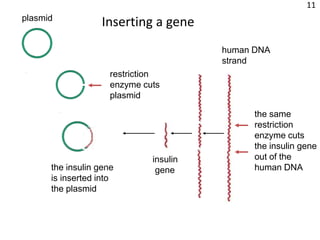
11Inserting a geneplasmidhuman DNAstrandrestriction enzyme cutsplasmidthe samerestriction enzyme cutsthe insulin geneout of thehuman DNAinsulin genethe insulin geneis inserted intothe plasmid
12The recombinant plastids are inserted into a bacterium *the insulin gene makes thebacterium produce insulinRecombinant plastids
13Only about 1 in 100,000 bacteria take up the recombined plasmids.There are techniques for identifying and isolating these bacteria.Human growth hormone can be made in a similar way.Chymosin, used for clotting milk in cheese-making, can be produced from yeast cells with recombinant plasmid DNA.Genetic engineering can be used to produce bacteria that make human insulin. The bacteria with the insulin gene are then allowed to reproduce in a culture solution from which the insulin can be extracted*Applications
15Genetic engineering does not always have to involve gene transfer between unrelated organismsGenes in a single organism can be modified to improve theircharacteristics or their products A gene for the production of  ß carotene (a precursor of Vitamin A)has been introduced to rice to benefit countries where rice is thestaple diet and Vitamin A deficiencies are common*The next slide shows tomatoes which have been genetically modified to suppress production of an enzyme which causes the fruit to soften as it ripens. This improves the keeping qualitiesApplications
Genetically modifiedControl tomatoesGenetically modified  tomatoesAfter storageAfter storage© AstraZenecaTomatoes

Powerpoint genetic engineering

  • 1.
    GENETIC ENGINEERINGTaking agene fromonespecies and puttingitintoanotherspecies
  • 2.
    9There are severalways in which genes from one organism can be inserted into a different organismThey can be coated on to microscopic gold particles and ‘fired’into the cellsThey can be delivered by virusesThey can be transmitted by using structures, called plasmids,present in bacteriaFor example, the human gene for making insulin can be transferred to bacteria, which are then allowed to reproduce in a culture mediumfrom which the insulin can be extractedPlasmids
  • 3.
    A bacterium10in additionto a loop of DNA……bacteria also contain numerous rings of DNA called plasmidscell wallcytoplasm0.001mmcell membranethe plasmids can be extracted and used forgenetic engineering
  • 4.
    11Inserting a geneplasmidhumanDNAstrandrestriction enzyme cutsplasmidthe samerestriction enzyme cutsthe insulin geneout of thehuman DNAinsulin genethe insulin geneis inserted intothe plasmid
  • 5.
    12The recombinant plastidsare inserted into a bacterium *the insulin gene makes thebacterium produce insulinRecombinant plastids
  • 6.
    13Only about 1in 100,000 bacteria take up the recombined plasmids.There are techniques for identifying and isolating these bacteria.Human growth hormone can be made in a similar way.Chymosin, used for clotting milk in cheese-making, can be produced from yeast cells with recombinant plasmid DNA.Genetic engineering can be used to produce bacteria that make human insulin. The bacteria with the insulin gene are then allowed to reproduce in a culture solution from which the insulin can be extracted*Applications
  • 8.
    15Genetic engineering doesnot always have to involve gene transfer between unrelated organismsGenes in a single organism can be modified to improve theircharacteristics or their products A gene for the production of ß carotene (a precursor of Vitamin A)has been introduced to rice to benefit countries where rice is thestaple diet and Vitamin A deficiencies are common*The next slide shows tomatoes which have been genetically modified to suppress production of an enzyme which causes the fruit to soften as it ripens. This improves the keeping qualitiesApplications
  • 9.
    Genetically modifiedControl tomatoesGeneticallymodified tomatoesAfter storageAfter storage© AstraZenecaTomatoes