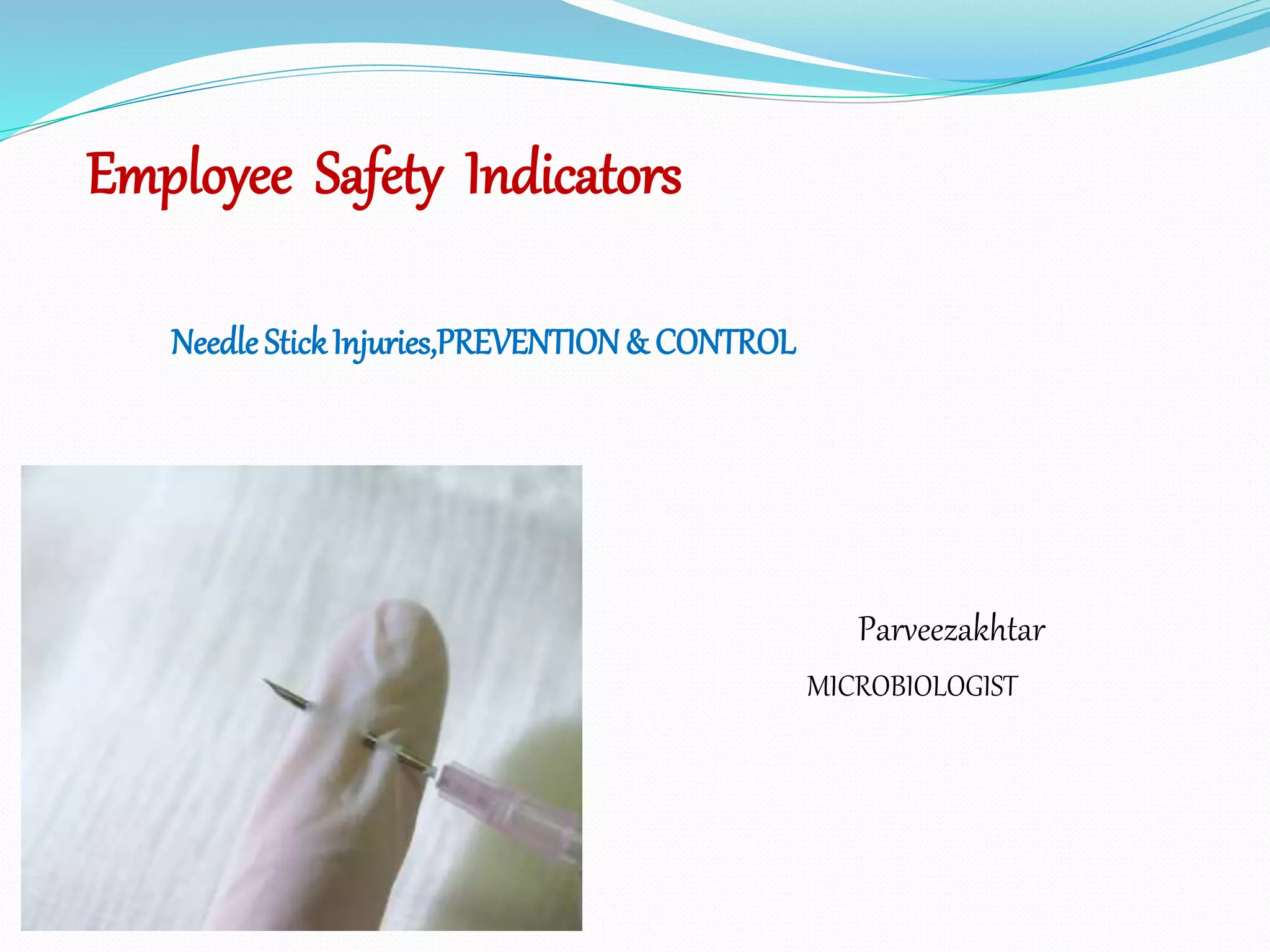
Employee Safety Indicators
Parveezakhtar
MICROBIOLOGIST
Needle StickInjuries,PREVENTION& CONTROL
Needle StickInjuries
It takes a team to eliminate sharps injuries
What is considered a needle stick injury?
Needle stick injury: A penetrating stab wound from a needle
(or other sharp object) that may result in exposure to blood or
other body fluids. The main concern is exposure to the blood
or other body fluids of another person who may be carrying
infectious disease.
Occupational exposure
Percutaneous injury, e.g. needle stick injury
(NSI) or other sharp injury.
Splash injury:
Contact with the mucous membrane
Contact with non-intact skin
Contact with the intact skin when the
duration is prolonged
Agents transmitted
Hepatitis B virus (HBV), Hepatitis C virus (HCV) and
HIV.
Risk of transmission is:
Highest for HBV (30%)
Followed by HCV (3%)
HIV (0.3%).
What is the Risk for HIV Alone?
 Percutaneous 0.3%
 Mucous membrane 0.1%
 Non-intact skin <0.1%
Who Gets Injured?
Nurse
43%
Technician
15%
Student
4%
Dental
1%
Housekeeping/
Maintenance
3%
Clerical / Admin
1%
Other
5%
Physician
28%
Occupational Groups of
Healthcare Personnel
Exposed to Blood/Body
Fluids
Where Do Sharps Injuries Occur?
 Patient Room 39%
(Inpatient: Medical – ICUs )
 Operating Room 27%
 Outpatient 8%
 ER 8%
 Laboratory 5%
 Other 13%
When Do Sharps Injuries Occur?
 During use 41%
 After use/before disposal 40%
 During and after disposal 15%
 Other 4%
What Devices are Involved in Sharps
Injuries?
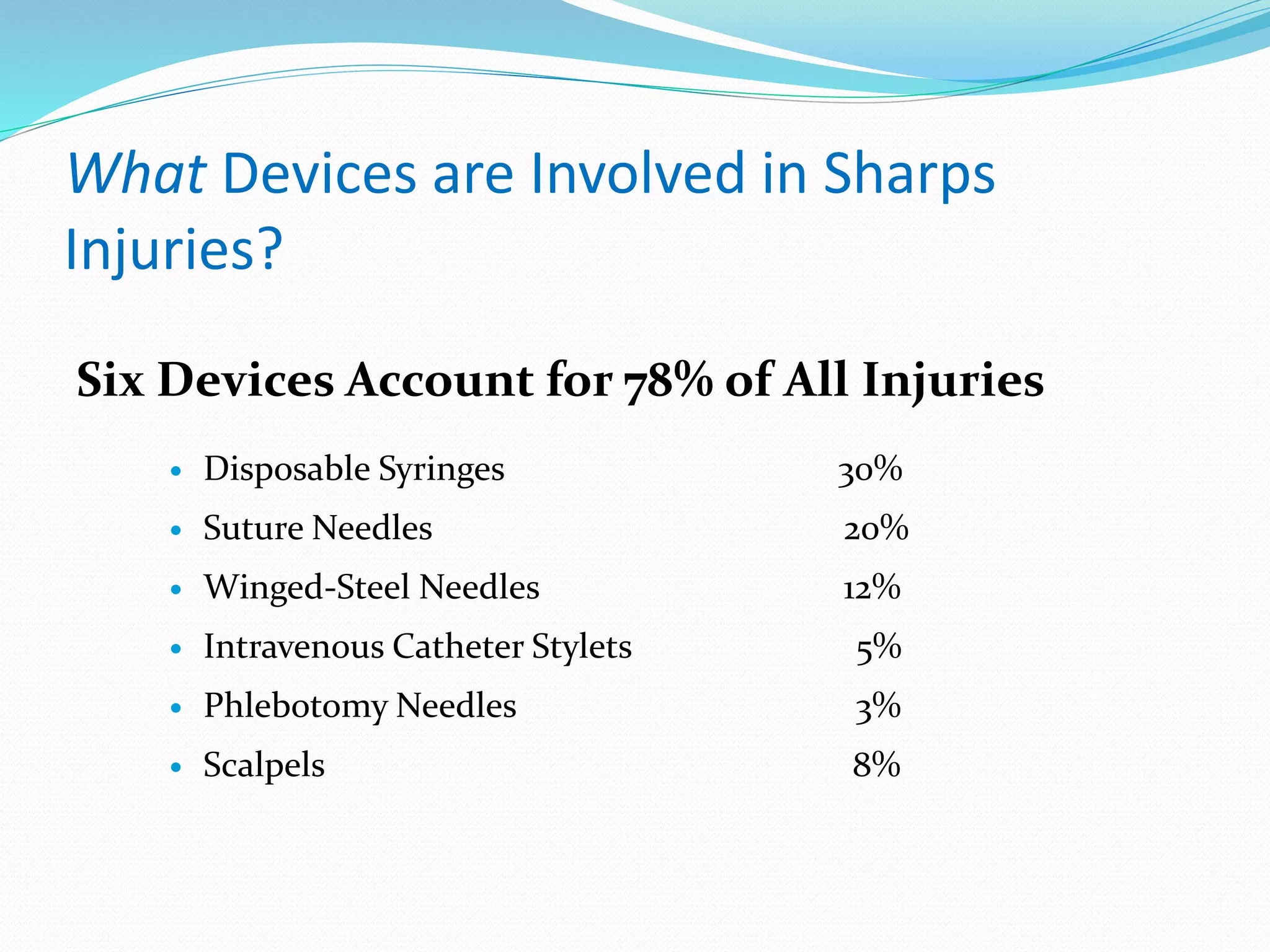
Six Devices Account for 78% of All Injuries
 Disposable Syringes 30%
 Suture Needles 20%
 Winged-Steel Needles 12%
 Intravenous Catheter Stylets 5%
 Phlebotomy Needles 3%
 Scalpels 8%
Infectious specimens for NSI
 Potentially infectious body fluids: Blood, genital
secretions (semen, vaginal secretions) and all body fluids
(CSF, synovial fluid, pleural fluid, peritoneal fluid).
 The following are not considered potentially infectious,
unless visibly contaminated with blood: Faeces, nasal
secretions, saliva, sputum, sweat, tears, urine and vomitus.
Factors that influence the risk of contracting
infection following NSI
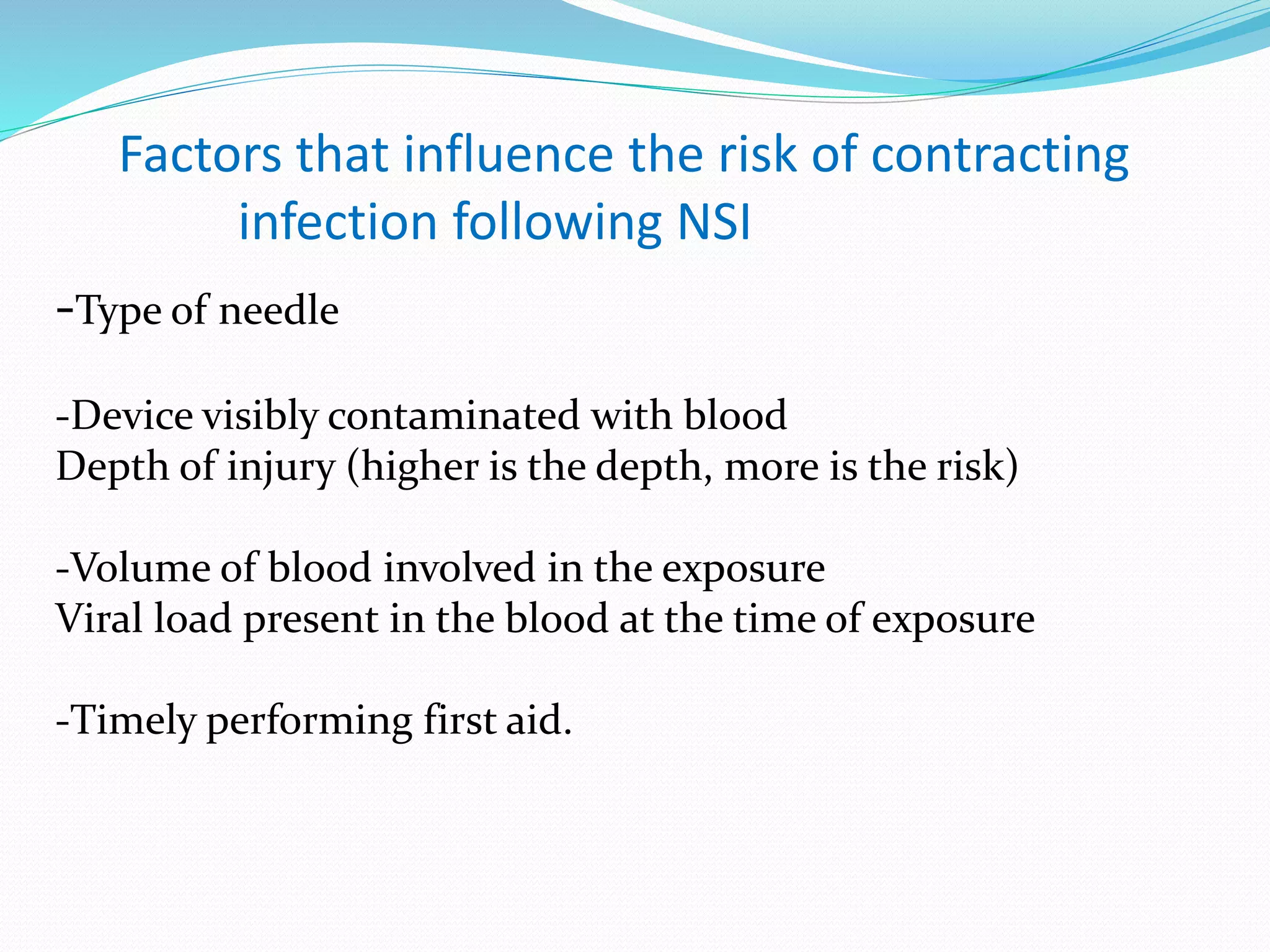
-Type of needle
-Device visibly contaminated with blood
Depth of injury (higher is the depth, more is the risk)
-Volume of blood involved in the exposure
Viral load present in the blood at the time of exposure
-Timely performing first aid.
PREVENTION OF NEEDLE STICK INJURY
Precautions During Handling Needles
-Standard precautions must be followed
-Work surfaces must be disinfected with 0.5% sodium
hypochlorite
-Health care workers (HCWs) must be immunized against
HBV
-Spillage of blood and other body fluids must be promptly
cleaned
-Disposable needles should be used
-Never recap needles and proper disposal after use
Precautions During Handling Needles
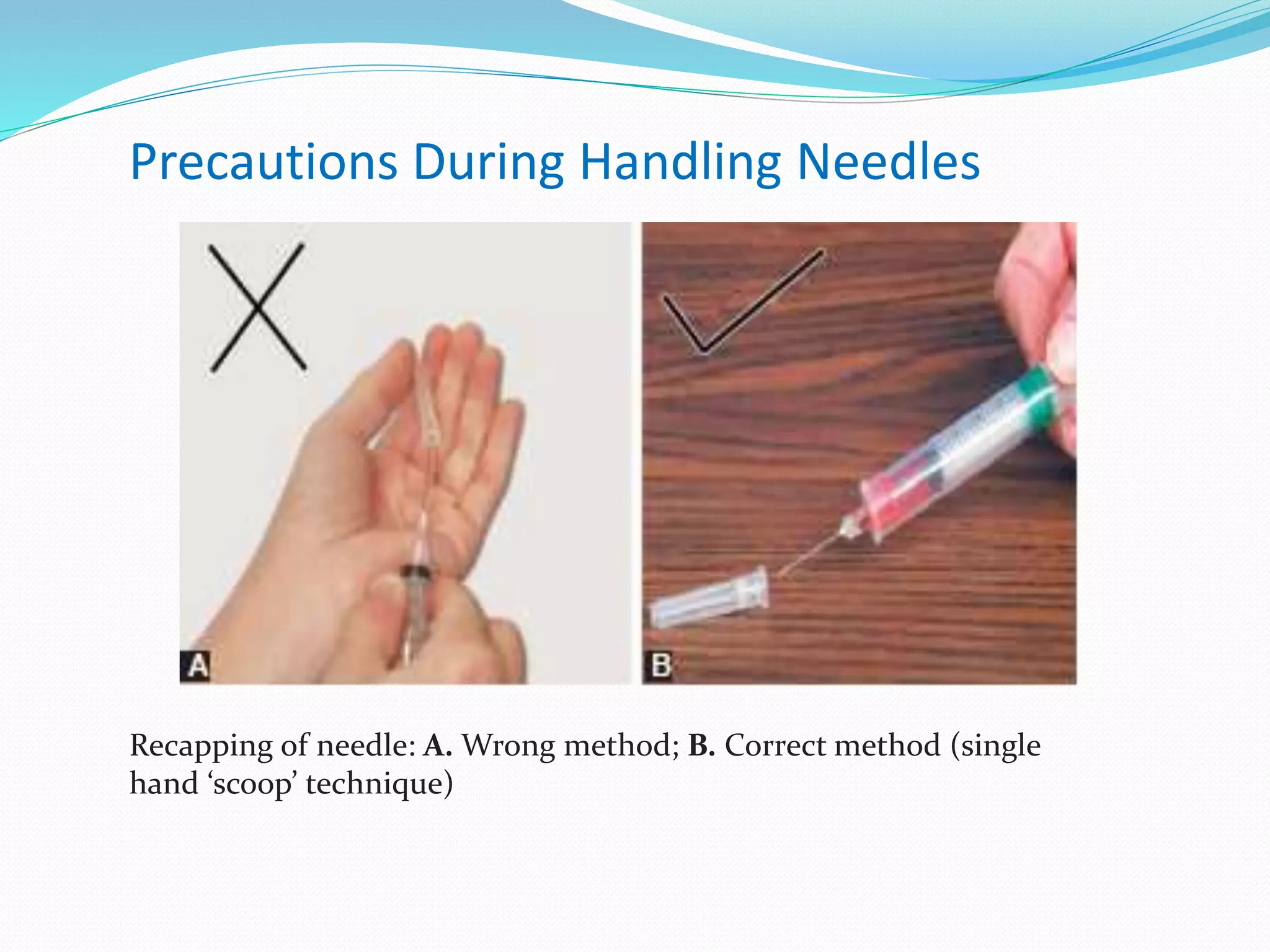
Recapping of needle: A. Wrong method; B. Correct method (single
hand ‘scoop’ technique)
POST-EXPOSURE MANAGEMENT
Steps of Post-exposure Management
 1. First aid
 2. Report to designated nodal center
 3. Take first dose of PEP for HIV
 4. Testing for BBVs
 5. Decision on PEP for HIV and HBV
 6. Documentation and recording of exposure
 7. Informed consent and counseling
 8. Follow-up testing of HCWs
First Aid: Management of exposed site
 Do’s
 Earliest is the first aid, lesser is the chance of
transmission of BBVs.
 For splash injury- Irrigate thoroughly the site (e.g. eyes
or mouth or other exposed area) vigorously with water
at least for 5 min.
 Spit fluid out immediately if gone into mouth and
Rinse the mouth several times.
 If wearing contact lenses, leave them in place while
irrigating. Once the eye is cleaned, remove the contact
lens and clean them in a normal manner.
Don’ts
 Do not panic
 Do not place the pricked finger into the mouth
reflexively
 Do not squeeze blood from wound
 Do not use antiseptics .
Revised NACO Guidelines for post-exposure
prophylaxis (PEP),
Source material: Blood, body fluids or other potentially infectious
material or an instrument contaminated with any of these substances.
 Exposure code:
 1. EC-1 (Mild exposure): Mucous membrane/non-intact skin exposure
with small volumes, or less duration
 2. EC-2 (Moderate exposure):
 Mucous membrane/non-intact skin with large volumes/splashes for
several minutes or more duration OR
 Percutaneous superficial exposure with needle or superficial scratch
 3. EC-3 (Severe exposure): Percutaneous exposure with:
 Large volume transfer By hollow needle, wide bore needle or deep
puncture
 Needle used in patient’s artery or vein
Prevention and Control
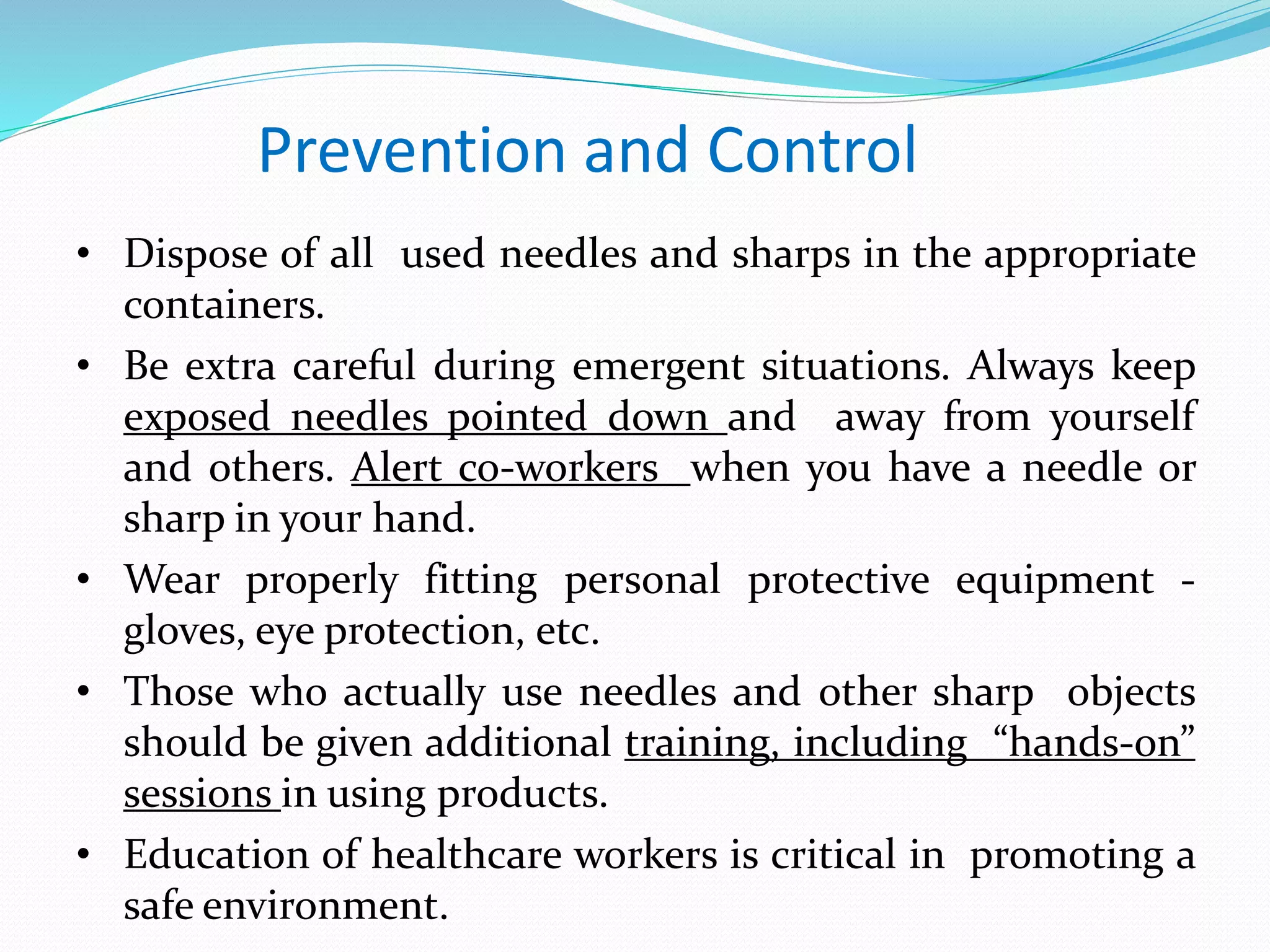
• Dispose of all used needles and sharps in the appropriate
containers.
• Be extra careful during emergent situations. Always keep
exposed needles pointed down and away from yourself
and others. Alert co-workers when you have a needle or
sharp in your hand.
• Wear properly fitting personal protective equipment -
gloves, eye protection, etc.
• Those who actually use needles and other sharp objects
should be given additional training, including “hands-on”
sessions in using products.
• Education of healthcare workers is critical in promoting a
safe environment.
What are Strategies to Eliminate Sharps
Injuries?
 Eliminate or reduce the use of needles and other sharps
 Use devices with safety features to isolate sharps
 Use safer practices to minimize risk for remaining hazards
Preventing
Sharps Injuries
is Our Goal!
Parveezakhtar

EMPLOYE SAFETY INDICATOR-NSI.pptx

  • 1.
  • 2.
    Needle StickInjuries It takesa team to eliminate sharps injuries
  • 3.
    What is considereda needle stick injury? Needle stick injury: A penetrating stab wound from a needle (or other sharp object) that may result in exposure to blood or other body fluids. The main concern is exposure to the blood or other body fluids of another person who may be carrying infectious disease.
  • 4.
    Occupational exposure Percutaneous injury,e.g. needle stick injury (NSI) or other sharp injury. Splash injury: Contact with the mucous membrane Contact with non-intact skin Contact with the intact skin when the duration is prolonged
  • 5.
    Agents transmitted Hepatitis Bvirus (HBV), Hepatitis C virus (HCV) and HIV. Risk of transmission is: Highest for HBV (30%) Followed by HCV (3%) HIV (0.3%).
  • 6.
    What is theRisk for HIV Alone?  Percutaneous 0.3%  Mucous membrane 0.1%  Non-intact skin <0.1%
  • 7.
    Who Gets Injured? Nurse 43% Technician 15% Student 4% Dental 1% Housekeeping/ Maintenance 3% Clerical/ Admin 1% Other 5% Physician 28% Occupational Groups of Healthcare Personnel Exposed to Blood/Body Fluids
  • 8.
    Where Do SharpsInjuries Occur?  Patient Room 39% (Inpatient: Medical – ICUs )  Operating Room 27%  Outpatient 8%  ER 8%  Laboratory 5%  Other 13%
  • 9.
    When Do SharpsInjuries Occur?  During use 41%  After use/before disposal 40%  During and after disposal 15%  Other 4%
  • 10.
    What Devices areInvolved in Sharps Injuries? Six Devices Account for 78% of All Injuries  Disposable Syringes 30%  Suture Needles 20%  Winged-Steel Needles 12%  Intravenous Catheter Stylets 5%  Phlebotomy Needles 3%  Scalpels 8%
  • 11.
    Infectious specimens forNSI  Potentially infectious body fluids: Blood, genital secretions (semen, vaginal secretions) and all body fluids (CSF, synovial fluid, pleural fluid, peritoneal fluid).  The following are not considered potentially infectious, unless visibly contaminated with blood: Faeces, nasal secretions, saliva, sputum, sweat, tears, urine and vomitus.
  • 12.
    Factors that influencethe risk of contracting infection following NSI -Type of needle -Device visibly contaminated with blood Depth of injury (higher is the depth, more is the risk) -Volume of blood involved in the exposure Viral load present in the blood at the time of exposure -Timely performing first aid.
  • 13.
  • 14.
    Precautions During HandlingNeedles -Standard precautions must be followed -Work surfaces must be disinfected with 0.5% sodium hypochlorite -Health care workers (HCWs) must be immunized against HBV -Spillage of blood and other body fluids must be promptly cleaned -Disposable needles should be used -Never recap needles and proper disposal after use
  • 15.
    Precautions During HandlingNeedles Recapping of needle: A. Wrong method; B. Correct method (single hand ‘scoop’ technique)
  • 16.
  • 17.
    Steps of Post-exposureManagement  1. First aid  2. Report to designated nodal center  3. Take first dose of PEP for HIV  4. Testing for BBVs  5. Decision on PEP for HIV and HBV  6. Documentation and recording of exposure  7. Informed consent and counseling  8. Follow-up testing of HCWs
  • 18.
    First Aid: Managementof exposed site  Do’s  Earliest is the first aid, lesser is the chance of transmission of BBVs.  For splash injury- Irrigate thoroughly the site (e.g. eyes or mouth or other exposed area) vigorously with water at least for 5 min.  Spit fluid out immediately if gone into mouth and Rinse the mouth several times.  If wearing contact lenses, leave them in place while irrigating. Once the eye is cleaned, remove the contact lens and clean them in a normal manner.
  • 19.
    Don’ts  Do notpanic  Do not place the pricked finger into the mouth reflexively  Do not squeeze blood from wound  Do not use antiseptics .
  • 20.
    Revised NACO Guidelinesfor post-exposure prophylaxis (PEP), Source material: Blood, body fluids or other potentially infectious material or an instrument contaminated with any of these substances.  Exposure code:  1. EC-1 (Mild exposure): Mucous membrane/non-intact skin exposure with small volumes, or less duration  2. EC-2 (Moderate exposure):  Mucous membrane/non-intact skin with large volumes/splashes for several minutes or more duration OR  Percutaneous superficial exposure with needle or superficial scratch  3. EC-3 (Severe exposure): Percutaneous exposure with:  Large volume transfer By hollow needle, wide bore needle or deep puncture  Needle used in patient’s artery or vein
  • 21.
    Prevention and Control •Dispose of all used needles and sharps in the appropriate containers. • Be extra careful during emergent situations. Always keep exposed needles pointed down and away from yourself and others. Alert co-workers when you have a needle or sharp in your hand. • Wear properly fitting personal protective equipment - gloves, eye protection, etc. • Those who actually use needles and other sharp objects should be given additional training, including “hands-on” sessions in using products. • Education of healthcare workers is critical in promoting a safe environment.
  • 22.
    What are Strategiesto Eliminate Sharps Injuries?  Eliminate or reduce the use of needles and other sharps  Use devices with safety features to isolate sharps  Use safer practices to minimize risk for remaining hazards
  • 23.
  • 24.