DR.SHARAD H. GAJURYAL
JUNIOR RESIDENT,MD(HA)
BPKIHS,NEPAL
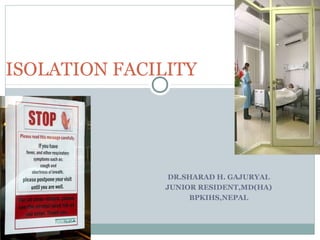
ISOLATION FACILITY
Background/History
• Contagious disease has challenged society
throughout human history.
• In the 18th and 19th centuries, smallpox led to
smallpox hospitals in some large urban
communities. At the same time, citizens lived with
the fear of outbreaks of typhus, typhoid fever,
diphtheria, scarlet fever and influenza.
• The effectiveness of isolation was often limited due
to the lack of knowledge of the cause and
transmission of these infectious diseases
The germ theory of infectious disease was
formulated during the second half of the 19th
century.
In the absence of specific treatment, isolation
became the principle strategy to prevent the
transmission of contagious disease.
• The Ontario Public Health Act in 1884 provided for
the expropriation of land for isolation hospitals and
required separate facilities for smallpox.
• The Nickle Wing of the Kingston General Hospital,
one of the earliest isolation facilities in Canada,
served the community from 1892 until 1922.
The introduction of public health defenses included
improved sanitation and safe water to prevent
cholera and typhoid fever;
Vaccines that lowered the incidence of smallpox,
diphtheria, pertussis, tetanus, rubella, measles,
mumps and polio;
And the discovery of antibiotics to treat specific
infectious disease
Extrapolating from these dramatic advances, many
concluded that infectious disease could be prevented
or easily managed. During the 20th century, the
practice of isolation in hospital and the home
declined.
• In recent years, even developed countries have
discovered that they remain painfully vulnerable to
infectious disease.
• The re-emergence of antibiotic resistant organisms
such as staph aureus, c. difficile, and tuberculosis
particularly in the immune deficient contribute to
nosocomial infections in hospitals, nursing homes
and the community, while epidemics of cholera occur
due to failure of sanitary conditions.
• The emergence of mutations of the influenza virus
leading to pandemics such as the SARS outbreak for
which there is little or no specific treatment are
annual concerns.
• These infections again require isolation in hospital
and the community. The lessons learned in the 19th
century are particularly relevant to these present day
challenges
In 1969, The Joint Commission on Accreditation of
Health Care Organisation (JCHAO) recommended
for the need of isolation facility and infection control
committee in Hospitals.
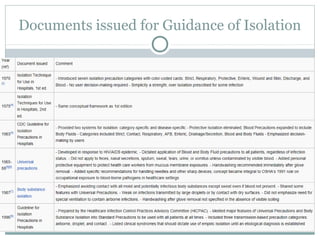
Documents issued for Guidance of Isolation
Definition :- Isolation is the separation of a person
or a group of person infected or believed to be
infected with contagious disease to prevent spread of
infection in hospital setting.
• Types of Isolation :
• Source Isolation :AIIR ( Airborne Infection Isolation
Room) or negative pressure room.
• Protective Isolation : Positive Pressure Room
*It is considered inadvisable to mix accomodation for patients
requiring src isolation and protective isolation
• Source Isolation ( Most frequent Type ;Negetive
Pressure Room) – This type of isolation facility is
used to prevent spread of infection from the patient
to other patient and hospital Staffs .
• Patients with communicable disease who can pass
infections to others via airborne droplets are isolated
in this type of room. eg.:TB.SARS,H1N1
Protective Isolation : (positive Pressure Room)-
These type of isolation facility are meant to isolate
profoundly immune -compromised patients, such as
patient undergoing organ transplant, or oncology
patient receiving chemotherapy, HIV, etc.
Basic concept of Pressure
Planning & Designing
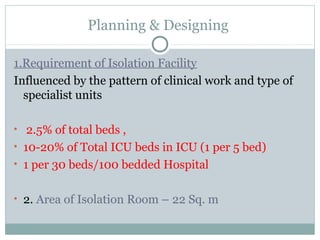
1.Requirement of Isolation Facility
Influenced by the pattern of clinical work and type of
specialist units
• 2.5% of total beds ,
• 10-20% of Total ICU beds in ICU (1 per 5 bed)
• 1 per 30 beds/100 bedded Hospital
• 2. Area of Isolation Room – 22 Sq. m
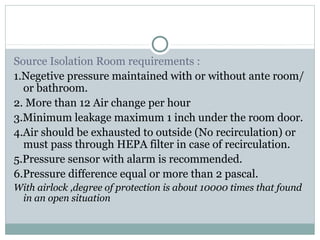
Source Isolation Room requirements :
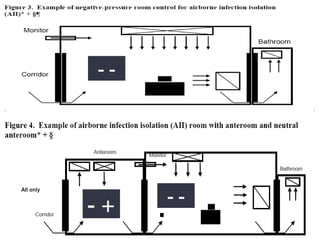
1.Negetive pressure maintained with or without ante room/
or bathroom.
2. More than 12 Air change per hour
3.Minimum leakage maximum 1 inch under the room door.
4.Air should be exhausted to outside (No recirculation) or
must pass through HEPA filter in case of recirculation.
5.Pressure sensor with alarm is recommended.
6.Pressure difference equal or more than 2 pascal.
With airlock ,degree of protection is about 10000 times that found
in an open situation
- +
- -
- -
The exhaust air should be drawn from low level exhaust duct approximately 150mm
above the floor
1- SMOKE TUBE TEST
2- TISSUE TEST A
THIN STRIP OF TISSUE SHOULD BE
HELD PARALLEL TO THE GAP
BETWEEN THE FLOOR AND
BOTTOM OF THE DOOR. THE
DIRECTION OF THE TISSUE‘S
MOVEMENT
WILL INDICATE THE DIRECTION OF
AIR MOVEMENT.
3-MANOMETER
Verifying Negative
Pressure
Protective Isolation Room
1. Positive pressure room in relation to
corridor with inside bathroom with
2. Pressure difference minimum 8 Pascal .
3. > 12 ACH is required .
4. Well sealed room.
5. Supply air must pass through HEPA filter.
6. Directed room airflow with air supply on
one side of the room that moves air across
the patient bed and out through an exhaust
on the opposite side of the room.
Protective Isolation Room requirements
1. Positive pressure room in relation to
corridor with inside bathroom with
2. Pressure difference minimum 8 Pascal .
3. > 12 ACH is required .
4. Well sealed room.
5. Supply air must pass through HEPA filter.
6. Directed room airflow with air supply on
one side of the room that moves air across
the patient bed and out through an exhaust
on the opposite side of the room.
3. Other requirement :
• Access to oxygen and compressed air ,
• Ante room,
• Wash room,
• Disposable crockery and cultery items ,
• Paper plastic Cups,
• speaking panel/ glass partitions to avoid direct
contact with visitors
Isolation cart
When a room used for isolation lacks the ante room
or lock chamber,an isolation cart is used which is not
taken inside the isolation room.
Physiological Stress of isolation
• Many patients with complete isolation from any
audible or visual indications of life outside impose
great psychological stress.
• Occasionally elderly patient subjected to prolonged
isolation have appeared to suffer from it .
• Children in isolation ward think they are being
punished, they have been rejected or unworthy.
• It is desirable for nurses to spend extra time in room.
• Mothers may also help to look after babies if
isolation procedures are shown to them.
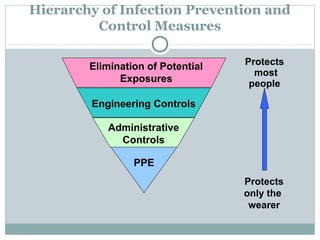
Hierarchy of Infection Prevention and
Control Measures
PPE
Engineering Controls
Protects
only the
wearer
Elimination of Potential
Exposures
Administrative
Controls
Protects
most
people
Elimination of Potential
Exposures
• Example: patients with mild
influenza like illness stay home
Engineering Controls
Physically separates the employee from the
hazard
Does not require employee compliance to be
effective
Examples:
Physical barriers at Triage
Airborne infection isolation room for
patients with known or suspect
airborne infectious diseases
Administrative Controls/
Workplace Practices
Policies, procedures, and programs that
minimize intensity or duration of
exposure
 Examples:
 signs on door of an airborne isolation
room
 triage, mask symptomatic patient
 provide tissues/ masks/hand sanitizer
to public
Standard procedures/ behaviors in caring
for patients e.g. hand hygiene, HCW
vaccination
Administrative aspect in management of epidemics and
communicable disease
PPE should be readily available
Avaibility of appropriate medications and disposables and
life saving equipments has to be ensured
Proper BMW disposal should be carried out
In case of exposure to staff,prophylaxis has to be provided
by institue.
Information to the state authority to be provided about the
case.
Media has to be provided relevent disease information and
update without creating panic
Personal Protective Equipment
Lowest level of hierarchy - requires employee
compliance for efficacy
Means higher elements of hierarchy fail to
adequately protect employee
May involve use of gowns, gloves, eye/splash
protection or respirators
Last line of defense
Face Masks vs. N95 Respirators
Loose fitting, not designed
to filter out small aerosols
Place on coughing patient
(source control)
HCW should wear mask to
 protect patient during
certain procedures (e.g.,
surgery)
 protect HCW
 droplet precautions
 Mask + goggles for
anticipated
spray/splash
Tight fitting respirator,
designed to filter the air
Protects the wearer
HCW should wear when
concerned about
transmission by airborne
route
THANK YOU FOR YOUR STERILE
ATTENTION !

Isolation facility in Hospital

  • 1.
    DR.SHARAD H. GAJURYAL JUNIORRESIDENT,MD(HA) BPKIHS,NEPAL ISOLATION FACILITY
  • 2.
    Background/History • Contagious diseasehas challenged society throughout human history. • In the 18th and 19th centuries, smallpox led to smallpox hospitals in some large urban communities. At the same time, citizens lived with the fear of outbreaks of typhus, typhoid fever, diphtheria, scarlet fever and influenza. • The effectiveness of isolation was often limited due to the lack of knowledge of the cause and transmission of these infectious diseases
  • 3.
    The germ theoryof infectious disease was formulated during the second half of the 19th century. In the absence of specific treatment, isolation became the principle strategy to prevent the transmission of contagious disease.
  • 4.
    • The OntarioPublic Health Act in 1884 provided for the expropriation of land for isolation hospitals and required separate facilities for smallpox. • The Nickle Wing of the Kingston General Hospital, one of the earliest isolation facilities in Canada, served the community from 1892 until 1922.
  • 5.
    The introduction ofpublic health defenses included improved sanitation and safe water to prevent cholera and typhoid fever; Vaccines that lowered the incidence of smallpox, diphtheria, pertussis, tetanus, rubella, measles, mumps and polio; And the discovery of antibiotics to treat specific infectious disease
  • 6.
    Extrapolating from thesedramatic advances, many concluded that infectious disease could be prevented or easily managed. During the 20th century, the practice of isolation in hospital and the home declined.
  • 7.
    • In recentyears, even developed countries have discovered that they remain painfully vulnerable to infectious disease. • The re-emergence of antibiotic resistant organisms such as staph aureus, c. difficile, and tuberculosis particularly in the immune deficient contribute to nosocomial infections in hospitals, nursing homes and the community, while epidemics of cholera occur due to failure of sanitary conditions.
  • 8.
    • The emergenceof mutations of the influenza virus leading to pandemics such as the SARS outbreak for which there is little or no specific treatment are annual concerns. • These infections again require isolation in hospital and the community. The lessons learned in the 19th century are particularly relevant to these present day challenges
  • 9.
    In 1969, TheJoint Commission on Accreditation of Health Care Organisation (JCHAO) recommended for the need of isolation facility and infection control committee in Hospitals.
  • 10.
    Documents issued forGuidance of Isolation
  • 11.
    Definition :- Isolationis the separation of a person or a group of person infected or believed to be infected with contagious disease to prevent spread of infection in hospital setting.
  • 13.
    • Types ofIsolation : • Source Isolation :AIIR ( Airborne Infection Isolation Room) or negative pressure room. • Protective Isolation : Positive Pressure Room *It is considered inadvisable to mix accomodation for patients requiring src isolation and protective isolation
  • 14.
    • Source Isolation( Most frequent Type ;Negetive Pressure Room) – This type of isolation facility is used to prevent spread of infection from the patient to other patient and hospital Staffs . • Patients with communicable disease who can pass infections to others via airborne droplets are isolated in this type of room. eg.:TB.SARS,H1N1
  • 15.
    Protective Isolation :(positive Pressure Room)- These type of isolation facility are meant to isolate profoundly immune -compromised patients, such as patient undergoing organ transplant, or oncology patient receiving chemotherapy, HIV, etc.
  • 16.
  • 17.
    Planning & Designing 1.Requirementof Isolation Facility Influenced by the pattern of clinical work and type of specialist units • 2.5% of total beds , • 10-20% of Total ICU beds in ICU (1 per 5 bed) • 1 per 30 beds/100 bedded Hospital • 2. Area of Isolation Room – 22 Sq. m
  • 18.
    Source Isolation Roomrequirements : 1.Negetive pressure maintained with or without ante room/ or bathroom. 2. More than 12 Air change per hour 3.Minimum leakage maximum 1 inch under the room door. 4.Air should be exhausted to outside (No recirculation) or must pass through HEPA filter in case of recirculation. 5.Pressure sensor with alarm is recommended. 6.Pressure difference equal or more than 2 pascal. With airlock ,degree of protection is about 10000 times that found in an open situation
  • 20.
  • 22.
    The exhaust airshould be drawn from low level exhaust duct approximately 150mm above the floor
  • 23.
    1- SMOKE TUBETEST 2- TISSUE TEST A THIN STRIP OF TISSUE SHOULD BE HELD PARALLEL TO THE GAP BETWEEN THE FLOOR AND BOTTOM OF THE DOOR. THE DIRECTION OF THE TISSUE‘S MOVEMENT WILL INDICATE THE DIRECTION OF AIR MOVEMENT. 3-MANOMETER Verifying Negative Pressure
  • 24.
    Protective Isolation Room 1.Positive pressure room in relation to corridor with inside bathroom with 2. Pressure difference minimum 8 Pascal . 3. > 12 ACH is required . 4. Well sealed room. 5. Supply air must pass through HEPA filter. 6. Directed room airflow with air supply on one side of the room that moves air across the patient bed and out through an exhaust on the opposite side of the room.
  • 26.
    Protective Isolation Roomrequirements 1. Positive pressure room in relation to corridor with inside bathroom with 2. Pressure difference minimum 8 Pascal . 3. > 12 ACH is required . 4. Well sealed room. 5. Supply air must pass through HEPA filter. 6. Directed room airflow with air supply on one side of the room that moves air across the patient bed and out through an exhaust on the opposite side of the room.
  • 28.
    3. Other requirement: • Access to oxygen and compressed air , • Ante room, • Wash room, • Disposable crockery and cultery items , • Paper plastic Cups, • speaking panel/ glass partitions to avoid direct contact with visitors
  • 29.
    Isolation cart When aroom used for isolation lacks the ante room or lock chamber,an isolation cart is used which is not taken inside the isolation room.
  • 30.
    Physiological Stress ofisolation • Many patients with complete isolation from any audible or visual indications of life outside impose great psychological stress. • Occasionally elderly patient subjected to prolonged isolation have appeared to suffer from it . • Children in isolation ward think they are being punished, they have been rejected or unworthy. • It is desirable for nurses to spend extra time in room. • Mothers may also help to look after babies if isolation procedures are shown to them.
  • 31.
    Hierarchy of InfectionPrevention and Control Measures PPE Engineering Controls Protects only the wearer Elimination of Potential Exposures Administrative Controls Protects most people
  • 32.
    Elimination of Potential Exposures •Example: patients with mild influenza like illness stay home
  • 33.
    Engineering Controls Physically separatesthe employee from the hazard Does not require employee compliance to be effective Examples: Physical barriers at Triage Airborne infection isolation room for patients with known or suspect airborne infectious diseases
  • 34.
    Administrative Controls/ Workplace Practices Policies,procedures, and programs that minimize intensity or duration of exposure  Examples:  signs on door of an airborne isolation room  triage, mask symptomatic patient  provide tissues/ masks/hand sanitizer to public Standard procedures/ behaviors in caring for patients e.g. hand hygiene, HCW vaccination
  • 35.
    Administrative aspect inmanagement of epidemics and communicable disease PPE should be readily available Avaibility of appropriate medications and disposables and life saving equipments has to be ensured Proper BMW disposal should be carried out In case of exposure to staff,prophylaxis has to be provided by institue. Information to the state authority to be provided about the case. Media has to be provided relevent disease information and update without creating panic
  • 36.
    Personal Protective Equipment Lowestlevel of hierarchy - requires employee compliance for efficacy Means higher elements of hierarchy fail to adequately protect employee May involve use of gowns, gloves, eye/splash protection or respirators Last line of defense
  • 37.
    Face Masks vs.N95 Respirators Loose fitting, not designed to filter out small aerosols Place on coughing patient (source control) HCW should wear mask to  protect patient during certain procedures (e.g., surgery)  protect HCW  droplet precautions  Mask + goggles for anticipated spray/splash Tight fitting respirator, designed to filter the air Protects the wearer HCW should wear when concerned about transmission by airborne route
  • 38.
    THANK YOU FORYOUR STERILE ATTENTION !

Editor's Notes

  • #38 Again, in health care settings, a patient with suspect ATD should wear a mask when around others HCW should wear surgical or procedural mask to protect the patient when performing certain procedures such as insertion of central lines/ lumbar punctures & epidurals HCW should wear a mask to protect his/her self against ATDs or as part of PPE for anticipated spray or splash http://www.cdc.gov/Features/MasksRespirators