Anderogenesis
Laraib Zafar Iqbal (L1F17BSBC0010)
1
Contents
• Introduction
• Methods for production
• Stages and pathways of development
• Factors affecting androgenesis
• Importance of androgenesis
• Conclusion
• References
2
Introduction
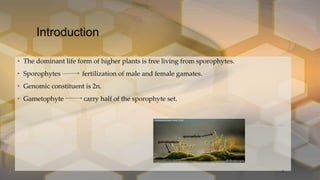
• The dominant life form of higher plants is free living from sporophytes.
• Sporophytes fertilization of male and female gamates.
• Genomic constituent is 2n.
• Gametophyte carry half of the sporophyte set.
3
• Several strategies and methods have been worked
for the production of haploid plants.
• Two methods:
• Androgenic methods
• Gynogenic methods
4
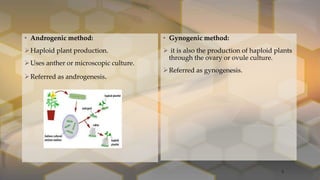
• Androgenic method:
Haploid plant production.
Uses anther or microscopic culture.
Referred as androgenesis.
• Gynogenic method:
 it is also the production of haploid plants
through the ovary or ovule culture.
Referred as gynogenesis.
5
Androgenesis
• Formation of sporophyte from the
male gametophyte.
• Artificial medium is uses.
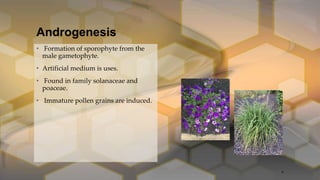
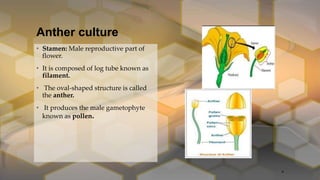
• Found in family solanaceae and
poaceae.
• Immature pollen grains are induced.
6
Methods for production:
• There are two methods for in vitro production of androgenic haploids
• They are :
 Anther culture
Isolated Pollen [microspore] culture.
7
Anther culture
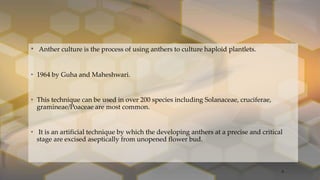
• Stamen: Male reproductive part of
flower.
• It is composed of log tube known as
filament.
• The oval-shaped structure is called
the anther.
• It produces the male gametophyte
known as pollen.
8
• Anther culture is the process of using anthers to culture haploid plantlets.
• 1964 by Guha and Maheshwari.
• This technique can be used in over 200 species including Solanaceae, cruciferae,
gramineae/Poaceae are most common.
• It is an artificial technique by which the developing anthers at a precise and critical
stage are excised aseptically from unopened flower bud.
9
Sources of anther culture:
• Success of androgenesis depend upon:
Variety used
Growth condition
Quality of donor
• The normal flower condition is the best environment for the anther production.
• Age of donor plant should must be noted.
10
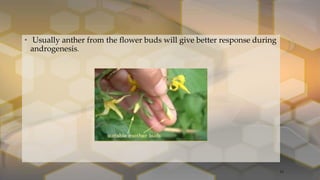
• Usually anther from the flower buds will give better response during
androgenesis.
11
Pretreatment of anther
• Once the donor plant is selected,
it requires the specific
pretreatment conditions.
• It can be done at different levels of explants.
12
Cont…
• Pretreatment plays a key role for anther callus induction.
• The main pretreatments applied to anther culture are
 cold treatment
hot treatment
• With regard to different explants, the type, levels, and duration of
pretreatments are different.
13
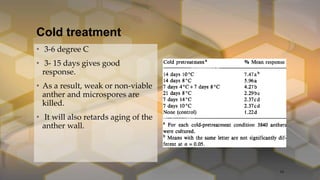
Cold treatment
• 3-6 degree C
• 3- 15 days gives good
response.
• As a result, weak or non-viable
anther and microspores are
killed.
• It will also retards aging of the
anther wall.
14
Hot treatment
• Plant in some species when subjected to 30 degree C for 24h or 40
degree for 1h stimulates embryogenesis.
• Dissolution of microtubules.
• Dislodging of the spindle which causes abnormal division.
• Sterilization of flower buds was carried out in the Laminar Air Flow
Cabinet.
• Young flower buds are surface sterilized.
• Calyx from the flower buds will be removed by flamed forceps.
15
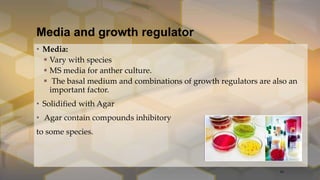
Media and growth regulator
• Media:
 Vary with species
 MS media for anther culture.
 The basal medium and combinations of growth regulators are also an
important factor.
• Solidified with Agar
• Agar contain compounds inhibitory
to some species.
16
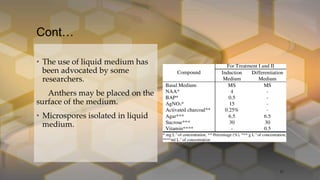
Cont…
• The use of liquid medium has
been advocated by some
researchers.
Anthers may be placed on the
surface of the medium.
• Microspores isolated in liquid
medium.
17
• Growth regulator:
Complete nutrient medium.
2-3 % sucrose is added.
 One or more hormone has been found necessary for an androgenic
response.
Activated charcoal to agar medium is advocated.
In some species it is not necessary in anther culture.
A low concentration of some form of auxin.
Cytokinin is sometimes used in combination with auxin.
18
Stages and pathways of development
• After inoculation haploid plants develop from anther culture either
directly or indirectly through a callus phase.
 Direct androgenesis
Indirect androgenesis
19
Direct androgenesis:
• It is also called pollen derived embryogenesis.
• Pollen grains directly acts as a zygote.
• Similar to zygotic embryogenesis.
• When the pollen grains has reached globular stage of embryo, the
wall of the pollen is broken and embryo is released.
20
• The released embryo develop
cotyledons, which ultimately give
rise to plantlets.
• Eg: Datura , Brassica campestris
21
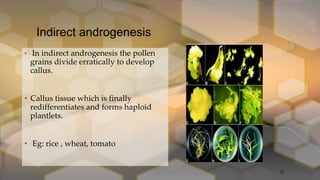
Indirect androgenesis
• In indirect androgenesis the pollen
grains divide erratically to develop
callus.
• Callus tissue which is finally
redifferentiates and forms haploid
plantlets.
• Eg: rice , wheat, tomato
22
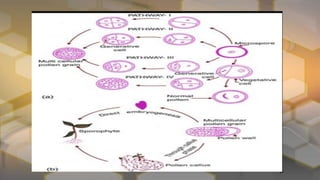
Pathways for development
• Depending on the composition of the medium, development pollen
may leads to the formation of callus.
• Based on the few initial divisions in the pollen grains or responds of
pollen grains.
• 4 pathways have been identified in in vitro androgenesis.
23
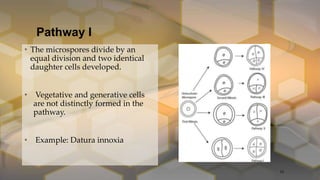
Pathway I
• The microspores divide by an
equal division and two identical
daughter cells developed.
• Vegetative and generative cells
are not distinctly formed in the
pathway.
• Example: Datura innoxia
24
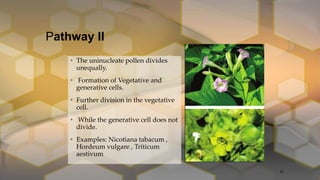
Pathway II
• The uninucleate pollen divides
unequally.
• Formation of Vegetative and
generative cells.
• Further division in the vegetative
cell.
• While the generative cell does not
divide.
• Examples: Nicotiana tabacum ,
Hordeum vulgare , Triticum
aestivum
25
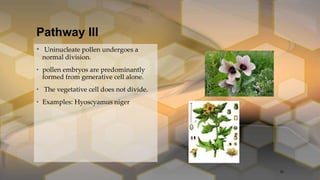
Pathway III
• Uninucleate pollen undergoes a
normal division.
• pollen embryos are predominantly
formed from generative cell alone.
• The vegetative cell does not divide.
• Examples: Hyoscyamus niger
26
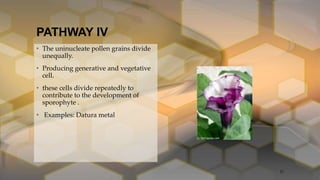
PATHWAY IV
• The uninucleate pollen grains divide
unequally.
• Producing generative and vegetative
cell.
• these cells divide repeatedly to
contribute to the development of
sporophyte .
• Examples: Datura metal
27
28
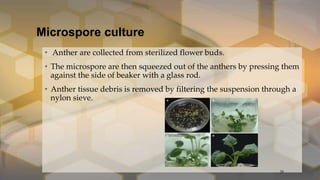
Microspore culture
• Anther are collected from sterilized flower buds.
• The microspore are then squeezed out of the anthers by pressing them
against the side of beaker with a glass rod.
• Anther tissue debris is removed by filtering the suspension through a
nylon sieve.
29
• This pollen suspension is then centrifuged.
• The supernatant containing fine debris is discarded.
• Resuspended in fresh media.
• Washed at least twice.
• Then pipetted in to small petri dishes.
• Incubated at 28 degree C.
• 14 days of culture.
30
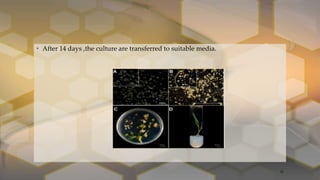
• After 14 days ,the culture are transferred to suitable media.
31
Factors affecting androgenesis
• Genotype of donor:
important for determining the success or failure of androgenesis.
• Anther wall factor:
Growth inhibiting substances leaking out of the anther wall in contact with
nutrient medium.
• Culture medium:
The culture medium also play a vital role in the correct amount and
proportion of inorganic nutrients.
32
• Growth regulators:
Kinetin or cytokinins are essential for induction of pollen embryos. Sucrose plays
an important role in induction of pollen haploid plants.
• Activated charcoal:
It removes the inhibitors from the medium and helps in the adsorption of 5-
hydroxymethylfurfural.
• Physical factor:
Temperature and light are two physical factors which plays an important role in the
culture of anthers.
Chilling of anthers before inoculation , increases the number of pollen embryoids.
33
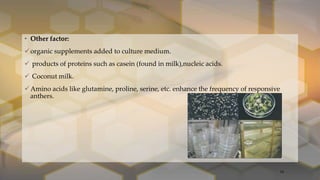
• Other factor:
organic supplements added to culture medium.
 products of proteins such as casein (found in milk),nucleic acids.
 Coconut milk.
Amino acids like glutamine, proline, serine, etc. enhance the frequency of responsive
anthers.
34
Conclusion
• Androgenesis involves the control and reprogramming of
developmental switches, it provides opportunities to investigate
key elements in developmental control. Moreover, via
androgenesis, fertile homozygous progeny from a heterozygous
parent can be obtained in a single generation,
35
Reference:
• https://www.slideshare.net/pillaiaswathy/androgenesis-by-
aswathy-iswanath
• Dubey R.C,A textbook of biotechnology, (2004),published by
S.Chand and company LTD.
• Bajaj, Y.P.S. 1983. In vitroproduction of haploids. In: Handbook of
Plant Cell Culture, Vol. 1: Techniques for Propagation and Breeding
. Ed. D.A. Evans et al. Macmillan, New York. 228–287
• http://www.plantphysiology.org/content/124/2/523
• http://www.hos.ufl.edu/mooreweb/TissueCulture/tccla ss.html
36
37

Androgenesis

  • 1.
  • 2.
    Contents • Introduction • Methodsfor production • Stages and pathways of development • Factors affecting androgenesis • Importance of androgenesis • Conclusion • References 2
  • 3.
    Introduction • The dominantlife form of higher plants is free living from sporophytes. • Sporophytes fertilization of male and female gamates. • Genomic constituent is 2n. • Gametophyte carry half of the sporophyte set. 3
  • 4.
    • Several strategiesand methods have been worked for the production of haploid plants. • Two methods: • Androgenic methods • Gynogenic methods 4
  • 5.
    • Androgenic method: Haploidplant production. Uses anther or microscopic culture. Referred as androgenesis. • Gynogenic method:  it is also the production of haploid plants through the ovary or ovule culture. Referred as gynogenesis. 5
  • 6.
    Androgenesis • Formation ofsporophyte from the male gametophyte. • Artificial medium is uses. • Found in family solanaceae and poaceae. • Immature pollen grains are induced. 6
  • 7.
    Methods for production: •There are two methods for in vitro production of androgenic haploids • They are :  Anther culture Isolated Pollen [microspore] culture. 7
  • 8.
    Anther culture • Stamen:Male reproductive part of flower. • It is composed of log tube known as filament. • The oval-shaped structure is called the anther. • It produces the male gametophyte known as pollen. 8
  • 9.
    • Anther cultureis the process of using anthers to culture haploid plantlets. • 1964 by Guha and Maheshwari. • This technique can be used in over 200 species including Solanaceae, cruciferae, gramineae/Poaceae are most common. • It is an artificial technique by which the developing anthers at a precise and critical stage are excised aseptically from unopened flower bud. 9
  • 10.
    Sources of antherculture: • Success of androgenesis depend upon: Variety used Growth condition Quality of donor • The normal flower condition is the best environment for the anther production. • Age of donor plant should must be noted. 10
  • 11.
    • Usually antherfrom the flower buds will give better response during androgenesis. 11
  • 12.
    Pretreatment of anther •Once the donor plant is selected, it requires the specific pretreatment conditions. • It can be done at different levels of explants. 12
  • 13.
    Cont… • Pretreatment playsa key role for anther callus induction. • The main pretreatments applied to anther culture are  cold treatment hot treatment • With regard to different explants, the type, levels, and duration of pretreatments are different. 13
  • 14.
    Cold treatment • 3-6degree C • 3- 15 days gives good response. • As a result, weak or non-viable anther and microspores are killed. • It will also retards aging of the anther wall. 14
  • 15.
    Hot treatment • Plantin some species when subjected to 30 degree C for 24h or 40 degree for 1h stimulates embryogenesis. • Dissolution of microtubules. • Dislodging of the spindle which causes abnormal division. • Sterilization of flower buds was carried out in the Laminar Air Flow Cabinet. • Young flower buds are surface sterilized. • Calyx from the flower buds will be removed by flamed forceps. 15
  • 16.
    Media and growthregulator • Media:  Vary with species  MS media for anther culture.  The basal medium and combinations of growth regulators are also an important factor. • Solidified with Agar • Agar contain compounds inhibitory to some species. 16
  • 17.
    Cont… • The useof liquid medium has been advocated by some researchers. Anthers may be placed on the surface of the medium. • Microspores isolated in liquid medium. 17
  • 18.
    • Growth regulator: Completenutrient medium. 2-3 % sucrose is added.  One or more hormone has been found necessary for an androgenic response. Activated charcoal to agar medium is advocated. In some species it is not necessary in anther culture. A low concentration of some form of auxin. Cytokinin is sometimes used in combination with auxin. 18
  • 19.
    Stages and pathwaysof development • After inoculation haploid plants develop from anther culture either directly or indirectly through a callus phase.  Direct androgenesis Indirect androgenesis 19
  • 20.
    Direct androgenesis: • Itis also called pollen derived embryogenesis. • Pollen grains directly acts as a zygote. • Similar to zygotic embryogenesis. • When the pollen grains has reached globular stage of embryo, the wall of the pollen is broken and embryo is released. 20
  • 21.
    • The releasedembryo develop cotyledons, which ultimately give rise to plantlets. • Eg: Datura , Brassica campestris 21
  • 22.
    Indirect androgenesis • Inindirect androgenesis the pollen grains divide erratically to develop callus. • Callus tissue which is finally redifferentiates and forms haploid plantlets. • Eg: rice , wheat, tomato 22
  • 23.
    Pathways for development •Depending on the composition of the medium, development pollen may leads to the formation of callus. • Based on the few initial divisions in the pollen grains or responds of pollen grains. • 4 pathways have been identified in in vitro androgenesis. 23
  • 24.
    Pathway I • Themicrospores divide by an equal division and two identical daughter cells developed. • Vegetative and generative cells are not distinctly formed in the pathway. • Example: Datura innoxia 24
  • 25.
    Pathway II • Theuninucleate pollen divides unequally. • Formation of Vegetative and generative cells. • Further division in the vegetative cell. • While the generative cell does not divide. • Examples: Nicotiana tabacum , Hordeum vulgare , Triticum aestivum 25
  • 26.
    Pathway III • Uninucleatepollen undergoes a normal division. • pollen embryos are predominantly formed from generative cell alone. • The vegetative cell does not divide. • Examples: Hyoscyamus niger 26
  • 27.
    PATHWAY IV • Theuninucleate pollen grains divide unequally. • Producing generative and vegetative cell. • these cells divide repeatedly to contribute to the development of sporophyte . • Examples: Datura metal 27
  • 28.
  • 29.
    Microspore culture • Antherare collected from sterilized flower buds. • The microspore are then squeezed out of the anthers by pressing them against the side of beaker with a glass rod. • Anther tissue debris is removed by filtering the suspension through a nylon sieve. 29
  • 30.
    • This pollensuspension is then centrifuged. • The supernatant containing fine debris is discarded. • Resuspended in fresh media. • Washed at least twice. • Then pipetted in to small petri dishes. • Incubated at 28 degree C. • 14 days of culture. 30
  • 31.
    • After 14days ,the culture are transferred to suitable media. 31
  • 32.
    Factors affecting androgenesis •Genotype of donor: important for determining the success or failure of androgenesis. • Anther wall factor: Growth inhibiting substances leaking out of the anther wall in contact with nutrient medium. • Culture medium: The culture medium also play a vital role in the correct amount and proportion of inorganic nutrients. 32
  • 33.
    • Growth regulators: Kinetinor cytokinins are essential for induction of pollen embryos. Sucrose plays an important role in induction of pollen haploid plants. • Activated charcoal: It removes the inhibitors from the medium and helps in the adsorption of 5- hydroxymethylfurfural. • Physical factor: Temperature and light are two physical factors which plays an important role in the culture of anthers. Chilling of anthers before inoculation , increases the number of pollen embryoids. 33
  • 34.
    • Other factor: organicsupplements added to culture medium.  products of proteins such as casein (found in milk),nucleic acids.  Coconut milk. Amino acids like glutamine, proline, serine, etc. enhance the frequency of responsive anthers. 34
  • 35.
    Conclusion • Androgenesis involvesthe control and reprogramming of developmental switches, it provides opportunities to investigate key elements in developmental control. Moreover, via androgenesis, fertile homozygous progeny from a heterozygous parent can be obtained in a single generation, 35
  • 36.
    Reference: • https://www.slideshare.net/pillaiaswathy/androgenesis-by- aswathy-iswanath • DubeyR.C,A textbook of biotechnology, (2004),published by S.Chand and company LTD. • Bajaj, Y.P.S. 1983. In vitroproduction of haploids. In: Handbook of Plant Cell Culture, Vol. 1: Techniques for Propagation and Breeding . Ed. D.A. Evans et al. Macmillan, New York. 228–287 • http://www.plantphysiology.org/content/124/2/523 • http://www.hos.ufl.edu/mooreweb/TissueCulture/tccla ss.html 36
  • 37.