
Dr. Divya Sharma
Assistant Professor
A Biodiction (A Unit of Dr. Divya Sharma)
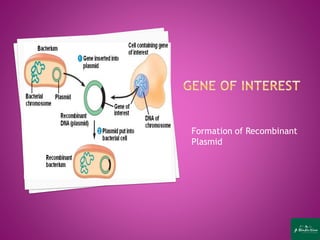
Formation of Recombinant
Plasmid
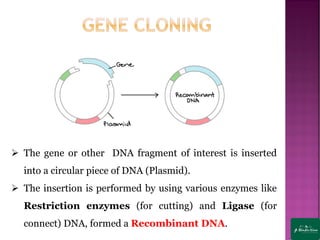
➢ The gene or other DNA fragment of interest is inserted
into a circular piece of DNA (Plasmid).
➢ The insertion is performed by using various enzymes like
Restriction enzymes (for cutting) and Ligase (for
connect) DNA, formed a Recombinant DNA.
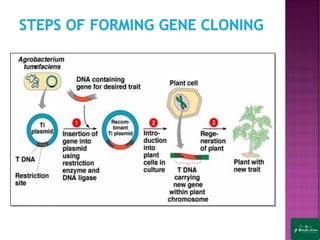
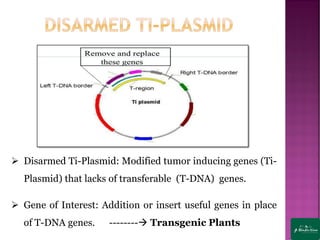
➢ Disarmed Ti-Plasmid: Modified tumor inducing genes (Ti-
Plasmid) that lacks of transferable (T-DNA) genes.
➢ Gene of Interest: Addition or insert useful genes in place
of T-DNA genes. --------→ Transgenic Plants
Agropine – Type (strain EHA105:: pEHA105)
Carry genes for agropine synthesis and catabolism.
Tumors do not differentiate and die out.
Octopine- Type (strain LBA4404::pAL4404)
Carry genes (3 required) to synthesize octopine in the
plant and catabolism in the bacteria.
Nopaline-Type (strain GV3101::Pmp90 [pTiC58])
Carry gene for synthesizing nopaline in the plant and
for utilization (catabolism) in the bacteria.
Tumors can differentitate into shooty masses
(teratomas)
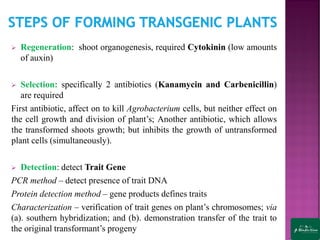
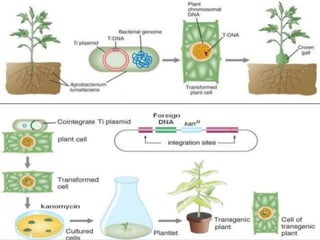
➢ Regeneration: shoot organogenesis, required Cytokinin (low amounts
of auxin)
➢ Selection: specifically 2 antibiotics (Kanamycin and Carbenicillin)
are required
First antibiotic, affect on to kill Agrobacterium cells, but neither effect on
the cell growth and division of plant’s; Another antibiotic, which allows
the transformed shoots growth; but inhibits the growth of untransformed
plant cells (simultaneously).
➢ Detection: detect Trait Gene
PCR method – detect presence of trait DNA
Protein detection method – gene products defines traits
Characterization – verification of trait genes on plant’s chromosomes; via
(a). southern hybridization; and (b). demonstration transfer of the trait to
the original transformant’s progeny
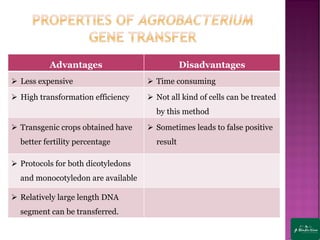
Advantages Disadvantages
➢ Less expensive ➢ Time consuming
➢ High transformation efficiency ➢ Not all kind of cells can be treated
by this method
➢ Transgenic crops obtained have
better fertility percentage
➢ Sometimes leads to false positive
result
➢ Protocols for both dicotyledons
and monocotyledon are available
➢ Relatively large length DNA
segment can be transferred.
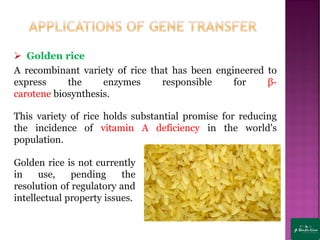
➢ Golden rice
A recombinant variety of rice that has been engineered to
express the enzymes responsible for β-
carotene biosynthesis.
This variety of rice holds substantial promise for reducing
the incidence of vitamin A deficiency in the world's
population.
Golden rice is not currently
in use, pending the
resolution of regulatory and
intellectual property issues.
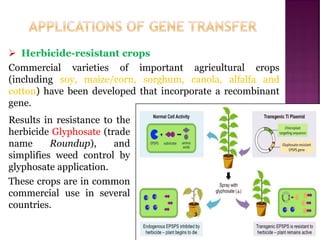
➢ Herbicide-resistant crops
Commercial varieties of important agricultural crops
(including soy, maize/corn, sorghum, canola, alfalfa and
cotton) have been developed that incorporate a recombinant
gene.
Results in resistance to the
herbicide Glyphosate (trade
name Roundup), and
simplifies weed control by
glyphosate application.
These crops are in common
commercial use in several
countries.
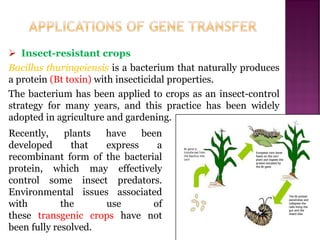
➢ Insect-resistant crops
Bacillus thuringeiensis is a bacterium that naturally produces
a protein (Bt toxin) with insecticidal properties.
The bacterium has been applied to crops as an insect-control
strategy for many years, and this practice has been widely
adopted in agriculture and gardening.
Recently, plants have been
developed that express a
recombinant form of the bacterial
protein, which may effectively
control some insect predators.
Environmental issues associated
with the use of
these transgenic crops have not
been fully resolved.
A Biodiction (A Unit of Dr. Divya Sharma)

Transgenic Plants

  • 1.
    Dr. Divya Sharma AssistantProfessor A Biodiction (A Unit of Dr. Divya Sharma)
  • 2.
  • 4.
    ➢ The geneor other DNA fragment of interest is inserted into a circular piece of DNA (Plasmid). ➢ The insertion is performed by using various enzymes like Restriction enzymes (for cutting) and Ligase (for connect) DNA, formed a Recombinant DNA.
  • 6.
    ➢ Disarmed Ti-Plasmid:Modified tumor inducing genes (Ti- Plasmid) that lacks of transferable (T-DNA) genes. ➢ Gene of Interest: Addition or insert useful genes in place of T-DNA genes. --------→ Transgenic Plants
  • 7.
    Agropine – Type(strain EHA105:: pEHA105) Carry genes for agropine synthesis and catabolism. Tumors do not differentiate and die out. Octopine- Type (strain LBA4404::pAL4404) Carry genes (3 required) to synthesize octopine in the plant and catabolism in the bacteria. Nopaline-Type (strain GV3101::Pmp90 [pTiC58]) Carry gene for synthesizing nopaline in the plant and for utilization (catabolism) in the bacteria. Tumors can differentitate into shooty masses (teratomas)
  • 8.
    ➢ Regeneration: shootorganogenesis, required Cytokinin (low amounts of auxin) ➢ Selection: specifically 2 antibiotics (Kanamycin and Carbenicillin) are required First antibiotic, affect on to kill Agrobacterium cells, but neither effect on the cell growth and division of plant’s; Another antibiotic, which allows the transformed shoots growth; but inhibits the growth of untransformed plant cells (simultaneously). ➢ Detection: detect Trait Gene PCR method – detect presence of trait DNA Protein detection method – gene products defines traits Characterization – verification of trait genes on plant’s chromosomes; via (a). southern hybridization; and (b). demonstration transfer of the trait to the original transformant’s progeny
  • 11.
    Advantages Disadvantages ➢ Lessexpensive ➢ Time consuming ➢ High transformation efficiency ➢ Not all kind of cells can be treated by this method ➢ Transgenic crops obtained have better fertility percentage ➢ Sometimes leads to false positive result ➢ Protocols for both dicotyledons and monocotyledon are available ➢ Relatively large length DNA segment can be transferred.
  • 12.
    ➢ Golden rice Arecombinant variety of rice that has been engineered to express the enzymes responsible for β- carotene biosynthesis. This variety of rice holds substantial promise for reducing the incidence of vitamin A deficiency in the world's population. Golden rice is not currently in use, pending the resolution of regulatory and intellectual property issues.
  • 13.
    ➢ Herbicide-resistant crops Commercialvarieties of important agricultural crops (including soy, maize/corn, sorghum, canola, alfalfa and cotton) have been developed that incorporate a recombinant gene. Results in resistance to the herbicide Glyphosate (trade name Roundup), and simplifies weed control by glyphosate application. These crops are in common commercial use in several countries.
  • 14.
    ➢ Insect-resistant crops Bacillusthuringeiensis is a bacterium that naturally produces a protein (Bt toxin) with insecticidal properties. The bacterium has been applied to crops as an insect-control strategy for many years, and this practice has been widely adopted in agriculture and gardening. Recently, plants have been developed that express a recombinant form of the bacterial protein, which may effectively control some insect predators. Environmental issues associated with the use of these transgenic crops have not been fully resolved.
  • 15.
    A Biodiction (AUnit of Dr. Divya Sharma)