AGROBACTERIUM TUMEFACIENS 
MEDIATED GENE TRANSFER 
IN PLANTS 
SUSHANTA SARMA 
M.Sc. BIOTECHNOLOGY
Agrobacterium - mediated Gene Transfer 
 Most common method of engineering dicots, but also used for monocots 
 Pioneered by J. Schell (Max-Planck Institute, Cologne) 
 Agrobacterium- 
 Soil borne, gram negative, rod shaped, motile found in rhizosphere 
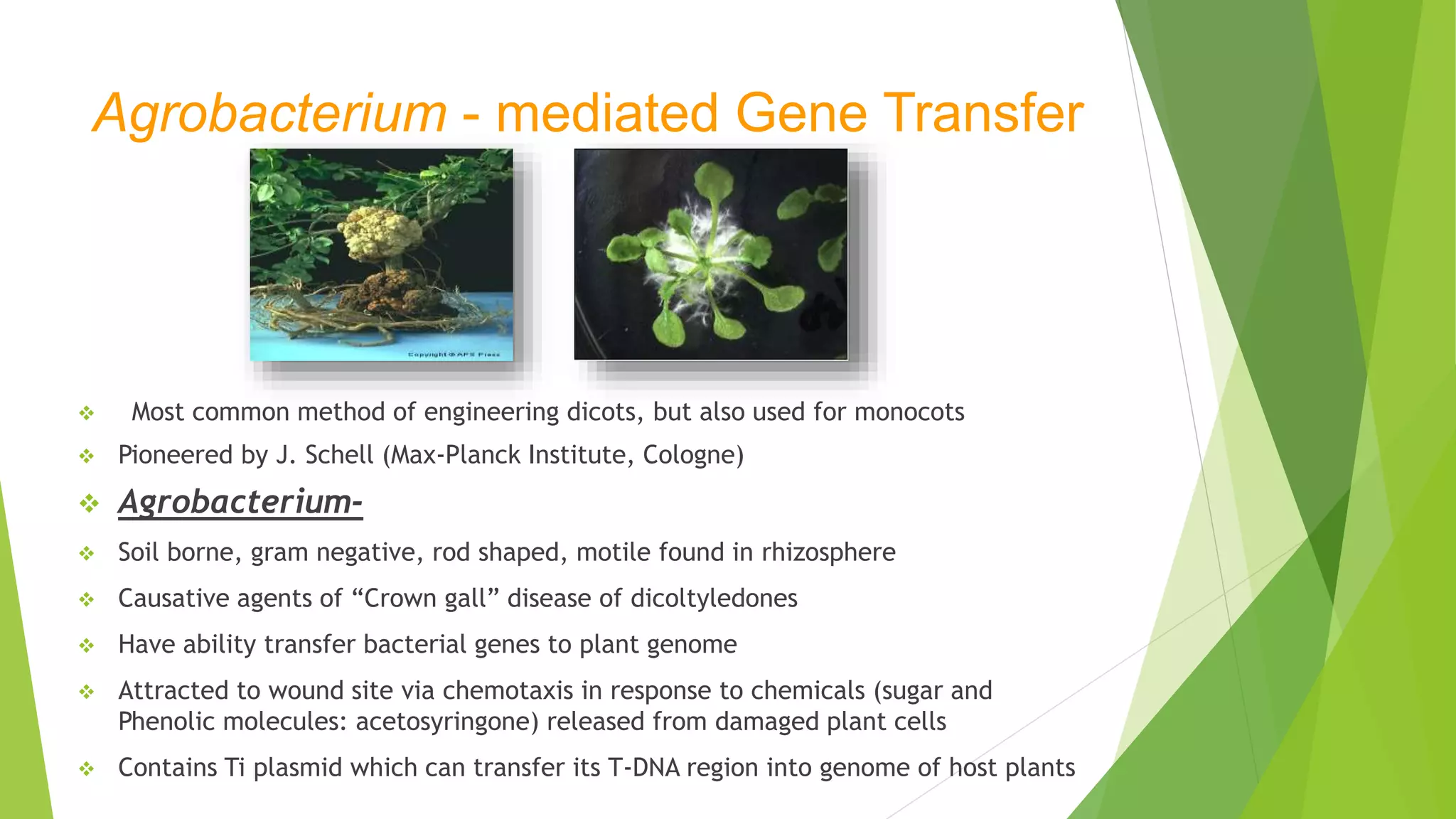
 Causative agents of “Crown gall” disease of dicoltyledones 
 Have ability transfer bacterial genes to plant genome 
 Attracted to wound site via chemotaxis in response to chemicals (sugar and 
Phenolic molecules: acetosyringone) released from damaged plant cells 
 Contains Ti plasmid which can transfer its T-DNA region into genome of host plants
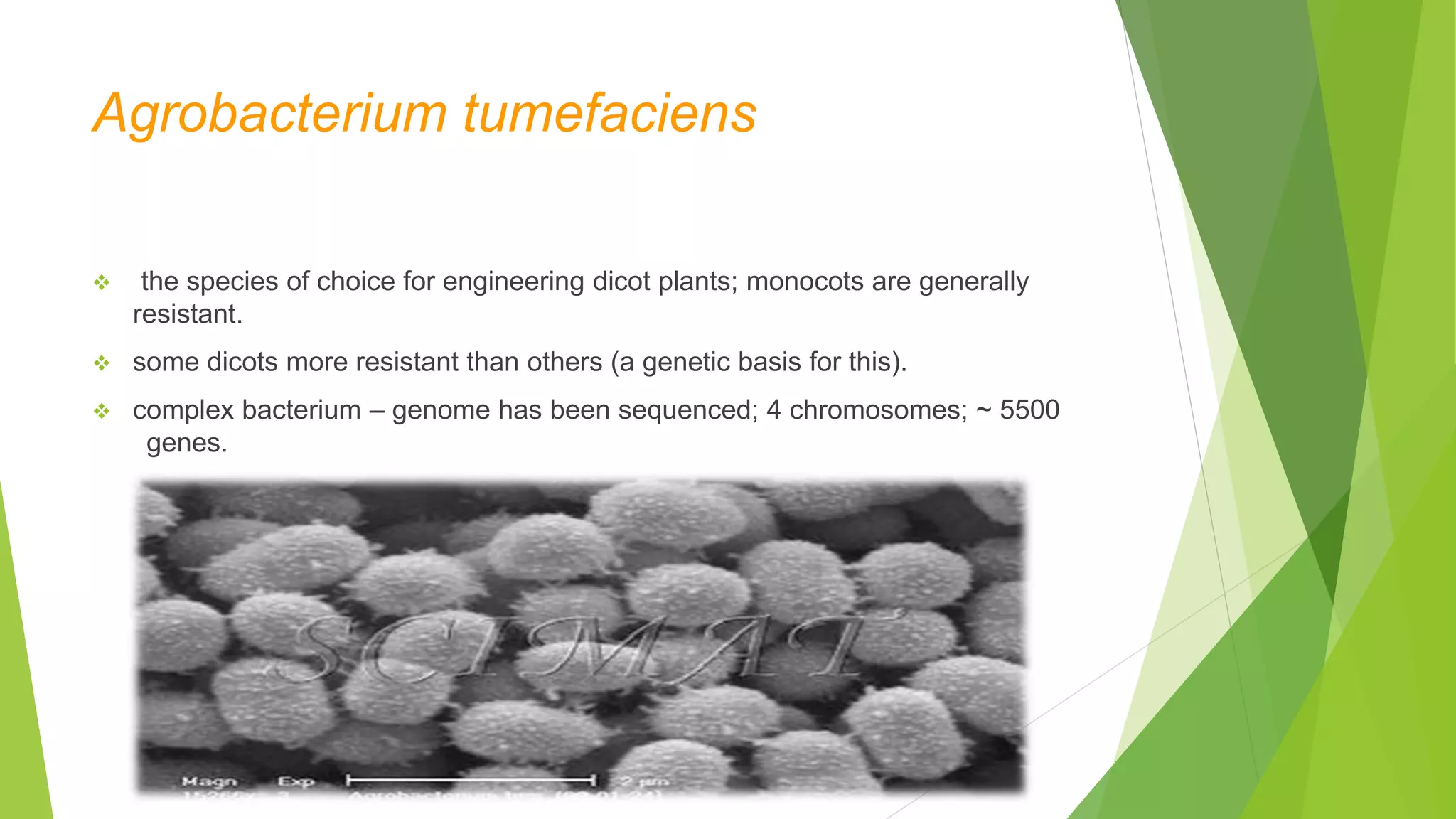
Agrobacterium tumefaciens 
 the species of choice for engineering dicot plants; monocots are generally 
resistant. 
 some dicots more resistant than others (a genetic basis for this). 
 complex bacterium – genome has been sequenced; 4 chromosomes; ~ 5500 
genes.
Infection and tumorigenesis 
 Infection occurs at wound sites. 
 Involves recognition and chemotaxis of the 
bacterium toward wounded cells. 
 galls are “real tumors”, can be removed and will 
grow indefinitely without hormones. 
 genetic information must be transferred to plant 
cells.
Tumor characteristics 
1. Synthesize a unique amino acid, called “opine” 
octopine and nopaline - derived from arginine 
agropine - derived from glutamate 
2. Opine depends on the strain of A. tumefaciens. 
3. Opines are catabolized by the bacteria, which 
can use only the specific opine that it causes 
the plant to produce.
Elucidation of the TIP (tumor-inducing 
principle) 
 It was recognized early that virulent strains could 
be cured of virulence, and that cured strains could 
regain virulence when exposed to virulent strains; 
suggested an extra-chromosomal element. 
 Large plasmids were found in A. tumefaciens and 
their presence correlated with virulence: called 
tumor-inducing or Ti plasmids.
Ti-plasmid features 
 Two strains of Ti-plasmid: 
 -Octopine strains- contains two T-DNA region: TL (14 kb) and TR ( 7 kb) 
 -Nopaline strains- contain one T-DNA region(20 kb) 
 Size is about 200 kb 
 Has a central role in Crown-gall formation 
 Contains one or more T-DNA region that is integrated into the genome of 
host plants 
 Contain a vir region ~ 40 kb at least 8~11 vir genes 
 Has origin of replication 
 Contains a region enabling conjugative transfer 
 Has genes for the catabolism of opines
Ti Plasmid 
(14 bp repeat) 
(7 bp repeat)
Ti plasmids and the bacterial chromosome 
act in concert to transform the plant 
 Agrobacterium tumefaciens chromosomal genes: chvA, chvB, pscA 
required for initial binding of the bacterium to the plant cell and code 
for polysaccharide on bacterial cell surface. 
 Virulence region (vir) carried on pTi, but not in the transferred region 
(T-DNA).Genes code for proteins that prepare the T-DNA and the 
bacterium for transfer. 
 T-DNA encodes genes for opine synthesis and for tumor production. 
 occ (opine catabolism) genes carried on the pTi allow the bacterium 
to utilize opines as nutrient.
Generation of the T-strand 
overdrive 
Right 
Border 
Left 
Border 
T-DNA 
virD/virC 
5’ 
VirD nicks the lower strand (T-strand) at the 
right border sequence and binds to the 5’ end.
Generation of the T-strand 
Right 
border 
Left 
border 
T-DNA 
D 
virD/virC 
gap filled in 
T-strand 
virE 
1. Helicases unwind the T-strand which 
is then coated by the virE protein. 
2. ~one T-strand produced per cell.
Right 
border 
Left 
border 
D 
T-DNA 
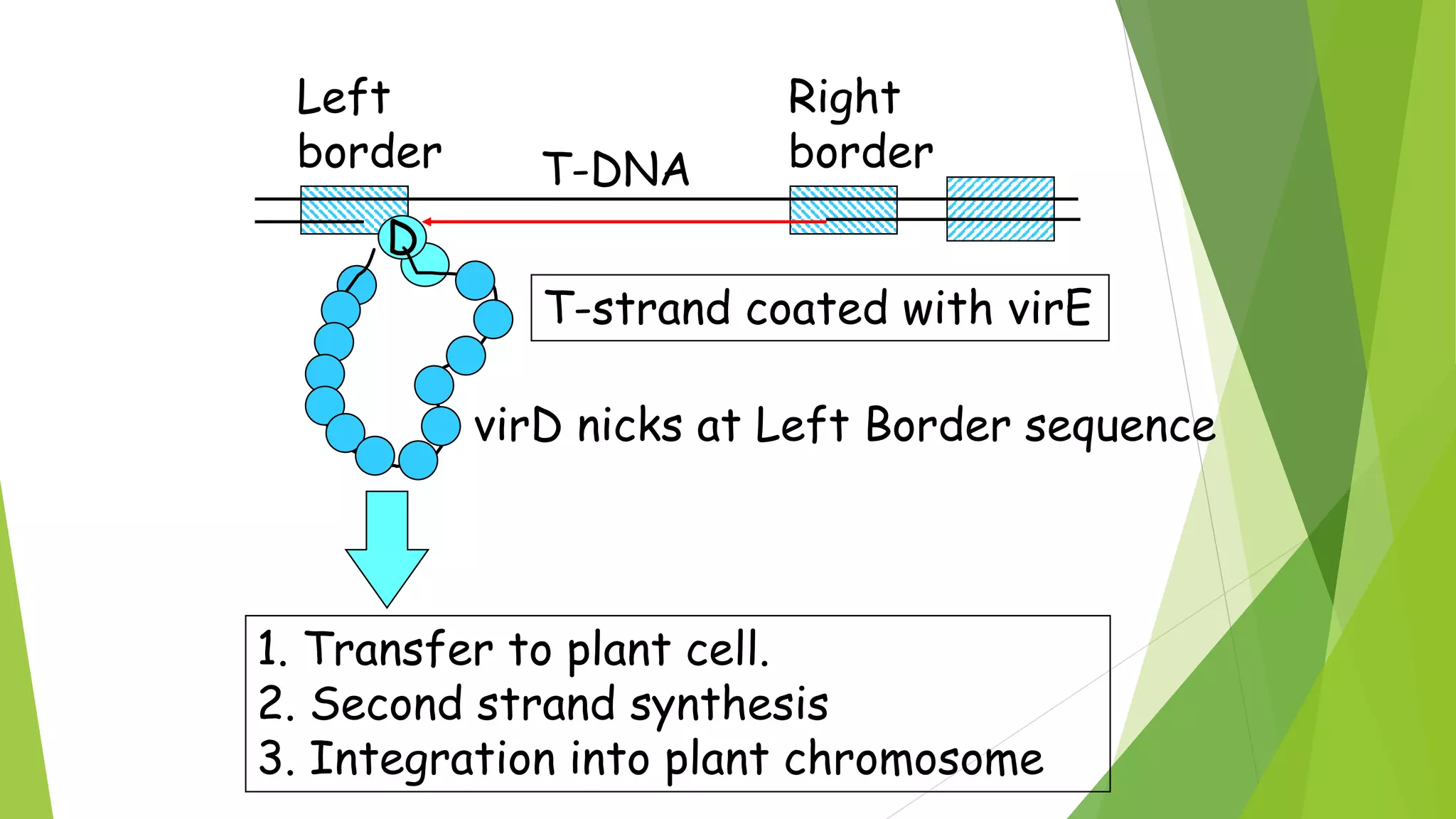
T-strand coated with virE 
virD nicks at Left Border sequence 
1. Transfer to plant cell. 
2. Second strand synthesis 
3. Integration into plant chromosome
Overview of the Infection Process
Important points: 
 Monocots don't produce AS in response 
to wounding. 
 Put any DNA between the LB and RB of 
T-DNA it will be transferred to plant cell. 
Engineering plants with 
Agrobacterium: 
Two problems had to be overcome: 
 Ti plasmids large, difficult to manipulate 
 couldn't regenerate plants from tumors
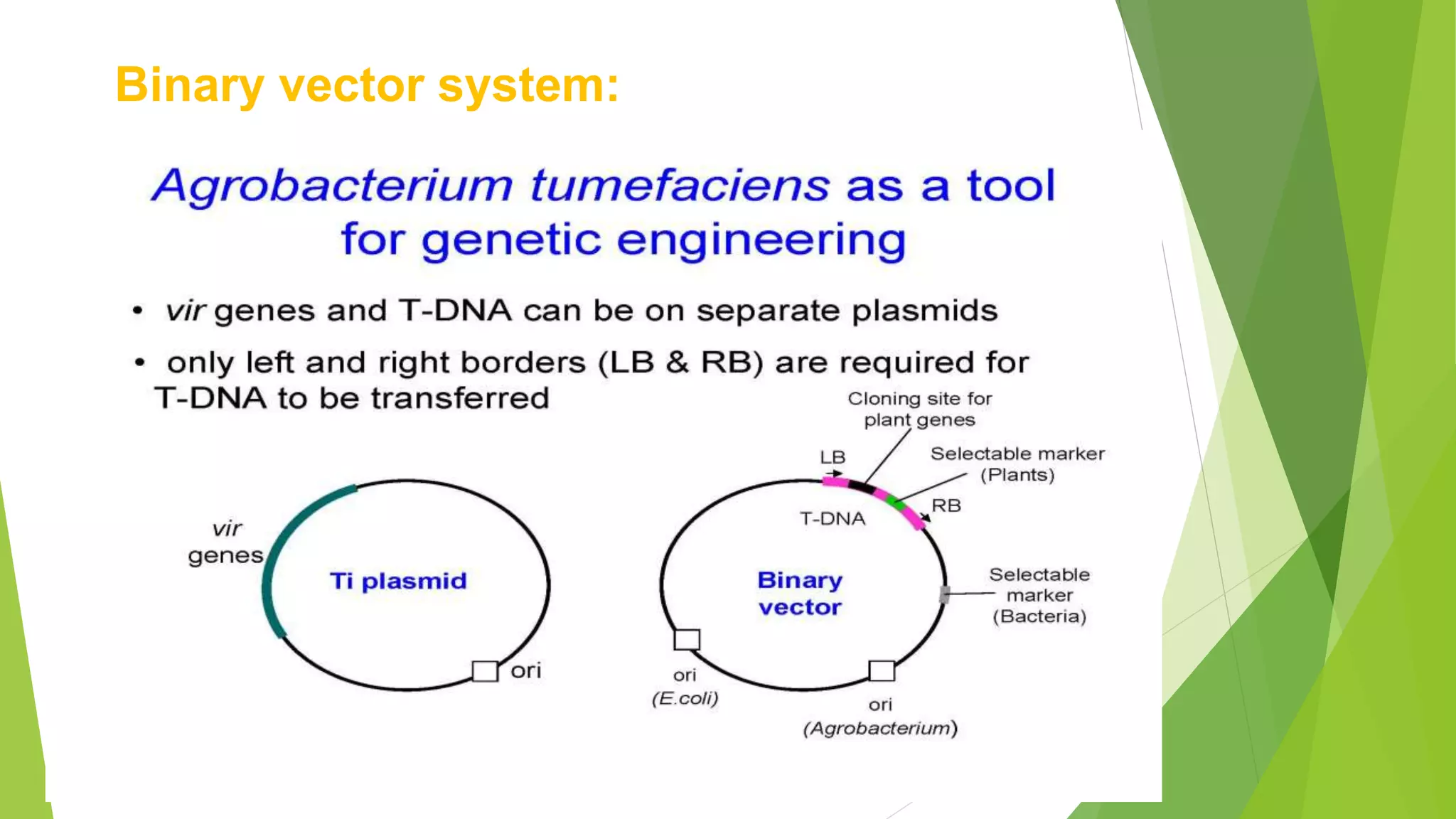
Binary vector system: 
 Strategy: 
 Move T-DNA onto a separate, small plasmid. 
 Remove aux and cyt genes. 
 Insert selectable marker (kanamycin 
resistance) gene in T-DNA. 
 Vir genes are retained on a separate plasmid. 
 Put foreign gene between T-DNA borders. 
 Co-transform Agrobacterium with both 
plasmids. 
 Infect plant with the transformed bacteria.
Binary vector system:
Practical application of 
Agrobacterium-mediated plant 
transformation: 
 Agrobacterium mediated transformation methods 
are thought to induce less rearrangement of the 
transgene. 
 Lower transgene copy number that direct DNA 
delivery methods. 
 Successful production of transgenic plants 
depends on the suitable transformation 
protocols.
Recent research
Conclusion: 
Agrobacteria are biological vector for introduction of 
genes into plants. Agrobacterium-mediated 
transformation is not restricted to eukaryotes as 
Agrobacterium is also able to act on the gram positive 
bacterium Streptomyces lividans. Agrobacterium can 
transfer not only DNA but also proteins to the host 
organisms through its type four secretion system.
References 
 Bevan, M. (1984) “Binary Agrobacterium vectors for plant transformation”. Nucleic 
Acids Res 12: 8711-8721. 
 Deblaere R., Bytebier B., De Greve H., Deboeck F., Schell J., Van Montagu M. and 
Leemans J. (1985) “Efficient octopine Ti plasmid-derived vectors for Agrobacterium-mediated 
gene transfer to plants”. Nucleic Acid Research 13:4777-4788. 
 Chilton, M.D. (1983) “A vector for introducing new genes into plants”. Scientific 
American, 248, 50-9. 
 Nadolska-Orczyk, A., Orczyk, W. and Przetakiewicz, A. (2000) “Agrobacterium-mediated 
transformation of cereals – from technique development to its 
application”. Acta Physiologiae Plantarum, 22, 77-8. 
 Kakkar, A. and Verma, V.K.,(2011) Agrobacterium mediated biotransformation. 
Journal of Applied Pharmaceutical Science 01 (07); 2011: 29-35.

Agrobacterium mediated gene transfer

  • 1.
    AGROBACTERIUM TUMEFACIENS MEDIATEDGENE TRANSFER IN PLANTS SUSHANTA SARMA M.Sc. BIOTECHNOLOGY
  • 2.
    Agrobacterium - mediatedGene Transfer  Most common method of engineering dicots, but also used for monocots  Pioneered by J. Schell (Max-Planck Institute, Cologne)  Agrobacterium-  Soil borne, gram negative, rod shaped, motile found in rhizosphere  Causative agents of “Crown gall” disease of dicoltyledones  Have ability transfer bacterial genes to plant genome  Attracted to wound site via chemotaxis in response to chemicals (sugar and Phenolic molecules: acetosyringone) released from damaged plant cells  Contains Ti plasmid which can transfer its T-DNA region into genome of host plants
  • 3.
    Agrobacterium tumefaciens the species of choice for engineering dicot plants; monocots are generally resistant.  some dicots more resistant than others (a genetic basis for this).  complex bacterium – genome has been sequenced; 4 chromosomes; ~ 5500 genes.
  • 4.
    Infection and tumorigenesis  Infection occurs at wound sites.  Involves recognition and chemotaxis of the bacterium toward wounded cells.  galls are “real tumors”, can be removed and will grow indefinitely without hormones.  genetic information must be transferred to plant cells.
  • 5.
    Tumor characteristics 1.Synthesize a unique amino acid, called “opine” octopine and nopaline - derived from arginine agropine - derived from glutamate 2. Opine depends on the strain of A. tumefaciens. 3. Opines are catabolized by the bacteria, which can use only the specific opine that it causes the plant to produce.
  • 6.
    Elucidation of theTIP (tumor-inducing principle)  It was recognized early that virulent strains could be cured of virulence, and that cured strains could regain virulence when exposed to virulent strains; suggested an extra-chromosomal element.  Large plasmids were found in A. tumefaciens and their presence correlated with virulence: called tumor-inducing or Ti plasmids.
  • 7.
    Ti-plasmid features Two strains of Ti-plasmid:  -Octopine strains- contains two T-DNA region: TL (14 kb) and TR ( 7 kb)  -Nopaline strains- contain one T-DNA region(20 kb)  Size is about 200 kb  Has a central role in Crown-gall formation  Contains one or more T-DNA region that is integrated into the genome of host plants  Contain a vir region ~ 40 kb at least 8~11 vir genes  Has origin of replication  Contains a region enabling conjugative transfer  Has genes for the catabolism of opines
  • 8.
    Ti Plasmid (14bp repeat) (7 bp repeat)
  • 9.
    Ti plasmids andthe bacterial chromosome act in concert to transform the plant  Agrobacterium tumefaciens chromosomal genes: chvA, chvB, pscA required for initial binding of the bacterium to the plant cell and code for polysaccharide on bacterial cell surface.  Virulence region (vir) carried on pTi, but not in the transferred region (T-DNA).Genes code for proteins that prepare the T-DNA and the bacterium for transfer.  T-DNA encodes genes for opine synthesis and for tumor production.  occ (opine catabolism) genes carried on the pTi allow the bacterium to utilize opines as nutrient.
  • 10.
    Generation of theT-strand overdrive Right Border Left Border T-DNA virD/virC 5’ VirD nicks the lower strand (T-strand) at the right border sequence and binds to the 5’ end.
  • 11.
    Generation of theT-strand Right border Left border T-DNA D virD/virC gap filled in T-strand virE 1. Helicases unwind the T-strand which is then coated by the virE protein. 2. ~one T-strand produced per cell.
  • 12.
    Right border Left border D T-DNA T-strand coated with virE virD nicks at Left Border sequence 1. Transfer to plant cell. 2. Second strand synthesis 3. Integration into plant chromosome
  • 13.
    Overview of theInfection Process
  • 14.
    Important points: Monocots don't produce AS in response to wounding.  Put any DNA between the LB and RB of T-DNA it will be transferred to plant cell. Engineering plants with Agrobacterium: Two problems had to be overcome:  Ti plasmids large, difficult to manipulate  couldn't regenerate plants from tumors
  • 15.
    Binary vector system:  Strategy:  Move T-DNA onto a separate, small plasmid.  Remove aux and cyt genes.  Insert selectable marker (kanamycin resistance) gene in T-DNA.  Vir genes are retained on a separate plasmid.  Put foreign gene between T-DNA borders.  Co-transform Agrobacterium with both plasmids.  Infect plant with the transformed bacteria.
  • 16.
  • 17.
    Practical application of Agrobacterium-mediated plant transformation:  Agrobacterium mediated transformation methods are thought to induce less rearrangement of the transgene.  Lower transgene copy number that direct DNA delivery methods.  Successful production of transgenic plants depends on the suitable transformation protocols.
  • 18.
  • 19.
    Conclusion: Agrobacteria arebiological vector for introduction of genes into plants. Agrobacterium-mediated transformation is not restricted to eukaryotes as Agrobacterium is also able to act on the gram positive bacterium Streptomyces lividans. Agrobacterium can transfer not only DNA but also proteins to the host organisms through its type four secretion system.
  • 20.
    References  Bevan,M. (1984) “Binary Agrobacterium vectors for plant transformation”. Nucleic Acids Res 12: 8711-8721.  Deblaere R., Bytebier B., De Greve H., Deboeck F., Schell J., Van Montagu M. and Leemans J. (1985) “Efficient octopine Ti plasmid-derived vectors for Agrobacterium-mediated gene transfer to plants”. Nucleic Acid Research 13:4777-4788.  Chilton, M.D. (1983) “A vector for introducing new genes into plants”. Scientific American, 248, 50-9.  Nadolska-Orczyk, A., Orczyk, W. and Przetakiewicz, A. (2000) “Agrobacterium-mediated transformation of cereals – from technique development to its application”. Acta Physiologiae Plantarum, 22, 77-8.  Kakkar, A. and Verma, V.K.,(2011) Agrobacterium mediated biotransformation. Journal of Applied Pharmaceutical Science 01 (07); 2011: 29-35.