ASSIGNMENT TOPIC:
AGROBACTRIUM MEDIATED TRANSFORMATION
SUBMITTED TO: MISS AREEBA
SUBMITTED BY: MISBAH TAHIR
1722105026
8TH SEMESTER
B.S BOTANY
2017 -2021
PLANT BIOTECHNOLOGY
GOVT.POST GRADUATE COLLEGE FOR WOMEN GULBERG,LAHORE.
TABLE OF CONTENT
Topic Pg no:
Introduction 1
History 2
Agrobactrium tumifaciens
Definition
3
Ti plasmid 4-5
Steps 6-8
Agrobactrium rhizogenes
Defintion
9-10
Ri plamids 11-13
Limitation cloning of agrobactrium with
plamids
14
Benefits and problem 15
Conclusion 16
References 17
AGROBACTRIUM MEDIATED TRANSFORMATION
INTRODUCTION
1. Transformation - the process of obtaining transgenic plant.
2. Transgenic plant - a plant with a foreign gene (or genes) from another
plant/animal that is incorporated into its chromosome.
3. Agrobacterium - is a genus of Gram-negative bacteria established by H. J.
Conn that uses horizontal gene transfer to cause tumors in plants.
4. Agrobacterium is a rod shaped plant pathogenic soil bacteria having two strains
A.tumifaciens cause crown gall (tumor) and A rhizogenes hairy root disease in
dicot plants by infecting through wounds on roots or stem at the soil surface.
5. The bacterium contains Ti (Tumor inducing ) and Ri (Root inducing) plasmids.
Both these plasmids can transfer part of their DNA (T-DNA) into plant cell
chromosome by which Plant cells become transformed by expression of T-DNA
gene which induce disease.
6. Oncogenes (for auxin and cytokinin synthesis) + Opines.
7. Disease producing Agrobacterium are higly pathogenic and do not benefit the
plant.
8. In the presence of exudates (e.g. acetosyringone) from wounded plants, Virulence
(VIR) genes are activated and cause the t-DNA to be transferred to plants.
Everything between the left and right border is transferred.
History:
9. Marc Van Montagu and Jozef Schell at the University of Ghent (Belgium)
discovered the gene transfer mechanism between Agrobacterium and plants,
which resulted in the development of methods to alter Agrobacterium into an
efficient delivery system for gene engineering in plants.
1
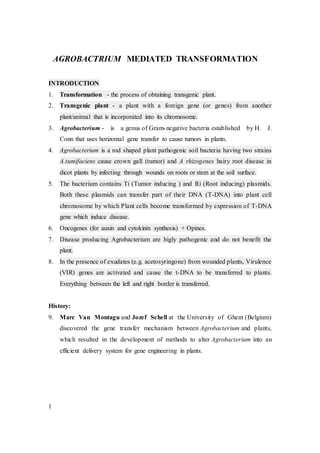
10. A team of researchers led by Dr Mary-Dell Chilton were the first to demonstrate
that the virulence genes could be removed without adversely affecting the ability
of Agrobacterium to insert its own DNA into the plant genome (1983).
11. Approved transgenic plants:
Soyabean,corn,cotton,oil seed rape ,sugarbeet ,tabbacco, potato and nut tress.
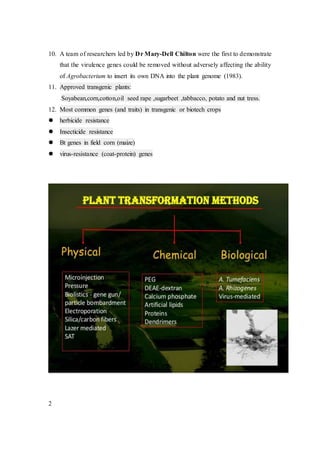
12. Most common genes (and traits) in transgenic or biotech crops
 herbicide resistance
 Insecticide resistance
 Bt genes in field corn (maize)
 virus-resistance (coat-protein) genes
2
Agrobacterium tumefaciens
Scientific classification
Kingdom :Bacteria
Phylum :Proteobacteria
Class :Alproteobacthaperia
Order :Rhizobiales
Family :Rhizobiaceae
Genus :Agrobacterium
Species : A. tumefaciens
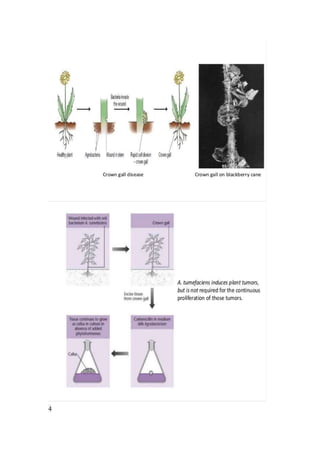
Definition: A. tumefaciens is a soil microorganism that causes crown gall disease in
many species of dicotyledonous plants.
 A rod shaped, Gram negative soil bacterium.
 A natural genetic engineer specie causes crown-gall disease in plants. The
disease is characterized by a tumour-like growth or gall on the infected plant,
often at the junction between the root and the shoot.
 Tumors are incited by the conjugative transfer of a DNA segment (T-DNA) from
the bacterial tumour-inducing (Ti) plasmid.
3
4
THE Ti PLASMID
1. This is a large (> 200 kb) plasmid that carries numerous genes involved in the
infective process.
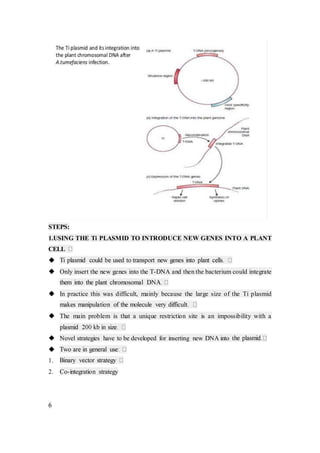
2. After infection, part of the Ti plasmid is integrated into the plant chromosomal
DNA. This segment, called the T-DNA, is 15-30 kb in size, depending on the
3. It is maintained in a stable form in the plant cell and is passed on to daughter cells
4. DNA contains eight or so genes that are expressed in the plant cell and are
responsible for the cancerous properties of the transformed cells.
5. These genes also direct synthesis of unusual compounds, called opines, that the
6. In short, A. tumefaciens genetically engineers the plant cell for its own purposes.
5
STEPS:
1.USING THE Ti PLASMID TO INTRODUCE NEW GENES INTO A PLANT
CELL

 Only insert the new genes into the T-DNA and then the bacterium could integrate
 In practice this was difficult, mainly because the large size of the Ti plasmid
 The main problem is that a unique restriction site is an impossibility with a
 Novel strategies have to be developed for inserting new DNA into t

1.
2. Co-integration strategy
6
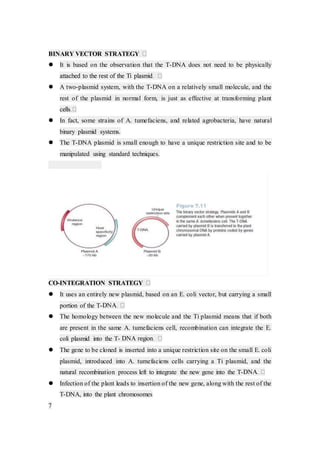
BINARY VECTOR STRATEGY
 It is based on the observation that the T-DNA does not need to be physically
 A two-plasmid system, with the T-DNA on a relatively small molecule, and the
rest of the plasmid in normal form, is just as effective at transforming plant
 In fact, some strains of A. tumefaciens, and related agrobacteria, have natural
binary plasmid systems.
 The T-DNA plasmid is small enough to have a unique restriction site and to be
manipulated using standard techniques.
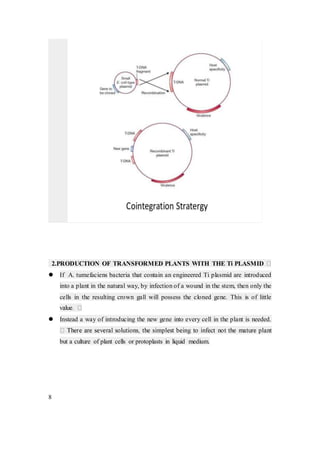
CO-INTEGRATION STRATEGY
 It uses an entirely new plasmid, based on an E. coli vector, but carrying a small
portion of the T-
 The homology between the new molecule and the Ti plasmid means that if both
are present in the same A. tumefaciens cell, recombination can integrate the E.
coli plasmid into the T-
 The gene to be cloned is inserted into a unique restriction site on the small E. coli
plasmid, introduced into A. tumefaciens cells carrying a Ti plasmid, and the
natural recombination process left to integrate the new gene into the T-
 Infection of the plant leads to insertion of the new gene, along with the rest of the
T-DNA, into the plant chromosomes
7
2.PRODUCTION OF TRANSFORMED PLANTS WITH THE Ti PLASMID
 If A. tumefaciens bacteria that contain an engineered Ti plasmid are introduced
into a plant in the natural way, by infection of a wound in the stem, then only the
cells in the resulting crown gall will possess the cloned gene. This is of little
 Instead a way of introducing the new gene into every cell in the plant is needed.
but a culture of plant cells or protoplasts in liquid medium.
8
3.PRODUCTION OF TRANSFORMED PLANTS WITH THE Ti PLASMID
 Plant cells and protoplasts whose cell walls have re-formed can be plated onto a
 A mature plant regenerated from transformed cells will contain the cloned gene
 Regeneration of a transformed plant can occur only if the Ti vector has been
“disarmed” so that the transformed cel
 Disarming is possible because the cancer genes, all of which lie in the T-DNA,
are not needed for the infection process, infectivity being controlled mainly by
 The only parts of the T-DNA that are involved in infection are two 25 bp repeat
sequences found at the left and right borders of the region integrated into the
plant DNA. Any DNA placed between these two repeat sequences will be
treated as “T- DNA” and transferred to the plant.
9
 Hence possible to remove all the cancer genes from the normal T-DNA, and
replace them with an entirely new set of genes, without disturbing the infection
process.
 a number of disarmed ti cloning vectors are now available.
 A typical example
 The left and right T-DNA borders present in this vector flank a copy of the
lacZ′ gene, containing a number of cloning sites, and a kanamycin resistance
gene that functions after integration of the vector sequences into the plant
 As with a yeast shuttle vector, the initial manipulations that result in insertion
of the gene to be cloned into pBIN19 are carried out in E. coli, the correct
recombinant pBIN19 molecule then being transferred to A. tumefaciens and
t
medium containing kanamycin resistance gene.
10
Agrobacterium rhizogenes
Scientific classification
Kingdom :Bacteria
Phylum :Proteobacteria
Class :Alproteobacthaperia
Order :Rhizobiales
Family :Rhizobiaceae
Genus :Agrobacterium
Species : A. rhizogenes
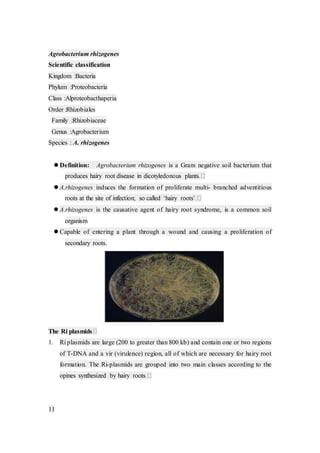
 Definition: Agrobacterium rhizogenes is a Gram negative soil bacterium that
 A.rhizogenes induces the formation of proliferate multi- branched adventitious
 A.rhizogenes is the causative agent of hairy root syndrome, is a common soil
organism
 Capable of entering a plant through a wound and causing a proliferation of
secondary roots.
The Ri plasmids
1. Ri plasmids are large (200 to greater than 800 kb) and contain one or two regions
of T-DNA and a vir (virulence) region, all of which are necessary for hairy root
formation. The Ri-plasmids are grouped into two main classes according to the
11
2. First, agropine-type strains induce roots to synthesise agropine, mannopine and
the related acids.
3. Second, mannopine-type strains induce roots to produce mannopine and the
4. The agropine-type Ri-plasmids are very similar as a group and a quite distinct
group from the mannopine-type plasmids.
The genes responsible for hairy root formation
1. The T-DNA of the agropine-type Ri-plasmid consists of two separate T-DNA
regions designed the TL-DNA and TR-DNA (15 - 20 kb).
2. These two fragments can be transferred independently during the infection
process.The genes encoding auxin synthesis (tms1 and tms2) and agropine
synthesis (ags) have been localised on the TR-DNA of the agropine type Ri-
3. The mannopine type Ri-plasmids contain only one T-DNA that shares
considerable DNA
4. rolA, rolB, and rolC
5. rolA is associated with internode shortening and leaf wrinkling.
12
6. rolB is responsible for protruding stigmas and reduced length of stamens.
7.
8. Although the TR-DNA is not essential for hairy root formation it has been shown
that the aux1 gene harbored in this segment provides to the trasformed cells with
an additional source of auxin.
Mechanisms of agrobactrium cell interaction:
1. One of the earliest stages in the interaction between Agrobacterium and a plant is
2. A plant cell becomes susceptible to Agrobacterium when it is wounded.The
wounded cells release phenolic compounds, such as acetosyringone, that activate
the vir-region of
3. The Agrobacterium plasmid carries three genetic components that are required
for plant cell
4. The Agrobacterium plasmid carries three genetic components that are required
for plant cell transformation. It has been shown that the Agrobacterium plasmid
carries three genetic components that are required for plant cell transformation.
The first component, the T-DNA that is integrated into the plant cells, is a mobile
DNA element.
5. The second one is the virulence area (vir), which contains several vir genes.
6. These genes do not enter the plant cell but,together with the chromosomal DNA
(two loci),cause the transfer of T-DNA. The third component, the so-called
border sequences (25bp), resides in the Agrobacterium chromosome.
7. The mobility of T-DNA is largely determined by these sequences, and they are
the only ciselements necessary for direct T-DNA processing.
13
ADVANTAGES
1. The hairy roots are grown in vitro in bioreactors to study their soil interaction
with
2. This technique has also led to the commercial production of certain metabolic
compounds that the plant is known to secrete, especially in regard to the
medicinal plants that are difficult to cultivate in sufficient quantities by other
3. The root cultures are also used for genetic engineering.
14
LIMITATIONS OF CLONING WITH AGROBACTERIUM PLASMIDS
 Several factors make it easier to clone genes in dicots such as tomato, tobacco,
potato, peas, and beans, but
 Monocots include wheat, barley, rice, and maize, which are the most important
 The main difficulty is that in nature A. tumefaciens and A. rhizogenes infect only
dicotyledonous plants; monocots are outside of the normal host range.
 Eventually artificial techniques for achieving T-
Transformation with an Agrobacterium vector normally involves regeneration
of an intact plant from a transformed protoplast, cell, or callus culture.
 The ease with which a plant can be regenerated depends very much on the
 Attempts to circumvent this problem have centered on the use of biolistics—
bombardment with micro-projectiles —to introduce plasmid DNA directly into
 Although this is a fairly violent transformation procedure it does not appear to be
too damaging for the embryos, which still continue their normal development
program to produce mature plants.The approach has been successful with maize
and several other important monocots.
15
Benefits and problems with agrobactrium
1. Scientists can insert any gene they want into the plasmid in place of the tumor
causing genes and subsequently into the plant cell genome
2. By varying experimental materials, culture conditions, bacterial strains, etc.
scientists have successfully used A. tumefaciens Gene Transfer to produce BT
Corn
3. This method of gene transfer enables large DNA strands to be transferred into the
plant cell without risk of rearrangement whereas other methods like the Gene
Gun have trouble doing this
4. The vast majority of approved genetically engineered agriculture has been
transformed by means of Agrobacterium tumefaciens Mediated Gene Transfer
Original problems existed in that Agrobacterium tumefaciens only affects
dicotyledonous plants
5. Monocotyledon plants are not very susceptible to the bacterial infection.
Conclusion
6. Transformed plants will help the world to meet the human demands for food,
energy, medicine, shelter, clothing, and a cleaner environment
7. Gene transfer technology is being used to produce plants capable of hyper
accumulating toxic metals from soil and water, thus contributing to a cleaner
environment Increases in plant production are needed to meet growing demands
for food.
8. Transformed Plants offers significant advantages over traditional plant breeding
in developing improved crops.
16
REFERENCE:
 Brown Ta. (2006). Gene Cloning And Dna Analysis. 5th Edition. Blackwell.
 Publishing, Oxford, U.K. Primrose Sb And Twyman Rm. (2006). Principles Of
Gene Manipulation And Genomics, 7th Edition. Blackwell Publishing, Oxford,
U.K.
 Tzfira And Citovsky, (2006) Agrobacterium-Mediated Genetic Transformation.
Current Opinion In Biotechnology, 17:147–
 Gelvin Sb,(1998)The Introduction And Expression Of Transgenes In Plants. Curr
Opin Biotechnol, 9:227-
 G.Ramawat – Plant Biotechnology (2004) . 3rd Edition, S.Chand And Company
Ltd. Page No. 231-238, 183 .
 M.K. Razdan – Introduction To Plant Tissue Culture (2012). 2nd Edition, Oxford
& Ibh Publishing Co. Pvt. Ltd. Page No. – 186-189.
17

Agrobactrium mediated transformation

  • 1.
    ASSIGNMENT TOPIC: AGROBACTRIUM MEDIATEDTRANSFORMATION SUBMITTED TO: MISS AREEBA SUBMITTED BY: MISBAH TAHIR 1722105026 8TH SEMESTER B.S BOTANY 2017 -2021 PLANT BIOTECHNOLOGY GOVT.POST GRADUATE COLLEGE FOR WOMEN GULBERG,LAHORE.
  • 2.
    TABLE OF CONTENT TopicPg no: Introduction 1 History 2 Agrobactrium tumifaciens Definition 3 Ti plasmid 4-5 Steps 6-8 Agrobactrium rhizogenes Defintion 9-10 Ri plamids 11-13 Limitation cloning of agrobactrium with plamids 14 Benefits and problem 15 Conclusion 16 References 17
  • 3.
    AGROBACTRIUM MEDIATED TRANSFORMATION INTRODUCTION 1.Transformation - the process of obtaining transgenic plant. 2. Transgenic plant - a plant with a foreign gene (or genes) from another plant/animal that is incorporated into its chromosome. 3. Agrobacterium - is a genus of Gram-negative bacteria established by H. J. Conn that uses horizontal gene transfer to cause tumors in plants. 4. Agrobacterium is a rod shaped plant pathogenic soil bacteria having two strains A.tumifaciens cause crown gall (tumor) and A rhizogenes hairy root disease in dicot plants by infecting through wounds on roots or stem at the soil surface. 5. The bacterium contains Ti (Tumor inducing ) and Ri (Root inducing) plasmids. Both these plasmids can transfer part of their DNA (T-DNA) into plant cell chromosome by which Plant cells become transformed by expression of T-DNA gene which induce disease. 6. Oncogenes (for auxin and cytokinin synthesis) + Opines. 7. Disease producing Agrobacterium are higly pathogenic and do not benefit the plant. 8. In the presence of exudates (e.g. acetosyringone) from wounded plants, Virulence (VIR) genes are activated and cause the t-DNA to be transferred to plants. Everything between the left and right border is transferred. History: 9. Marc Van Montagu and Jozef Schell at the University of Ghent (Belgium) discovered the gene transfer mechanism between Agrobacterium and plants, which resulted in the development of methods to alter Agrobacterium into an efficient delivery system for gene engineering in plants. 1
  • 4.
    10. A teamof researchers led by Dr Mary-Dell Chilton were the first to demonstrate that the virulence genes could be removed without adversely affecting the ability of Agrobacterium to insert its own DNA into the plant genome (1983). 11. Approved transgenic plants: Soyabean,corn,cotton,oil seed rape ,sugarbeet ,tabbacco, potato and nut tress. 12. Most common genes (and traits) in transgenic or biotech crops  herbicide resistance  Insecticide resistance  Bt genes in field corn (maize)  virus-resistance (coat-protein) genes 2
  • 5.
    Agrobacterium tumefaciens Scientific classification Kingdom:Bacteria Phylum :Proteobacteria Class :Alproteobacthaperia Order :Rhizobiales Family :Rhizobiaceae Genus :Agrobacterium Species : A. tumefaciens Definition: A. tumefaciens is a soil microorganism that causes crown gall disease in many species of dicotyledonous plants.  A rod shaped, Gram negative soil bacterium.  A natural genetic engineer specie causes crown-gall disease in plants. The disease is characterized by a tumour-like growth or gall on the infected plant, often at the junction between the root and the shoot.  Tumors are incited by the conjugative transfer of a DNA segment (T-DNA) from the bacterial tumour-inducing (Ti) plasmid. 3
  • 6.
  • 7.
    THE Ti PLASMID 1.This is a large (> 200 kb) plasmid that carries numerous genes involved in the infective process. 2. After infection, part of the Ti plasmid is integrated into the plant chromosomal DNA. This segment, called the T-DNA, is 15-30 kb in size, depending on the 3. It is maintained in a stable form in the plant cell and is passed on to daughter cells 4. DNA contains eight or so genes that are expressed in the plant cell and are responsible for the cancerous properties of the transformed cells. 5. These genes also direct synthesis of unusual compounds, called opines, that the 6. In short, A. tumefaciens genetically engineers the plant cell for its own purposes. 5
  • 8.
    STEPS: 1.USING THE TiPLASMID TO INTRODUCE NEW GENES INTO A PLANT CELL   Only insert the new genes into the T-DNA and then the bacterium could integrate  In practice this was difficult, mainly because the large size of the Ti plasmid  The main problem is that a unique restriction site is an impossibility with a  Novel strategies have to be developed for inserting new DNA into t  1. 2. Co-integration strategy 6
  • 9.
    BINARY VECTOR STRATEGY It is based on the observation that the T-DNA does not need to be physically  A two-plasmid system, with the T-DNA on a relatively small molecule, and the rest of the plasmid in normal form, is just as effective at transforming plant  In fact, some strains of A. tumefaciens, and related agrobacteria, have natural binary plasmid systems.  The T-DNA plasmid is small enough to have a unique restriction site and to be manipulated using standard techniques. CO-INTEGRATION STRATEGY  It uses an entirely new plasmid, based on an E. coli vector, but carrying a small portion of the T-  The homology between the new molecule and the Ti plasmid means that if both are present in the same A. tumefaciens cell, recombination can integrate the E. coli plasmid into the T-  The gene to be cloned is inserted into a unique restriction site on the small E. coli plasmid, introduced into A. tumefaciens cells carrying a Ti plasmid, and the natural recombination process left to integrate the new gene into the T-  Infection of the plant leads to insertion of the new gene, along with the rest of the T-DNA, into the plant chromosomes 7
  • 10.
    2.PRODUCTION OF TRANSFORMEDPLANTS WITH THE Ti PLASMID  If A. tumefaciens bacteria that contain an engineered Ti plasmid are introduced into a plant in the natural way, by infection of a wound in the stem, then only the cells in the resulting crown gall will possess the cloned gene. This is of little  Instead a way of introducing the new gene into every cell in the plant is needed. but a culture of plant cells or protoplasts in liquid medium. 8
  • 11.
    3.PRODUCTION OF TRANSFORMEDPLANTS WITH THE Ti PLASMID  Plant cells and protoplasts whose cell walls have re-formed can be plated onto a  A mature plant regenerated from transformed cells will contain the cloned gene  Regeneration of a transformed plant can occur only if the Ti vector has been “disarmed” so that the transformed cel  Disarming is possible because the cancer genes, all of which lie in the T-DNA, are not needed for the infection process, infectivity being controlled mainly by  The only parts of the T-DNA that are involved in infection are two 25 bp repeat sequences found at the left and right borders of the region integrated into the plant DNA. Any DNA placed between these two repeat sequences will be treated as “T- DNA” and transferred to the plant. 9
  • 12.
     Hence possibleto remove all the cancer genes from the normal T-DNA, and replace them with an entirely new set of genes, without disturbing the infection process.  a number of disarmed ti cloning vectors are now available.  A typical example  The left and right T-DNA borders present in this vector flank a copy of the lacZ′ gene, containing a number of cloning sites, and a kanamycin resistance gene that functions after integration of the vector sequences into the plant  As with a yeast shuttle vector, the initial manipulations that result in insertion of the gene to be cloned into pBIN19 are carried out in E. coli, the correct recombinant pBIN19 molecule then being transferred to A. tumefaciens and t medium containing kanamycin resistance gene. 10
  • 13.
    Agrobacterium rhizogenes Scientific classification Kingdom:Bacteria Phylum :Proteobacteria Class :Alproteobacthaperia Order :Rhizobiales Family :Rhizobiaceae Genus :Agrobacterium Species : A. rhizogenes  Definition: Agrobacterium rhizogenes is a Gram negative soil bacterium that  A.rhizogenes induces the formation of proliferate multi- branched adventitious  A.rhizogenes is the causative agent of hairy root syndrome, is a common soil organism  Capable of entering a plant through a wound and causing a proliferation of secondary roots. The Ri plasmids 1. Ri plasmids are large (200 to greater than 800 kb) and contain one or two regions of T-DNA and a vir (virulence) region, all of which are necessary for hairy root formation. The Ri-plasmids are grouped into two main classes according to the 11
  • 14.
    2. First, agropine-typestrains induce roots to synthesise agropine, mannopine and the related acids. 3. Second, mannopine-type strains induce roots to produce mannopine and the 4. The agropine-type Ri-plasmids are very similar as a group and a quite distinct group from the mannopine-type plasmids. The genes responsible for hairy root formation 1. The T-DNA of the agropine-type Ri-plasmid consists of two separate T-DNA regions designed the TL-DNA and TR-DNA (15 - 20 kb). 2. These two fragments can be transferred independently during the infection process.The genes encoding auxin synthesis (tms1 and tms2) and agropine synthesis (ags) have been localised on the TR-DNA of the agropine type Ri- 3. The mannopine type Ri-plasmids contain only one T-DNA that shares considerable DNA 4. rolA, rolB, and rolC 5. rolA is associated with internode shortening and leaf wrinkling. 12
  • 15.
    6. rolB isresponsible for protruding stigmas and reduced length of stamens. 7. 8. Although the TR-DNA is not essential for hairy root formation it has been shown that the aux1 gene harbored in this segment provides to the trasformed cells with an additional source of auxin. Mechanisms of agrobactrium cell interaction: 1. One of the earliest stages in the interaction between Agrobacterium and a plant is 2. A plant cell becomes susceptible to Agrobacterium when it is wounded.The wounded cells release phenolic compounds, such as acetosyringone, that activate the vir-region of 3. The Agrobacterium plasmid carries three genetic components that are required for plant cell 4. The Agrobacterium plasmid carries three genetic components that are required for plant cell transformation. It has been shown that the Agrobacterium plasmid carries three genetic components that are required for plant cell transformation. The first component, the T-DNA that is integrated into the plant cells, is a mobile DNA element. 5. The second one is the virulence area (vir), which contains several vir genes. 6. These genes do not enter the plant cell but,together with the chromosomal DNA (two loci),cause the transfer of T-DNA. The third component, the so-called border sequences (25bp), resides in the Agrobacterium chromosome. 7. The mobility of T-DNA is largely determined by these sequences, and they are the only ciselements necessary for direct T-DNA processing. 13
  • 16.
    ADVANTAGES 1. The hairyroots are grown in vitro in bioreactors to study their soil interaction with 2. This technique has also led to the commercial production of certain metabolic compounds that the plant is known to secrete, especially in regard to the medicinal plants that are difficult to cultivate in sufficient quantities by other 3. The root cultures are also used for genetic engineering. 14
  • 17.
    LIMITATIONS OF CLONINGWITH AGROBACTERIUM PLASMIDS  Several factors make it easier to clone genes in dicots such as tomato, tobacco, potato, peas, and beans, but  Monocots include wheat, barley, rice, and maize, which are the most important  The main difficulty is that in nature A. tumefaciens and A. rhizogenes infect only dicotyledonous plants; monocots are outside of the normal host range.  Eventually artificial techniques for achieving T- Transformation with an Agrobacterium vector normally involves regeneration of an intact plant from a transformed protoplast, cell, or callus culture.  The ease with which a plant can be regenerated depends very much on the  Attempts to circumvent this problem have centered on the use of biolistics— bombardment with micro-projectiles —to introduce plasmid DNA directly into  Although this is a fairly violent transformation procedure it does not appear to be too damaging for the embryos, which still continue their normal development program to produce mature plants.The approach has been successful with maize and several other important monocots. 15
  • 18.
    Benefits and problemswith agrobactrium 1. Scientists can insert any gene they want into the plasmid in place of the tumor causing genes and subsequently into the plant cell genome 2. By varying experimental materials, culture conditions, bacterial strains, etc. scientists have successfully used A. tumefaciens Gene Transfer to produce BT Corn 3. This method of gene transfer enables large DNA strands to be transferred into the plant cell without risk of rearrangement whereas other methods like the Gene Gun have trouble doing this 4. The vast majority of approved genetically engineered agriculture has been transformed by means of Agrobacterium tumefaciens Mediated Gene Transfer Original problems existed in that Agrobacterium tumefaciens only affects dicotyledonous plants 5. Monocotyledon plants are not very susceptible to the bacterial infection. Conclusion 6. Transformed plants will help the world to meet the human demands for food, energy, medicine, shelter, clothing, and a cleaner environment 7. Gene transfer technology is being used to produce plants capable of hyper accumulating toxic metals from soil and water, thus contributing to a cleaner environment Increases in plant production are needed to meet growing demands for food. 8. Transformed Plants offers significant advantages over traditional plant breeding in developing improved crops. 16
  • 19.
    REFERENCE:  Brown Ta.(2006). Gene Cloning And Dna Analysis. 5th Edition. Blackwell.  Publishing, Oxford, U.K. Primrose Sb And Twyman Rm. (2006). Principles Of Gene Manipulation And Genomics, 7th Edition. Blackwell Publishing, Oxford, U.K.  Tzfira And Citovsky, (2006) Agrobacterium-Mediated Genetic Transformation. Current Opinion In Biotechnology, 17:147–  Gelvin Sb,(1998)The Introduction And Expression Of Transgenes In Plants. Curr Opin Biotechnol, 9:227-  G.Ramawat – Plant Biotechnology (2004) . 3rd Edition, S.Chand And Company Ltd. Page No. 231-238, 183 .  M.K. Razdan – Introduction To Plant Tissue Culture (2012). 2nd Edition, Oxford & Ibh Publishing Co. Pvt. Ltd. Page No. – 186-189. 17