GENE EXPRESSION
and CONTROL
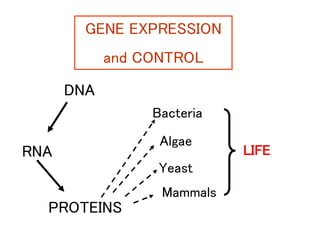
DNA
RNA
PROTEINS
LIFE
Bacteria
Algae
Yeast
Mammals
• Regulation of gene action
•Gene action or gene expression refers to the
production of the concerned trait or phenotype by
gene
•In molecular terms it is transcription
•Gene regulation at various levels
•Gene amplification, destruction or distribution-
whether a gene present or not, no. of copies-
extrachromosomal copies of rRNA in nucleolous
•Transcription
•Post transcription
•Translation
•Post translation
•Transcription- given gene is transcribed or not in a
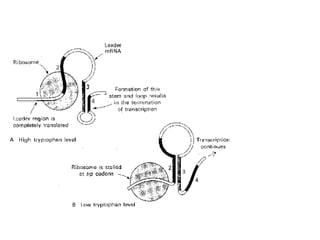
given cell in a given time
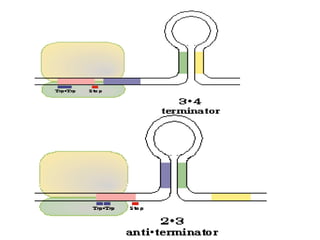
•Post transcription- if the mRNA produced is available
for translation or not
•Translation-mRNA is suitable for regulation or not,
regulation is based on ribosomes, tRNA, regulatory
proteins, regulatory RNA
•Post translation- governs the activity of proteins,
protein modification, protein degradation, feed back
inhibition
•Regulation of Transcription in prokaryotes
•Genes are organized in groups called Operons
•Operon concept was proposed by Jacob and Monod
in 1961
•Operon consists of a group of structural genes whose
transcription is regulated by the same set of genes
viz., regulator gene, promoter and operator sequences
•Operator sequences generally overlaps Promoter
sequence
structural genes encode enzymes for biosynthetic or
metabolic pathway
•Operons are regulated by regulatory proteins that
bind to operator sequences and are encoded by
regulatory genes
Promoter – a nucleotide sequence that enables a gene to be
transcribed. The promoter is recognized by RNA
polymerase, which then initiates transcription. In RNA
synthesis, promoters indicate which genes should be used for
messenger RNA creation – and, by extension, control which
proteins the cell produces.
Operator – a segment of DNA that a regulator binds to. It is
classically defined in the lac operon as a segment between the
promoter and the genes of the operon. In the case of a
repressor, the repressor protein physically obstructs the RNA
polymerase from transcribing the genes.
Structural genes – the genes that are co-regulated by the
operon and encode enzymes for biosynthetic or
metabolic pathway
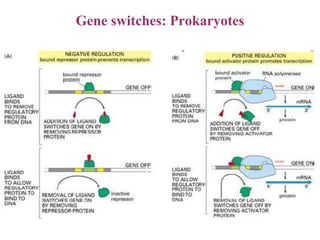
•Regulation of Operons are two types
•Positive regulation
•Negative regulation
•In case of positive control binding of regulatory
proteins (Activators) to the operator is necessary for
transcription
•In case of negative control binding of regulatory
proteins (Repressors) to the operator inhibits
transcription
•Negative regulation is common in prokaryotes and
lower eukaryotes
•Positive regulation is common in higher eukaryotes
•Transcription can be regulated by
•Attenuation (trp, thr, his Operons)- regulates in
response to the availability of specific aminoacids-
Tryptophan in case of trp operon- if the concerned aa
is available translation continues and transcription is
blocked
• Anti termination- RNA pol will not recognize
terminator seq because of association with
antiterminator proteins
•Modification of RNA pol: Effected by certain proteins
•Sigma factor is most important
•Sigma H specifies heat shock genes
•Sigma F specifies flagellar structure & chemotaxis
genes
•Negative control
•Binding of regulator protein (repressor) to the O seq
stops transcription
•When repressor binds to O, RNA pol binds to the
promoter so strongly that it is unable to leave the P to
carry on transcription
•But when repressor leaves O, the enzyme
immediately initiates transcription
•Negative control again two types
•Inducible Operons
•Repressible Operons
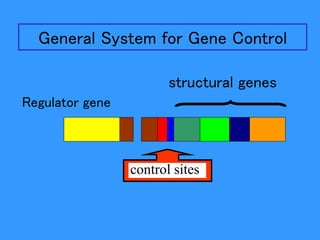
structural genes
control sites
Regulator gene
General System for Gene Control
• In bacteria, genes are clustered into operons
• Operons: gene clusters that encode the proteins
necessary to perform coordinated function, such as
biosynthesis of a given amino acid
• RNA that is transcribed from a prokaryotic operons is
polycistronic - multiple proteins are encoded in a
single transcript
• Transcription initiation is controlled by two DNA
sequence elements that are approximately 35 bases
and 10 bases, resply, upstream of the site of
transcriptional initiation (the -35 and -10 positions)
• These 2 sequence elements are termed promoter
sequences, because they promote recognition of
transcriptional start sites by RNA polymerase
• The consensus sequence for the -35 position is
TTGACA, and for the -10 position, TATAAT. (The -10
position is also known as the Pribnow-box.)
•The activity of RNA polymerase at a given promoter
regulated by interaction with accessory proteins,
which affect its ability to recognize start sites
•These regulatory proteins can act both positively
(activators) and negatively (repressors)
•The operator region is adjacent to the promoter
elements in most operons and the sequences of the
operator bind a repressor protein
• Several operons are present in E. coli that contain
overlapping sequence elements, one that binds a
repressor and one that binds an activator
• Two major modes of transcriptional regulation
function in bacteria (E. coli) to control the expression
of operons
• Catabolite-regulated operons that produce gene
products necessary for the utilization of energy
• Operons that produce gene products necessary for
the synthesis of small biomolecules such as amino
acids. Expression from the latter class of operons is
attenuated by sequences within the transcribed RNA
Lac Operon
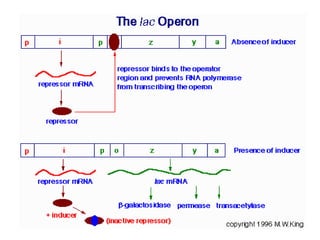
• Consists of one regulatory gene (the i gene) and
three structural genes (z, y, and a)
• The i gene codes for the repressor of the lac operon
•The z gene codes for b-galactosidase (b-gal)
• The y gene codes for permease, which increases
permeability of the cell to b-galactosides
• The a gene encodes a transacetylase
• During normal growth on a glucose-based medium,
the lac repressor is bound to the operator region of the
lac operon, preventing transcription
• In the presence of an inducer, the repressor protein
binds the inducer and is rendered incapable of
interacting with the operator region of the operon
Lac Operon (contd.)
• RNA polymerase is thus able to bind at the promoter
region, and transcription of the operon ensues
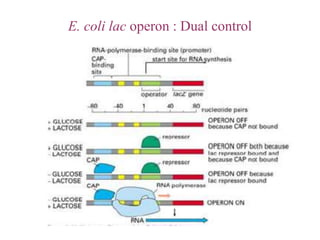
• lac operon is repressed, even in the presence of lactose,
if glucose is also present
• The repression of the lac operon under these conditions
is termed catabolite repression and is a result of the low
levels of cAMP resulting from an adequate glucose
supply
•The repression of the lac operon is relieved in the
presence of glucose if excess cAMP is added
•The ability of cAMP to activate the lac operon results
from an interaction of cAMP with a protein termed CRP
(cAMP receptor protein)
Lac Operon (contd.)
•The protein is also called CAP (for catabolite activator
protein)
•The cAMP-CRP complex binds to a region of the lac
operon just upstream of the region bound by RNA
polymerase which overlaps with that of the repressor
binding site of the operator region
• The binding of the cAMP-CRP complex to the lac
operon stimulates RNA polymerase activity 20-to-50-
fold.
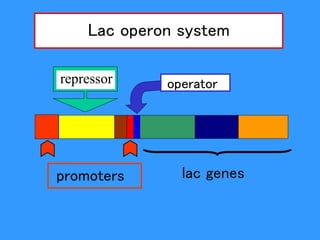
promoters lac genes
repressor operator
Lac operon system
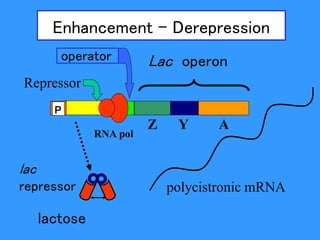
lactose
polycistronic mRNA
Lac operon
operator
Z Y A
Repressor
lac
repressor
Enhancement - Derepression
P P
RNA pol
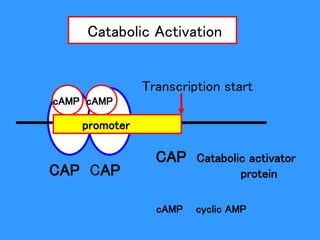
CAP CAP
Transcription start
cAMP cAMP
promoter
Catabolic Activation
CAP Catabolic activator
protein
cAMP cyclic AMP
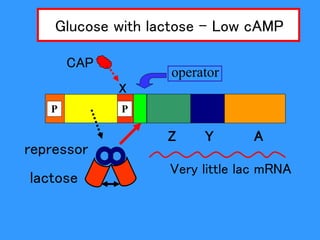
lactose
Glucose with lactose – Low cAMP
repressor
operator
CAP
X
Z Y A
P P
Very little lac mRNA
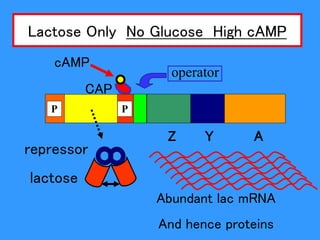
Lactose Only No Glucose High cAMP
lactose
repressor
operator
CAP
Z Y A
P P
cAMP
Abundant lac mRNA
And hence proteins
Gene switches: Prokaryotes
E. coli lac operon : Dual control
Trp Operon
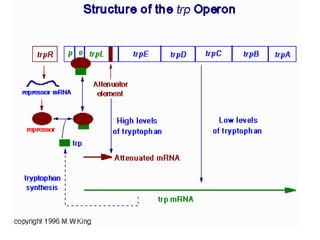
• encodes the genes for the synthesis of tryptophan
•The activity of the trp repressor for binding the operator
region is enhanced when it binds tryptophan; in this
capacity, tryptophan is known as a corepressor
• the rate of expression of the trp operon is graded in
response to the level of tryptophan in the cell
• Expression of the trp operon is also regulated by
attenuation
• The attenuator region is composed of sequences found
within the transcribed RNAand is involved in controlling
transcription from the operon after RNA polymerase has
initiated synthesis
Trp Operon (contd.)
• The attenuator of sequences of the RNA are found near the
5' end of the RNA termed the leader region of the RNA
• The leader sequences are located prior to the start of the
coding region for the first gene of the operon (the trpE gene)
• The attenuator region contains codons for a small leader
polypeptide, that contains tandem tryp codons
• This region of the RNA is also capable of forming several
different stable stem-loop structures
• Depending on the level of tryptophan in the cell---and hence
the level of charged trp-tRNAs---the position of ribosomes on
the leader polypeptide and the rate at which they are
translating allows different stem-loops to form
Trp Operon (contd.)
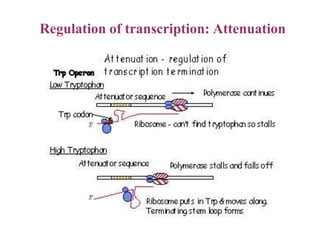
• If tryptophan is abundant, the ribosome prevents
stem-loop 1-2 from forming and thereby favors stem-
loop 3-4
•The latter is found near a region rich in uracil and acts
as the transcriptional terminator loop
Regulation of transcription: Attenuation
Operon
Leader
Length
Sequence
trp 14 MKAIFVLKGWWRTS
pheA 16 MKHIPFFFAFFFTFP
his 16 MTRVQFKHHHHHHHPD
thr 21 MKRISTTITTTITITTQNGAG
leu 28 MSHIVRFTGLLLLNAFIVRGRP
Tryptophan operon in E. coli

Gene regulation operon

  • 1.
  • 2.
    • Regulation ofgene action •Gene action or gene expression refers to the production of the concerned trait or phenotype by gene •In molecular terms it is transcription •Gene regulation at various levels •Gene amplification, destruction or distribution- whether a gene present or not, no. of copies- extrachromosomal copies of rRNA in nucleolous •Transcription •Post transcription •Translation •Post translation
  • 3.
    •Transcription- given geneis transcribed or not in a given cell in a given time •Post transcription- if the mRNA produced is available for translation or not •Translation-mRNA is suitable for regulation or not, regulation is based on ribosomes, tRNA, regulatory proteins, regulatory RNA •Post translation- governs the activity of proteins, protein modification, protein degradation, feed back inhibition
  • 4.
    •Regulation of Transcriptionin prokaryotes •Genes are organized in groups called Operons •Operon concept was proposed by Jacob and Monod in 1961 •Operon consists of a group of structural genes whose transcription is regulated by the same set of genes viz., regulator gene, promoter and operator sequences •Operator sequences generally overlaps Promoter sequence structural genes encode enzymes for biosynthetic or metabolic pathway •Operons are regulated by regulatory proteins that bind to operator sequences and are encoded by regulatory genes
  • 5.
    Promoter – anucleotide sequence that enables a gene to be transcribed. The promoter is recognized by RNA polymerase, which then initiates transcription. In RNA synthesis, promoters indicate which genes should be used for messenger RNA creation – and, by extension, control which proteins the cell produces. Operator – a segment of DNA that a regulator binds to. It is classically defined in the lac operon as a segment between the promoter and the genes of the operon. In the case of a repressor, the repressor protein physically obstructs the RNA polymerase from transcribing the genes. Structural genes – the genes that are co-regulated by the operon and encode enzymes for biosynthetic or metabolic pathway
  • 6.
    •Regulation of Operonsare two types •Positive regulation •Negative regulation •In case of positive control binding of regulatory proteins (Activators) to the operator is necessary for transcription •In case of negative control binding of regulatory proteins (Repressors) to the operator inhibits transcription •Negative regulation is common in prokaryotes and lower eukaryotes •Positive regulation is common in higher eukaryotes
  • 7.
    •Transcription can beregulated by •Attenuation (trp, thr, his Operons)- regulates in response to the availability of specific aminoacids- Tryptophan in case of trp operon- if the concerned aa is available translation continues and transcription is blocked • Anti termination- RNA pol will not recognize terminator seq because of association with antiterminator proteins •Modification of RNA pol: Effected by certain proteins •Sigma factor is most important •Sigma H specifies heat shock genes •Sigma F specifies flagellar structure & chemotaxis genes
  • 8.
    •Negative control •Binding ofregulator protein (repressor) to the O seq stops transcription •When repressor binds to O, RNA pol binds to the promoter so strongly that it is unable to leave the P to carry on transcription •But when repressor leaves O, the enzyme immediately initiates transcription •Negative control again two types •Inducible Operons •Repressible Operons
  • 9.
    structural genes control sites Regulatorgene General System for Gene Control
  • 10.
    • In bacteria,genes are clustered into operons • Operons: gene clusters that encode the proteins necessary to perform coordinated function, such as biosynthesis of a given amino acid • RNA that is transcribed from a prokaryotic operons is polycistronic - multiple proteins are encoded in a single transcript • Transcription initiation is controlled by two DNA sequence elements that are approximately 35 bases and 10 bases, resply, upstream of the site of transcriptional initiation (the -35 and -10 positions) • These 2 sequence elements are termed promoter sequences, because they promote recognition of transcriptional start sites by RNA polymerase
  • 11.
    • The consensussequence for the -35 position is TTGACA, and for the -10 position, TATAAT. (The -10 position is also known as the Pribnow-box.) •The activity of RNA polymerase at a given promoter regulated by interaction with accessory proteins, which affect its ability to recognize start sites •These regulatory proteins can act both positively (activators) and negatively (repressors) •The operator region is adjacent to the promoter elements in most operons and the sequences of the operator bind a repressor protein • Several operons are present in E. coli that contain overlapping sequence elements, one that binds a repressor and one that binds an activator
  • 12.
    • Two majormodes of transcriptional regulation function in bacteria (E. coli) to control the expression of operons • Catabolite-regulated operons that produce gene products necessary for the utilization of energy • Operons that produce gene products necessary for the synthesis of small biomolecules such as amino acids. Expression from the latter class of operons is attenuated by sequences within the transcribed RNA
  • 13.
    Lac Operon • Consistsof one regulatory gene (the i gene) and three structural genes (z, y, and a) • The i gene codes for the repressor of the lac operon •The z gene codes for b-galactosidase (b-gal) • The y gene codes for permease, which increases permeability of the cell to b-galactosides • The a gene encodes a transacetylase • During normal growth on a glucose-based medium, the lac repressor is bound to the operator region of the lac operon, preventing transcription • In the presence of an inducer, the repressor protein binds the inducer and is rendered incapable of interacting with the operator region of the operon
  • 14.
    Lac Operon (contd.) •RNA polymerase is thus able to bind at the promoter region, and transcription of the operon ensues • lac operon is repressed, even in the presence of lactose, if glucose is also present • The repression of the lac operon under these conditions is termed catabolite repression and is a result of the low levels of cAMP resulting from an adequate glucose supply •The repression of the lac operon is relieved in the presence of glucose if excess cAMP is added •The ability of cAMP to activate the lac operon results from an interaction of cAMP with a protein termed CRP (cAMP receptor protein)
  • 15.
    Lac Operon (contd.) •Theprotein is also called CAP (for catabolite activator protein) •The cAMP-CRP complex binds to a region of the lac operon just upstream of the region bound by RNA polymerase which overlaps with that of the repressor binding site of the operator region • The binding of the cAMP-CRP complex to the lac operon stimulates RNA polymerase activity 20-to-50- fold.
  • 17.
    promoters lac genes repressoroperator Lac operon system
  • 18.
    lactose polycistronic mRNA Lac operon operator ZY A Repressor lac repressor Enhancement - Derepression P P RNA pol
  • 19.
    CAP CAP Transcription start cAMPcAMP promoter Catabolic Activation CAP Catabolic activator protein cAMP cyclic AMP
  • 20.
    lactose Glucose with lactose– Low cAMP repressor operator CAP X Z Y A P P Very little lac mRNA
  • 21.
    Lactose Only NoGlucose High cAMP lactose repressor operator CAP Z Y A P P cAMP Abundant lac mRNA And hence proteins
  • 22.
  • 23.
    E. coli lacoperon : Dual control
  • 24.
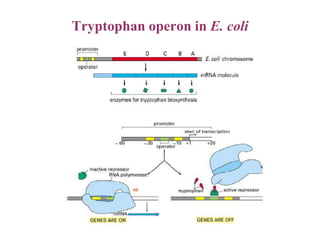
    Trp Operon • encodesthe genes for the synthesis of tryptophan •The activity of the trp repressor for binding the operator region is enhanced when it binds tryptophan; in this capacity, tryptophan is known as a corepressor • the rate of expression of the trp operon is graded in response to the level of tryptophan in the cell • Expression of the trp operon is also regulated by attenuation • The attenuator region is composed of sequences found within the transcribed RNAand is involved in controlling transcription from the operon after RNA polymerase has initiated synthesis
  • 25.
    Trp Operon (contd.) •The attenuator of sequences of the RNA are found near the 5' end of the RNA termed the leader region of the RNA • The leader sequences are located prior to the start of the coding region for the first gene of the operon (the trpE gene) • The attenuator region contains codons for a small leader polypeptide, that contains tandem tryp codons • This region of the RNA is also capable of forming several different stable stem-loop structures • Depending on the level of tryptophan in the cell---and hence the level of charged trp-tRNAs---the position of ribosomes on the leader polypeptide and the rate at which they are translating allows different stem-loops to form
  • 26.
    Trp Operon (contd.) •If tryptophan is abundant, the ribosome prevents stem-loop 1-2 from forming and thereby favors stem- loop 3-4 •The latter is found near a region rich in uracil and acts as the transcriptional terminator loop
  • 28.
  • 31.
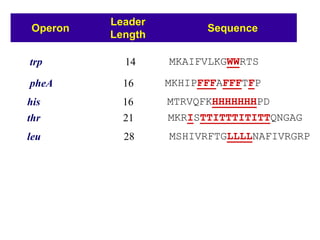
    Operon Leader Length Sequence trp 14 MKAIFVLKGWWRTS pheA16 MKHIPFFFAFFFTFP his 16 MTRVQFKHHHHHHHPD thr 21 MKRISTTITTTITITTQNGAG leu 28 MSHIVRFTGLLLLNAFIVRGRP
  • 32.