Dr Neethu Asokan
 Regulation of gene expression, or gene
regulation, includes a wide range of
mechanisms that are used by cells to increase
or decrease the production of specific gene
products.
 Gene regulation is the process of turning
genes on and off.
 Gene regulation ensures that the appropriate
genes are expressed at the proper times.
Gene regulation can also help an organism
respond to its environment.
Dr Neethu Asokan
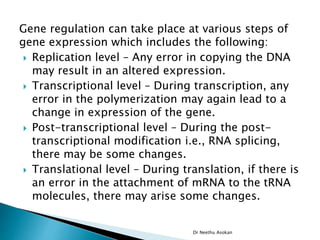
Gene regulation can take place at various steps of
gene expression which includes the following:
 Replication level – Any error in copying the DNA
may result in an altered expression.
 Transcriptional level – During transcription, any
error in the polymerization may again lead to a
change in expression of the gene.
 Post-transcriptional level – During the post-
transcriptional modification i.e., RNA splicing,
there may be some changes.
 Translational level – During translation, if there is
an error in the attachment of mRNA to the tRNA
molecules, there may arise some changes.
Dr Neethu Asokan
 Operon, genetic regulatory system found in
bacteria and their viruses in which genes
coding for functionally related proteins are
clustered along the DNA.
 This feature allows protein synthesis to be
controlled coordinately in response to the
needs of the cell.
 By providing the means to produce proteins
only when and where they are required, the
operon allows the cell to conserve energy.
Dr Neethu Asokan
 The regulation usually takes place in the
expression of the RNA polymerase at the
promoter site. This affects the accessory
proteins which bind to the recognition sites.
These accessory proteins can regulate the
promoter site in two ways:
◦ Positive regulation by activators
◦ Negative regulation by repressors
Dr Neethu Asokan
 Two regulatory proteins communicate these
signals with the genes:
◦ Positive regulators (activators): Activator increases
transcription of the regulated genes. In lac operon,
activator ( called CAP) acts as a glucose sensor. It
activates the transcription of the operon when
glucose is absent/low.
◦ Negative regulators (repressor): Repressor
decreases or eliminates transcription of genes. In
lac operon, repressor acts as a lactose sensor.
Dr Neethu Asokan
 The lactose or lac operon of Escherichia coli
is a cluster of three structural genes encoding
proteins involved in lactose metabolism and
the sites on the DNA involved in the
regulation of the operon.
 It was Jacob and Monod in 1961 who
proposed the operon model for the regulation
of transcription.
Dr Neethu Asokan
The lac operon consists of:
 Regulatory gene i – It codes for the repressor
protein.
 z gene – It codes for beta-galactosidase which
catalyzes the hydrolysis of lactose into glucose
and galactose.
 y gene – It codes for permease which regulates
the lactose permeability in the cell.
 a gene – It codes for transacetylase which assists
the enzyme beta-galactosidase.
 Hence, all these genes help in lactose
metabolism. In lac operon, lactose acts as an
inducer. If lactose is provided in the medium for
the bacteria, the regulatory gene is activated.
Dr Neethu Asokan
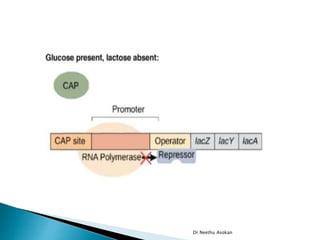
 When lactose is absent
The lac repressor senses the presence of
lactose (more precisely allolactose-an isomer of
lactose) in the medium. In the absence of
allolactose (A) the repressor protein (R) binds to
the operator region (O) and blocks the RNA
polymerase from transcribing the structural
genes.
Dr Neethu Asokan
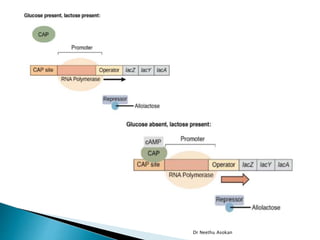
 When lactose is present
◦ When lactose is present in a medium, some of it will be
converted to allolactose. This allolactose binds to the
repressor protein.
◦ Binding of allolactose with repressor protein changes the
shape of repressor protein so it can no longer binds to
the operator region.
◦ This allows the RNA polymerase to bind to the promoter
site, starting the initiation of transcription of the
structural genes lacZ, lacY, and lacA to produce mRNA.
◦ Once the mRNA is produced, it is translated to produce
enzymes.
◦ The lacZ gene encodes for the production of the
enzyme β-galactosidase (B), lacY gene for the
production of the enzyme permease (P) and the lacA
gene is responsible for the production of the enzyme
thiogalactoside transacetylase.
Dr Neethu Asokan
 When glucose levels are high
 When glucose levels are high, no cAMP is
made, the CAP–cAMP complex does not form.
CAP cannot bind DNA without cAMP and RNA
polymerase cannot bind to the promoter
efficiently. In this case, transcription occurs
only at a low level.

Dr Neethu Asokan
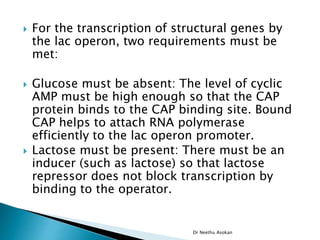
 For the transcription of structural genes by
the lac operon, two requirements must be
met:
 Glucose must be absent: The level of cyclic
AMP must be high enough so that the CAP
protein binds to the CAP binding site. Bound
CAP helps to attach RNA polymerase
efficiently to the lac operon promoter.
 Lactose must be present: There must be an
inducer (such as lactose) so that lactose
repressor does not block transcription by
binding to the operator.
Dr Neethu Asokan
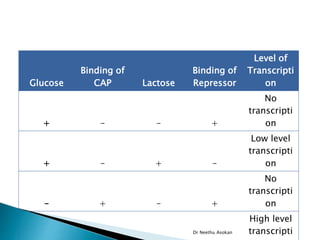
Glucose
Binding of
CAP Lactose
Binding of
Repressor
Level of
Transcripti
on
+ – – +
No
transcripti
on
+ – + –
Low level
transcripti
on
– + – +
No
transcripti
on
High level
transcripti
Dr Neethu Asokan
Dr Neethu Asokan
Dr Neethu Asokan
Dr Neethu Asokan

Gene regulation

  • 1.
  • 2.
     Regulation ofgene expression, or gene regulation, includes a wide range of mechanisms that are used by cells to increase or decrease the production of specific gene products.  Gene regulation is the process of turning genes on and off.  Gene regulation ensures that the appropriate genes are expressed at the proper times. Gene regulation can also help an organism respond to its environment. Dr Neethu Asokan
  • 3.
    Gene regulation cantake place at various steps of gene expression which includes the following:  Replication level – Any error in copying the DNA may result in an altered expression.  Transcriptional level – During transcription, any error in the polymerization may again lead to a change in expression of the gene.  Post-transcriptional level – During the post- transcriptional modification i.e., RNA splicing, there may be some changes.  Translational level – During translation, if there is an error in the attachment of mRNA to the tRNA molecules, there may arise some changes. Dr Neethu Asokan
  • 4.
     Operon, geneticregulatory system found in bacteria and their viruses in which genes coding for functionally related proteins are clustered along the DNA.  This feature allows protein synthesis to be controlled coordinately in response to the needs of the cell.  By providing the means to produce proteins only when and where they are required, the operon allows the cell to conserve energy. Dr Neethu Asokan
  • 5.
     The regulationusually takes place in the expression of the RNA polymerase at the promoter site. This affects the accessory proteins which bind to the recognition sites. These accessory proteins can regulate the promoter site in two ways: ◦ Positive regulation by activators ◦ Negative regulation by repressors Dr Neethu Asokan
  • 6.
     Two regulatoryproteins communicate these signals with the genes: ◦ Positive regulators (activators): Activator increases transcription of the regulated genes. In lac operon, activator ( called CAP) acts as a glucose sensor. It activates the transcription of the operon when glucose is absent/low. ◦ Negative regulators (repressor): Repressor decreases or eliminates transcription of genes. In lac operon, repressor acts as a lactose sensor. Dr Neethu Asokan
  • 7.
     The lactoseor lac operon of Escherichia coli is a cluster of three structural genes encoding proteins involved in lactose metabolism and the sites on the DNA involved in the regulation of the operon.  It was Jacob and Monod in 1961 who proposed the operon model for the regulation of transcription. Dr Neethu Asokan
  • 8.
    The lac operonconsists of:  Regulatory gene i – It codes for the repressor protein.  z gene – It codes for beta-galactosidase which catalyzes the hydrolysis of lactose into glucose and galactose.  y gene – It codes for permease which regulates the lactose permeability in the cell.  a gene – It codes for transacetylase which assists the enzyme beta-galactosidase.  Hence, all these genes help in lactose metabolism. In lac operon, lactose acts as an inducer. If lactose is provided in the medium for the bacteria, the regulatory gene is activated. Dr Neethu Asokan
  • 9.
     When lactoseis absent The lac repressor senses the presence of lactose (more precisely allolactose-an isomer of lactose) in the medium. In the absence of allolactose (A) the repressor protein (R) binds to the operator region (O) and blocks the RNA polymerase from transcribing the structural genes. Dr Neethu Asokan
  • 10.
     When lactoseis present ◦ When lactose is present in a medium, some of it will be converted to allolactose. This allolactose binds to the repressor protein. ◦ Binding of allolactose with repressor protein changes the shape of repressor protein so it can no longer binds to the operator region. ◦ This allows the RNA polymerase to bind to the promoter site, starting the initiation of transcription of the structural genes lacZ, lacY, and lacA to produce mRNA. ◦ Once the mRNA is produced, it is translated to produce enzymes. ◦ The lacZ gene encodes for the production of the enzyme β-galactosidase (B), lacY gene for the production of the enzyme permease (P) and the lacA gene is responsible for the production of the enzyme thiogalactoside transacetylase. Dr Neethu Asokan
  • 11.
     When glucoselevels are high  When glucose levels are high, no cAMP is made, the CAP–cAMP complex does not form. CAP cannot bind DNA without cAMP and RNA polymerase cannot bind to the promoter efficiently. In this case, transcription occurs only at a low level.  Dr Neethu Asokan
  • 12.
     For thetranscription of structural genes by the lac operon, two requirements must be met:  Glucose must be absent: The level of cyclic AMP must be high enough so that the CAP protein binds to the CAP binding site. Bound CAP helps to attach RNA polymerase efficiently to the lac operon promoter.  Lactose must be present: There must be an inducer (such as lactose) so that lactose repressor does not block transcription by binding to the operator. Dr Neethu Asokan
  • 13.
    Glucose Binding of CAP Lactose Bindingof Repressor Level of Transcripti on + – – + No transcripti on + – + – Low level transcripti on – + – + No transcripti on High level transcripti Dr Neethu Asokan
  • 14.
  • 15.
  • 16.