CAMPBELL BIOLOGY IN FOCUS
© 2014 Pearson Education, Inc.
Urry • Cain • Wasserman • Minorsky • Jackson • Reece
Lecture Presentations by
Kathleen Fitzpatrick and Nicole Tunbridge
15
Regulation of
Gene Expression
© 2014 Pearson Education, Inc.
Overview: Differential Expression of Genes
 Prokaryotes and eukaryotes alter gene expression
in response to their changing environment
 Multicellular eukaryotes also develop and maintain
multiple cell types
 Gene expression is often regulated at the
transcription stage, but control at other stages is
important, too
© 2014 Pearson Education, Inc.
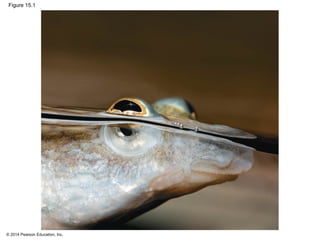
Figure 15.1
© 2014 Pearson Education, Inc.
Concept 15.1: Bacteria often respond to
environmental change by regulating
transcription
 Natural selection has favored bacteria that produce
only the gene products needed by the cell
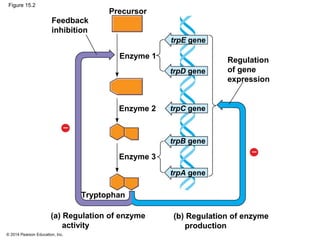
 A cell can regulate the production of enzymes by
feedback inhibition or by gene regulation
 Gene expression in bacteria is controlled by a
mechanism described as the operon model
© 2014 Pearson Education, Inc.
Figure 15.2
Regulation
of gene
expression
Precursor
trpE gene
(a) Regulation of enzyme
activity
Feedback
inhibition
Enzyme 1
Enzyme 2
Enzyme 3
Tryptophan
(b) Regulation of enzyme
production
trpD gene
trpC gene
trpB gene
trpA gene
© 2014 Pearson Education, Inc.
Operons: The Basic Concept
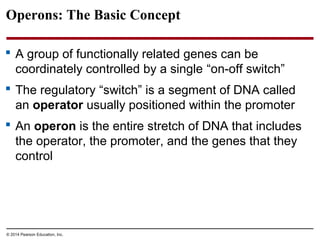
 A group of functionally related genes can be
coordinately controlled by a single “on-off switch”
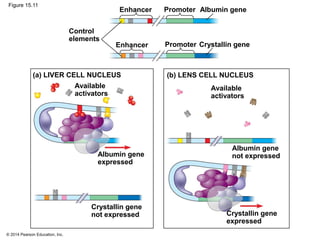
 The regulatory “switch” is a segment of DNA called
an operator usually positioned within the promoter
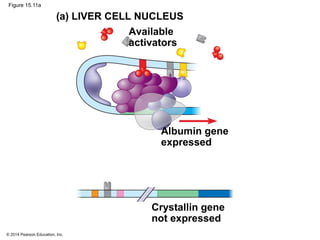
 An operon is the entire stretch of DNA that includes
the operator, the promoter, and the genes that they
control
© 2014 Pearson Education, Inc.
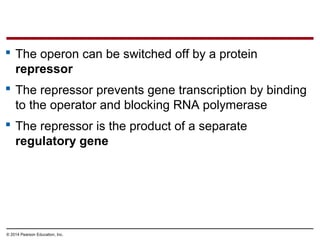
 The operon can be switched off by a protein
repressor
 The repressor prevents gene transcription by binding
to the operator and blocking RNA polymerase
 The repressor is the product of a separate
regulatory gene
© 2014 Pearson Education, Inc.
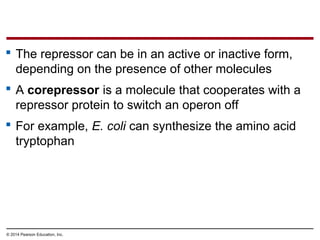
 The repressor can be in an active or inactive form,
depending on the presence of other molecules
 A corepressor is a molecule that cooperates with a
repressor protein to switch an operon off
 For example, E. coli can synthesize the amino acid
tryptophan
© 2014 Pearson Education, Inc.
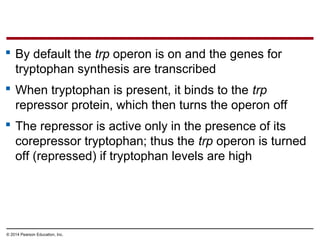
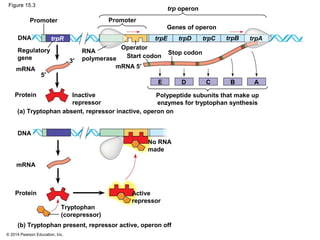
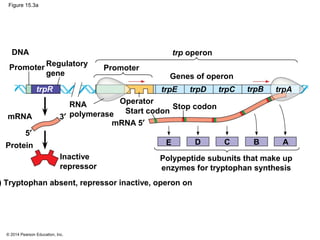
 By default the trp operon is on and the genes for
tryptophan synthesis are transcribed
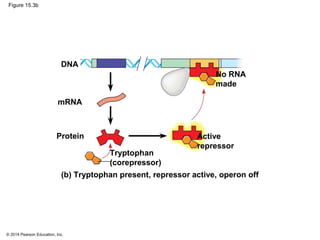
 When tryptophan is present, it binds to the trp
repressor protein, which then turns the operon off
 The repressor is active only in the presence of its
corepressor tryptophan; thus the trp operon is turned
off (repressed) if tryptophan levels are high
© 2014 Pearson Education, Inc.
Figure 15.3
Promoter Promoter
trp operon
Genes of operon
DNA
Regulatory
gene
mRNA
Protein
RNA
polymerase
Inactive
repressor
Operator
Start codon
Stop codon
mRNA 5′
trpE trpD trpC trpB trpA
E D C B A
(a) Tryptophan absent, repressor inactive, operon on
DNA
mRNA
Protein Active
repressor
No RNA
made
Tryptophan
(corepressor)
(b) Tryptophan present, repressor active, operon off
Polypeptide subunits that make up
enzymes for tryptophan synthesis
5′
3′
trpR
© 2014 Pearson Education, Inc.
Figure 15.3a
) Tryptophan absent, repressor inactive, operon on
Polypeptide subunits that make up
enzymes for tryptophan synthesis
Protein
Inactive
repressor
mRNA
5′
3′
E D C B A
Promoter
DNA
Regulatory
gene
RNA
polymerase
Promoter
trp operon
Genes of operon
Operator
Start codon
Stop codon
mRNA 5′
trpE trpD trpC trpB trpAtrpR
© 2014 Pearson Education, Inc.
Figure 15.3b
DNA
mRNA
Protein Active
repressor
No RNA
made
Tryptophan
(corepressor)
(b) Tryptophan present, repressor active, operon off
© 2014 Pearson Education, Inc.
Repressible and Inducible Operons: Two Types
of Negative Gene Regulation
 A repressible operon is one that is usually on;
binding of a repressor to the operator shuts off
transcription
 The trp operon is a repressible operon
 An inducible operon is one that is usually off; a
molecule called an inducer inactivates the repressor
and turns on transcription
© 2014 Pearson Education, Inc.
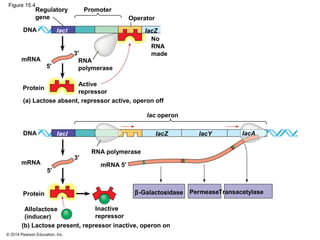
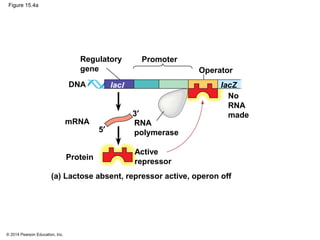
 The lac operon is an inducible operon and contains
genes that code for enzymes used in the hydrolysis
and metabolism of lactose
 By itself, the lac repressor is active and switches the
lac operon off
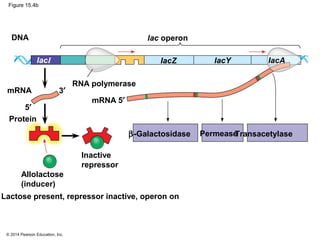
 A molecule called an inducer inactivates the
repressor to turn the lac operon on
© 2014 Pearson Education, Inc.
 For the lac operon, the inducer is allolactose, formed
from lactose that enters the cell
 Enzymes of the lactose pathway are called inducible
enzymes
 Analogously, the enzymes for tryptophan synthesis
are said to be repressible enzymes
Video: lac Repressor Model
© 2014 Pearson Education, Inc.
Figure 15.4
DNA
mRNA
Promoter
Operator
Regulatory
gene
No
RNA
made
RNA
polymerase
3′
5′
IacZ
Active
repressor
Protein
(a) Lactose absent, repressor active, operon off
IacZ IacY IacAIacIDNA
mRNA
Protein
RNA polymerase
Inactive
repressor
Allolactose
(inducer)
(b) Lactose present, repressor inactive, operon on
mRNA 5′
3′
5′
lac operon
lacI
PermeaseTransacetylaseβ-Galactosidase
© 2014 Pearson Education, Inc.
Figure 15.4a
DNA
Promoter
Operator
Regulatory
gene
No
RNA
made
IacZlacI
mRNA RNA
polymerase
3′
5′
Active
repressor
Protein
(a) Lactose absent, repressor active, operon off
© 2014 Pearson Education, Inc.
Figure 15.4b
IacZ IacY IacAIacI
DNA lac operon
PermeaseTransacetylaseβ-Galactosidase
mRNA
Protein
RNA polymerase
mRNA 5′
3′
5′
Inactive
repressor
Allolactose
(inducer)
Lactose present, repressor inactive, operon on
© 2014 Pearson Education, Inc.
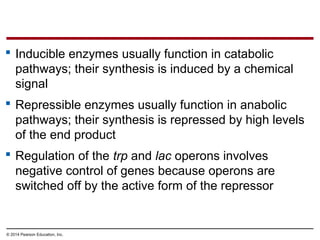
 Inducible enzymes usually function in catabolic
pathways; their synthesis is induced by a chemical
signal
 Repressible enzymes usually function in anabolic
pathways; their synthesis is repressed by high levels
of the end product
 Regulation of the trp and lac operons involves
negative control of genes because operons are
switched off by the active form of the repressor
© 2014 Pearson Education, Inc.
Positive Gene Regulation
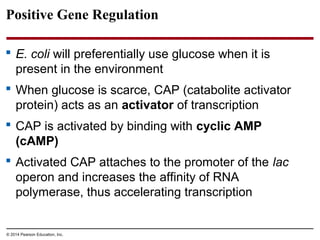
 E. coli will preferentially use glucose when it is
present in the environment
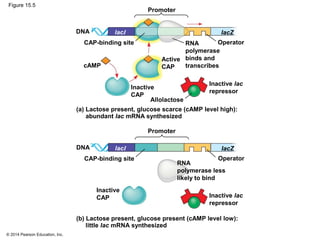
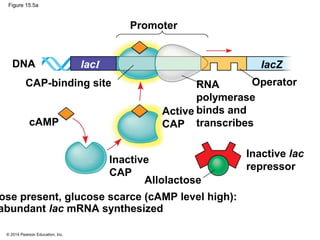
 When glucose is scarce, CAP (catabolite activator
protein) acts as an activator of transcription
 CAP is activated by binding with cyclic AMP
(cAMP)
 Activated CAP attaches to the promoter of the lac
operon and increases the affinity of RNA
polymerase, thus accelerating transcription
© 2014 Pearson Education, Inc.
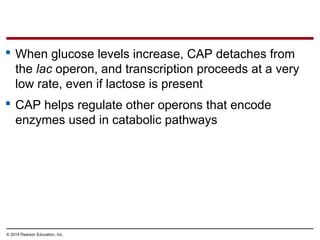
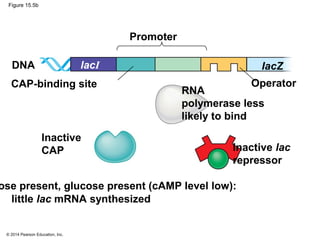
 When glucose levels increase, CAP detaches from
the lac operon, and transcription proceeds at a very
low rate, even if lactose is present
 CAP helps regulate other operons that encode
enzymes used in catabolic pathways
© 2014 Pearson Education, Inc.
Figure 15.5
DNA
Promoter
Operator
IacZlacI
CAP-binding site
cAMP
Inactive
CAP
Active
CAP
RNA
polymerase
binds and
transcribes
Allolactose
Inactive lac
repressor
(a) Lactose present, glucose scarce (cAMP level high):
Promoter
abundant lac mRNA synthesized
DNA
Operator
IacZlacI
CAP-binding site
RNA
polymerase less
likely to bind
(b) Lactose present, glucose present (cAMP level low):
little lac mRNA synthesized
Inactive
CAP
Inactive lac
repressor
© 2014 Pearson Education, Inc.
Figure 15.5a
DNA
Promoter
IacZlacI
OperatorRNA
polymerase
binds and
transcribes
Active
CAP
Inactive
CAP
Allolactose
Inactive lac
repressor
CAP-binding site
cAMP
ose present, glucose scarce (cAMP level high):
abundant lac mRNA synthesized
© 2014 Pearson Education, Inc.
Figure 15.5b
Promoter
DNA
Operator
IacZlacI
CAP-binding site
Inactive
CAP Inactive lac
repressor
RNA
polymerase less
likely to bind
little lac mRNA synthesized
ose present, glucose present (cAMP level low):
© 2014 Pearson Education, Inc.
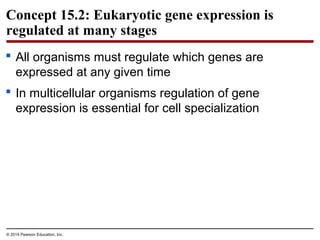
Concept 15.2: Eukaryotic gene expression is
regulated at many stages
 All organisms must regulate which genes are
expressed at any given time
 In multicellular organisms regulation of gene
expression is essential for cell specialization
© 2014 Pearson Education, Inc.
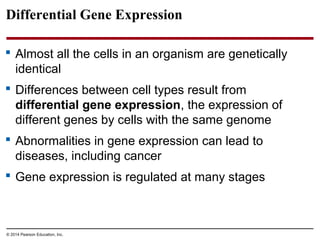
Differential Gene Expression
 Almost all the cells in an organism are genetically
identical
 Differences between cell types result from
differential gene expression, the expression of
different genes by cells with the same genome
 Abnormalities in gene expression can lead to
diseases, including cancer
 Gene expression is regulated at many stages
© 2014 Pearson Education, Inc.
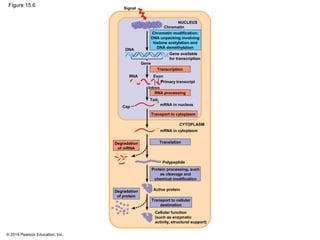
Figure 15.6 Signal
NUCLEUS
Chromatin
Chromatin modification:
DNA unpacking involving
histone acetylation and
DNA demethylation
DNA
Gene
RNA Exon
Gene available
for transcription
Transcription
Primary transcript
Intron
RNA processing
Tail
mRNA in nucleus
Transport to cytoplasm
CYTOPLASM
mRNA in cytoplasm
TranslationDegradation
of mRNA
Polypeptide
Cap
Protein processing, such
as cleavage and
chemical modification
Active protein
Transport to cellular
destination
Degradation
of protein
Cellular function
(such as enzymatic
activity, structural support)
© 2014 Pearson Education, Inc.
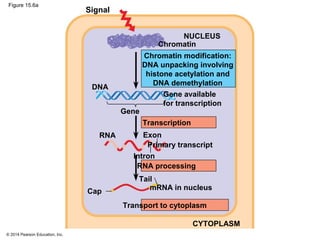
Figure 15.6a
Signal
NUCLEUS
Chromatin
Chromatin modification:
DNA unpacking involving
histone acetylation and
DNA demethylation
DNA
Gene
RNA Exon
Gene available
for transcription
Transcription
Primary transcript
Intron
RNA processing
Tail
mRNA in nucleus
Transport to cytoplasm
Cap
CYTOPLASM
© 2014 Pearson Education, Inc.
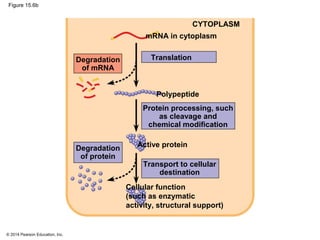
Figure 15.6b
CYTOPLASM
mRNA in cytoplasm
TranslationDegradation
of mRNA
Polypeptide
Protein processing, such
as cleavage and
chemical modification
Active protein
Transport to cellular
destination
Degradation
of protein
Cellular function
(such as enzymatic
activity, structural support)
© 2014 Pearson Education, Inc.
 In all organisms, a common control point for gene
expression is at transcription
 The greater complexity of eukaryotic cell structure
and function provides opportunities for regulating
gene expression at many additional stages
© 2014 Pearson Education, Inc.
Regulation of Chromatin Structure
 The structural organization of chromatin packs DNA
into a compact form and also helps regulate gene
expression in several ways
 The location of a gene promoter relative to
nucleosomes and scaffold or lamina attachment
sites can influence gene transcription
© 2014 Pearson Education, Inc.
 Genes within highly condensed heterochromatin are
usually not expressed
 Chemical modifications to histone proteins and DNA
can influence chromatin structure and gene
expression
© 2014 Pearson Education, Inc.
Histone Modifications and DNA Methylation
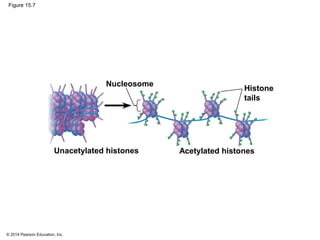
 In histone acetylation, acetyl groups are attached
to positively charged lysines in histone tails
 This generally loosens chromatin structure,
promoting the initiation of transcription
 The addition of methyl groups (methylation) can
condense chromatin and lead to reduced
transcription
© 2014 Pearson Education, Inc.
Figure 15.7
Nucleosome
Unacetylated histones Acetylated histones
Histone
tails
© 2014 Pearson Education, Inc.
 DNA methylation is the addition of methyl groups to
certain bases in DNA, usually cytosine
 Individual genes are usually more heavily
methylated in cells where they are not expressed
 Once methylated, genes usually remain so through
successive cell divisions
 After replication, enzymes methylate the correct
daughter strand so that the methylation pattern is
inherited
© 2014 Pearson Education, Inc.
Epigenetic Inheritance
 Though chromatin modifications do not alter DNA
sequence, they may be passed to future
generations of cells
 The inheritance of traits transmitted by mechanisms
not directly involving the nucleotide sequence is
called epigenetic inheritance
 Epigenetic modifications can be reversed, unlike
mutations in DNA sequence
© 2014 Pearson Education, Inc.
Regulation of Transcription Initiation
 Chromatin-modifying enzymes provide initial control
of gene expression by making a region of DNA
either more or less able to bind the transcription
machinery
© 2014 Pearson Education, Inc.
Organization of a Typical Eukaryotic Gene
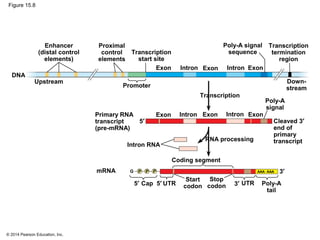
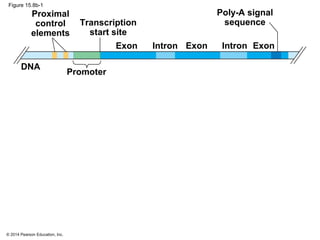
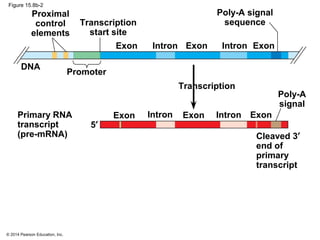
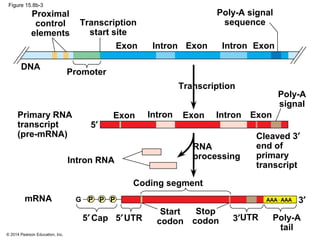
 Associated with most eukaryotic genes are multiple
control elements, segments of noncoding DNA that
serve as binding sites for transcription factors that
help regulate transcription
 Control elements and the transcription factors they
bind are critical for the precise regulation of gene
expression in different cell types
Animation: mRNA Degradation
© 2014 Pearson Education, Inc.
Figure 15.8
DNA
Upstream
Enhancer
(distal control
elements)
Proximal
control
elements
Transcription
start site
Exon Intron Exon
Promoter
Intron Exon
Poly-A signal
sequence
Transcription
termination
region
Down-
stream
Transcription
Exon Intron IntronExon Exon
Poly-A
signal
Primary RNA
transcript
(pre-mRNA)
5′ Cleaved 3′
end of
primary
transcript
Intron RNA
mRNA
RNA processing
Coding segment
3′
5′ 5′ 3′Cap UTR
Start
codon
Stop
codon UTR Poly-A
tail
G P P P AAA…
AAA
© 2014 Pearson Education, Inc.
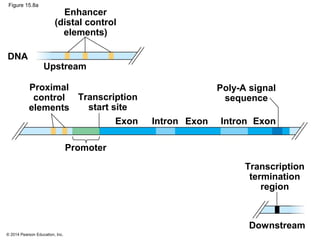
Figure 15.8a
DNA
Upstream
Enhancer
(distal control
elements)
Proximal
control
elements
Transcription
start site
Exon Intron Exon
Promoter
Intron Exon
Poly-A signal
sequence
Transcription
termination
region
Downstream
© 2014 Pearson Education, Inc.
Figure 15.8b-1
Proximal
control
elements
Transcription
start site
Exon Intron Exon
Promoter
Intron Exon
Poly-A signal
sequence
DNA
© 2014 Pearson Education, Inc.
Figure 15.8b-2
Proximal
control
elements
Transcription
start site
Promoter
Poly-A signal
sequence
DNA
Transcription
Exon Intron IntronExon Exon
Poly-A
signal
Primary RNA
transcript
(pre-mRNA)
5′
Cleaved 3′
end of
primary
transcript
Exon Intron Exon Intron Exon
© 2014 Pearson Education, Inc.
Figure 15.8b-3
Proximal
control
elements
Transcription
start site
Promoter
Poly-A signal
sequence
DNA
Transcription
Exon Intron IntronExon Exon
Poly-A
signal
Primary RNA
transcript
(pre-mRNA)
5′
Cleaved 3′
end of
primary
transcript
Intron RNA
mRNA
RNA
processing
Coding segment
3′
5′ 5′ 3′Cap UTR
Start
codon
Stop
codon UTR Poly-A
tail
G P P P AAA…
AAA
Exon Intron Exon Intron Exon
© 2014 Pearson Education, Inc.
The Roles of Transcription Factors
 To initiate transcription, eukaryotic RNA polymerase
requires the assistance of proteins called
transcription factors
 General transcription factors are essential for the
transcription of all protein-coding genes
 In eukaryotes, high levels of transcription of
particular genes depend on interaction between
control elements and specific transcription factors
© 2014 Pearson Education, Inc.
 Proximal control elements are located close to the
promoter
 Distal control elements, groupings of which are
called enhancers, may be far away from a gene or
even located in an intron
Enhancers and Specific Transcription Factors
© 2014 Pearson Education, Inc.
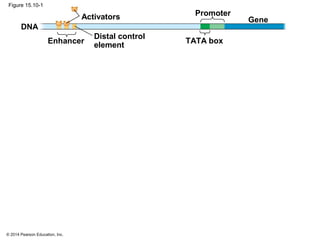
 An activator is a protein that binds to an enhancer
and stimulates transcription of a gene
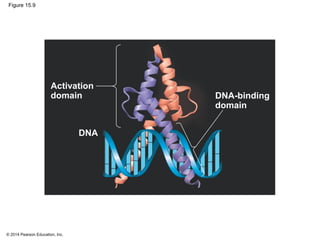
 Activators have two domains, one that binds DNA
and a second that activates transcription
 Bound activators facilitate a sequence of protein-
protein interactions that result in transcription of a
given gene
© 2014 Pearson Education, Inc.
Figure 15.9
Activation
domain
DNA
DNA-binding
domain
© 2014 Pearson Education, Inc.
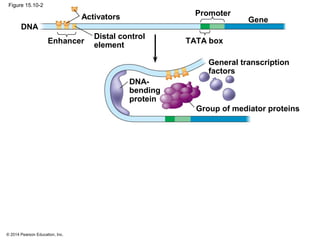
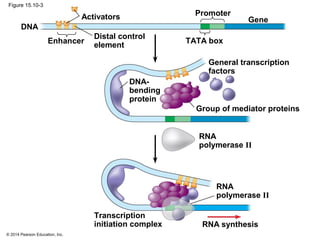
 Bound activators are brought into contact with a
group of mediator proteins through DNA bending
 The mediator proteins in turn interact with proteins
at the promoter
 These protein-protein interactions help to assemble
and position the initiation complex on the promoter
Animation: Transcription Initiation
© 2014 Pearson Education, Inc.
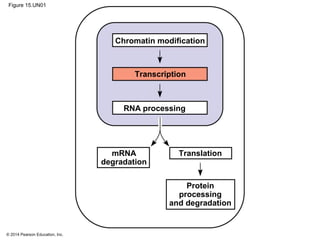
Figure 15.UN01
Chromatin modification
Transcription
RNA processing
TranslationmRNA
degradation
Protein
processing
and degradation
© 2014 Pearson Education, Inc.
Figure 15.10-1
DNA
Enhancer
Distal control
element
Activators Promoter
Gene
TATA box
© 2014 Pearson Education, Inc.
Figure 15.10-2
DNA
Enhancer
Distal control
element
Activators Promoter
Gene
TATA box
DNA-
bending
protein
Group of mediator proteins
General transcription
factors
© 2014 Pearson Education, Inc.
Figure 15.10-3
DNA
Enhancer
Distal control
element
Activators Promoter
Gene
TATA box
DNA-
bending
protein
Group of mediator proteins
General transcription
factors
RNA
polymerase II
RNA
polymerase II
RNA synthesis
Transcription
initiation complex
© 2014 Pearson Education, Inc.
 Some transcription factors function as repressors,
inhibiting expression of a particular gene by a
variety of methods
 Some activators and repressors act indirectly by
influencing chromatin structure to promote or
silence transcription
© 2014 Pearson Education, Inc.
 A particular combination of control elements can
activate transcription only when the appropriate
activator proteins are present
Combinatorial Control of Gene Activation
© 2014 Pearson Education, Inc.
Figure 15.11
Albumin gene
Crystallin gene
Promoter
Promoter
(b) LENS CELL NUCLEUS
Available
activators
Albumin gene
not expressed
Crystallin gene
expressed
Crystallin gene
not expressed
Albumin gene
expressed
Available
activators
(a) LIVER CELL NUCLEUS
Control
elements
Enhancer
Enhancer
© 2014 Pearson Education, Inc.
Figure 15.11a
Crystallin gene
not expressed
Albumin gene
expressed
Available
activators
(a) LIVER CELL NUCLEUS
© 2014 Pearson Education, Inc.
Figure 15.11b
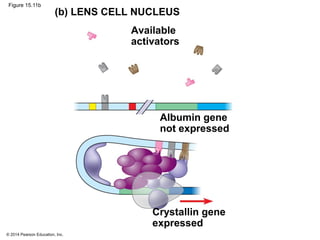
(b) LENS CELL NUCLEUS
Available
activators
Albumin gene
not expressed
Crystallin gene
expressed
© 2014 Pearson Education, Inc.
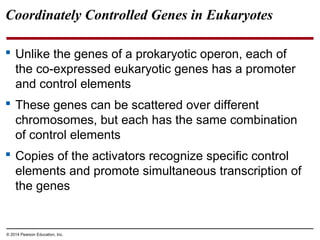
Coordinately Controlled Genes in Eukaryotes
 Unlike the genes of a prokaryotic operon, each of
the co-expressed eukaryotic genes has a promoter
and control elements
 These genes can be scattered over different
chromosomes, but each has the same combination
of control elements
 Copies of the activators recognize specific control
elements and promote simultaneous transcription of
the genes
© 2014 Pearson Education, Inc.
Mechanisms of Post-Transcriptional
Regulation
 Transcription alone does not account for gene
expression
 Regulatory mechanisms can operate at various
stages after transcription
 Such mechanisms allow a cell to fine-tune gene
expression rapidly in response to environmental
changes
© 2014 Pearson Education, Inc.
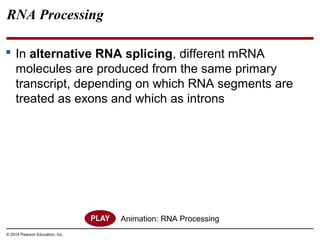
RNA Processing
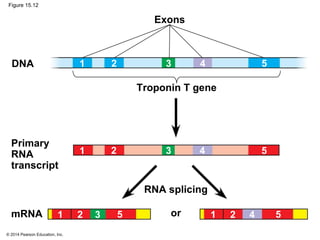
 In alternative RNA splicing, different mRNA
molecules are produced from the same primary
transcript, depending on which RNA segments are
treated as exons and which as introns
Animation: RNA Processing
© 2014 Pearson Education, Inc.
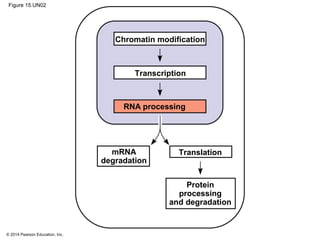
Figure 15.UN02
Chromatin modification
Transcription
RNA processing
TranslationmRNA
degradation
Protein
processing
and degradation
© 2014 Pearson Education, Inc.
Figure 15.12
DNA
Primary
RNA
transcript
mRNA or
Exons
Troponin T gene
RNA splicing
1 2 3 4 5
1 2 3 5 1 2 4 5
1 2 3 4 5
© 2014 Pearson Education, Inc.
mRNA Degradation
 The life span of mRNA molecules in the cytoplasm
is important in determining the pattern of protein
synthesis in a cell
 Eukaryotic mRNA generally survives longer than
prokaryotic mRNA
 Nucleotide sequences that influence the life span of
mRNA in eukaryotes reside in the untranslated
region (UTR) at the 3′ end of the molecule
© 2014 Pearson Education, Inc.
Initiation of Translation
 The initiation of translation of selected mRNAs can
be blocked by regulatory proteins that bind to
sequences or structures of the mRNA
 Alternatively, translation of all mRNAs in a cell may
be regulated simultaneously
 For example, translation initiation factors are
simultaneously activated in an egg following
fertilization
© 2014 Pearson Education, Inc.
Protein Processing and Degradation
 After translation, various types of protein processing,
including cleavage and chemical modification, are
subject to control
 The length of time each protein functions in a cell is
regulated by means of selective degradation
 To mark a particular protein for destruction, the cell
commonly attaches molecules of ubiquitin to the
protein, which triggers its destruction
© 2014 Pearson Education, Inc.
Concept 15.3: Noncoding RNAs play multiple
roles in controlling gene expression
 Only a small fraction of DNA encodes proteins, and
a very small fraction of the non-protein-coding DNA
consists of genes for RNA such as rRNA and tRNA
 A significant amount of the genome may be
transcribed into noncoding RNAs (ncRNAs)
 Noncoding RNAs regulate gene expression at
several points
© 2014 Pearson Education, Inc.
Effects on mRNAs by MicroRNAs and Small
Interfering RNAs
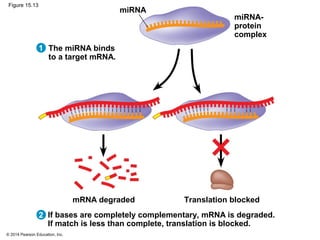
 MicroRNAs (miRNAs) are small single-stranded
RNA molecules that can bind to complementary
mRNA sequences
 These can degrade the mRNA or block its translation
© 2014 Pearson Education, Inc.
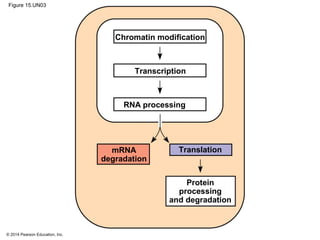
Figure 15.UN03
Chromatin modification
Transcription
RNA processing
TranslationmRNA
degradation
Protein
processing
and degradation
© 2014 Pearson Education, Inc.
Figure 15.13
miRNA
miRNA-
protein
complex
Translation blockedmRNA degraded
The miRNA binds
to a target mRNA.
1
If bases are completely complementary, mRNA is degraded.
If match is less than complete, translation is blocked.
2
© 2014 Pearson Education, Inc.
 Another class of small RNAs are called small
interfering RNAs (siRNAs)
 siRNAs and miRNAs are similar but form from
different RNA precursors
 The phenomenon of inhibition of gene expression by
siRNAs is called RNA interference (RNAi)
© 2014 Pearson Education, Inc.
Chromatin Remodeling and Effects on
Transcription by ncRNAs
 In some yeasts RNA produced from centromeric
DNA is copied into double-stranded RNA and then
processed into siRNAs
 The siRNAs, together with a complex of proteins, act
as a homing device to target transcripts being made
from centromeric sequences
 Proteins in the complex then recruit enzymes that
modify the chromatin to form the highly condensed
heterochromatin found at the centromere
© 2014 Pearson Education, Inc.
 A class of small ncRNAs called piwi-associated
RNAs (piRNAs) also induce formation of
heterochromatin
 They block expression of transposons, parasitic
DNA elements in the genome
 The role of ncRNAs adds to the complexity of the
processes involved in regulation of gene expression
© 2014 Pearson Education, Inc.
Concept 15.4: Researchers can monitor
expression of specific genes
 Cells of a given multicellular organism differ from
each other because they express different genes
from an identical genome
 The most straightforward way to discover which
genes are expressed by cells of interest is to identify
the mRNAs being made
© 2014 Pearson Education, Inc.
Studying the Expression of Single Genes
 We can detect mRNA in a cell using nucleic acid
hybridization, the base pairing of a strand of
nucleic acid to its complementary sequence
 The complementary molecule in this case is a short
single-stranded DNA or RNA called a nucleic acid
probe
 Each probe is labeled with a fluorescent tag to allow
visualization
© 2014 Pearson Education, Inc.
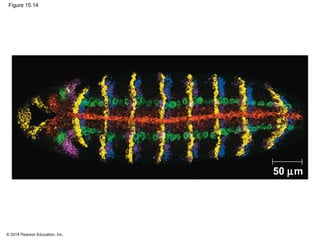
 The technique allows us to see the mRNA in place
(in situ) in the intact organism and is thus called in
situ hybridization
© 2014 Pearson Education, Inc.
Figure 15.14
50 µm
© 2014 Pearson Education, Inc.
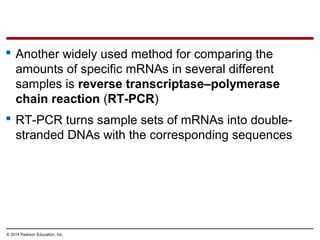
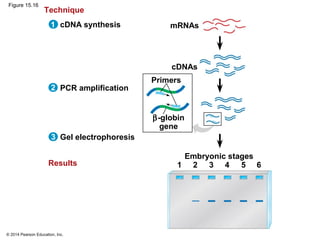
 Another widely used method for comparing the
amounts of specific mRNAs in several different
samples is reverse transcriptase–polymerase
chain reaction (RT-PCR)
 RT-PCR turns sample sets of mRNAs into double-
stranded DNAs with the corresponding sequences
© 2014 Pearson Education, Inc.
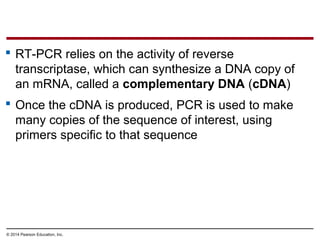
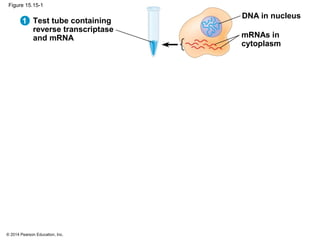
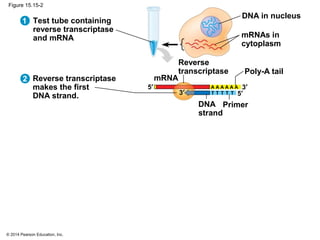
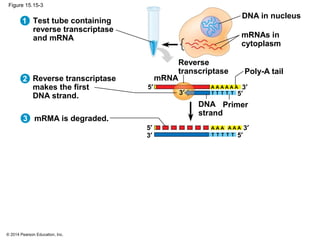
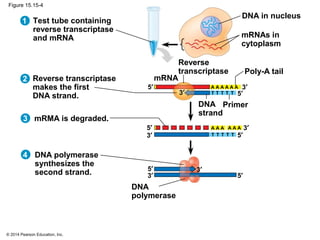
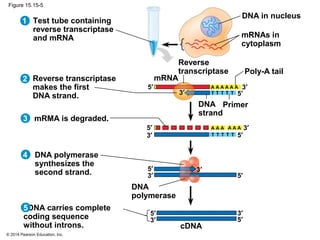
 RT-PCR relies on the activity of reverse
transcriptase, which can synthesize a DNA copy of
an mRNA, called a complementary DNA (cDNA)
 Once the cDNA is produced, PCR is used to make
many copies of the sequence of interest, using
primers specific to that sequence
© 2014 Pearson Education, Inc.
Figure 15.15-1
Test tube containing
reverse transcriptase
and mRNA
DNA in nucleus
mRNAs in
cytoplasm
1
© 2014 Pearson Education, Inc.
Figure 15.15-2
Test tube containing
reverse transcriptase
and mRNA
DNA in nucleus
mRNAs in
cytoplasm
Reverse transcriptase
makes the first
DNA strand.
Reverse
transcriptase
mRNA
Poly-A tail
DNA
strand
Primer
5′
3′
3′
5′
A A A A A A
T
1
2
T T T T
© 2014 Pearson Education, Inc.
Figure 15.15-3
Test tube containing
reverse transcriptase
and mRNA
DNA in nucleus
mRNAs in
cytoplasm
Reverse transcriptase
makes the first
DNA strand.
Reverse
transcriptase
mRNA
Poly-A tail
DNA
strand
Primer
5′
3′
3′
5′
A A A A A A
1
2
mRMA is degraded.3
5′
3′
3′
5′
A A A
T
A A A
T T T T T
T T T T
© 2014 Pearson Education, Inc.
Figure 15.15-4
Test tube containing
reverse transcriptase
and mRNA
DNA in nucleus
mRNAs in
cytoplasm
Reverse transcriptase
makes the first
DNA strand.
Reverse
transcriptase
mRNA
Poly-A tail
DNA
strand
Primer
5′
3′
3′
5′
A A A A A A
1
2
mRMA is degraded.3
5′
3′
3′
5′
A A A A A A
DNA polymerase
synthesizes the
second strand.
DNA
polymerase
5′
3′
3′
5′
4
T
T T T T T
T T T T
© 2014 Pearson Education, Inc.
Figure 15.15-5
Test tube containing
reverse transcriptase
and mRNA
DNA in nucleus
mRNAs in
cytoplasm
Reverse transcriptase
makes the first
DNA strand.
Reverse
transcriptase
mRNA
Poly-A tail
DNA
strand
Primer
5′
3′
3′
5′
A A A A A A
1
2
mRMA is degraded.3
5′
3′
3′
5′
A A A A A A
DNA polymerase
synthesizes the
second strand.
DNA
polymerase
5′
3′
3′
5′
4
5′
3′
3′
5′
cDNA
cDNA carries complete
coding sequence
without introns.
5
T
T T T T T
T T T T
© 2014 Pearson Education, Inc.
Figure 15.16
mRNAs
cDNAs
Embryonic stages
1
cDNA synthesis
PCR amplification
Gel electrophoresis
Results
Technique
1
2
3
Primers
β-globin
gene
2 3 4 5 6
© 2014 Pearson Education, Inc.
Studying the Expression of Groups of Genes
 A major goal of biologists is to learn how genes act
together to produce and maintain a functioning
organism
 Large groups of genes are studied by a systems
approach
 Such approaches allow networks of expression
across a genome to be identified
© 2014 Pearson Education, Inc.
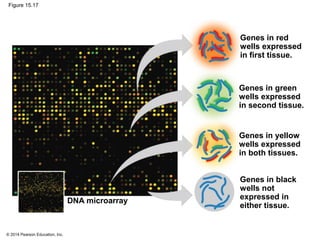
 Genome-wide expression studies can be carried out
using DNA microarray assays
 A microarray—also called a DNA chip—contains
tiny amounts of many single-stranded DNA
fragments affixed to the slide in a grid
 mRNAs from cells of interest are isolated and made
into cDNAs labeled with fluorescent molecules
© 2014 Pearson Education, Inc.
 cDNAs from two different samples are labeled with
different fluorescent tags and tested on the same
microarray
 The experiment can identify subsets of genes that
are being expressed differently in one sample
compared to another
© 2014 Pearson Education, Inc.
Figure 15.17
Genes in red
wells expressed
in first tissue.
Genes in green
wells expressed
in second tissue.
Genes in yellow
wells expressed
in both tissues.
Genes in black
wells not
expressed in
either tissue.
DNA microarray
© 2014 Pearson Education, Inc.
 An alternative to microarray analysis is simply to
sequence cDNA samples from different tissues or
stages to discover which genes are expressed
 This is called RNA sequencing
 This method is becoming more widespread as the
cost of sequencing decreases
© 2014 Pearson Education, Inc.
 Studies of genes that are expressed together in
some tissues but not others may contribute to a
better understanding of diseases and suggest new
diagnostic tests or therapies
© 2014 Pearson Education, Inc.
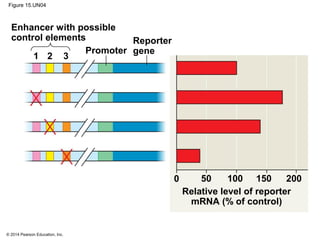
Figure 15.UN04
Promoter
Reporter
gene
Enhancer with possible
control elements
Relative level of reporter
mRNA (% of control)
1
0 50 150 200100
2 3
© 2014 Pearson Education, Inc.
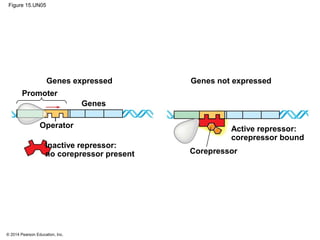
Figure 15.UN05
Genes expressed Genes not expressed
Corepressor
Operator
Promoter
Genes
Active repressor:
corepressor bound
Inactive repressor:
no corepressor present
© 2014 Pearson Education, Inc.
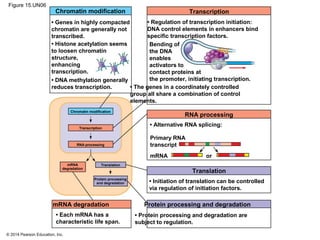
Figure 15.UN06
Chromatin modification Transcription
RNA processing
Translation
mRNA degradation Protein processing and degradation
• Protein processing and degradation are
subject to regulation.
• Each mRNA has a
characteristic life span.
• Initiation of translation can be controlled
via regulation of initiation factors.
mRNA or
Primary RNA
transcript
• Alternative RNA splicing:
• The genes in a coordinately controlled
group all share a combination of control
elements.
• Regulation of transcription initiation:
DNA control elements in enhancers bind
specific transcription factors.
Bending of
the DNA
enables
activators to
contact proteins at
the promoter, initiating transcription.
• Genes in highly compacted
chromatin are generally not
transcribed.
• Histone acetylation seems
to loosen chromatin
structure,
enhancing
transcription.
• DNA methylation generally
reduces transcription.
Chromatin modification
Transcription
RNA processing
mRNA
degradation
Translation
Protein processing
and degradation
© 2014 Pearson Education, Inc.
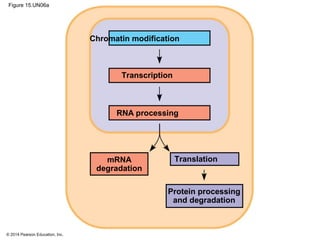
Figure 15.UN06a
Chromatin modification
Transcription
RNA processing
mRNA
degradation
Translation
Protein processing
and degradation
© 2014 Pearson Education, Inc.
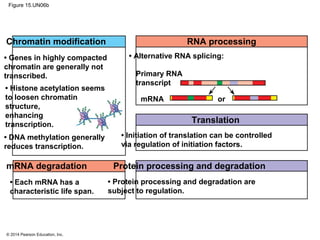
Figure 15.UN06b
Chromatin modification
• Genes in highly compacted
chromatin are generally not
transcribed.
• Histone acetylation seems
to loosen chromatin
structure,
enhancing
transcription.
• DNA methylation generally
reduces transcription.
RNA processing
mRNA or
Primary RNA
transcript
• Alternative RNA splicing:
Translation
Protein processing and degradation
• Protein processing and degradation are
subject to regulation.
• Initiation of translation can be controlled
via regulation of initiation factors.
mRNA degradation
• Each mRNA has a
characteristic life span.
© 2014 Pearson Education, Inc.
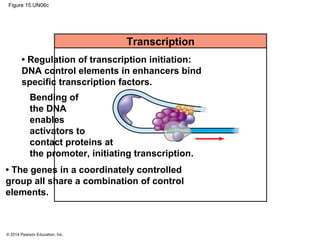
Figure 15.UN06c
Transcription
• The genes in a coordinately controlled
group all share a combination of control
elements.
• Regulation of transcription initiation:
DNA control elements in enhancers bind
specific transcription factors.
Bending of
the DNA
enables
activators to
contact proteins at
the promoter, initiating transcription.
© 2014 Pearson Education, Inc.
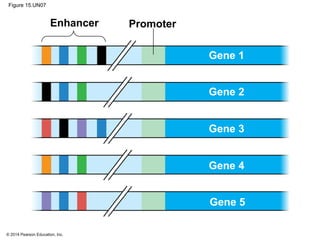
Figure 15.UN07
PromoterEnhancer
Gene 1
Gene 2
Gene 3
Gene 4
Gene 5

Biology in Focus - Chapter 15

  • 1.
    CAMPBELL BIOLOGY INFOCUS © 2014 Pearson Education, Inc. Urry • Cain • Wasserman • Minorsky • Jackson • Reece Lecture Presentations by Kathleen Fitzpatrick and Nicole Tunbridge 15 Regulation of Gene Expression
  • 2.
    © 2014 PearsonEducation, Inc. Overview: Differential Expression of Genes  Prokaryotes and eukaryotes alter gene expression in response to their changing environment  Multicellular eukaryotes also develop and maintain multiple cell types  Gene expression is often regulated at the transcription stage, but control at other stages is important, too
  • 3.
    © 2014 PearsonEducation, Inc. Figure 15.1
  • 4.
    © 2014 PearsonEducation, Inc. Concept 15.1: Bacteria often respond to environmental change by regulating transcription  Natural selection has favored bacteria that produce only the gene products needed by the cell  A cell can regulate the production of enzymes by feedback inhibition or by gene regulation  Gene expression in bacteria is controlled by a mechanism described as the operon model
  • 5.
    © 2014 PearsonEducation, Inc. Figure 15.2 Regulation of gene expression Precursor trpE gene (a) Regulation of enzyme activity Feedback inhibition Enzyme 1 Enzyme 2 Enzyme 3 Tryptophan (b) Regulation of enzyme production trpD gene trpC gene trpB gene trpA gene
  • 6.
    © 2014 PearsonEducation, Inc. Operons: The Basic Concept  A group of functionally related genes can be coordinately controlled by a single “on-off switch”  The regulatory “switch” is a segment of DNA called an operator usually positioned within the promoter  An operon is the entire stretch of DNA that includes the operator, the promoter, and the genes that they control
  • 7.
    © 2014 PearsonEducation, Inc.  The operon can be switched off by a protein repressor  The repressor prevents gene transcription by binding to the operator and blocking RNA polymerase  The repressor is the product of a separate regulatory gene
  • 8.
    © 2014 PearsonEducation, Inc.  The repressor can be in an active or inactive form, depending on the presence of other molecules  A corepressor is a molecule that cooperates with a repressor protein to switch an operon off  For example, E. coli can synthesize the amino acid tryptophan
  • 9.
    © 2014 PearsonEducation, Inc.  By default the trp operon is on and the genes for tryptophan synthesis are transcribed  When tryptophan is present, it binds to the trp repressor protein, which then turns the operon off  The repressor is active only in the presence of its corepressor tryptophan; thus the trp operon is turned off (repressed) if tryptophan levels are high
  • 10.
    © 2014 PearsonEducation, Inc. Figure 15.3 Promoter Promoter trp operon Genes of operon DNA Regulatory gene mRNA Protein RNA polymerase Inactive repressor Operator Start codon Stop codon mRNA 5′ trpE trpD trpC trpB trpA E D C B A (a) Tryptophan absent, repressor inactive, operon on DNA mRNA Protein Active repressor No RNA made Tryptophan (corepressor) (b) Tryptophan present, repressor active, operon off Polypeptide subunits that make up enzymes for tryptophan synthesis 5′ 3′ trpR
  • 11.
    © 2014 PearsonEducation, Inc. Figure 15.3a ) Tryptophan absent, repressor inactive, operon on Polypeptide subunits that make up enzymes for tryptophan synthesis Protein Inactive repressor mRNA 5′ 3′ E D C B A Promoter DNA Regulatory gene RNA polymerase Promoter trp operon Genes of operon Operator Start codon Stop codon mRNA 5′ trpE trpD trpC trpB trpAtrpR
  • 12.
    © 2014 PearsonEducation, Inc. Figure 15.3b DNA mRNA Protein Active repressor No RNA made Tryptophan (corepressor) (b) Tryptophan present, repressor active, operon off
  • 13.
    © 2014 PearsonEducation, Inc. Repressible and Inducible Operons: Two Types of Negative Gene Regulation  A repressible operon is one that is usually on; binding of a repressor to the operator shuts off transcription  The trp operon is a repressible operon  An inducible operon is one that is usually off; a molecule called an inducer inactivates the repressor and turns on transcription
  • 14.
    © 2014 PearsonEducation, Inc.  The lac operon is an inducible operon and contains genes that code for enzymes used in the hydrolysis and metabolism of lactose  By itself, the lac repressor is active and switches the lac operon off  A molecule called an inducer inactivates the repressor to turn the lac operon on
  • 15.
    © 2014 PearsonEducation, Inc.  For the lac operon, the inducer is allolactose, formed from lactose that enters the cell  Enzymes of the lactose pathway are called inducible enzymes  Analogously, the enzymes for tryptophan synthesis are said to be repressible enzymes Video: lac Repressor Model
  • 16.
    © 2014 PearsonEducation, Inc. Figure 15.4 DNA mRNA Promoter Operator Regulatory gene No RNA made RNA polymerase 3′ 5′ IacZ Active repressor Protein (a) Lactose absent, repressor active, operon off IacZ IacY IacAIacIDNA mRNA Protein RNA polymerase Inactive repressor Allolactose (inducer) (b) Lactose present, repressor inactive, operon on mRNA 5′ 3′ 5′ lac operon lacI PermeaseTransacetylaseβ-Galactosidase
  • 17.
    © 2014 PearsonEducation, Inc. Figure 15.4a DNA Promoter Operator Regulatory gene No RNA made IacZlacI mRNA RNA polymerase 3′ 5′ Active repressor Protein (a) Lactose absent, repressor active, operon off
  • 18.
    © 2014 PearsonEducation, Inc. Figure 15.4b IacZ IacY IacAIacI DNA lac operon PermeaseTransacetylaseβ-Galactosidase mRNA Protein RNA polymerase mRNA 5′ 3′ 5′ Inactive repressor Allolactose (inducer) Lactose present, repressor inactive, operon on
  • 19.
    © 2014 PearsonEducation, Inc.  Inducible enzymes usually function in catabolic pathways; their synthesis is induced by a chemical signal  Repressible enzymes usually function in anabolic pathways; their synthesis is repressed by high levels of the end product  Regulation of the trp and lac operons involves negative control of genes because operons are switched off by the active form of the repressor
  • 20.
    © 2014 PearsonEducation, Inc. Positive Gene Regulation  E. coli will preferentially use glucose when it is present in the environment  When glucose is scarce, CAP (catabolite activator protein) acts as an activator of transcription  CAP is activated by binding with cyclic AMP (cAMP)  Activated CAP attaches to the promoter of the lac operon and increases the affinity of RNA polymerase, thus accelerating transcription
  • 21.
    © 2014 PearsonEducation, Inc.  When glucose levels increase, CAP detaches from the lac operon, and transcription proceeds at a very low rate, even if lactose is present  CAP helps regulate other operons that encode enzymes used in catabolic pathways
  • 22.
    © 2014 PearsonEducation, Inc. Figure 15.5 DNA Promoter Operator IacZlacI CAP-binding site cAMP Inactive CAP Active CAP RNA polymerase binds and transcribes Allolactose Inactive lac repressor (a) Lactose present, glucose scarce (cAMP level high): Promoter abundant lac mRNA synthesized DNA Operator IacZlacI CAP-binding site RNA polymerase less likely to bind (b) Lactose present, glucose present (cAMP level low): little lac mRNA synthesized Inactive CAP Inactive lac repressor
  • 23.
    © 2014 PearsonEducation, Inc. Figure 15.5a DNA Promoter IacZlacI OperatorRNA polymerase binds and transcribes Active CAP Inactive CAP Allolactose Inactive lac repressor CAP-binding site cAMP ose present, glucose scarce (cAMP level high): abundant lac mRNA synthesized
  • 24.
    © 2014 PearsonEducation, Inc. Figure 15.5b Promoter DNA Operator IacZlacI CAP-binding site Inactive CAP Inactive lac repressor RNA polymerase less likely to bind little lac mRNA synthesized ose present, glucose present (cAMP level low):
  • 25.
    © 2014 PearsonEducation, Inc. Concept 15.2: Eukaryotic gene expression is regulated at many stages  All organisms must regulate which genes are expressed at any given time  In multicellular organisms regulation of gene expression is essential for cell specialization
  • 26.
    © 2014 PearsonEducation, Inc. Differential Gene Expression  Almost all the cells in an organism are genetically identical  Differences between cell types result from differential gene expression, the expression of different genes by cells with the same genome  Abnormalities in gene expression can lead to diseases, including cancer  Gene expression is regulated at many stages
  • 27.
    © 2014 PearsonEducation, Inc. Figure 15.6 Signal NUCLEUS Chromatin Chromatin modification: DNA unpacking involving histone acetylation and DNA demethylation DNA Gene RNA Exon Gene available for transcription Transcription Primary transcript Intron RNA processing Tail mRNA in nucleus Transport to cytoplasm CYTOPLASM mRNA in cytoplasm TranslationDegradation of mRNA Polypeptide Cap Protein processing, such as cleavage and chemical modification Active protein Transport to cellular destination Degradation of protein Cellular function (such as enzymatic activity, structural support)
  • 28.
    © 2014 PearsonEducation, Inc. Figure 15.6a Signal NUCLEUS Chromatin Chromatin modification: DNA unpacking involving histone acetylation and DNA demethylation DNA Gene RNA Exon Gene available for transcription Transcription Primary transcript Intron RNA processing Tail mRNA in nucleus Transport to cytoplasm Cap CYTOPLASM
  • 29.
    © 2014 PearsonEducation, Inc. Figure 15.6b CYTOPLASM mRNA in cytoplasm TranslationDegradation of mRNA Polypeptide Protein processing, such as cleavage and chemical modification Active protein Transport to cellular destination Degradation of protein Cellular function (such as enzymatic activity, structural support)
  • 30.
    © 2014 PearsonEducation, Inc.  In all organisms, a common control point for gene expression is at transcription  The greater complexity of eukaryotic cell structure and function provides opportunities for regulating gene expression at many additional stages
  • 31.
    © 2014 PearsonEducation, Inc. Regulation of Chromatin Structure  The structural organization of chromatin packs DNA into a compact form and also helps regulate gene expression in several ways  The location of a gene promoter relative to nucleosomes and scaffold or lamina attachment sites can influence gene transcription
  • 32.
    © 2014 PearsonEducation, Inc.  Genes within highly condensed heterochromatin are usually not expressed  Chemical modifications to histone proteins and DNA can influence chromatin structure and gene expression
  • 33.
    © 2014 PearsonEducation, Inc. Histone Modifications and DNA Methylation  In histone acetylation, acetyl groups are attached to positively charged lysines in histone tails  This generally loosens chromatin structure, promoting the initiation of transcription  The addition of methyl groups (methylation) can condense chromatin and lead to reduced transcription
  • 34.
    © 2014 PearsonEducation, Inc. Figure 15.7 Nucleosome Unacetylated histones Acetylated histones Histone tails
  • 35.
    © 2014 PearsonEducation, Inc.  DNA methylation is the addition of methyl groups to certain bases in DNA, usually cytosine  Individual genes are usually more heavily methylated in cells where they are not expressed  Once methylated, genes usually remain so through successive cell divisions  After replication, enzymes methylate the correct daughter strand so that the methylation pattern is inherited
  • 36.
    © 2014 PearsonEducation, Inc. Epigenetic Inheritance  Though chromatin modifications do not alter DNA sequence, they may be passed to future generations of cells  The inheritance of traits transmitted by mechanisms not directly involving the nucleotide sequence is called epigenetic inheritance  Epigenetic modifications can be reversed, unlike mutations in DNA sequence
  • 37.
    © 2014 PearsonEducation, Inc. Regulation of Transcription Initiation  Chromatin-modifying enzymes provide initial control of gene expression by making a region of DNA either more or less able to bind the transcription machinery
  • 38.
    © 2014 PearsonEducation, Inc. Organization of a Typical Eukaryotic Gene  Associated with most eukaryotic genes are multiple control elements, segments of noncoding DNA that serve as binding sites for transcription factors that help regulate transcription  Control elements and the transcription factors they bind are critical for the precise regulation of gene expression in different cell types Animation: mRNA Degradation
  • 39.
    © 2014 PearsonEducation, Inc. Figure 15.8 DNA Upstream Enhancer (distal control elements) Proximal control elements Transcription start site Exon Intron Exon Promoter Intron Exon Poly-A signal sequence Transcription termination region Down- stream Transcription Exon Intron IntronExon Exon Poly-A signal Primary RNA transcript (pre-mRNA) 5′ Cleaved 3′ end of primary transcript Intron RNA mRNA RNA processing Coding segment 3′ 5′ 5′ 3′Cap UTR Start codon Stop codon UTR Poly-A tail G P P P AAA… AAA
  • 40.
    © 2014 PearsonEducation, Inc. Figure 15.8a DNA Upstream Enhancer (distal control elements) Proximal control elements Transcription start site Exon Intron Exon Promoter Intron Exon Poly-A signal sequence Transcription termination region Downstream
  • 41.
    © 2014 PearsonEducation, Inc. Figure 15.8b-1 Proximal control elements Transcription start site Exon Intron Exon Promoter Intron Exon Poly-A signal sequence DNA
  • 42.
    © 2014 PearsonEducation, Inc. Figure 15.8b-2 Proximal control elements Transcription start site Promoter Poly-A signal sequence DNA Transcription Exon Intron IntronExon Exon Poly-A signal Primary RNA transcript (pre-mRNA) 5′ Cleaved 3′ end of primary transcript Exon Intron Exon Intron Exon
  • 43.
    © 2014 PearsonEducation, Inc. Figure 15.8b-3 Proximal control elements Transcription start site Promoter Poly-A signal sequence DNA Transcription Exon Intron IntronExon Exon Poly-A signal Primary RNA transcript (pre-mRNA) 5′ Cleaved 3′ end of primary transcript Intron RNA mRNA RNA processing Coding segment 3′ 5′ 5′ 3′Cap UTR Start codon Stop codon UTR Poly-A tail G P P P AAA… AAA Exon Intron Exon Intron Exon
  • 44.
    © 2014 PearsonEducation, Inc. The Roles of Transcription Factors  To initiate transcription, eukaryotic RNA polymerase requires the assistance of proteins called transcription factors  General transcription factors are essential for the transcription of all protein-coding genes  In eukaryotes, high levels of transcription of particular genes depend on interaction between control elements and specific transcription factors
  • 45.
    © 2014 PearsonEducation, Inc.  Proximal control elements are located close to the promoter  Distal control elements, groupings of which are called enhancers, may be far away from a gene or even located in an intron Enhancers and Specific Transcription Factors
  • 46.
    © 2014 PearsonEducation, Inc.  An activator is a protein that binds to an enhancer and stimulates transcription of a gene  Activators have two domains, one that binds DNA and a second that activates transcription  Bound activators facilitate a sequence of protein- protein interactions that result in transcription of a given gene
  • 47.
    © 2014 PearsonEducation, Inc. Figure 15.9 Activation domain DNA DNA-binding domain
  • 48.
    © 2014 PearsonEducation, Inc.  Bound activators are brought into contact with a group of mediator proteins through DNA bending  The mediator proteins in turn interact with proteins at the promoter  These protein-protein interactions help to assemble and position the initiation complex on the promoter Animation: Transcription Initiation
  • 49.
    © 2014 PearsonEducation, Inc. Figure 15.UN01 Chromatin modification Transcription RNA processing TranslationmRNA degradation Protein processing and degradation
  • 50.
    © 2014 PearsonEducation, Inc. Figure 15.10-1 DNA Enhancer Distal control element Activators Promoter Gene TATA box
  • 51.
    © 2014 PearsonEducation, Inc. Figure 15.10-2 DNA Enhancer Distal control element Activators Promoter Gene TATA box DNA- bending protein Group of mediator proteins General transcription factors
  • 52.
    © 2014 PearsonEducation, Inc. Figure 15.10-3 DNA Enhancer Distal control element Activators Promoter Gene TATA box DNA- bending protein Group of mediator proteins General transcription factors RNA polymerase II RNA polymerase II RNA synthesis Transcription initiation complex
  • 53.
    © 2014 PearsonEducation, Inc.  Some transcription factors function as repressors, inhibiting expression of a particular gene by a variety of methods  Some activators and repressors act indirectly by influencing chromatin structure to promote or silence transcription
  • 54.
    © 2014 PearsonEducation, Inc.  A particular combination of control elements can activate transcription only when the appropriate activator proteins are present Combinatorial Control of Gene Activation
  • 55.
    © 2014 PearsonEducation, Inc. Figure 15.11 Albumin gene Crystallin gene Promoter Promoter (b) LENS CELL NUCLEUS Available activators Albumin gene not expressed Crystallin gene expressed Crystallin gene not expressed Albumin gene expressed Available activators (a) LIVER CELL NUCLEUS Control elements Enhancer Enhancer
  • 56.
    © 2014 PearsonEducation, Inc. Figure 15.11a Crystallin gene not expressed Albumin gene expressed Available activators (a) LIVER CELL NUCLEUS
  • 57.
    © 2014 PearsonEducation, Inc. Figure 15.11b (b) LENS CELL NUCLEUS Available activators Albumin gene not expressed Crystallin gene expressed
  • 58.
    © 2014 PearsonEducation, Inc. Coordinately Controlled Genes in Eukaryotes  Unlike the genes of a prokaryotic operon, each of the co-expressed eukaryotic genes has a promoter and control elements  These genes can be scattered over different chromosomes, but each has the same combination of control elements  Copies of the activators recognize specific control elements and promote simultaneous transcription of the genes
  • 59.
    © 2014 PearsonEducation, Inc. Mechanisms of Post-Transcriptional Regulation  Transcription alone does not account for gene expression  Regulatory mechanisms can operate at various stages after transcription  Such mechanisms allow a cell to fine-tune gene expression rapidly in response to environmental changes
  • 60.
    © 2014 PearsonEducation, Inc. RNA Processing  In alternative RNA splicing, different mRNA molecules are produced from the same primary transcript, depending on which RNA segments are treated as exons and which as introns Animation: RNA Processing
  • 61.
    © 2014 PearsonEducation, Inc. Figure 15.UN02 Chromatin modification Transcription RNA processing TranslationmRNA degradation Protein processing and degradation
  • 62.
    © 2014 PearsonEducation, Inc. Figure 15.12 DNA Primary RNA transcript mRNA or Exons Troponin T gene RNA splicing 1 2 3 4 5 1 2 3 5 1 2 4 5 1 2 3 4 5
  • 63.
    © 2014 PearsonEducation, Inc. mRNA Degradation  The life span of mRNA molecules in the cytoplasm is important in determining the pattern of protein synthesis in a cell  Eukaryotic mRNA generally survives longer than prokaryotic mRNA  Nucleotide sequences that influence the life span of mRNA in eukaryotes reside in the untranslated region (UTR) at the 3′ end of the molecule
  • 64.
    © 2014 PearsonEducation, Inc. Initiation of Translation  The initiation of translation of selected mRNAs can be blocked by regulatory proteins that bind to sequences or structures of the mRNA  Alternatively, translation of all mRNAs in a cell may be regulated simultaneously  For example, translation initiation factors are simultaneously activated in an egg following fertilization
  • 65.
    © 2014 PearsonEducation, Inc. Protein Processing and Degradation  After translation, various types of protein processing, including cleavage and chemical modification, are subject to control  The length of time each protein functions in a cell is regulated by means of selective degradation  To mark a particular protein for destruction, the cell commonly attaches molecules of ubiquitin to the protein, which triggers its destruction
  • 66.
    © 2014 PearsonEducation, Inc. Concept 15.3: Noncoding RNAs play multiple roles in controlling gene expression  Only a small fraction of DNA encodes proteins, and a very small fraction of the non-protein-coding DNA consists of genes for RNA such as rRNA and tRNA  A significant amount of the genome may be transcribed into noncoding RNAs (ncRNAs)  Noncoding RNAs regulate gene expression at several points
  • 67.
    © 2014 PearsonEducation, Inc. Effects on mRNAs by MicroRNAs and Small Interfering RNAs  MicroRNAs (miRNAs) are small single-stranded RNA molecules that can bind to complementary mRNA sequences  These can degrade the mRNA or block its translation
  • 68.
    © 2014 PearsonEducation, Inc. Figure 15.UN03 Chromatin modification Transcription RNA processing TranslationmRNA degradation Protein processing and degradation
  • 69.
    © 2014 PearsonEducation, Inc. Figure 15.13 miRNA miRNA- protein complex Translation blockedmRNA degraded The miRNA binds to a target mRNA. 1 If bases are completely complementary, mRNA is degraded. If match is less than complete, translation is blocked. 2
  • 70.
    © 2014 PearsonEducation, Inc.  Another class of small RNAs are called small interfering RNAs (siRNAs)  siRNAs and miRNAs are similar but form from different RNA precursors  The phenomenon of inhibition of gene expression by siRNAs is called RNA interference (RNAi)
  • 71.
    © 2014 PearsonEducation, Inc. Chromatin Remodeling and Effects on Transcription by ncRNAs  In some yeasts RNA produced from centromeric DNA is copied into double-stranded RNA and then processed into siRNAs  The siRNAs, together with a complex of proteins, act as a homing device to target transcripts being made from centromeric sequences  Proteins in the complex then recruit enzymes that modify the chromatin to form the highly condensed heterochromatin found at the centromere
  • 72.
    © 2014 PearsonEducation, Inc.  A class of small ncRNAs called piwi-associated RNAs (piRNAs) also induce formation of heterochromatin  They block expression of transposons, parasitic DNA elements in the genome  The role of ncRNAs adds to the complexity of the processes involved in regulation of gene expression
  • 73.
    © 2014 PearsonEducation, Inc. Concept 15.4: Researchers can monitor expression of specific genes  Cells of a given multicellular organism differ from each other because they express different genes from an identical genome  The most straightforward way to discover which genes are expressed by cells of interest is to identify the mRNAs being made
  • 74.
    © 2014 PearsonEducation, Inc. Studying the Expression of Single Genes  We can detect mRNA in a cell using nucleic acid hybridization, the base pairing of a strand of nucleic acid to its complementary sequence  The complementary molecule in this case is a short single-stranded DNA or RNA called a nucleic acid probe  Each probe is labeled with a fluorescent tag to allow visualization
  • 75.
    © 2014 PearsonEducation, Inc.  The technique allows us to see the mRNA in place (in situ) in the intact organism and is thus called in situ hybridization
  • 76.
    © 2014 PearsonEducation, Inc. Figure 15.14 50 µm
  • 77.
    © 2014 PearsonEducation, Inc.  Another widely used method for comparing the amounts of specific mRNAs in several different samples is reverse transcriptase–polymerase chain reaction (RT-PCR)  RT-PCR turns sample sets of mRNAs into double- stranded DNAs with the corresponding sequences
  • 78.
    © 2014 PearsonEducation, Inc.  RT-PCR relies on the activity of reverse transcriptase, which can synthesize a DNA copy of an mRNA, called a complementary DNA (cDNA)  Once the cDNA is produced, PCR is used to make many copies of the sequence of interest, using primers specific to that sequence
  • 79.
    © 2014 PearsonEducation, Inc. Figure 15.15-1 Test tube containing reverse transcriptase and mRNA DNA in nucleus mRNAs in cytoplasm 1
  • 80.
    © 2014 PearsonEducation, Inc. Figure 15.15-2 Test tube containing reverse transcriptase and mRNA DNA in nucleus mRNAs in cytoplasm Reverse transcriptase makes the first DNA strand. Reverse transcriptase mRNA Poly-A tail DNA strand Primer 5′ 3′ 3′ 5′ A A A A A A T 1 2 T T T T
  • 81.
    © 2014 PearsonEducation, Inc. Figure 15.15-3 Test tube containing reverse transcriptase and mRNA DNA in nucleus mRNAs in cytoplasm Reverse transcriptase makes the first DNA strand. Reverse transcriptase mRNA Poly-A tail DNA strand Primer 5′ 3′ 3′ 5′ A A A A A A 1 2 mRMA is degraded.3 5′ 3′ 3′ 5′ A A A T A A A T T T T T T T T T
  • 82.
    © 2014 PearsonEducation, Inc. Figure 15.15-4 Test tube containing reverse transcriptase and mRNA DNA in nucleus mRNAs in cytoplasm Reverse transcriptase makes the first DNA strand. Reverse transcriptase mRNA Poly-A tail DNA strand Primer 5′ 3′ 3′ 5′ A A A A A A 1 2 mRMA is degraded.3 5′ 3′ 3′ 5′ A A A A A A DNA polymerase synthesizes the second strand. DNA polymerase 5′ 3′ 3′ 5′ 4 T T T T T T T T T T
  • 83.
    © 2014 PearsonEducation, Inc. Figure 15.15-5 Test tube containing reverse transcriptase and mRNA DNA in nucleus mRNAs in cytoplasm Reverse transcriptase makes the first DNA strand. Reverse transcriptase mRNA Poly-A tail DNA strand Primer 5′ 3′ 3′ 5′ A A A A A A 1 2 mRMA is degraded.3 5′ 3′ 3′ 5′ A A A A A A DNA polymerase synthesizes the second strand. DNA polymerase 5′ 3′ 3′ 5′ 4 5′ 3′ 3′ 5′ cDNA cDNA carries complete coding sequence without introns. 5 T T T T T T T T T T
  • 84.
    © 2014 PearsonEducation, Inc. Figure 15.16 mRNAs cDNAs Embryonic stages 1 cDNA synthesis PCR amplification Gel electrophoresis Results Technique 1 2 3 Primers β-globin gene 2 3 4 5 6
  • 85.
    © 2014 PearsonEducation, Inc. Studying the Expression of Groups of Genes  A major goal of biologists is to learn how genes act together to produce and maintain a functioning organism  Large groups of genes are studied by a systems approach  Such approaches allow networks of expression across a genome to be identified
  • 86.
    © 2014 PearsonEducation, Inc.  Genome-wide expression studies can be carried out using DNA microarray assays  A microarray—also called a DNA chip—contains tiny amounts of many single-stranded DNA fragments affixed to the slide in a grid  mRNAs from cells of interest are isolated and made into cDNAs labeled with fluorescent molecules
  • 87.
    © 2014 PearsonEducation, Inc.  cDNAs from two different samples are labeled with different fluorescent tags and tested on the same microarray  The experiment can identify subsets of genes that are being expressed differently in one sample compared to another
  • 88.
    © 2014 PearsonEducation, Inc. Figure 15.17 Genes in red wells expressed in first tissue. Genes in green wells expressed in second tissue. Genes in yellow wells expressed in both tissues. Genes in black wells not expressed in either tissue. DNA microarray
  • 89.
    © 2014 PearsonEducation, Inc.  An alternative to microarray analysis is simply to sequence cDNA samples from different tissues or stages to discover which genes are expressed  This is called RNA sequencing  This method is becoming more widespread as the cost of sequencing decreases
  • 90.
    © 2014 PearsonEducation, Inc.  Studies of genes that are expressed together in some tissues but not others may contribute to a better understanding of diseases and suggest new diagnostic tests or therapies
  • 91.
    © 2014 PearsonEducation, Inc. Figure 15.UN04 Promoter Reporter gene Enhancer with possible control elements Relative level of reporter mRNA (% of control) 1 0 50 150 200100 2 3
  • 92.
    © 2014 PearsonEducation, Inc. Figure 15.UN05 Genes expressed Genes not expressed Corepressor Operator Promoter Genes Active repressor: corepressor bound Inactive repressor: no corepressor present
  • 93.
    © 2014 PearsonEducation, Inc. Figure 15.UN06 Chromatin modification Transcription RNA processing Translation mRNA degradation Protein processing and degradation • Protein processing and degradation are subject to regulation. • Each mRNA has a characteristic life span. • Initiation of translation can be controlled via regulation of initiation factors. mRNA or Primary RNA transcript • Alternative RNA splicing: • The genes in a coordinately controlled group all share a combination of control elements. • Regulation of transcription initiation: DNA control elements in enhancers bind specific transcription factors. Bending of the DNA enables activators to contact proteins at the promoter, initiating transcription. • Genes in highly compacted chromatin are generally not transcribed. • Histone acetylation seems to loosen chromatin structure, enhancing transcription. • DNA methylation generally reduces transcription. Chromatin modification Transcription RNA processing mRNA degradation Translation Protein processing and degradation
  • 94.
    © 2014 PearsonEducation, Inc. Figure 15.UN06a Chromatin modification Transcription RNA processing mRNA degradation Translation Protein processing and degradation
  • 95.
    © 2014 PearsonEducation, Inc. Figure 15.UN06b Chromatin modification • Genes in highly compacted chromatin are generally not transcribed. • Histone acetylation seems to loosen chromatin structure, enhancing transcription. • DNA methylation generally reduces transcription. RNA processing mRNA or Primary RNA transcript • Alternative RNA splicing: Translation Protein processing and degradation • Protein processing and degradation are subject to regulation. • Initiation of translation can be controlled via regulation of initiation factors. mRNA degradation • Each mRNA has a characteristic life span.
  • 96.
    © 2014 PearsonEducation, Inc. Figure 15.UN06c Transcription • The genes in a coordinately controlled group all share a combination of control elements. • Regulation of transcription initiation: DNA control elements in enhancers bind specific transcription factors. Bending of the DNA enables activators to contact proteins at the promoter, initiating transcription.
  • 97.
    © 2014 PearsonEducation, Inc. Figure 15.UN07 PromoterEnhancer Gene 1 Gene 2 Gene 3 Gene 4 Gene 5

Editor's Notes

  • #4 Figure 15.1 How can this fish’s eyes see equally well in both air and water?
  • #6 Figure 15.2 Regulation of a metabolic pathway
  • #11 Figure 15.3 The trp operon in E. coli: regulated synthesis of repressible enzymes
  • #12 Figure 15.3a The trp operon in E. coli: regulated synthesis of repressible enzymes (part 1: tryptophan absent)
  • #13 Figure 15.3b The trp operon in E. coli: regulated synthesis of repressible enzymes (part 2: tryptophan present)
  • #17 Figure 15.4 The lac operon in E. coli: regulated synthesis of inducible enzymes
  • #18 Figure 15.4a The lac operon in E. coli: regulated synthesis of inducible enzymes (part 1: lactose absent)
  • #19 Figure 15.4b The lac operon in E. coli: regulated synthesis of inducible enzymes (part 2: lactose present)
  • #23 Figure 15.5 Positive control of the lac operon by catabolite activator protein (CAP)
  • #24 Figure 15.5a Positive control of the lac operon by catabolite activator protein (CAP) (part 1: glucose scarce)
  • #25 Figure 15.5b Positive control of the lac operon by catabolite activator protein (CAP) (part 2: glucose present)
  • #28 Figure 15.6 Stages in gene expression that can be regulated in eukaryotic cells
  • #29 Figure 15.6a Stages in gene expression that can be regulated in eukaryotic cells (part 1: nucleus)
  • #30 Figure 15.6b Stages in gene expression that can be regulated in eukaryotic cells (part 2: cytoplasm)
  • #35 Figure 15.7 A simple model of the effect of histone acetylation
  • #40 Figure 15.8 A eukaryotic gene and its transcript
  • #41 Figure 15.8a A eukaryotic gene and its transcript (part 1)
  • #42 Figure 15.8b-1 A eukaryotic gene and its transcript (part 2, step 1)
  • #43 Figure 15.8b-2 A eukaryotic gene and its transcript (part 2, step 2)
  • #44 Figure 15.8b-3 A eukaryotic gene and its transcript (part 2, step 3)
  • #48 Figure 15.9 MyoD, a transcription activator
  • #50 Figure 15.UN01 In-text figure, regulation at the level of transcription, p. 301
  • #51 Figure 15.10-1 A model for the action of enhancers and transcription activators (step 1)
  • #52 Figure 15.10-2 A model for the action of enhancers and transcription activators (step 2)
  • #53 Figure 15.10-3 A model for the action of enhancers and transcription activators (step 3)
  • #56 Figure 15.11 Cell type–specific transcription
  • #57 Figure 15.11a Cell type–specific transcription (part 1: liver cell)
  • #58 Figure 15.11b Cell type–specific transcription (part 2: lens cell)
  • #62 Figure 15.UN02 In-text figure, regulation at the level of RNA processing, p. 304
  • #63 Figure 15.12 Alternative RNA splicing of the troponin T gene
  • #69 Figure 15.UN03 In-text figure, regulation at the level of translation, p. 306
  • #70 Figure 15.13 Regulation of gene expression by miRNAs
  • #77 Figure 15.14 Determining where genes are expressed by in situ hybridization analysis
  • #80 Figure 15.15-1 Making complementary DNA (cDNA) from eukaryotic genes (step 1)
  • #81 Figure 15.15-2 Making complementary DNA (cDNA) from eukaryotic genes (step 2)
  • #82 Figure 15.15-3 Making complementary DNA (cDNA) from eukaryotic genes (step 3)
  • #83 Figure 15.15-4 Making complementary DNA (cDNA) from eukaryotic genes (step 4)
  • #84 Figure 15.15-5 Making complementary DNA (cDNA) from eukaryotic genes (step 5)
  • #85 Figure 15.16 Research method: RT-PCR analysis of the expression of single genes
  • #89 Figure 15.17 DNA microarray assay of gene expression levels
  • #92 Figure 15.UN04 Skills exercise: analyzing DNA deletion experiments
  • #93 Figure 15.UN05 Summary of key concepts: transcription regulation
  • #94 Figure 15.UN06 Summary of key concepts: eukaryotic regulation of gene expression
  • #95 Figure 15.UN06a Summary of key concepts: eukaryotic regulation of gene expression (part 1)
  • #96 Figure 15.UN06b Summary of key concepts: eukaryotic regulation of gene expression (part 2)
  • #97 Figure 15.UN06c Summary of key concepts: eukaryotic regulation of gene expression (part 3)
  • #98 Figure 15.UN07 Test your understanding, question 7 (activator proteins)