PORTER’S GENERIC STRATEGIES
Introduction…
   Michael Porter is a professor at Harward Business
    School.

   A firm’s success in strategy rests upon how it positions
    itself in respect to its environment.

   Michael Porter has argued that a firm's strengths
    ultimately fall into one of two headings: cost advantage
    and differentiation.

   By applying these strengths in either a broad or narrow
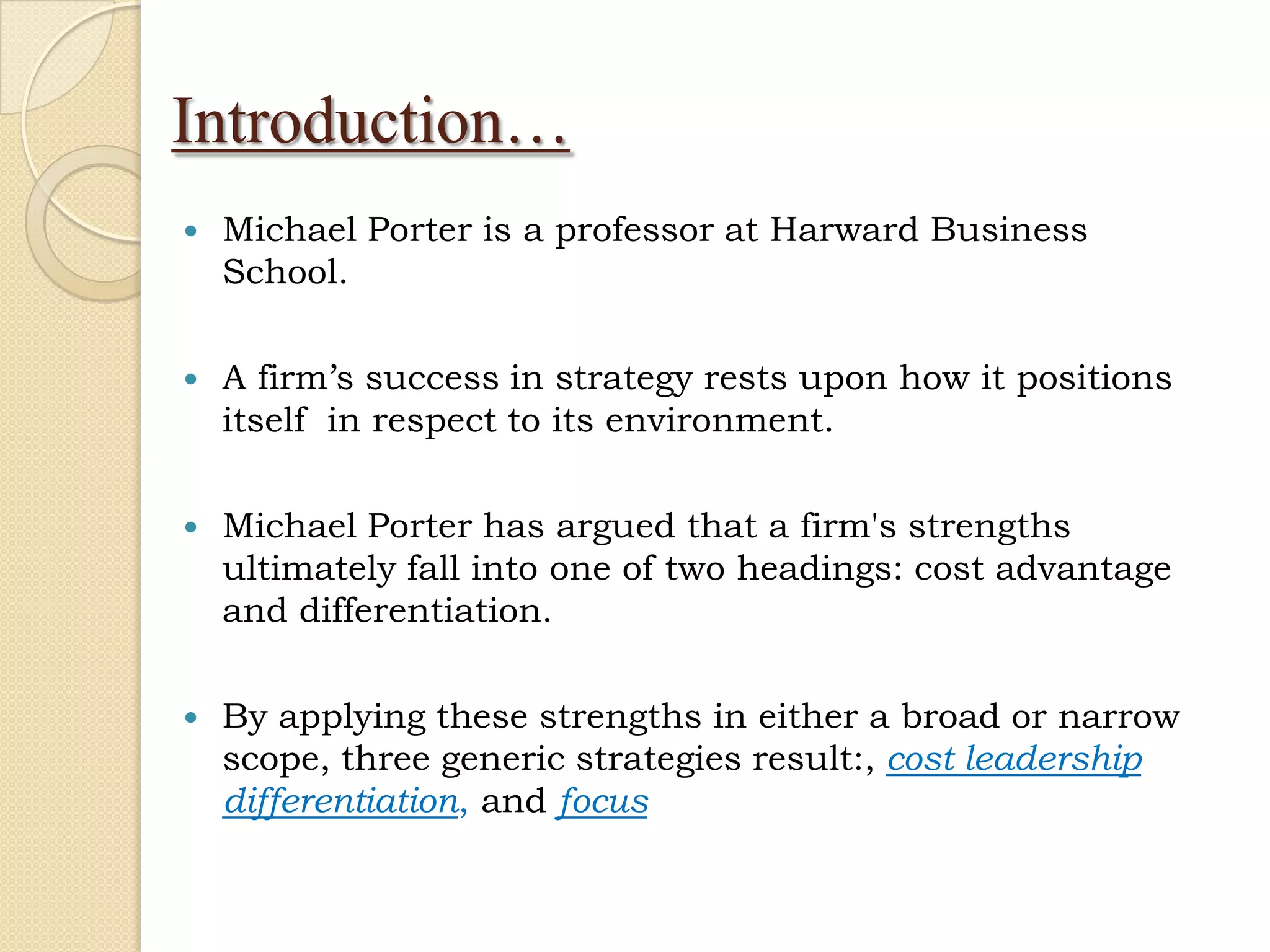
    scope, three generic strategies result:, cost leadership
    differentiation, and focus
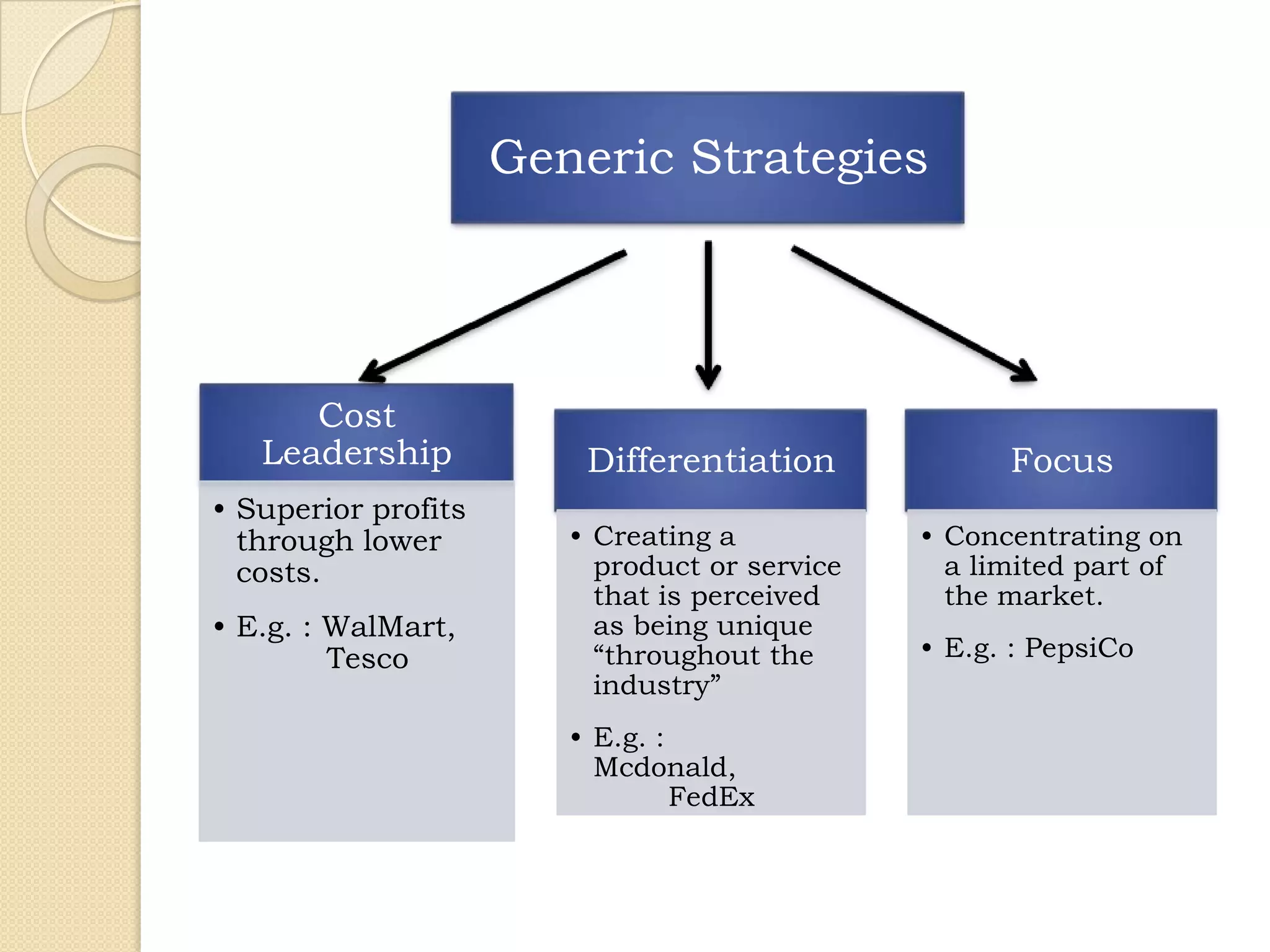
Generic Strategies


      Cost
   Leadership            Differentiation             Focus
• Superior profits
  through lower         • Creating a           • Concentrating on
  costs.                  product or service     a limited part of
                          that is perceived      the market.
• E.g. : WalMart,         as being unique
         Tesco            “throughout the      • E.g. : PepsiCo
                          industry”
                        • E.g. :
                          Mcdonald,
                                 FedEx
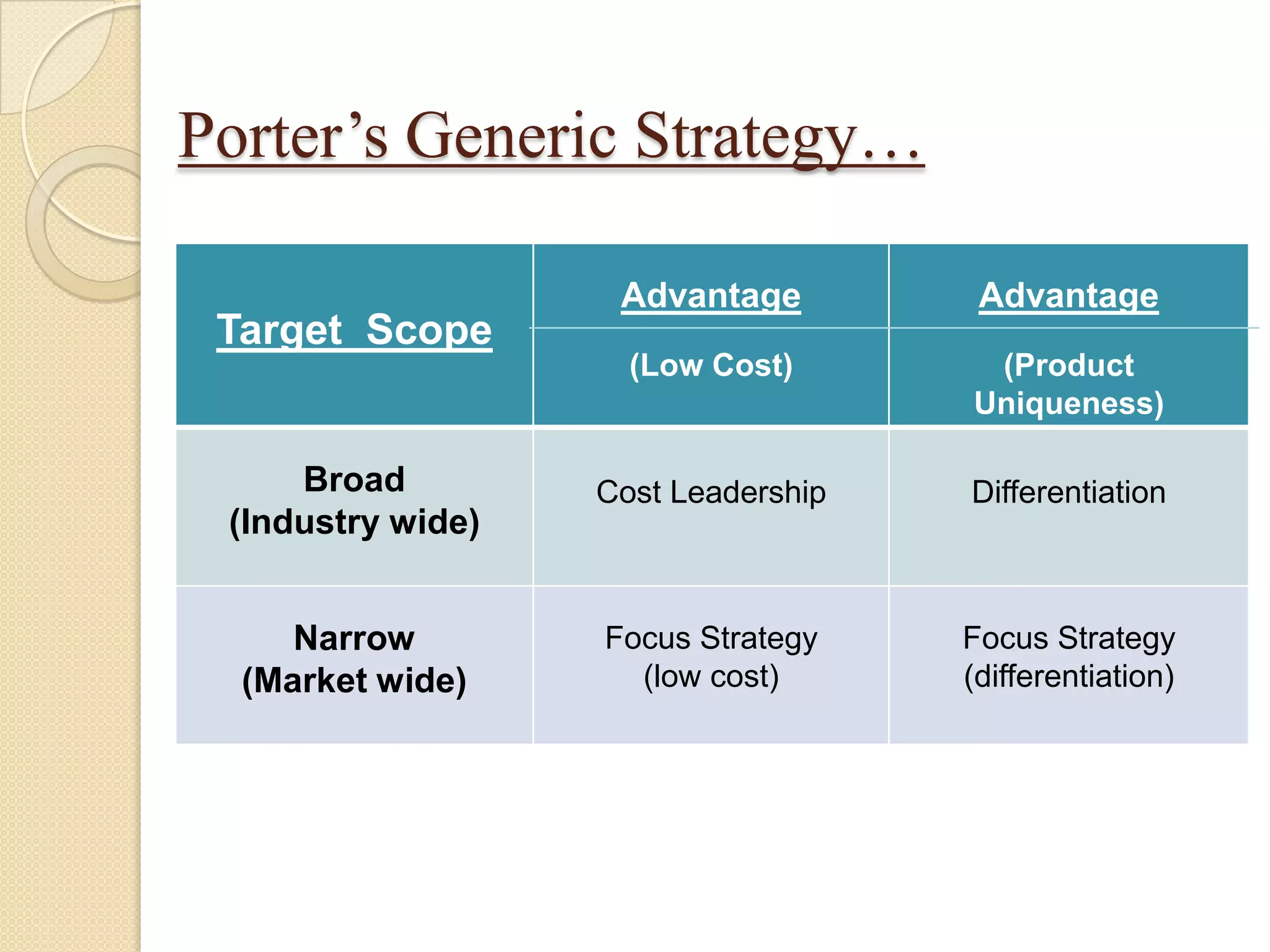
Porter’s Generic Strategy…

                    Advantage         Advantage
 Target Scope
                     (Low Cost)       (Product
                                     Uniqueness)

     Broad         Cost Leadership   Differentiation
 (Industry wide)


     Narrow        Focus Strategy    Focus Strategy
  (Market wide)      (low cost)      (differentiation)
Cost Leadership Strategy
   Aiming to become Lowest Cost Producer
   The firm can compete on the price with every other
    industries and earn higher unit profits.
   Cost reduction provides the focus of the organisation’s
    strategy.
   Targets a broad market.
   Competitive advantage is achieved by driving down
    costs.
   A successful cost leadership strategy requires that the
    firm is the cost leader and is unchallenged in this
    position.
   Especially beneficial : where customers are price
    sensitive
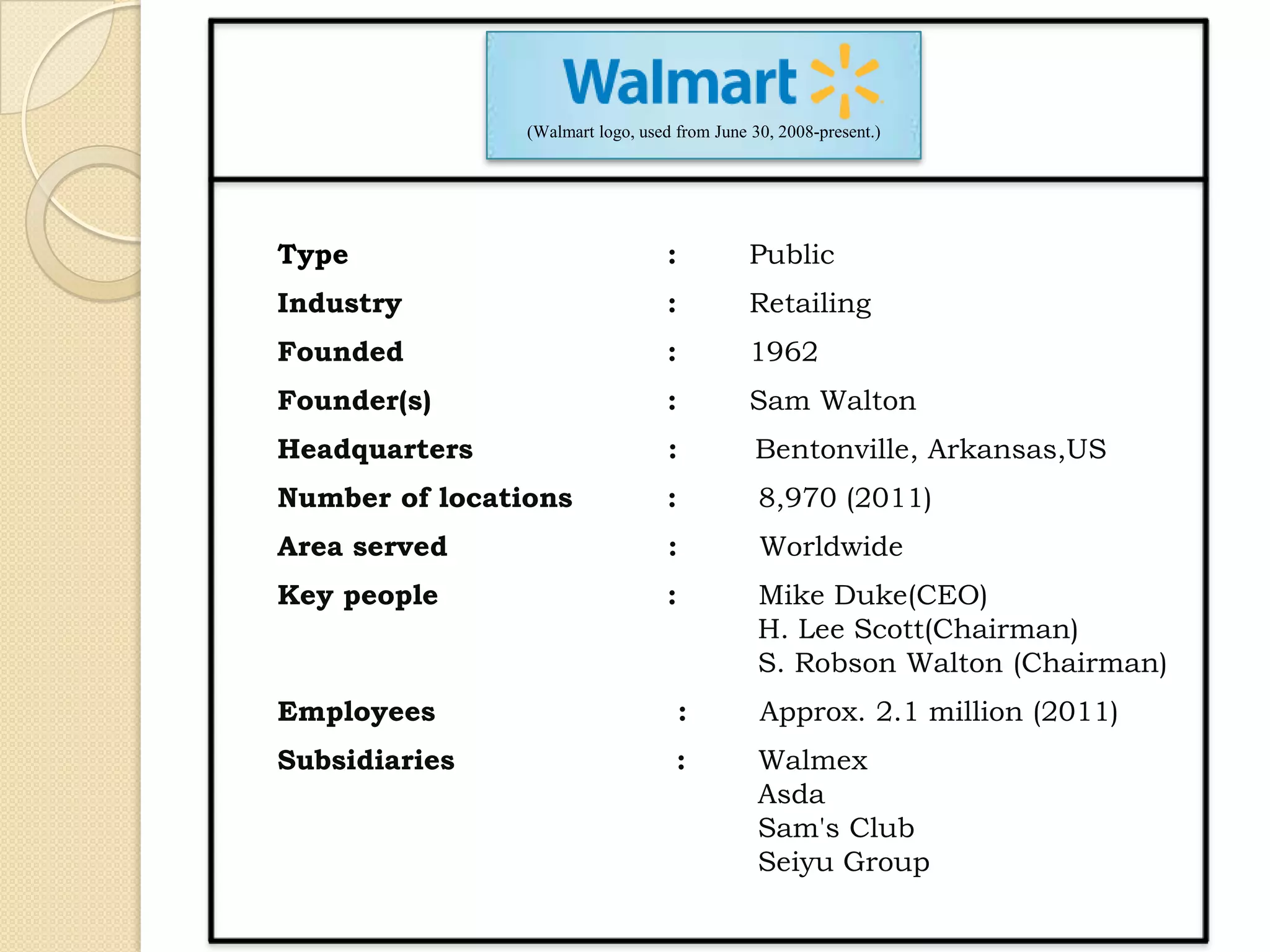
(Walmart logo, used from June 30, 2008-present.)


Type                               :          Public
Industry                           :          Retailing
Founded                            :          1962
Founder(s)                         :          Sam Walton
Headquarters                       :          Bentonville, Arkansas,US
Number of locations                :           8,970 (2011)
Area served                        :           Worldwide
Key people                         :           Mike Duke(CEO)
                                               H. Lee Scott(Chairman)
                                               S. Robson Walton (Chairman)
Employees                              :       Approx. 2.1 million (2011)
Subsidiaries                        :          Walmex
                                               Asda
                                               Sam's Club
                                               Seiyu Group
   The central goal of Wal-Mart is to keep retail prices low -- and
    the company has been very successful at this.


   Experts estimate that Wal-Mart saves shoppers at least 15
    percent on a typical cart of groceries.


   Wal-Mart Stores Inc. is rolling out its "everyday low prices"
    (EDLP) retail strategy to more international markets to replace
    the more usual high-low pricing in emerging markets. EDLP
    means working with suppliers to ensure their prices are
    constantly low, but also means price changes are kept to a
    minimum.


    Wal-Mart also employs a good structure that works with the
    systems to empower the low price strategy.


    Wal-Mart has in place a set of systems that helps it achieve its
    strategy of low prices everyday.
Success Mantra…
   Access to the capital required to make a significant
    investment in production assets.

   Design skills for efficient manufacturing

   High level of expertise in manufacturing process
    engineering.

   Efficient distribution channels.
Risks Involved..
   Other firms may be able to lower their costs as well.

   As technology improves, the competition may be able to
    leapfrog the production capabilities, thus eliminating
    the competitive advantage.

   It could lead to a damaging price wars.

   There might be difficulty in sustaining cost leadership
    in the long run.

   A firm following a focus strategy might be able to
    achieve even lower cost within their segment.
Differentiation Strategy
   A differentiation strategy calls for the development of a
    product or service that offers unique attributes that are
    valued by customers.

   Customers perceive the product to be different and
    better than that of rivals.

   The value added by the uniqueness of the product may
    allow the firm to charge a premium price for it.

   Differentiation can be based on product image or
    durability,after-sales,quality,additional features.

   It requires flair,research capability and strong
    marketing.
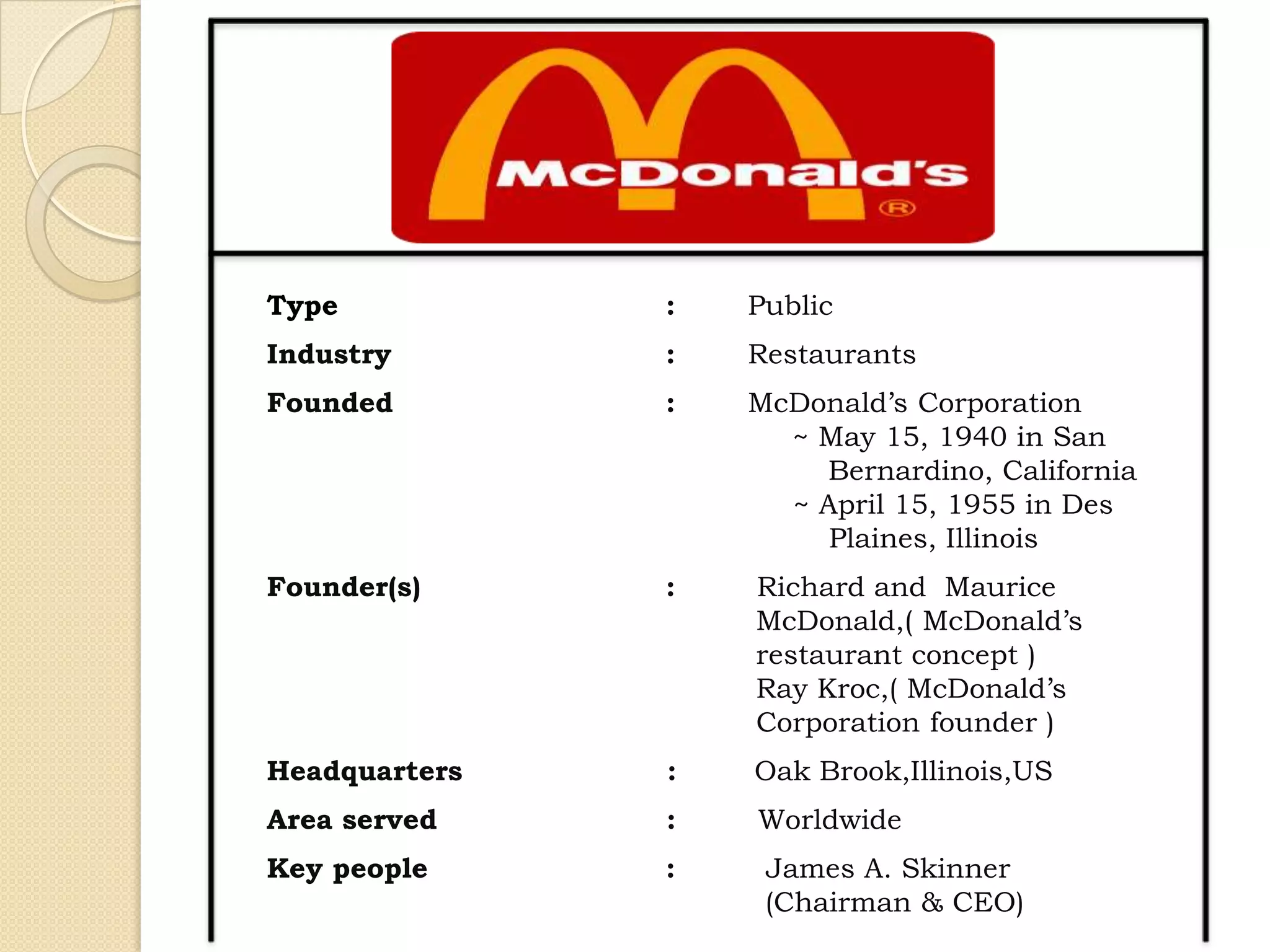
Type           :   Public
Industry       :   Restaurants
Founded        :   McDonald’s Corporation
                     ~ May 15, 1940 in San
                        Bernardino, California
                     ~ April 15, 1955 in Des
                        Plaines, Illinois
Founder(s)     :   Richard and Maurice
                   McDonald,( McDonald’s
                   restaurant concept )
                   Ray Kroc,( McDonald’s
                   Corporation founder )
Headquarters   :   Oak Brook,Illinois,US
Area served    :   Worldwide
Key people     :    James A. Skinner
                    (Chairman & CEO)
Number of locations   :    32,000
            Employees             :     4,00,000 ( 2010)
            Products              :       Fast Food
                                       ( hamburgers , chicken ,
                                         french fries , soft drinks ,
                                         coffee , milkshakes
, salads,                                desserts , breakfast )


       McDonald's customers are of all classes, but largely
        working and middle classes, and people of all ages.

       McDonald’s strove to meet a customer wait time at no
        more than one minute in line and 30 seconds at the
        counter.
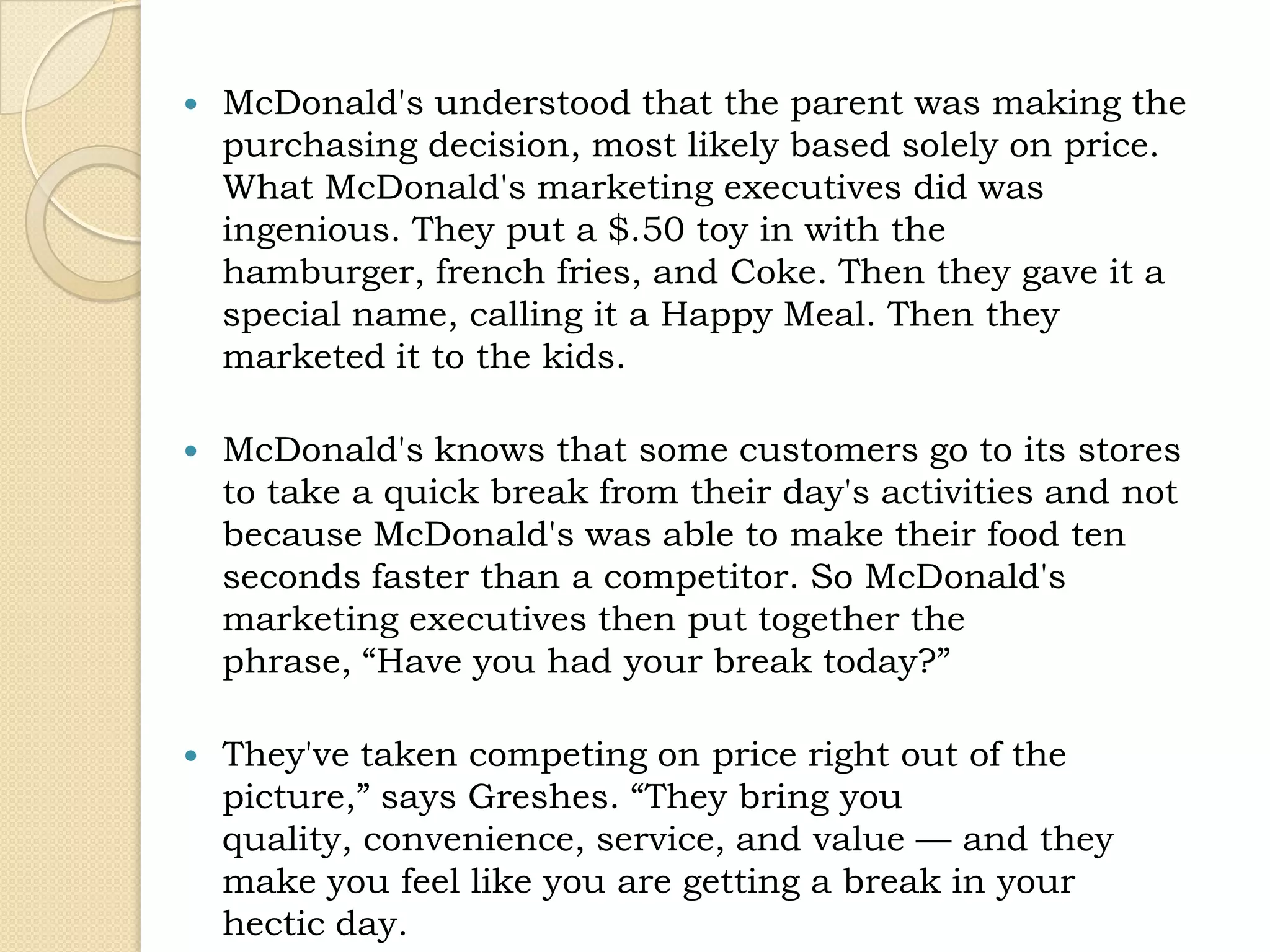
   McDonald's understood that the parent was making the
    purchasing decision, most likely based solely on price.
    What McDonald's marketing executives did was
    ingenious. They put a $.50 toy in with the
    hamburger, french fries, and Coke. Then they gave it a
    special name, calling it a Happy Meal. Then they
    marketed it to the kids.

   McDonald's knows that some customers go to its stores
    to take a quick break from their day's activities and not
    because McDonald's was able to make their food ten
    seconds faster than a competitor. So McDonald's
    marketing executives then put together the
    phrase, “Have you had your break today?”

   They've taken competing on price right out of the
    picture,” says Greshes. “They bring you
    quality, convenience, service, and value — and they
    make you feel like you are getting a break in your
    hectic day.
Success Mantra…
   Access to leading scientific research.

   Highly skilled and creative product development team.

   Strong sales team with the ability to successfully
    communicate the perceived strengths of the product.

   Corporate reputation for quality and innovation.
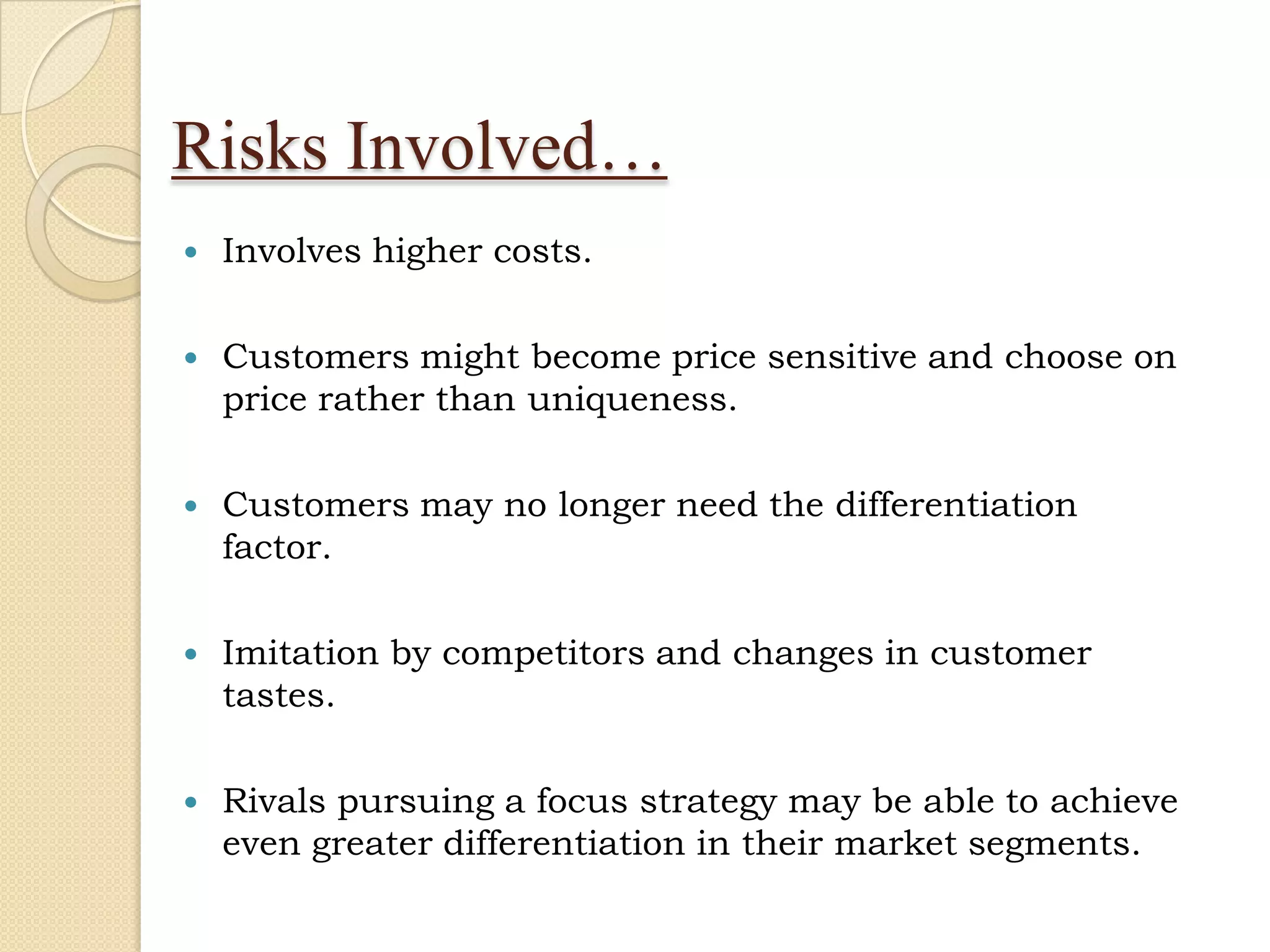
Risks Involved…
   Involves higher costs.

   Customers might become price sensitive and choose on
    price rather than uniqueness.

   Customers may no longer need the differentiation
    factor.

   Imitation by competitors and changes in customer
    tastes.

   Rivals pursuing a focus strategy may be able to achieve
    even greater differentiation in their market segments.
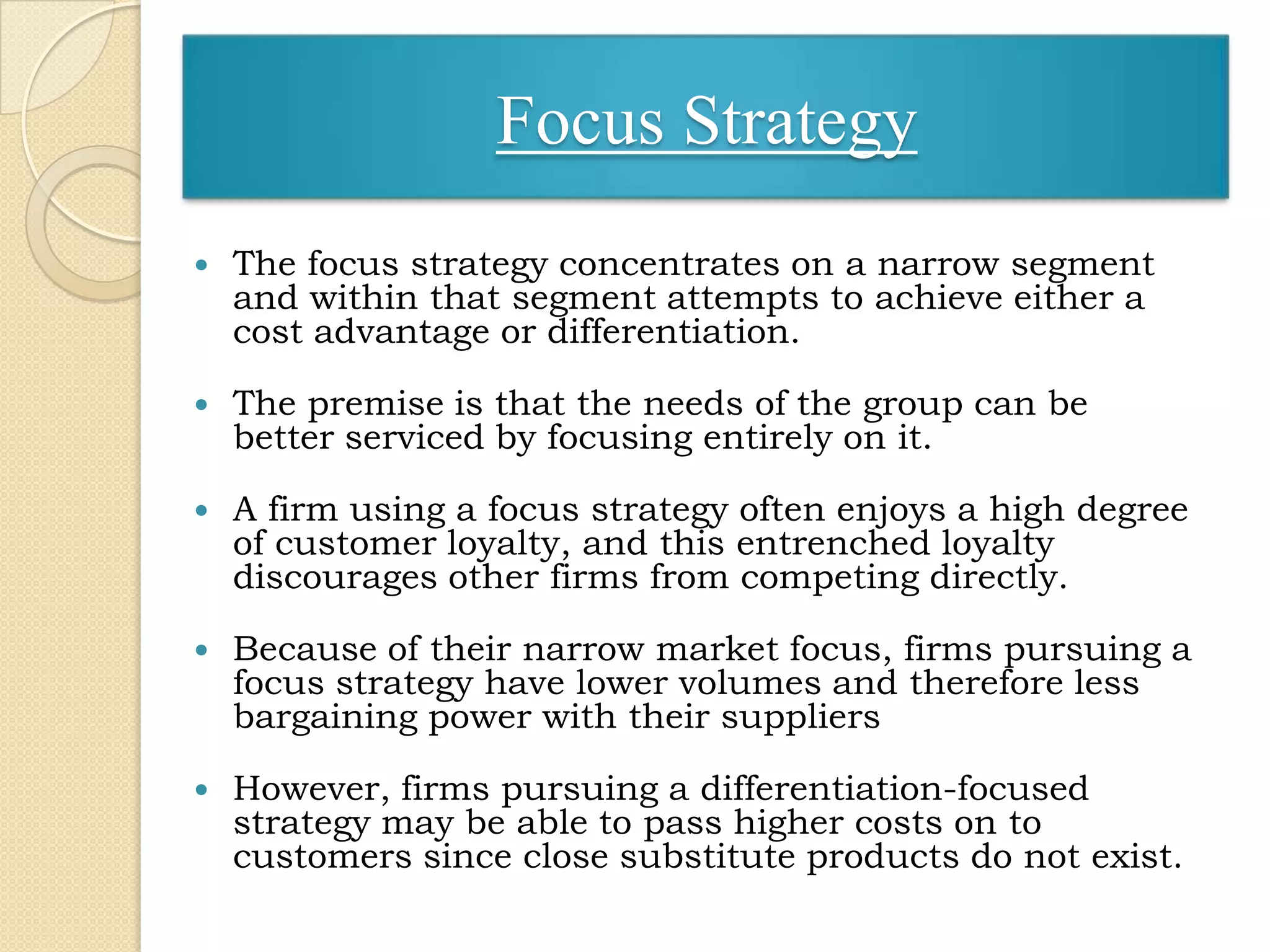
Focus Strategy
   The focus strategy concentrates on a narrow segment
    and within that segment attempts to achieve either a
    cost advantage or differentiation.

   The premise is that the needs of the group can be
    better serviced by focusing entirely on it.

   A firm using a focus strategy often enjoys a high degree
    of customer loyalty, and this entrenched loyalty
    discourages other firms from competing directly.

   Because of their narrow market focus, firms pursuing a
    focus strategy have lower volumes and therefore less
    bargaining power with their suppliers

   However, firms pursuing a differentiation-focused
    strategy may be able to pass higher costs on to
    customers since close substitute products do not exist.
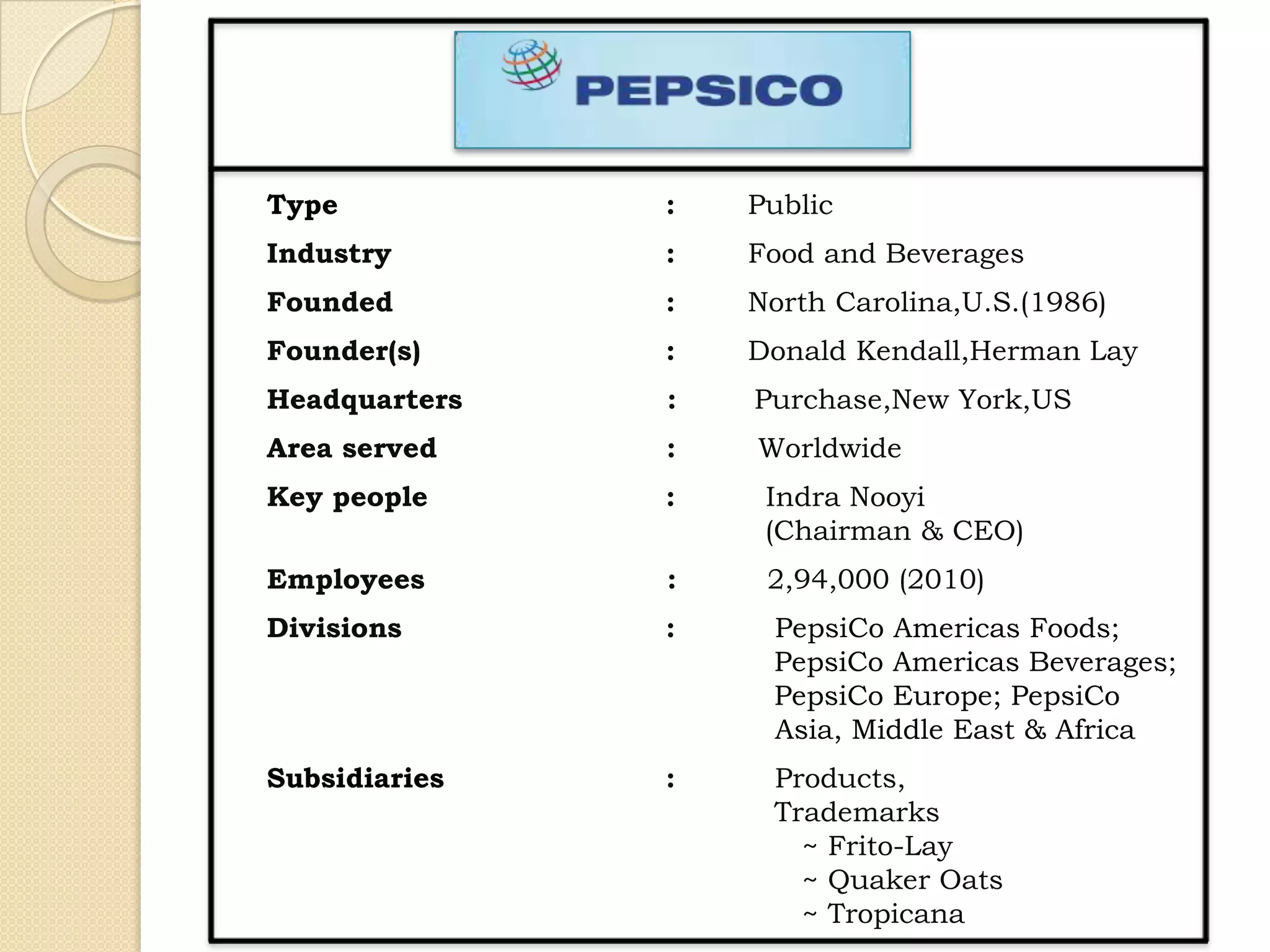
Type           :   Public
Industry       :   Food and Beverages
Founded        :   North Carolina,U.S.(1986)
Founder(s)     :   Donald Kendall,Herman Lay
Headquarters   :   Purchase,New York,US
Area served    :   Worldwide
Key people     :    Indra Nooyi
                    (Chairman & CEO)
Employees      :    2,94,000 (2010)
Divisions      :    PepsiCo Americas Foods;
                    PepsiCo Americas Beverages;
                    PepsiCo Europe; PepsiCo
                    Asia, Middle East & Africa
Subsidiaries   :    Products,
                    Trademarks
                      ~ Frito-Lay
                      ~ Quaker Oats
                      ~ Tropicana
   By successfully adopting the 'focus' strategy since
    1997, PepsiCo has emerged as the second largest
    consumer packaged goods company.

   The company has significantly strengthened its
    competitive position in the beverages segment.

   By acquiring leading beverages' company like Tropicana
    products (July 1998), South Beach Beverage Company
    (October 2000) and Quaker Oats (December 2000)
Success Mantra…
   Lower investment in resources.

   The firm benefits from specialisation.

   Provides scope for greater knowledge of a segment of
    the market.

   Makes entry to new markets easier and less costly.

   Firms using a focus strategy often enjoy a high degree
    of customer loyalty.
Risk Involved…
   Limited opportunities for growth.

   The firm could outgrow the market.

   Danger of decline in the chosen segment or niche.

   Risk of imitation.

   Risk of changes in the target segment.

   A reputation for specialisation inhibits move into new
    sector.
We have Learnt…
   Cost Leadership
        - Being the lowest cost producer in the industry as
          a whole

   Differentiation
         - The exploitation of a product or service which is
           believed to be unique

   Focus
     - Restricting activities to only part of the market through:
     - Providing goods or services at lower cost to that
       segment (cost focus)
     - Providing a differentiated product or service to that
       segment (differentiation focus)
prepared by…………..
            DiPALi

Porter's Generic Strategies with examples

  • 1.
  • 2.
    Introduction…  Michael Porter is a professor at Harward Business School.  A firm’s success in strategy rests upon how it positions itself in respect to its environment.  Michael Porter has argued that a firm's strengths ultimately fall into one of two headings: cost advantage and differentiation.  By applying these strengths in either a broad or narrow scope, three generic strategies result:, cost leadership differentiation, and focus
  • 3.
    Generic Strategies Cost Leadership Differentiation Focus • Superior profits through lower • Creating a • Concentrating on costs. product or service a limited part of that is perceived the market. • E.g. : WalMart, as being unique Tesco “throughout the • E.g. : PepsiCo industry” • E.g. : Mcdonald, FedEx
  • 4.
    Porter’s Generic Strategy… Advantage Advantage Target Scope (Low Cost) (Product Uniqueness) Broad Cost Leadership Differentiation (Industry wide) Narrow Focus Strategy Focus Strategy (Market wide) (low cost) (differentiation)
  • 5.
    Cost Leadership Strategy  Aiming to become Lowest Cost Producer  The firm can compete on the price with every other industries and earn higher unit profits.  Cost reduction provides the focus of the organisation’s strategy.  Targets a broad market.  Competitive advantage is achieved by driving down costs.  A successful cost leadership strategy requires that the firm is the cost leader and is unchallenged in this position.  Especially beneficial : where customers are price sensitive
  • 6.
    (Walmart logo, usedfrom June 30, 2008-present.) Type : Public Industry : Retailing Founded : 1962 Founder(s) : Sam Walton Headquarters : Bentonville, Arkansas,US Number of locations : 8,970 (2011) Area served : Worldwide Key people : Mike Duke(CEO) H. Lee Scott(Chairman) S. Robson Walton (Chairman) Employees : Approx. 2.1 million (2011) Subsidiaries : Walmex Asda Sam's Club Seiyu Group
  • 7.
    The central goal of Wal-Mart is to keep retail prices low -- and the company has been very successful at this.  Experts estimate that Wal-Mart saves shoppers at least 15 percent on a typical cart of groceries.  Wal-Mart Stores Inc. is rolling out its "everyday low prices" (EDLP) retail strategy to more international markets to replace the more usual high-low pricing in emerging markets. EDLP means working with suppliers to ensure their prices are constantly low, but also means price changes are kept to a minimum.  Wal-Mart also employs a good structure that works with the systems to empower the low price strategy.  Wal-Mart has in place a set of systems that helps it achieve its strategy of low prices everyday.
  • 8.
    Success Mantra…  Access to the capital required to make a significant investment in production assets.  Design skills for efficient manufacturing  High level of expertise in manufacturing process engineering.  Efficient distribution channels.
  • 9.
    Risks Involved..  Other firms may be able to lower their costs as well.  As technology improves, the competition may be able to leapfrog the production capabilities, thus eliminating the competitive advantage.  It could lead to a damaging price wars.  There might be difficulty in sustaining cost leadership in the long run.  A firm following a focus strategy might be able to achieve even lower cost within their segment.
  • 10.
    Differentiation Strategy  A differentiation strategy calls for the development of a product or service that offers unique attributes that are valued by customers.  Customers perceive the product to be different and better than that of rivals.  The value added by the uniqueness of the product may allow the firm to charge a premium price for it.  Differentiation can be based on product image or durability,after-sales,quality,additional features.  It requires flair,research capability and strong marketing.
  • 11.
    Type : Public Industry : Restaurants Founded : McDonald’s Corporation ~ May 15, 1940 in San Bernardino, California ~ April 15, 1955 in Des Plaines, Illinois Founder(s) : Richard and Maurice McDonald,( McDonald’s restaurant concept ) Ray Kroc,( McDonald’s Corporation founder ) Headquarters : Oak Brook,Illinois,US Area served : Worldwide Key people : James A. Skinner (Chairman & CEO)
  • 12.
    Number of locations : 32,000 Employees : 4,00,000 ( 2010) Products : Fast Food ( hamburgers , chicken , french fries , soft drinks , coffee , milkshakes , salads, desserts , breakfast )  McDonald's customers are of all classes, but largely working and middle classes, and people of all ages.  McDonald’s strove to meet a customer wait time at no more than one minute in line and 30 seconds at the counter.
  • 13.
    McDonald's understood that the parent was making the purchasing decision, most likely based solely on price. What McDonald's marketing executives did was ingenious. They put a $.50 toy in with the hamburger, french fries, and Coke. Then they gave it a special name, calling it a Happy Meal. Then they marketed it to the kids.  McDonald's knows that some customers go to its stores to take a quick break from their day's activities and not because McDonald's was able to make their food ten seconds faster than a competitor. So McDonald's marketing executives then put together the phrase, “Have you had your break today?”  They've taken competing on price right out of the picture,” says Greshes. “They bring you quality, convenience, service, and value — and they make you feel like you are getting a break in your hectic day.
  • 14.
    Success Mantra…  Access to leading scientific research.  Highly skilled and creative product development team.  Strong sales team with the ability to successfully communicate the perceived strengths of the product.  Corporate reputation for quality and innovation.
  • 15.
    Risks Involved…  Involves higher costs.  Customers might become price sensitive and choose on price rather than uniqueness.  Customers may no longer need the differentiation factor.  Imitation by competitors and changes in customer tastes.  Rivals pursuing a focus strategy may be able to achieve even greater differentiation in their market segments.
  • 16.
    Focus Strategy  The focus strategy concentrates on a narrow segment and within that segment attempts to achieve either a cost advantage or differentiation.  The premise is that the needs of the group can be better serviced by focusing entirely on it.  A firm using a focus strategy often enjoys a high degree of customer loyalty, and this entrenched loyalty discourages other firms from competing directly.  Because of their narrow market focus, firms pursuing a focus strategy have lower volumes and therefore less bargaining power with their suppliers  However, firms pursuing a differentiation-focused strategy may be able to pass higher costs on to customers since close substitute products do not exist.
  • 17.
    Type : Public Industry : Food and Beverages Founded : North Carolina,U.S.(1986) Founder(s) : Donald Kendall,Herman Lay Headquarters : Purchase,New York,US Area served : Worldwide Key people : Indra Nooyi (Chairman & CEO) Employees : 2,94,000 (2010) Divisions : PepsiCo Americas Foods; PepsiCo Americas Beverages; PepsiCo Europe; PepsiCo Asia, Middle East & Africa Subsidiaries : Products, Trademarks ~ Frito-Lay ~ Quaker Oats ~ Tropicana
  • 18.
    By successfully adopting the 'focus' strategy since 1997, PepsiCo has emerged as the second largest consumer packaged goods company.  The company has significantly strengthened its competitive position in the beverages segment.  By acquiring leading beverages' company like Tropicana products (July 1998), South Beach Beverage Company (October 2000) and Quaker Oats (December 2000)
  • 19.
    Success Mantra…  Lower investment in resources.  The firm benefits from specialisation.  Provides scope for greater knowledge of a segment of the market.  Makes entry to new markets easier and less costly.  Firms using a focus strategy often enjoy a high degree of customer loyalty.
  • 20.
    Risk Involved…  Limited opportunities for growth.  The firm could outgrow the market.  Danger of decline in the chosen segment or niche.  Risk of imitation.  Risk of changes in the target segment.  A reputation for specialisation inhibits move into new sector.
  • 21.
    We have Learnt…  Cost Leadership - Being the lowest cost producer in the industry as a whole  Differentiation - The exploitation of a product or service which is believed to be unique  Focus - Restricting activities to only part of the market through: - Providing goods or services at lower cost to that segment (cost focus) - Providing a differentiated product or service to that segment (differentiation focus)
  • 22.