GENERAL ELECTRIC
MODEL
Group Members:
⪼ Diptendu
⪼ Nandita
⪼ Ayana
⪼ Madhuleena
⪼ Sourav
NETAJI NAGAR DAY COLLEGE
M.COM PART-1 [ Session 2012-2014]
INTRODUCTION
• This matrix was developed in 1970s by the
General Electric Company with the assistance of the
consulting firm, McKinsey & Co, USA. This is also
called GE multifactor portfolio matrix.
• The G.E Model is an alternative technique used in
brand marketing and product management to help
a company decide what products to its product portfolio
and which market opportunities are worthy of continued
investment.
• This matrix consists of nine cells (3X3) based on two key
variables :
1. Business Strength
2. Industry Attractiveness
OBJECTIVE OF G.E MODEL
• The GE/McKinsey Matrix identifies the optimum
business portfolio as one that fits perfectly to the
company's strengths and helps to explore the most
attractive industry sectors or markets.
• The objective of the analysis is to position each SBU on
the chart depending on the SBU's Strength and the
Attractiveness of the Industry Sector or Market on which
it is focused. Each axis is divided into Low, Medium and
High.
FACTORS OF MARKET ATTRACTIVENESS
AND
BUSINESS STRENGTHS
MARKET ATTRACTIVENESS BUSINESS STRENGTHS
(External) (Internal)
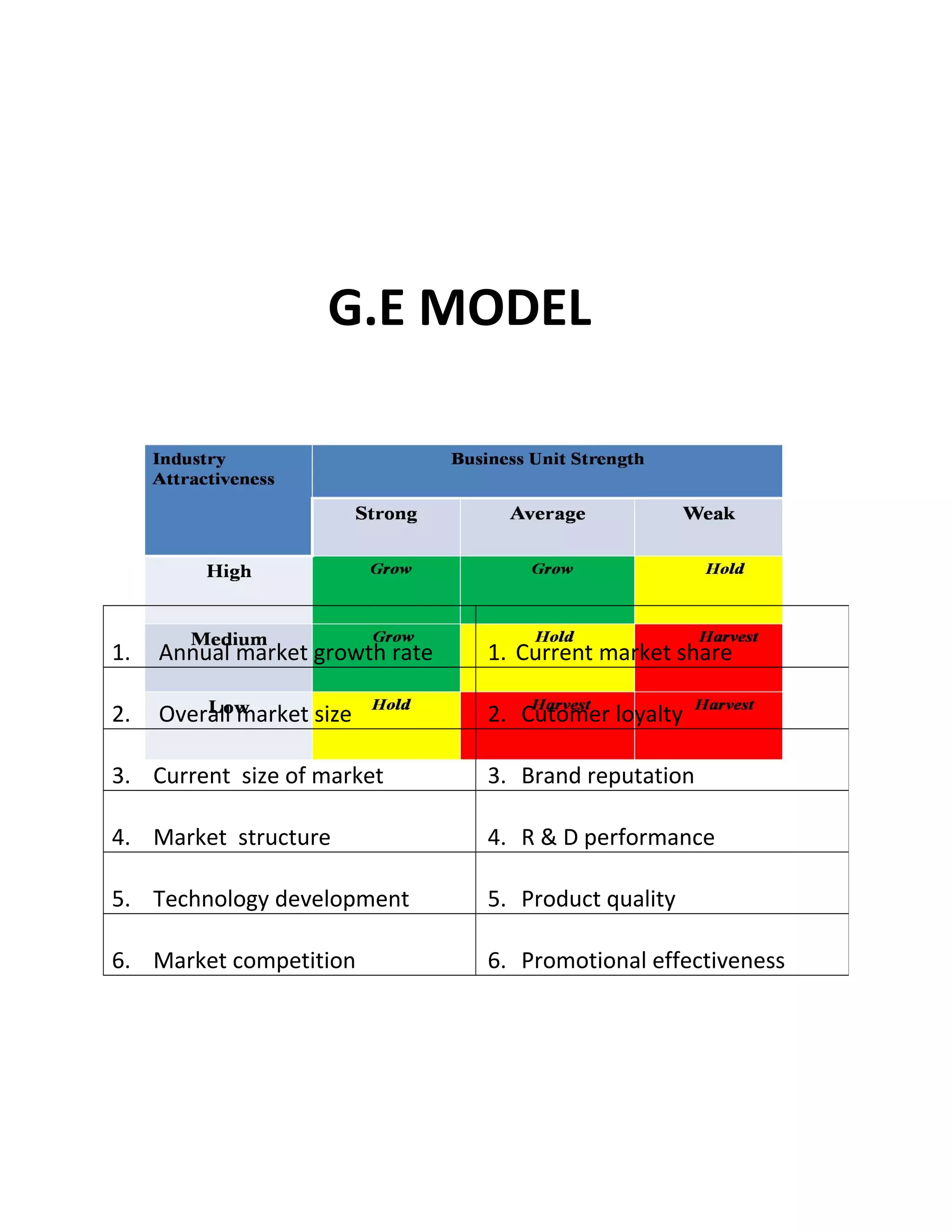
G.E MODEL
1. Annual market growth rate 1. Current market share
2. Overall market size 2. Cutomer loyalty
3. Current size of market 3. Brand reputation
4. Market structure 4. R & D performance
5. Technology development 5. Product quality
6. Market competition 6. Promotional effectiveness
Grow – Business units that fall under grow attract high
investment. Firms may go for product differentiation or Cost
leadership. Huge cash is generated in this phase. Market
leaders exist in this phase.
Hold – Business units that fall under hold phase attract
moderate investment. Market segmentation, Market
penetration, imitation strategies are adopted in this phase.
Followers exist in this phase.
Harvest - Business units that fall under this phase are
unattractive. Low priority is given in these business units.
Strategies like divestment, Diversification, mergers are adopted
in this phase.
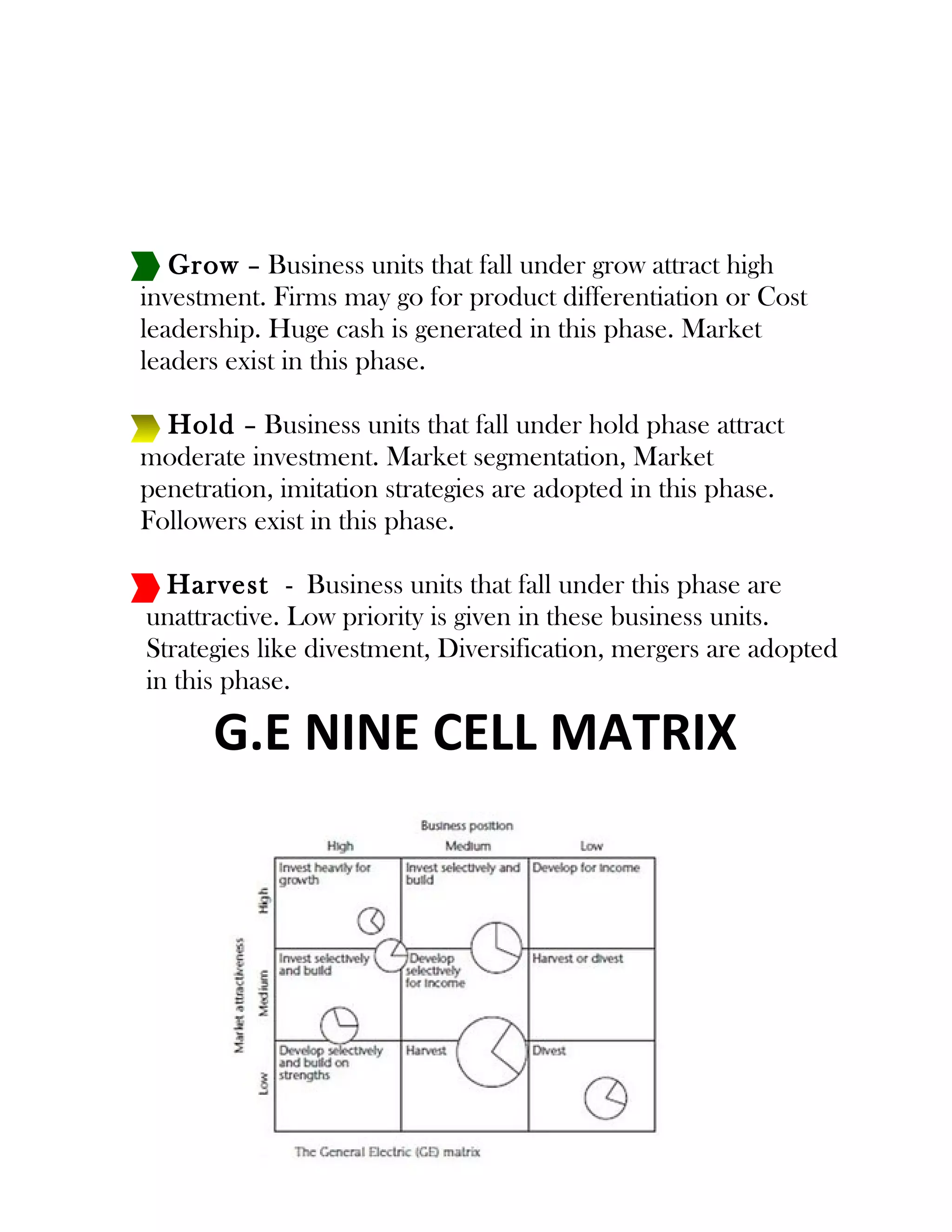
G.E NINE CELL MATRIX
Superimposed on the basic diagram are a number of circles. These
circles are of variable size. The plotted circles convey the information in
the following way:
 The size of the circle represents the market size of the SBU.
 Within each circle is a clearly defined segment which represents the
business’s market share within that market.
 The larger the circle, the larger the market, and the larger the
segment, the larger the market share.
DIFFERENCE BETWEEN BCG MATRIX
AND G.E MATRIX
BCG MATRIX G.E MATRIX
ADVANTAGES
• More sophisticated than BCG matrix.
• Helps managers to think more strategically
1. BCG Matrix consists of 4 cells. 1. G.E. Matrix consists of 9 cells.
2. The business unit is rated against
relative market share and industry
growth rate.
2. The business unit is rated against business
strength and industry attractiveness.
3. The matrix uses 2 types of classification
i.e high and low.
3. The matrix uses 3 types of classification, i.e,
high/medium/low & strong/ average/ weak.
4. BCG model can be made quickly. 4. G.E model needs more time to prepare.
• Helps to improve the performance of
business
• Provide directions regarding resources
allocation
• Helps in the growth of business
• Provides information about strengths and
weaknesses
• Provides information about opportunities
available in market
LIMITATIONS
• The interrelationship among SBU’s is not
taken into account.
• It requires a huge amount of data & research.
• Factors ranking is subjective and personal.
• Time consuming & costly.
• Proper implementation of strategies are
absent.

General electric model small presentation

  • 1.
    GENERAL ELECTRIC MODEL Group Members: ⪼Diptendu ⪼ Nandita ⪼ Ayana ⪼ Madhuleena ⪼ Sourav
  • 2.
    NETAJI NAGAR DAYCOLLEGE M.COM PART-1 [ Session 2012-2014] INTRODUCTION • This matrix was developed in 1970s by the General Electric Company with the assistance of the consulting firm, McKinsey & Co, USA. This is also called GE multifactor portfolio matrix. • The G.E Model is an alternative technique used in brand marketing and product management to help a company decide what products to its product portfolio and which market opportunities are worthy of continued investment. • This matrix consists of nine cells (3X3) based on two key variables : 1. Business Strength
  • 3.
    2. Industry Attractiveness OBJECTIVEOF G.E MODEL • The GE/McKinsey Matrix identifies the optimum business portfolio as one that fits perfectly to the company's strengths and helps to explore the most attractive industry sectors or markets. • The objective of the analysis is to position each SBU on the chart depending on the SBU's Strength and the Attractiveness of the Industry Sector or Market on which it is focused. Each axis is divided into Low, Medium and High.
  • 4.
    FACTORS OF MARKETATTRACTIVENESS AND BUSINESS STRENGTHS MARKET ATTRACTIVENESS BUSINESS STRENGTHS (External) (Internal)
  • 5.
    G.E MODEL 1. Annualmarket growth rate 1. Current market share 2. Overall market size 2. Cutomer loyalty 3. Current size of market 3. Brand reputation 4. Market structure 4. R & D performance 5. Technology development 5. Product quality 6. Market competition 6. Promotional effectiveness
  • 6.
    Grow – Businessunits that fall under grow attract high investment. Firms may go for product differentiation or Cost leadership. Huge cash is generated in this phase. Market leaders exist in this phase. Hold – Business units that fall under hold phase attract moderate investment. Market segmentation, Market penetration, imitation strategies are adopted in this phase. Followers exist in this phase. Harvest - Business units that fall under this phase are unattractive. Low priority is given in these business units. Strategies like divestment, Diversification, mergers are adopted in this phase. G.E NINE CELL MATRIX
  • 7.
    Superimposed on thebasic diagram are a number of circles. These circles are of variable size. The plotted circles convey the information in the following way:  The size of the circle represents the market size of the SBU.  Within each circle is a clearly defined segment which represents the business’s market share within that market.  The larger the circle, the larger the market, and the larger the segment, the larger the market share. DIFFERENCE BETWEEN BCG MATRIX AND G.E MATRIX BCG MATRIX G.E MATRIX
  • 8.
    ADVANTAGES • More sophisticatedthan BCG matrix. • Helps managers to think more strategically 1. BCG Matrix consists of 4 cells. 1. G.E. Matrix consists of 9 cells. 2. The business unit is rated against relative market share and industry growth rate. 2. The business unit is rated against business strength and industry attractiveness. 3. The matrix uses 2 types of classification i.e high and low. 3. The matrix uses 3 types of classification, i.e, high/medium/low & strong/ average/ weak. 4. BCG model can be made quickly. 4. G.E model needs more time to prepare.
  • 9.
    • Helps toimprove the performance of business • Provide directions regarding resources allocation • Helps in the growth of business • Provides information about strengths and weaknesses • Provides information about opportunities available in market LIMITATIONS • The interrelationship among SBU’s is not taken into account.
  • 10.
    • It requiresa huge amount of data & research. • Factors ranking is subjective and personal. • Time consuming & costly. • Proper implementation of strategies are absent.