Women constitute ½ of the world’s population, 
2/3 of the world’s labour force but get 1/10th of 
the world’s income and 1% of the world’s 
Wealth. 
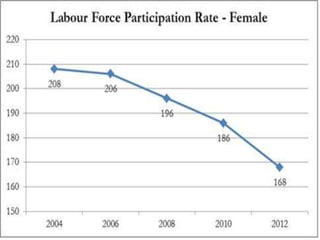
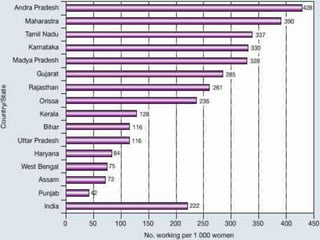
As per 2001 Census, 23% of women are in the 
work force. 94% of all working women are in 
the informal sector.
 “Women carry a disproportionately greater 
burden of work than men and since women are 
responsible for a greater share of non-SNA 
(System of National Accounts) work in the 
care economy , they enter labour market 
already overburdened with work.” Report of 
Gender Diagnosis and Budgeting in India of 
National Institute of Public Finance and Policy, 
NIPFP. December, 2001
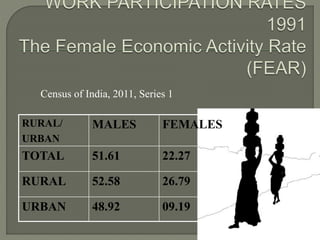
Census of India, 2011, Series 1 
RURAL/ 
URBAN 
MALES FEMALES 
TOTAL 51.61 22.27 
RURAL 52.58 26.79 
URBAN 48.92 09.19
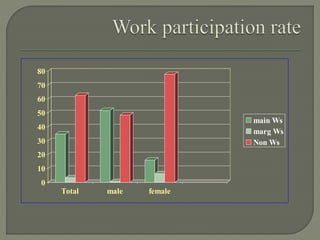
80 
70 
60 
50 
40 
30 
20 
10 
0 
Total male female 
main Ws 
marg Ws 
Non Ws
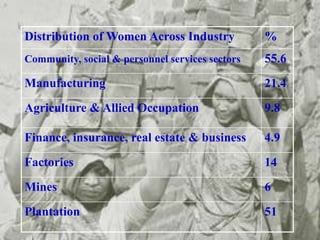
Distribution of Women Across Industry % 
Community, social & personnel services sectors 55.6 
Manufacturing 21.4 
Agriculture & Allied Occupation 9.8 
Finance, insurance, real estate & business 4.9 
Factories 14 
Mines 6 
Plantation 51
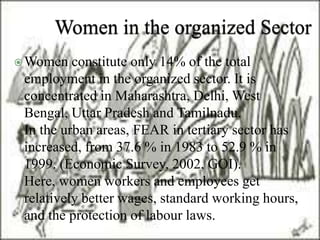
Women constitute only 14% of the total 
employment in the organized sector. It is 
concentrated in Maharashtra, Delhi, West 
Bengal, Uttar Pradesh and Tamilnadu. 
In the urban areas, FEAR in tertiary sector has 
increased, from 37.6 % in 1983 to 52.9 % in 
1999. (Economic Survey, 2002, GOI). 
Here, women workers and employees get 
relatively better wages, standard working hours, 
and the protection of labour laws.
Changes in age-structure, urbanisation, 
level & nature of economic development, 
infrastructure, government policies, labour 
laws, nature of work,structure of family, 
culture & tradition affecting autonomy and 
control, fertility levels and childbearing 
practices, nature of housework, women’s 
property rights, education, age at marriage, 
migration, access to technology.
Nature of wage differentials (WD)-for 
identical tasks women are paid less. And 
women are confined to relatively inferior 
tasks, casual work. 
Causes of WD-patriarchal attitude, myths 
Effects of WD- subordination of women, 
son preference, man is treated as a “bread 
winner”- Head of the Household (HoH)
Legislative measures 
Equal Remuneration Act 
 Formation of women’s union 
Constitutional guarantees 
Job reservation for women 
Self Help Groups(SHGs)
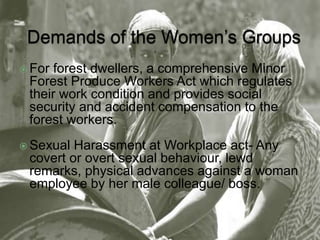
 For forest dwellers, a comprehensive Minor 
Forest Produce Workers Act which regulates 
their work condition and provides social 
security and accident compensation to the 
forest workers. 
 Sexual Harassment at Workplace act- Any 
covert or overt sexual behaviour, lewd 
remarks, physical advances against a woman 
employee by her male colleague/ boss.
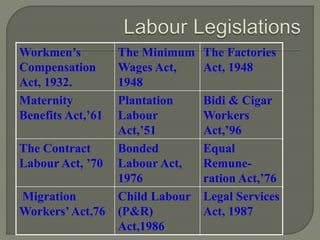
Workmen’s 
Compensation 
Act, 1932. 
The Minimum 
Wages Act, 
1948 
The Factories 
Act, 1948 
Maternity 
Benefits Act,’61 
Plantation 
Labour 
Act,’51 
Bidi & Cigar 
Workers 
Act,’96 
The Contract 
Labour Act, ’70 
Bonded 
Labour Act, 
1976 
Equal 
Remune-ration 
Act,’76 
Migration 
Workers’ Act,76 
Child Labour 
(P&R) 
Act,1986 
Legal Services 
Act, 1987
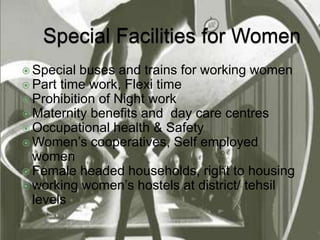
 Special buses and trains for working women 
 Part time work, Flexi time 
 Prohibition of Night work 
 Maternity benefits and day care centres 
 Occupational health & Safety 
 Women’s cooperatives, Self employed 
women 
 Female headed households, right to housing 
 working women’s hostels at district/ tehsil 
levels
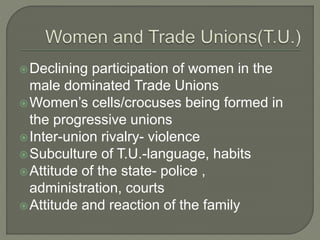
Declining participation of women in the 
male dominated Trade Unions 
Women’s cells/crocuses being formed in 
the progressive unions 
 Inter-union rivalry- violence 
Subculture of T.U.-language, habits 
 Attitude of the state- police , 
administration, courts 
 Attitude and reaction of the family
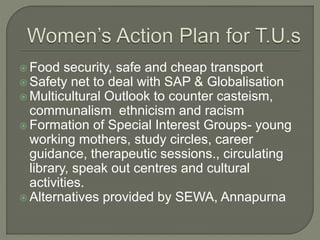
 Food security, safe and cheap transport 
 Safety net to deal with SAP & Globalisation 
 Multicultural Outlook to counter casteism, 
communalism ethnicism and racism 
 Formation of Special Interest Groups- young 
working mothers, study circles, career 
guidance, therapeutic sessions., circulating 
library, speak out centres and cultural 
activities. 
 Alternatives provided by SEWA, Annapurna
Implementation of statutory provision 
Guaranteeing state stipulated minimum 
wages 
Reduction in military budget 
Environmental issues- fuel, fodder, water 
Land rights of agrarian and tribal women 
Public education/ awareness generation
 Conventional indicators of DEVELOPMENT 
are economic growth, rise in national & per 
capita income and GDP, rapid pace of 
urbanisation, high mobility of labour & capital, 
expansion of industrial base, agrarian growth 
and growth of foreign trade. 
 This thinking has been challenged by gender 
economists as this indicators have not taken 
into consideration just distribution of resources, 
opportunities and material wellbeing to majority 
of human beings, especially women.
Women in Development-awareness about 
marginalisation of women, Towards Equality 
Report, The UN Charter, 1975.Equality, Deve, 
Peace 
Women & Development- integration of women in 
the mainstream through Education, health and 
economic development of women- NPP, GOI. 
 Gender & Development- bending the existing 
power structure in favour of women thru’ 
empowerment of women in apex bodies of 
decision making. CEDAW
 Main indicators of human development are 
educational achievements, income, health profile 
and human rights. 
 Human Development Report, 2001 has provided 
development radars comprising of 8 indicators-indices 
of poverty, per capita consumption 
expenditure, life expectancy at age one, infant 
mortality rates, intensity of formal education, literacy 
rates, access to safe drinking water, proportion of 
households with pakka houses. What about 
declining sex- ratio ?
 Women don’t have control over resources in 
the subsistence sector. 
Women work for more hours & in return get 
less wages. 
 Land reforms have taken away land rights of 
women as the titles were made in the name 
of men. 
 Girl Child labour are extremely vulnerable. 
 Absence of social services for women 
workers increases women’s plight at the time 
of pregnancy, old age, illness and destitution.
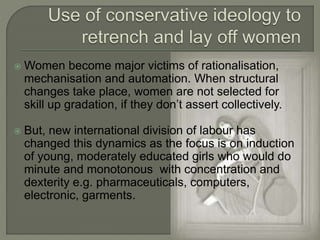
Women become major victims of rationalisation, 
mechanisation and automation. When structural 
changes take place, women are not selected for 
skill up gradation, if they don’t assert collectively. 
 But, new international division of labour has 
changed this dynamics as the focus is on induction 
of young, moderately educated girls who would do 
minute and monotonous with concentration and 
dexterity e.g. pharmaceuticals, computers, 
electronic, garments.
 Patriarchal structure of trade unions- Prejudice of 
male leaders- Women being treated as an auxiliary 
labour force that can be hired last at the time of 
economic expansion & fired first at the time of 
economic recession- Division of labour within 
Unions-Men as leaders and Women as supporters- 
Time & Place of Union meetings-Women’s role in 
collective bargaining & reflection of women’s 
aspirations and demands in the charter of demands-communal 
and casteist biases within T.U. Workers 
Education Programmes- CHILD LABOUR ?
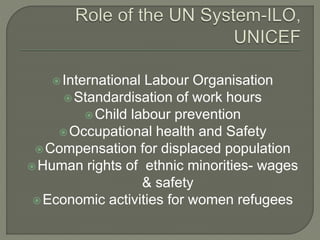
 International Labour Organisation 
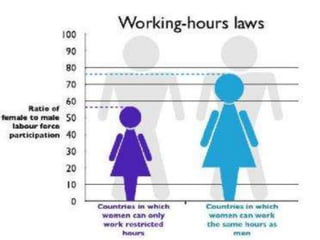
Standardisation of work hours 
Child labour prevention 
Occupational health and Safety 
Compensation for displaced population 
Human rights of ethnic minorities- wages 
& safety 
Economic activities for women refugees
Women labour

Women labour

  • 2.
    Women constitute ½of the world’s population, 2/3 of the world’s labour force but get 1/10th of the world’s income and 1% of the world’s Wealth. As per 2001 Census, 23% of women are in the work force. 94% of all working women are in the informal sector.
  • 3.
     “Women carrya disproportionately greater burden of work than men and since women are responsible for a greater share of non-SNA (System of National Accounts) work in the care economy , they enter labour market already overburdened with work.” Report of Gender Diagnosis and Budgeting in India of National Institute of Public Finance and Policy, NIPFP. December, 2001
  • 4.
    Census of India,2011, Series 1 RURAL/ URBAN MALES FEMALES TOTAL 51.61 22.27 RURAL 52.58 26.79 URBAN 48.92 09.19
  • 5.
    80 70 60 50 40 30 20 10 0 Total male female main Ws marg Ws Non Ws
  • 8.
    Distribution of WomenAcross Industry % Community, social & personnel services sectors 55.6 Manufacturing 21.4 Agriculture & Allied Occupation 9.8 Finance, insurance, real estate & business 4.9 Factories 14 Mines 6 Plantation 51
  • 9.
    Women constitute only14% of the total employment in the organized sector. It is concentrated in Maharashtra, Delhi, West Bengal, Uttar Pradesh and Tamilnadu. In the urban areas, FEAR in tertiary sector has increased, from 37.6 % in 1983 to 52.9 % in 1999. (Economic Survey, 2002, GOI). Here, women workers and employees get relatively better wages, standard working hours, and the protection of labour laws.
  • 10.
    Changes in age-structure,urbanisation, level & nature of economic development, infrastructure, government policies, labour laws, nature of work,structure of family, culture & tradition affecting autonomy and control, fertility levels and childbearing practices, nature of housework, women’s property rights, education, age at marriage, migration, access to technology.
  • 11.
    Nature of wagedifferentials (WD)-for identical tasks women are paid less. And women are confined to relatively inferior tasks, casual work. Causes of WD-patriarchal attitude, myths Effects of WD- subordination of women, son preference, man is treated as a “bread winner”- Head of the Household (HoH)
  • 12.
    Legislative measures EqualRemuneration Act  Formation of women’s union Constitutional guarantees Job reservation for women Self Help Groups(SHGs)
  • 13.
     For forestdwellers, a comprehensive Minor Forest Produce Workers Act which regulates their work condition and provides social security and accident compensation to the forest workers.  Sexual Harassment at Workplace act- Any covert or overt sexual behaviour, lewd remarks, physical advances against a woman employee by her male colleague/ boss.
  • 14.
    Workmen’s Compensation Act,1932. The Minimum Wages Act, 1948 The Factories Act, 1948 Maternity Benefits Act,’61 Plantation Labour Act,’51 Bidi & Cigar Workers Act,’96 The Contract Labour Act, ’70 Bonded Labour Act, 1976 Equal Remune-ration Act,’76 Migration Workers’ Act,76 Child Labour (P&R) Act,1986 Legal Services Act, 1987
  • 15.
     Special busesand trains for working women  Part time work, Flexi time  Prohibition of Night work  Maternity benefits and day care centres  Occupational health & Safety  Women’s cooperatives, Self employed women  Female headed households, right to housing  working women’s hostels at district/ tehsil levels
  • 16.
    Declining participation ofwomen in the male dominated Trade Unions Women’s cells/crocuses being formed in the progressive unions  Inter-union rivalry- violence Subculture of T.U.-language, habits  Attitude of the state- police , administration, courts  Attitude and reaction of the family
  • 17.
     Food security,safe and cheap transport  Safety net to deal with SAP & Globalisation  Multicultural Outlook to counter casteism, communalism ethnicism and racism  Formation of Special Interest Groups- young working mothers, study circles, career guidance, therapeutic sessions., circulating library, speak out centres and cultural activities.  Alternatives provided by SEWA, Annapurna
  • 19.
    Implementation of statutoryprovision Guaranteeing state stipulated minimum wages Reduction in military budget Environmental issues- fuel, fodder, water Land rights of agrarian and tribal women Public education/ awareness generation
  • 20.
     Conventional indicatorsof DEVELOPMENT are economic growth, rise in national & per capita income and GDP, rapid pace of urbanisation, high mobility of labour & capital, expansion of industrial base, agrarian growth and growth of foreign trade.  This thinking has been challenged by gender economists as this indicators have not taken into consideration just distribution of resources, opportunities and material wellbeing to majority of human beings, especially women.
  • 21.
    Women in Development-awarenessabout marginalisation of women, Towards Equality Report, The UN Charter, 1975.Equality, Deve, Peace Women & Development- integration of women in the mainstream through Education, health and economic development of women- NPP, GOI.  Gender & Development- bending the existing power structure in favour of women thru’ empowerment of women in apex bodies of decision making. CEDAW
  • 22.
     Main indicatorsof human development are educational achievements, income, health profile and human rights.  Human Development Report, 2001 has provided development radars comprising of 8 indicators-indices of poverty, per capita consumption expenditure, life expectancy at age one, infant mortality rates, intensity of formal education, literacy rates, access to safe drinking water, proportion of households with pakka houses. What about declining sex- ratio ?
  • 23.
     Women don’thave control over resources in the subsistence sector. Women work for more hours & in return get less wages.  Land reforms have taken away land rights of women as the titles were made in the name of men.  Girl Child labour are extremely vulnerable.  Absence of social services for women workers increases women’s plight at the time of pregnancy, old age, illness and destitution.
  • 24.
    Women become majorvictims of rationalisation, mechanisation and automation. When structural changes take place, women are not selected for skill up gradation, if they don’t assert collectively.  But, new international division of labour has changed this dynamics as the focus is on induction of young, moderately educated girls who would do minute and monotonous with concentration and dexterity e.g. pharmaceuticals, computers, electronic, garments.
  • 25.
     Patriarchal structureof trade unions- Prejudice of male leaders- Women being treated as an auxiliary labour force that can be hired last at the time of economic expansion & fired first at the time of economic recession- Division of labour within Unions-Men as leaders and Women as supporters- Time & Place of Union meetings-Women’s role in collective bargaining & reflection of women’s aspirations and demands in the charter of demands-communal and casteist biases within T.U. Workers Education Programmes- CHILD LABOUR ?
  • 26.
     International LabourOrganisation Standardisation of work hours Child labour prevention Occupational health and Safety Compensation for displaced population Human rights of ethnic minorities- wages & safety Economic activities for women refugees