VALUE CHAIN ANALYSIS :
VALUE
 THE VALUE IS THE TOTAL AMOUNT (i.e. TOTAL
REVENUE) THAT BUYERS ARE WILLING TO PAY
FOR A FIRM’S PRODUCTS.
 THE DIFFERENCE BETWEEN THE TOTAL VALUE
(OR REVENUE) AND THE TOTAL COST OF
PERFORMING ALL OF THE FIRM’S ACTIVITIES
PROVIDES THE MARGIN .
 THE VALUE CHAIN IS A TOOL DEVELOPED BY DR.
MICHAEL PORTER(HARVARD BUSINESS SCHOOL)
What is the value chain?
 Porter’s definition includes all activities to
design, produce, market, deliver, and support the
product/service.
 The value chain is concentrating on the activities
starting with raw materials till the conversion into
final goods or services.
 Two categories:
Primary Activities (operations, distribution, sales)
Support Activities (R&D, Human Resources)
TYPES OF VALUE CHAIN:
• Value Chain is categorized into types based on
the type of organizations.
• Manufacturing based.
• Service based.
• Both manufacturing and service based.
What is value chain analysis?
• Used to identify sources of competitive advantage
• Specifically:
– Opportunities to secure cost advantages
– Opportunities to create product/service
differentiation
• Includes the value-creating activities of all industry
participants
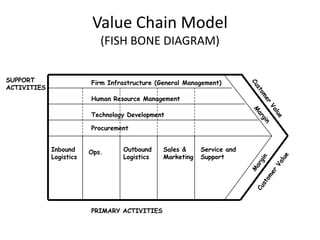
Value Chain Model
(FISH BONE DIAGRAM)
Firm Infrastructure (General Management)
Human Resource Management
Technology Development
Procurement
Inbound
Logistics
Ops. Outbound
Logistics
Sales &
Marketing
Service and
Support
PRIMARY ACTIVITIES
SUPPORT
ACTIVITIES
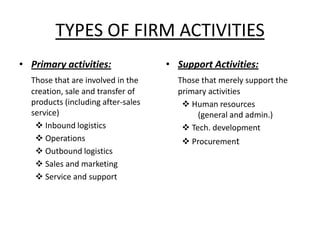
TYPES OF FIRM ACTIVITIES
• Primary activities:
Those that are involved in the
creation, sale and transfer of
products (including after-sales
service)
 Inbound logistics
 Operations
 Outbound logistics
 Sales and marketing
 Service and support
• Support Activities:
Those that merely support the
primary activities
 Human resources
(general and admin.)
 Tech. development
 Procurement
PRIMARY ACTIVITIES
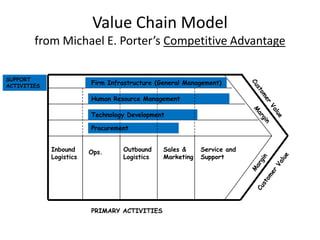
Value Chain Model
from Michael E. Porter’s Competitive Advantage
Firm Infrastructure (General Management)
Human Resource Management
Technology Development
Procurement
Inbound
Logistics
Operation
s
Outbound
Logistics
Sales &
Marketing
Service and
Support
PRIMARY ACTIVITIES
SUPPORT
ACTIVITIES
PRIMARY ACTIVITIES
1.INBOUND LOGISTICS
- CONCERNED WITH RECEIVING, STORING, DISTRIBUTING INPUTS (e.g.
HANDLING OF RAW MATERIALS, WAREHOUSING, INVENTORY
CONTROL)
2. OPERATIONS
- COMPRISE THE TRANSFORMATION OF THE INPUTS INTO THE FINAL
PRODUCT FORM (E.G. PRODUCTION, ASSEMBLY, AND PACKAGING)
3. OUTBOUND LOGISTICS
-INVOLVE THE COLLECTING, STORING, AND DISTRIBUTING THE PRODUCT
TO THE BUYERS (e.g. PROCESSING OF ORDERS, WAREHOUSING OF
FINISHED GOODS, AND DELIVERY)
PRIMARY ACTIVITIES
4. MARKETING AND SALES
-Identification of customer needs and generation of sales.
(e.g. ADVERTISING, PROMOTION, DISTRIBUTION)
5. SERVICE
-INVOLVES HOW TO MAINTAIN THE VALUE OF THE PRODUCT
AFTER IT IS PURCHASED.(e.g. INSTALLATION, REPAIR,
MAINTENANCE, AND TRAINING)
SUPPORT ACTIVITIES
Value Chain Model
from Michael E. Porter’s Competitive Advantage
Firm Infrastructure (General Management)
Human Resource Management
Technology Development
Procurement
Inbound
Logistics
Ops. Outbound
Logistics
Sales &
Marketing
Service and
Support
PRIMARY ACTIVITIES
SUPPORT
ACTIVITIES
SUPPORT ACTIVITIES
1.FIRM INFRASTRUCTURE
The activities such as Organization structure, control system, company
culture are categorized under firm infrastructure.
2.HUMAN RESOURCE MANAGEMENT
Involved in recruiting, hiring, training, development and compensation.
3.TECHNOLOGY DEVELOPMENT
These activities are intended to improve the product and the process, can
occur in many parts of the firm.
4.PROCUREMENT
Concerned with the tasks of purchasing inputs such as raw
materials, equipment, and even labor.
USES OF VALUE CHAIN ANALYSIS:
• The sources of the competitive advantage of a firm can be seen from its
discrete activities and how they interact with one one another.
• The value chain is a tool for systematically examining the activities of a firm
and how they interact with one another and affect each other’s cost and
performance.
• A firm gains a competitive advantage by performing these activities better
or at lower cost than competitors.
• Helps you to stay out of the “No Profit Zone”
• Presents opportunities for integration
• Aligns spending with value processes
VERTICAL LINKAGES:
• LINKAGES CAN ALSO EXIST OUTSIDE THE FIRM; FOR
INSTANCE THERE IS A LINKAGE BETWEEN A FIRM’S CHAIN
AND THE VALUE CHAIN OF ITS SUPPLIERS AND CHANNELS.
e.g. THE ACTIVITIES OF THE RAW MATERIALS SUPPLIERS AFFECT
THE ACTIVITIES OF THE FIRM. SIMILARLY, THE ACTIVITIES OF
THE DISTRIBUTOR ALSO AFFECT THE FIRM.
APPLYING THE VALUE CHAIN TO AN INDUSTRY
• THE VALUE CHAINS OF THE DIFFERENT FIRMS
WITHIN AN INDUSTRY VARY FROM ONE
ANOTHER.
• IN FACT, THE DIFFERENCES IN THE VALUE
CHAINS AMONG THE DIFFERENT INDUSTRY
PLAYERS PROVIDE THE SOURCE OF
COMPETITIVE ADVANTAGES BETWEEN THESE
PLAYERS.
TATA MOTORS
(A Manufacturing Based Company)
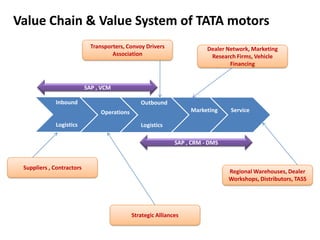
Value Chain & Value System of TATA motors
Inbound
Logistics
Operations Marketing Service
Outbound
Logistics
Suppliers , Contractors
SAP , VCM
SAP , CRM - DMS
Strategic Alliances
Transporters, Convoy Drivers
Association
Dealer Network, Marketing
Research Firms, Vehicle
Financing
Regional Warehouses, Dealer
Workshops, Distributors, TASS
PRIMARY ACTIVITIES
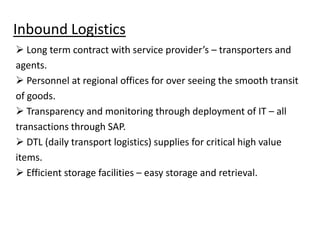
Inbound Logistics
 Long term contract with service provider’s – transporters and
agents.
 Personnel at regional offices for over seeing the smooth transit
of goods.
 Transparency and monitoring through deployment of IT – all
transactions through SAP.
 DTL (daily transport logistics) supplies for critical high value
items.
 Efficient storage facilities – easy storage and retrieval.
Operations
 Capital Equipment Manufacturing division – tooling development capabilities
of global standard.
 Apprentice Trainee Course – ensuring stable source of skilled manpower.
 Kaizen & TPM(total productive management) team – continuous drive to
improve efficiencies.
 Automated manufacturing processes.
 Distributed manufacturing – Assembly units at South
Africa, Thailand, Bangladesh, Brazil etc.
 Maintenance – technical competence.
 Capacity Utilization – Mercedes Benz cars make use of Tata Motors paint shop
facilities.
Outbound Logistics
 Stockyards, all across the country.
 Long term contracts with transporter’s – higher volume of
business to transporters ensures competitive price.
 Regional Sales Office and Vehicle Dispatch Section linked through
SAP.
 Efficient security system for prevention of any kind of pilferage.
Marketing & Sales
 Structured approach to understanding the requirements of individual customers
– QFD’s conducted at regular intervals.
 Clear identification of product requirements, leading to development of
innovative products – Tata 207 DI, Tata Ace
 Pan India presence and global footprint.
 Independent teams for addressing the requirements of institutional customers –
Defense, State Transport Units
 Helping to augment the scarce resources – Fiat selling vehicles through Tata
dealerships, in return Tata has access to Fiat’s technology and unutilized capacity.
 Quick assessment of the changing market dynamics and consumer preferences –
Tata 407 LCV
 Large network of dealers – use of technology (CRM-DMS).
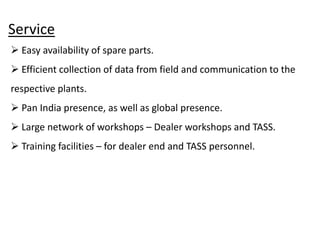
Service
 Easy availability of spare parts.
 Efficient collection of data from field and communication to the
respective plants.
 Pan India presence, as well as global presence.
 Large network of workshops – Dealer workshops and TASS.
 Training facilities – for dealer end and TASS personnel.
SUPPORT ACTIVITIES
Procurement
 E procurement initiative.
 Global Sourcing Team – China , a key destination for sourcing
essential items like tires, power steering units etc., Steel procured
from Belarus
 Long term relationships with a stable and loyal pool of suppliers.
 Technology driven procurement – SAP and VCM.
 Strategic subsidiaries & JV’s – TACO group of companies , Tata
Cummins
 Centralized Strategic Sourcing for key components – FIP’s, Steel
etc.
 Group resources – Tata Steel and Tata International .
 Localized supplier base at mfg. locations – low inventory levels.
Technology Development
 Approximately 2% of the annual profits of the company invested
in research and development.
 Knowledge portal – helps employees keep abreast with the latest
technologies.
 Extensive prototype building and testing facilities.
 Strategic partnerships – MDI (France), Fiat etc.
 Formal benchmarking process.
 “Technology Day” organized across all plant locations.
Human Resource
 Vast pool of technically competent engineers and managers.
 Focus on development of technical capabilities – Technical
Training Center’s, Alliance with technical Institutes
 Focus on development of managerial capabilities – MTC’s
, TMTC, executive training programs at premier business schools
 Career advancement schemes – ESS, FTSS
Firm Infrastructure
 Multi – Location facilities
 Strong leadership – under the aegis of Tata Sons
 Best in class prototype building facilities
 Technology – SAP
 Large product portfolio
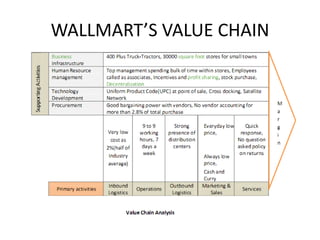
WALLMART
(A Service Based Company)
WALLMART’S VALUE CHAIN
THANK U………
PRESENTED BY:
JAYA PRAKASH NAIDU.YALLA(09MBI023)
KUNDANA .A(09MBI065)
D.S.C.GUPTA(09MBI073)
MONISH.R.M.(09MBI105)
SANKHAR(09MBI125)
VEENA V(09MBI124)
• http://www.srpgroup.co.in/logistics/companies/tatamotors.htm
• http://www.tatamotors.co.th/en/careers-detail.php?c=33
• http://www.fvlmagazine.com/Article.aspx?aid=161
• http://www.sap.com/india/about/company/successes/pdfs/Tata_Motors.pdf
• http://archive.ciol.com/ec/cio-speak/tata-motors-implements-sap-for-end-to-end-supply-
chain-integration/151207102235/0/
• http://books.google.co.in/books?id=Q2MNPPUq1v0C&pg=PA262&lpg=PA262&dq=vcm+tata+
motors+ltd&source=bl&ots=8VLnwpIieL&sig=uumCnws2Qd79EraSP-
KGVauJDtI&hl=en&sa=X&ei=n8BCUej9IcOHrQfU2YDwBw&sqi=2&ved=0CEgQ6AEwBA#v=one
page&q=vcm%20tata%20motors%20ltd&f=false
(263 page)
http://customercare-cv.tatamotors.com/customer-care/customer-services.asp
http://suppliers.tatamotors.com/Project_Docs/rfq_terms_conditions.pdf
http://customercare.tatamotors.com/manual/indigo-XL-OMSB.pdf
http://www.indiastudychannel.com/projects/4754-Tata-motors.aspx
• CRM Initiatives at TATA Motors Ltd.
Given that the customer is king (or queen), it would be logical to presume that establishing —
and nurturing — a relationship with such royalty is a priority for enterprises looking to sell a
product or service. Fact is, it may be a priority but organisations rarely pay more than lip
service to what goes by the grandiose nomenclature of customer relationship management.
For Tata Motors, though, this has always been an imperative.
It made eminent sense for India’s premier automobile company — with over 1 million
customers, 22,000 employees and a geographically fragmented business that operates out of
1,600 locations in a notoriously cyclic business environment — to put many eggs in the
relationship management basket. But this was an idea cooked in the cauldron of adversity.
Tata Motors got started on what it has tagged the customer relationship management-dealer
management system (CRM-DMS) at the turn of the millennium, when it was battling to
regain relevance at a difficult time in its history. That’s when it realised that survival in the
auto business depended on managing its relationships with its customers, dealers and anyone
else who had a deep connection with the mother company.
This was no mean task, considering the scale and complexity of the issues involved. Two
parameters — customers, and their interface with the company, the dealers — were the
critical links in a complex chain that Tata Motors had to deal with. The solution led to the
emergence of Tata Motors’ integrated CRM-DMS, which is today the largest such application
in the automobile industry worldwide, linking to more than 1,200 dealers across India and
tracking the needs of some 25,000 customers.
Tata Motors had no standard or benchmark to model its solution on when the relationship
concept was first considered, back in 2002. The company realised that it had to look at the
business in a fundamentally different way. Instead of selling to the customer,...

Value chain analysis

  • 1.
  • 2.
    VALUE  THE VALUEIS THE TOTAL AMOUNT (i.e. TOTAL REVENUE) THAT BUYERS ARE WILLING TO PAY FOR A FIRM’S PRODUCTS.  THE DIFFERENCE BETWEEN THE TOTAL VALUE (OR REVENUE) AND THE TOTAL COST OF PERFORMING ALL OF THE FIRM’S ACTIVITIES PROVIDES THE MARGIN .  THE VALUE CHAIN IS A TOOL DEVELOPED BY DR. MICHAEL PORTER(HARVARD BUSINESS SCHOOL)
  • 3.
    What is thevalue chain?  Porter’s definition includes all activities to design, produce, market, deliver, and support the product/service.  The value chain is concentrating on the activities starting with raw materials till the conversion into final goods or services.  Two categories: Primary Activities (operations, distribution, sales) Support Activities (R&D, Human Resources)
  • 4.
    TYPES OF VALUECHAIN: • Value Chain is categorized into types based on the type of organizations. • Manufacturing based. • Service based. • Both manufacturing and service based.
  • 5.
    What is valuechain analysis? • Used to identify sources of competitive advantage • Specifically: – Opportunities to secure cost advantages – Opportunities to create product/service differentiation • Includes the value-creating activities of all industry participants
  • 6.
    Value Chain Model (FISHBONE DIAGRAM) Firm Infrastructure (General Management) Human Resource Management Technology Development Procurement Inbound Logistics Ops. Outbound Logistics Sales & Marketing Service and Support PRIMARY ACTIVITIES SUPPORT ACTIVITIES
  • 7.
    TYPES OF FIRMACTIVITIES • Primary activities: Those that are involved in the creation, sale and transfer of products (including after-sales service)  Inbound logistics  Operations  Outbound logistics  Sales and marketing  Service and support • Support Activities: Those that merely support the primary activities  Human resources (general and admin.)  Tech. development  Procurement
  • 8.
  • 9.
    Value Chain Model fromMichael E. Porter’s Competitive Advantage Firm Infrastructure (General Management) Human Resource Management Technology Development Procurement Inbound Logistics Operation s Outbound Logistics Sales & Marketing Service and Support PRIMARY ACTIVITIES SUPPORT ACTIVITIES
  • 10.
    PRIMARY ACTIVITIES 1.INBOUND LOGISTICS -CONCERNED WITH RECEIVING, STORING, DISTRIBUTING INPUTS (e.g. HANDLING OF RAW MATERIALS, WAREHOUSING, INVENTORY CONTROL) 2. OPERATIONS - COMPRISE THE TRANSFORMATION OF THE INPUTS INTO THE FINAL PRODUCT FORM (E.G. PRODUCTION, ASSEMBLY, AND PACKAGING) 3. OUTBOUND LOGISTICS -INVOLVE THE COLLECTING, STORING, AND DISTRIBUTING THE PRODUCT TO THE BUYERS (e.g. PROCESSING OF ORDERS, WAREHOUSING OF FINISHED GOODS, AND DELIVERY)
  • 11.
    PRIMARY ACTIVITIES 4. MARKETINGAND SALES -Identification of customer needs and generation of sales. (e.g. ADVERTISING, PROMOTION, DISTRIBUTION) 5. SERVICE -INVOLVES HOW TO MAINTAIN THE VALUE OF THE PRODUCT AFTER IT IS PURCHASED.(e.g. INSTALLATION, REPAIR, MAINTENANCE, AND TRAINING)
  • 12.
  • 13.
    Value Chain Model fromMichael E. Porter’s Competitive Advantage Firm Infrastructure (General Management) Human Resource Management Technology Development Procurement Inbound Logistics Ops. Outbound Logistics Sales & Marketing Service and Support PRIMARY ACTIVITIES SUPPORT ACTIVITIES
  • 14.
    SUPPORT ACTIVITIES 1.FIRM INFRASTRUCTURE Theactivities such as Organization structure, control system, company culture are categorized under firm infrastructure. 2.HUMAN RESOURCE MANAGEMENT Involved in recruiting, hiring, training, development and compensation. 3.TECHNOLOGY DEVELOPMENT These activities are intended to improve the product and the process, can occur in many parts of the firm. 4.PROCUREMENT Concerned with the tasks of purchasing inputs such as raw materials, equipment, and even labor.
  • 15.
    USES OF VALUECHAIN ANALYSIS: • The sources of the competitive advantage of a firm can be seen from its discrete activities and how they interact with one one another. • The value chain is a tool for systematically examining the activities of a firm and how they interact with one another and affect each other’s cost and performance. • A firm gains a competitive advantage by performing these activities better or at lower cost than competitors. • Helps you to stay out of the “No Profit Zone” • Presents opportunities for integration • Aligns spending with value processes
  • 16.
    VERTICAL LINKAGES: • LINKAGESCAN ALSO EXIST OUTSIDE THE FIRM; FOR INSTANCE THERE IS A LINKAGE BETWEEN A FIRM’S CHAIN AND THE VALUE CHAIN OF ITS SUPPLIERS AND CHANNELS. e.g. THE ACTIVITIES OF THE RAW MATERIALS SUPPLIERS AFFECT THE ACTIVITIES OF THE FIRM. SIMILARLY, THE ACTIVITIES OF THE DISTRIBUTOR ALSO AFFECT THE FIRM.
  • 17.
    APPLYING THE VALUECHAIN TO AN INDUSTRY • THE VALUE CHAINS OF THE DIFFERENT FIRMS WITHIN AN INDUSTRY VARY FROM ONE ANOTHER. • IN FACT, THE DIFFERENCES IN THE VALUE CHAINS AMONG THE DIFFERENT INDUSTRY PLAYERS PROVIDE THE SOURCE OF COMPETITIVE ADVANTAGES BETWEEN THESE PLAYERS.
  • 18.
  • 19.
    Value Chain &Value System of TATA motors Inbound Logistics Operations Marketing Service Outbound Logistics Suppliers , Contractors SAP , VCM SAP , CRM - DMS Strategic Alliances Transporters, Convoy Drivers Association Dealer Network, Marketing Research Firms, Vehicle Financing Regional Warehouses, Dealer Workshops, Distributors, TASS
  • 20.
  • 21.
    Inbound Logistics  Longterm contract with service provider’s – transporters and agents.  Personnel at regional offices for over seeing the smooth transit of goods.  Transparency and monitoring through deployment of IT – all transactions through SAP.  DTL (daily transport logistics) supplies for critical high value items.  Efficient storage facilities – easy storage and retrieval.
  • 22.
    Operations  Capital EquipmentManufacturing division – tooling development capabilities of global standard.  Apprentice Trainee Course – ensuring stable source of skilled manpower.  Kaizen & TPM(total productive management) team – continuous drive to improve efficiencies.  Automated manufacturing processes.  Distributed manufacturing – Assembly units at South Africa, Thailand, Bangladesh, Brazil etc.  Maintenance – technical competence.  Capacity Utilization – Mercedes Benz cars make use of Tata Motors paint shop facilities.
  • 23.
    Outbound Logistics  Stockyards,all across the country.  Long term contracts with transporter’s – higher volume of business to transporters ensures competitive price.  Regional Sales Office and Vehicle Dispatch Section linked through SAP.  Efficient security system for prevention of any kind of pilferage.
  • 24.
    Marketing & Sales Structured approach to understanding the requirements of individual customers – QFD’s conducted at regular intervals.  Clear identification of product requirements, leading to development of innovative products – Tata 207 DI, Tata Ace  Pan India presence and global footprint.  Independent teams for addressing the requirements of institutional customers – Defense, State Transport Units  Helping to augment the scarce resources – Fiat selling vehicles through Tata dealerships, in return Tata has access to Fiat’s technology and unutilized capacity.  Quick assessment of the changing market dynamics and consumer preferences – Tata 407 LCV  Large network of dealers – use of technology (CRM-DMS).
  • 25.
    Service  Easy availabilityof spare parts.  Efficient collection of data from field and communication to the respective plants.  Pan India presence, as well as global presence.  Large network of workshops – Dealer workshops and TASS.  Training facilities – for dealer end and TASS personnel.
  • 27.
  • 28.
    Procurement  E procurementinitiative.  Global Sourcing Team – China , a key destination for sourcing essential items like tires, power steering units etc., Steel procured from Belarus  Long term relationships with a stable and loyal pool of suppliers.  Technology driven procurement – SAP and VCM.  Strategic subsidiaries & JV’s – TACO group of companies , Tata Cummins  Centralized Strategic Sourcing for key components – FIP’s, Steel etc.  Group resources – Tata Steel and Tata International .  Localized supplier base at mfg. locations – low inventory levels.
  • 29.
    Technology Development  Approximately2% of the annual profits of the company invested in research and development.  Knowledge portal – helps employees keep abreast with the latest technologies.  Extensive prototype building and testing facilities.  Strategic partnerships – MDI (France), Fiat etc.  Formal benchmarking process.  “Technology Day” organized across all plant locations.
  • 30.
    Human Resource  Vastpool of technically competent engineers and managers.  Focus on development of technical capabilities – Technical Training Center’s, Alliance with technical Institutes  Focus on development of managerial capabilities – MTC’s , TMTC, executive training programs at premier business schools  Career advancement schemes – ESS, FTSS
  • 31.
    Firm Infrastructure  Multi– Location facilities  Strong leadership – under the aegis of Tata Sons  Best in class prototype building facilities  Technology – SAP  Large product portfolio
  • 32.
  • 33.
  • 34.
    THANK U……… PRESENTED BY: JAYAPRAKASH NAIDU.YALLA(09MBI023) KUNDANA .A(09MBI065) D.S.C.GUPTA(09MBI073) MONISH.R.M.(09MBI105) SANKHAR(09MBI125) VEENA V(09MBI124)
  • 35.
    • http://www.srpgroup.co.in/logistics/companies/tatamotors.htm • http://www.tatamotors.co.th/en/careers-detail.php?c=33 •http://www.fvlmagazine.com/Article.aspx?aid=161 • http://www.sap.com/india/about/company/successes/pdfs/Tata_Motors.pdf • http://archive.ciol.com/ec/cio-speak/tata-motors-implements-sap-for-end-to-end-supply- chain-integration/151207102235/0/ • http://books.google.co.in/books?id=Q2MNPPUq1v0C&pg=PA262&lpg=PA262&dq=vcm+tata+ motors+ltd&source=bl&ots=8VLnwpIieL&sig=uumCnws2Qd79EraSP- KGVauJDtI&hl=en&sa=X&ei=n8BCUej9IcOHrQfU2YDwBw&sqi=2&ved=0CEgQ6AEwBA#v=one page&q=vcm%20tata%20motors%20ltd&f=false (263 page) http://customercare-cv.tatamotors.com/customer-care/customer-services.asp http://suppliers.tatamotors.com/Project_Docs/rfq_terms_conditions.pdf http://customercare.tatamotors.com/manual/indigo-XL-OMSB.pdf http://www.indiastudychannel.com/projects/4754-Tata-motors.aspx
  • 36.
    • CRM Initiativesat TATA Motors Ltd. Given that the customer is king (or queen), it would be logical to presume that establishing — and nurturing — a relationship with such royalty is a priority for enterprises looking to sell a product or service. Fact is, it may be a priority but organisations rarely pay more than lip service to what goes by the grandiose nomenclature of customer relationship management. For Tata Motors, though, this has always been an imperative. It made eminent sense for India’s premier automobile company — with over 1 million customers, 22,000 employees and a geographically fragmented business that operates out of 1,600 locations in a notoriously cyclic business environment — to put many eggs in the relationship management basket. But this was an idea cooked in the cauldron of adversity. Tata Motors got started on what it has tagged the customer relationship management-dealer management system (CRM-DMS) at the turn of the millennium, when it was battling to regain relevance at a difficult time in its history. That’s when it realised that survival in the auto business depended on managing its relationships with its customers, dealers and anyone else who had a deep connection with the mother company. This was no mean task, considering the scale and complexity of the issues involved. Two parameters — customers, and their interface with the company, the dealers — were the critical links in a complex chain that Tata Motors had to deal with. The solution led to the emergence of Tata Motors’ integrated CRM-DMS, which is today the largest such application in the automobile industry worldwide, linking to more than 1,200 dealers across India and tracking the needs of some 25,000 customers. Tata Motors had no standard or benchmark to model its solution on when the relationship concept was first considered, back in 2002. The company realised that it had to look at the business in a fundamentally different way. Instead of selling to the customer,...