Porter's Five Forces
A MODEL FOR INDUSTRY ANALYSIS
Presented By
Mayur Khatri
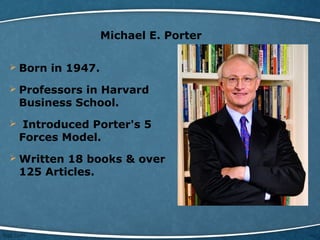
Michael E. Porter
 Born in 1947.
 Professors in Harvard
Business School.
 Introduced Porter's 5
Forces Model.
 Written 18 books & over
125 Articles.
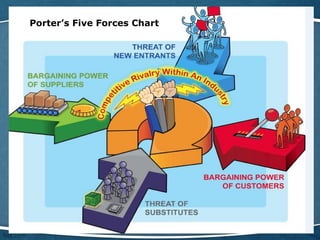
Porter’s Five Forces Chart
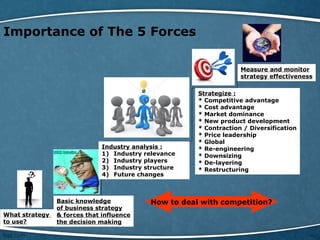
Importance of The 5 Forces
Strategize :
* Competitive advantage
* Cost advantage
* Market dominance
* New product development
* Contraction / Diversification
* Price leadership
* Global
* Re-engineering
* Downsizing
* De-layering
* Restructuring
Measure and monitor
strategy effectiveness
What strategy
to use?
Basic knowledge
of business strategy
& forces that influence
the decision making
Industry analysis :
1) Industry relevance
2) Industry players
3) Industry structure
4) Future changes
How to deal with competition?
Threats of New Entrants
• The easier it is for new companies to enter the
industry, the more cutthroat competition there
will be. Factors that can limit the threat of new
entrants are:
1. How loyal are the end users in this industry?
2. How troublesome or hard is it for the end users to
switch and use another product?
3. Does it require a large seed capital to enter this
industry?
4. Do entries to this industry regulated by government?
5. How hard is it to gain access to the distribution
channels?
6. How long does it take for new staff to acquire the
necessary skills to do the work?
Threats of New Entrants :
McDonald’s company analysis
1.The threat of new entrants in the fast food industry
is high because there are no legal barriers.
2.The economies of scale and the access of the
distribution are the major barriers that firms face in the
industry.
3.Firms must spend a large amount of capital on
advertising and marketing in order to enjoy successful
existence and long life of a fast food outlet.
4.Large established companies with strong brand
names such as McDonald’s make it more difficult to enter
the market because new entrants are faced with price
competition from existing chain restaurants.
5.Thus, it takes a pretty much time for a new business
to establish in the fast food industry.
Threat of Substitutes
Threats of Substitute in the Porter’s theory actually
means goods and services that does similar functions
 How many close substitutes are available?
 How pricy are the substitutes?
 What is the perceived quality of the
substitutes?
When there is one product successful, it also leads to the creation
of other products that can perform the same functions as the
product of the same industry.
Porter also mentions that if one industry wishes to follow suit
producing products with similar function, attention should be
given to :
1. Products that enjoy steady price-performance tread offs with
the industry’s product
2. Would entail minimum switching costs for a buyer.
3. Are produced by industry earning high profits
Porter recommends that by doing advertising, product quality
improvement, marketing, R&D and product distribution, an industry
can improve its collective position against the substitute.
Threat of Substitute: Examples
Intensity of rivalry among established firms
1. How many close competitors exist in the
industry?
2. What are the sizes of your close competitors?
3. What is the industry structure? Is it a
fragmented, consolidated, oligopoly or
monopoly industry?
4. What is the current industry growth rate?
4. How high are the exit barriers? Do your competitors
have a high committed fixed cost thus they have to
operate even at a loss?
• How diversified are your competitors?
• How extensively do your direct competitors
advertise?
7. Each competitors aim to serve different needs and
market segment with different mixes of
– price
– products
– service
– features
Intensity of rivalry among established firms
: Examples
Bargaining power of Customers
1. How large are your buyers’ company?
2. How many companies are there for the buyer to
choose from?
3. Are the buyers buying a huge volume?
4. Do you depend only on a few buyers to sustain
your sales?
5. How hard is it for the buyers to switch and use a
competing product?
6. Are the buyers purchasing from you as well as your
competitors?
7. Do the buyers have the capacity to enter your
business and produce the goods themselves?
depends on the marketing channel used. or Coca-Cola,
1. Super Markets
2. Convenience Stores
3. Mass Merchandisers
4. Soda Shop
5. vending machine
6. Restaurants and Food stores
Bargaining power of buyer is high for fountain
supermarkets and mass merchandising because of the
low profitability and strong negotiation power of retail
channels but for vending bargaining power is non-
existing caused by high profitability.
Bargaining power of Customers:
Example of Coca-Cola Company
Bargaining power of Suppliers
• Are there substitutes for your suppliers’ products?
• Do your suppliers serve multiple industries? Does
the total industry revenue accounting for only a
mall portion of the supplier’s total revenue?
• Do you have high switching cost to use another
supplier?
• Do suppliers have the capacity to enter your
business?
• Does your company capable to enter the supplier’s
business?

Porter's Five Forces

  • 1.
    Porter's Five Forces AMODEL FOR INDUSTRY ANALYSIS Presented By Mayur Khatri
  • 2.
    Michael E. Porter Born in 1947.  Professors in Harvard Business School.  Introduced Porter's 5 Forces Model.  Written 18 books & over 125 Articles.
  • 3.
  • 4.
    Importance of The5 Forces Strategize : * Competitive advantage * Cost advantage * Market dominance * New product development * Contraction / Diversification * Price leadership * Global * Re-engineering * Downsizing * De-layering * Restructuring Measure and monitor strategy effectiveness What strategy to use? Basic knowledge of business strategy & forces that influence the decision making Industry analysis : 1) Industry relevance 2) Industry players 3) Industry structure 4) Future changes How to deal with competition?
  • 5.
    Threats of NewEntrants • The easier it is for new companies to enter the industry, the more cutthroat competition there will be. Factors that can limit the threat of new entrants are: 1. How loyal are the end users in this industry? 2. How troublesome or hard is it for the end users to switch and use another product? 3. Does it require a large seed capital to enter this industry? 4. Do entries to this industry regulated by government? 5. How hard is it to gain access to the distribution channels? 6. How long does it take for new staff to acquire the necessary skills to do the work?
  • 6.
    Threats of NewEntrants : McDonald’s company analysis 1.The threat of new entrants in the fast food industry is high because there are no legal barriers. 2.The economies of scale and the access of the distribution are the major barriers that firms face in the industry. 3.Firms must spend a large amount of capital on advertising and marketing in order to enjoy successful existence and long life of a fast food outlet. 4.Large established companies with strong brand names such as McDonald’s make it more difficult to enter the market because new entrants are faced with price competition from existing chain restaurants. 5.Thus, it takes a pretty much time for a new business to establish in the fast food industry.
  • 7.
    Threat of Substitutes Threatsof Substitute in the Porter’s theory actually means goods and services that does similar functions  How many close substitutes are available?  How pricy are the substitutes?  What is the perceived quality of the substitutes?
  • 8.
    When there isone product successful, it also leads to the creation of other products that can perform the same functions as the product of the same industry. Porter also mentions that if one industry wishes to follow suit producing products with similar function, attention should be given to : 1. Products that enjoy steady price-performance tread offs with the industry’s product 2. Would entail minimum switching costs for a buyer. 3. Are produced by industry earning high profits Porter recommends that by doing advertising, product quality improvement, marketing, R&D and product distribution, an industry can improve its collective position against the substitute.
  • 9.
  • 10.
    Intensity of rivalryamong established firms 1. How many close competitors exist in the industry? 2. What are the sizes of your close competitors? 3. What is the industry structure? Is it a fragmented, consolidated, oligopoly or monopoly industry? 4. What is the current industry growth rate?
  • 11.
    4. How highare the exit barriers? Do your competitors have a high committed fixed cost thus they have to operate even at a loss? • How diversified are your competitors? • How extensively do your direct competitors advertise? 7. Each competitors aim to serve different needs and market segment with different mixes of – price – products – service – features
  • 12.
    Intensity of rivalryamong established firms : Examples
  • 13.
    Bargaining power ofCustomers 1. How large are your buyers’ company? 2. How many companies are there for the buyer to choose from? 3. Are the buyers buying a huge volume? 4. Do you depend only on a few buyers to sustain your sales?
  • 14.
    5. How hardis it for the buyers to switch and use a competing product? 6. Are the buyers purchasing from you as well as your competitors? 7. Do the buyers have the capacity to enter your business and produce the goods themselves?
  • 15.
    depends on themarketing channel used. or Coca-Cola, 1. Super Markets 2. Convenience Stores 3. Mass Merchandisers 4. Soda Shop 5. vending machine 6. Restaurants and Food stores Bargaining power of buyer is high for fountain supermarkets and mass merchandising because of the low profitability and strong negotiation power of retail channels but for vending bargaining power is non- existing caused by high profitability. Bargaining power of Customers: Example of Coca-Cola Company
  • 16.
    Bargaining power ofSuppliers • Are there substitutes for your suppliers’ products? • Do your suppliers serve multiple industries? Does the total industry revenue accounting for only a mall portion of the supplier’s total revenue?
  • 17.
    • Do youhave high switching cost to use another supplier? • Do suppliers have the capacity to enter your business? • Does your company capable to enter the supplier’s business?