Marketing planning
By: Kalpana Ambepitiya
PhD (Marketing) (Reading), MBA (Finance) (IGNOU-India),
MPA (Colombo-Sri Lanka), PGD (Finance) (IGNOU-India),
BBMgmt Hons (Marketing) (Kelaniya-Sri Lanka)
Strategic planning is Critical
• A strategic business plan describes the overall
direction an organization will pursue within its
environment and also guides the allocation of
resources. It provides the logic that integrates
the perspectives of functional departments and
operating units, and points them all in the same
direction.
• A strategic marketing plan outlines the actions
necessary, who is responsible, when and where
they will be completed, and how they will be
coordinated. A marketing plan is carried out
within the context of a firm’s broader strategic
business plan.
Strategic Planning
Strategic planning is the process of developing and
maintaining a strategic fit between the
organization’s goals and capabilities and its
changing marketing opportunities
2-4
Market-Oriented Mission
Mission statement: The organization’s purpose, what it
wants to accomplish in the larger environment
Market-oriented mission statement: Defines the
business in terms of satisfying basic customer needs
2-5
Business Portfolio
The business portfolio is the collection of businesses
and products that make up the company
2-7
Strategic business unit
• Strategic business unit (SBU) is a unit of the company that
has a separate mission and objectives that can be planned
separately from other company businesses
• Company division
• Product line within a division
• Single product or brand
2-10
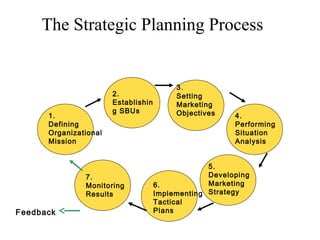
The Strategic Planning Process
1.
Defining
Organizational
Mission
2.
Establishin
g SBUs
3.
Setting
Marketing
Objectives 4.
Performing
Situation
Analysis
5.
Developing
Marketing
Strategy
6.
Implementing
Tactical
Plans
7.
Monitoring
Results
Feedback
Step One in the Strategic Planning Process
1. Define
Organizational
Mission
1. Defining
Organizational
Mission
Defining the organizational mission refers to a
long-term commitment to a type of business and a
place in the market. It “describes the scope of the firm
and its dominant emphasis and values,” based on a
firm’s history, current management preferences,
resources, and distinctive competence, and on
environmental factors.
Step Two in the
Strategic Planning Process
2.
Establishing
SBUs
Each of a firm’s Strategic Business Units (SBU
) has six attributes:
• A specific target market
• Its own senior marketing executive
• Control over its resources
• Its own marketing strategy
• Clear-cut competition
• Distinct differential advantages
Step Three in the
Strategic Planning Process
3.
Setting
Marketing
Objectives
Marketing objectives establish the firm’s goals for
each SBU. Objectives are described in both
quantitative terms (dollar sales, percentage profit
growth, and market share), and qualitative terms
(image, level of innovativeness, and industry leadership
role).
Without clearly identified objectives, firms often fail.
Step Four in the
Strategic Planning Process
4.
Performing
Situation
Analysis
The situation analysis is known as
SWOT Analysis
• Internal factors include:
•Strengths
•Weaknesses
• External factors include:
•Opportunities
•Threats
The SWOT analysis is a continuous review of a
firm’s market position.
Step Five in the
Strategic Planning Process
5.
Developing
Marketing
Strategy
A marketing strategy outlines the way in which the
marketing mix is used to attract and satisfy the target
market.
A separate strategy is necessary for each SBU.
Four strategic planning approaches are:
• Product/Market Opportunity Matrix
• Boston Consulting Group Matrix
• General Electric Business Screen
• Porter Generic Strategy Model
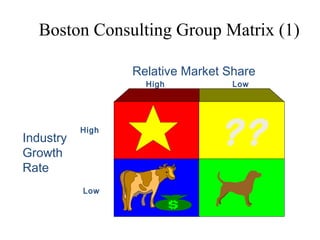
Boston Consulting Group Matrix (1)
??
Relative Market Share
Industry
Growth
Rate
High Low
Low
High
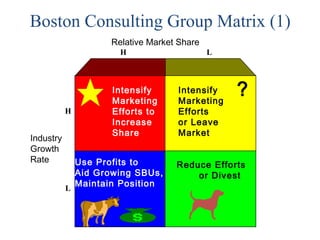
?
Relative Market Share
Industry
Growth
Rate
H
H L
L
Intensify
Marketing
Efforts to
Increase
Share
Intensify
Marketing
Efforts
or Leave
Market
Use Profits to
Aid Growing SBUs,
Maintain Position
Reduce Efforts
or Divest
Boston Consulting Group Matrix (1)
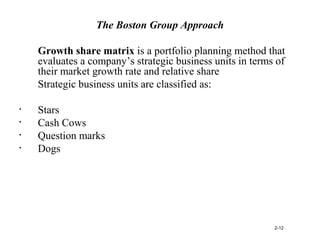
The Boston Group Approach
Growth share matrix is a portfolio planning method that
evaluates a company’s strategic business units in terms of
their market growth rate and relative share
Strategic business units are classified as:
• Stars
• Cash Cows
• Question marks
• Dogs
2-12
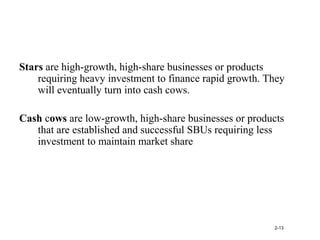
Stars are high-growth, high-share businesses or products
requiring heavy investment to finance rapid growth. They
will eventually turn into cash cows.
Cash cows are low-growth, high-share businesses or products
that are established and successful SBUs requiring less
investment to maintain market share
2-13
Question marks are low-share business units in high-growth
markets requiring a lot of cash to hold their share
Dogs are low-growth, low-share businesses and products that
may generate enough cash to maintain themselves but do not
promise to be large sources of cash
2-14
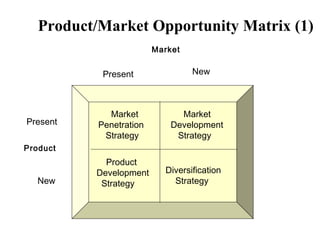
Product/Market Opportunity Matrix (1)
Market
Product
New
Present
Present New
Market
Penetration
Strategy
Market
Development
Strategy
Product
Development
Strategy
Diversification
Strategy
Product/Market Opportunity Matrix (2)
Market
Product
New
Present
Present New
Expand sales of present
products in current
market by pricing,
promotion, and
distribution strategies
Seek greater sales of
present products from
new markets or new
uses
Develop new or
modified products
to appeal to
present market
Develop new
products aimed
at new markets
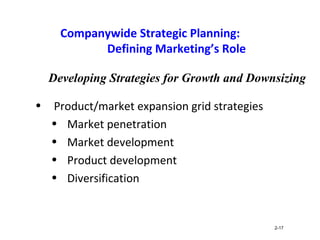
Companywide Strategic Planning:
Defining Marketing’s Role
• Product/market expansion grid strategies
• Market penetration
• Market development
• Product development
• Diversification
2-17
Developing Strategies for Growth and Downsizing
Market penetration is a growth strategy increasing
sales to current market segments without changing
the product
Market development is a growth strategy that
identifies and develops new market segments for
current products
2-18
Product development is a growth strategy that offers
new or modified products to existing market
segments
Diversification is a growth strategy through starting up
or acquiring businesses outside the company’s
current products and markets
2-19
Copyright Atomic Dog Publishing, 2001
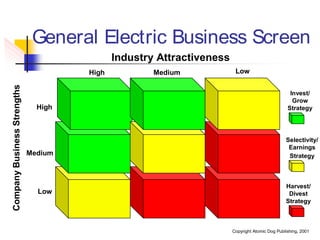
General Electric Business Screen
Industry Attractiveness
CompanyBusinessStrengths
Low
Medium
High
LowMediumHigh
Harvest/
Divest
Strategy
Selectivity/
Earnings
Strategy
Invest/
Grow
Strategy
• Business Unit Strength
The horizontal axis of the GE matrix is the strength of the
business unit. Some factors that can be used to determine
business unit strength include:
• Market share
• Growth in market share
• Brand equity
• Distribution channel access
• Production capacity
• Profit margins relative to competitors
• The business unit strength index can be calculated by
multiplying the estimated value of each factor by the factor's
weighting, as done for industry attractiveness.
• Industry Attractiveness
The vertical axis of the GE matrix is industry attractiveness,
which is determined by factors such as the following:
• Market growth rate
• Market size
• Demand variability
• Industry profitability
• Industry rivalry
• Global opportunities
• Macro environmental factors (PEST)
• Strategic Implications
Resource allocation recommendations can be made to grow,
hold, or harvest a strategic business unit based on its position
on the matrix as follows:
• Grow strong business units in attractive industries, average
business units in attractive industries, and strong business
units in average industries.
• Hold average businesses in average industries, strong
businesses in weak industries, and weak business in attractive
industries.
• Harvest weak business units in unattractive industries,
average business units in unattractive industries, and weak
business units in average industries.
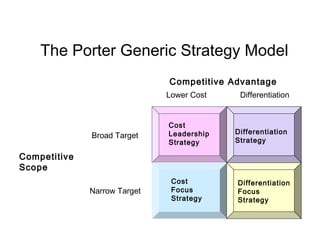
Cost
Leadership
Strategy
Differentiation
Strategy
Cost
Focus
Strategy
Differentiation
Focus
Strategy
The Porter Generic Strategy Model
Competitive Advantage
Competitive
Scope
Broad Target
Narrow Target
Lower Cost Differentiation
• Cost Leadership
In cost leadership, a firm sets out to become the low cost
producer in its industry. The sources of cost advantage are
varied and depend on the structure of the industry. They may
include the pursuit of economies of scale, proprietary
technology, preferential access to raw materials and other
factors. A low cost producer must find and exploit all sources of
cost advantage. if a firm can achieve and sustain overall cost
leadership, then it will be an above average performer in its
industry, provided it can command prices at or near the industry
average.
• 2. Differentiation
In a differentiation strategy a firm seeks to be unique in its
industry along some dimensions that are widely valued by
buyers. It selects one or more attributes that many buyers in an
industry perceive as important, and uniquely positions itself to
meet those needs. It is rewarded for its uniqueness with a
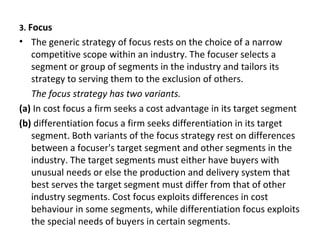
3. Focus
• The generic strategy of focus rests on the choice of a narrow
competitive scope within an industry. The focuser selects a
segment or group of segments in the industry and tailors its
strategy to serving them to the exclusion of others.
The focus strategy has two variants.
(a) In cost focus a firm seeks a cost advantage in its target segment
(b) differentiation focus a firm seeks differentiation in its target
segment. Both variants of the focus strategy rest on differences
between a focuser's target segment and other segments in the
industry. The target segments must either have buyers with
unusual needs or else the production and delivery system that
best serves the target segment must differ from that of other
industry segments. Cost focus exploits differences in cost
behaviour in some segments, while differentiation focus exploits
the special needs of buyers in certain segments.
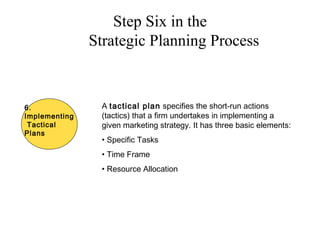
Step Six in the
Strategic Planning Process
6.
Implementing
Tactical
Plans
A tactical plan specifies the short-run actions
(tactics) that a firm undertakes in implementing a
given marketing strategy. It has three basic elements:
• Specific Tasks
• Time Frame
• Resource Allocation
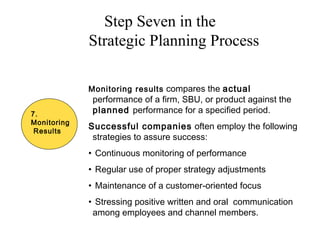
Step Seven in the
Strategic Planning Process
7.
Monitoring
Results
Monitoring results compares the actual
performance of a firm, SBU, or product against the
planned performance for a specified period.
Successful companies often employ the following
strategies to assure success:
• Continuous monitoring of performance
• Regular use of proper strategy adjustments
• Maintenance of a customer-oriented focus
• Stressing positive written and oral communication
among employees and channel members.

Marketing planning

  • 1.
    Marketing planning By: KalpanaAmbepitiya PhD (Marketing) (Reading), MBA (Finance) (IGNOU-India), MPA (Colombo-Sri Lanka), PGD (Finance) (IGNOU-India), BBMgmt Hons (Marketing) (Kelaniya-Sri Lanka)
  • 2.
    Strategic planning isCritical • A strategic business plan describes the overall direction an organization will pursue within its environment and also guides the allocation of resources. It provides the logic that integrates the perspectives of functional departments and operating units, and points them all in the same direction. • A strategic marketing plan outlines the actions necessary, who is responsible, when and where they will be completed, and how they will be coordinated. A marketing plan is carried out within the context of a firm’s broader strategic business plan.
  • 3.
    Strategic Planning Strategic planningis the process of developing and maintaining a strategic fit between the organization’s goals and capabilities and its changing marketing opportunities 2-4
  • 4.
    Market-Oriented Mission Mission statement:The organization’s purpose, what it wants to accomplish in the larger environment Market-oriented mission statement: Defines the business in terms of satisfying basic customer needs 2-5
  • 5.
    Business Portfolio The businessportfolio is the collection of businesses and products that make up the company 2-7
  • 6.
    Strategic business unit •Strategic business unit (SBU) is a unit of the company that has a separate mission and objectives that can be planned separately from other company businesses • Company division • Product line within a division • Single product or brand 2-10
  • 7.
    The Strategic PlanningProcess 1. Defining Organizational Mission 2. Establishin g SBUs 3. Setting Marketing Objectives 4. Performing Situation Analysis 5. Developing Marketing Strategy 6. Implementing Tactical Plans 7. Monitoring Results Feedback
  • 8.
    Step One inthe Strategic Planning Process 1. Define Organizational Mission 1. Defining Organizational Mission Defining the organizational mission refers to a long-term commitment to a type of business and a place in the market. It “describes the scope of the firm and its dominant emphasis and values,” based on a firm’s history, current management preferences, resources, and distinctive competence, and on environmental factors.
  • 9.
    Step Two inthe Strategic Planning Process 2. Establishing SBUs Each of a firm’s Strategic Business Units (SBU ) has six attributes: • A specific target market • Its own senior marketing executive • Control over its resources • Its own marketing strategy • Clear-cut competition • Distinct differential advantages
  • 10.
    Step Three inthe Strategic Planning Process 3. Setting Marketing Objectives Marketing objectives establish the firm’s goals for each SBU. Objectives are described in both quantitative terms (dollar sales, percentage profit growth, and market share), and qualitative terms (image, level of innovativeness, and industry leadership role). Without clearly identified objectives, firms often fail.
  • 11.
    Step Four inthe Strategic Planning Process 4. Performing Situation Analysis The situation analysis is known as SWOT Analysis • Internal factors include: •Strengths •Weaknesses • External factors include: •Opportunities •Threats The SWOT analysis is a continuous review of a firm’s market position.
  • 12.
    Step Five inthe Strategic Planning Process 5. Developing Marketing Strategy A marketing strategy outlines the way in which the marketing mix is used to attract and satisfy the target market. A separate strategy is necessary for each SBU. Four strategic planning approaches are: • Product/Market Opportunity Matrix • Boston Consulting Group Matrix • General Electric Business Screen • Porter Generic Strategy Model
  • 13.
    Boston Consulting GroupMatrix (1) ?? Relative Market Share Industry Growth Rate High Low Low High
  • 14.
    ? Relative Market Share Industry Growth Rate H HL L Intensify Marketing Efforts to Increase Share Intensify Marketing Efforts or Leave Market Use Profits to Aid Growing SBUs, Maintain Position Reduce Efforts or Divest Boston Consulting Group Matrix (1)
  • 15.
    The Boston GroupApproach Growth share matrix is a portfolio planning method that evaluates a company’s strategic business units in terms of their market growth rate and relative share Strategic business units are classified as: • Stars • Cash Cows • Question marks • Dogs 2-12
  • 16.
    Stars are high-growth,high-share businesses or products requiring heavy investment to finance rapid growth. They will eventually turn into cash cows. Cash cows are low-growth, high-share businesses or products that are established and successful SBUs requiring less investment to maintain market share 2-13
  • 17.
    Question marks arelow-share business units in high-growth markets requiring a lot of cash to hold their share Dogs are low-growth, low-share businesses and products that may generate enough cash to maintain themselves but do not promise to be large sources of cash 2-14
  • 18.
    Product/Market Opportunity Matrix(1) Market Product New Present Present New Market Penetration Strategy Market Development Strategy Product Development Strategy Diversification Strategy
  • 19.
    Product/Market Opportunity Matrix(2) Market Product New Present Present New Expand sales of present products in current market by pricing, promotion, and distribution strategies Seek greater sales of present products from new markets or new uses Develop new or modified products to appeal to present market Develop new products aimed at new markets
  • 20.
    Companywide Strategic Planning: DefiningMarketing’s Role • Product/market expansion grid strategies • Market penetration • Market development • Product development • Diversification 2-17 Developing Strategies for Growth and Downsizing
  • 21.
    Market penetration isa growth strategy increasing sales to current market segments without changing the product Market development is a growth strategy that identifies and develops new market segments for current products 2-18
  • 22.
    Product development isa growth strategy that offers new or modified products to existing market segments Diversification is a growth strategy through starting up or acquiring businesses outside the company’s current products and markets 2-19
  • 23.
    Copyright Atomic DogPublishing, 2001 General Electric Business Screen Industry Attractiveness CompanyBusinessStrengths Low Medium High LowMediumHigh Harvest/ Divest Strategy Selectivity/ Earnings Strategy Invest/ Grow Strategy
  • 24.
    • Business UnitStrength The horizontal axis of the GE matrix is the strength of the business unit. Some factors that can be used to determine business unit strength include: • Market share • Growth in market share • Brand equity • Distribution channel access • Production capacity • Profit margins relative to competitors • The business unit strength index can be calculated by multiplying the estimated value of each factor by the factor's weighting, as done for industry attractiveness.
  • 25.
    • Industry Attractiveness Thevertical axis of the GE matrix is industry attractiveness, which is determined by factors such as the following: • Market growth rate • Market size • Demand variability • Industry profitability • Industry rivalry • Global opportunities • Macro environmental factors (PEST)
  • 26.
    • Strategic Implications Resourceallocation recommendations can be made to grow, hold, or harvest a strategic business unit based on its position on the matrix as follows: • Grow strong business units in attractive industries, average business units in attractive industries, and strong business units in average industries. • Hold average businesses in average industries, strong businesses in weak industries, and weak business in attractive industries. • Harvest weak business units in unattractive industries, average business units in unattractive industries, and weak business units in average industries.
  • 27.
    Cost Leadership Strategy Differentiation Strategy Cost Focus Strategy Differentiation Focus Strategy The Porter GenericStrategy Model Competitive Advantage Competitive Scope Broad Target Narrow Target Lower Cost Differentiation
  • 28.
    • Cost Leadership Incost leadership, a firm sets out to become the low cost producer in its industry. The sources of cost advantage are varied and depend on the structure of the industry. They may include the pursuit of economies of scale, proprietary technology, preferential access to raw materials and other factors. A low cost producer must find and exploit all sources of cost advantage. if a firm can achieve and sustain overall cost leadership, then it will be an above average performer in its industry, provided it can command prices at or near the industry average. • 2. Differentiation In a differentiation strategy a firm seeks to be unique in its industry along some dimensions that are widely valued by buyers. It selects one or more attributes that many buyers in an industry perceive as important, and uniquely positions itself to meet those needs. It is rewarded for its uniqueness with a
  • 29.
    3. Focus • Thegeneric strategy of focus rests on the choice of a narrow competitive scope within an industry. The focuser selects a segment or group of segments in the industry and tailors its strategy to serving them to the exclusion of others. The focus strategy has two variants. (a) In cost focus a firm seeks a cost advantage in its target segment (b) differentiation focus a firm seeks differentiation in its target segment. Both variants of the focus strategy rest on differences between a focuser's target segment and other segments in the industry. The target segments must either have buyers with unusual needs or else the production and delivery system that best serves the target segment must differ from that of other industry segments. Cost focus exploits differences in cost behaviour in some segments, while differentiation focus exploits the special needs of buyers in certain segments.
  • 30.
    Step Six inthe Strategic Planning Process 6. Implementing Tactical Plans A tactical plan specifies the short-run actions (tactics) that a firm undertakes in implementing a given marketing strategy. It has three basic elements: • Specific Tasks • Time Frame • Resource Allocation
  • 31.
    Step Seven inthe Strategic Planning Process 7. Monitoring Results Monitoring results compares the actual performance of a firm, SBU, or product against the planned performance for a specified period. Successful companies often employ the following strategies to assure success: • Continuous monitoring of performance • Regular use of proper strategy adjustments • Maintenance of a customer-oriented focus • Stressing positive written and oral communication among employees and channel members.