BOSTON CONSULTING GROUP
MATRIX
INTRODUCTION
 BOSTON CONSULTING GROUP (BCG) MATRIX is

developed by BRUCE HENDERSON of the
BOSTON CONSULTING GROUP IN THE EARLY
1970’s.

 According to this technique, businesses or products

are classified as low or high performers depending
upon their market growth rate and relative market
share.
To understand the Boston Matrix you need to
understand how market share and market growth
interrelate.
MARKET SHARE

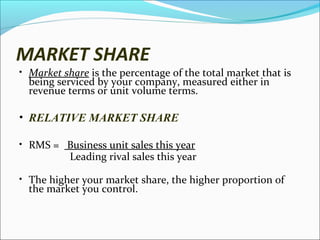
• Market share is the percentage of the total market that is

being serviced by your company, measured either in
revenue terms or unit volume terms.

• RELATIVE MARKET SHARE
• RMS = Business unit sales this year

Leading rival sales this year

• The higher your market share, the higher proportion of

the market you control.
MARKET GROWTH
RATE
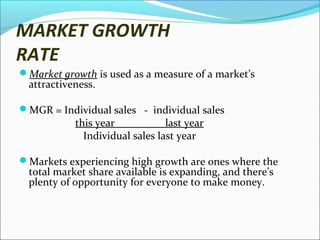
Market growth is used as a measure of a market’s

attractiveness.

MGR = Individual sales - individual sales

this year
last year
Individual sales last year

Markets experiencing high growth are ones where the

total market share available is expanding, and there’s
plenty of opportunity for everyone to make money.
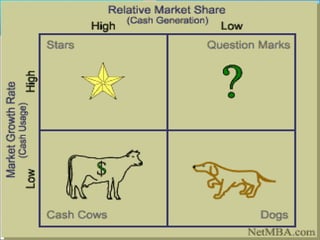
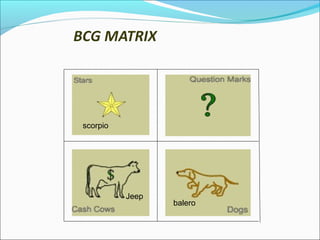
THE BCG GROWTH-SHARE
MATRIX
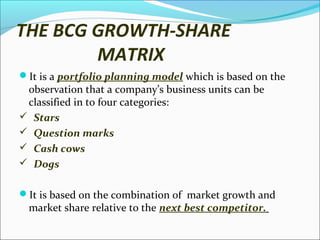
It is a portfolio planning model which is based on the

observation that a company’s business units can be
classified in to four categories:
 Stars
 Question marks
 Cash cows
 Dogs

It is based on the combination of market growth and

market share relative to the next best competitor.
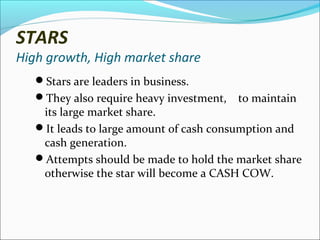
STARS

High growth, High market share
Stars are leaders in business.
They also require heavy investment,

to maintain

its large market share.
It leads to large amount of cash consumption and
cash generation.
Attempts should be made to hold the market share
otherwise the star will become a CASH COW.
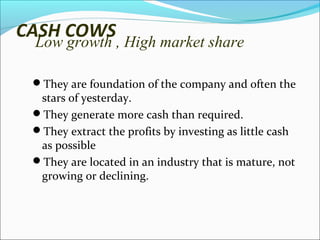
CASH COWS

Low growth , High market share

They are foundation of the company and often the

stars of yesterday.
They generate more cash than required.
They extract the profits by investing as little cash
as possible
They are located in an industry that is mature, not
growing or declining.
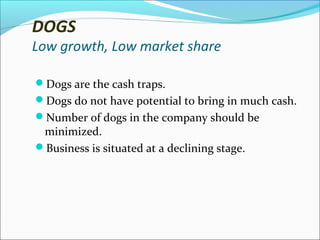
DOGS

Low growth, Low market share
Dogs are the cash traps.
Dogs do not have potential to bring in much cash.
Number of dogs in the company should be

minimized.
Business is situated at a declining stage.
QUESTION MARKS

High growth , Low market share
Most businesses start of as question marks.
They will absorb great amounts of cash if the

market share remains unchanged, (low).
Why question marks?
Question marks have potential to become star and
eventually cash cow but can also become a dog.
Investments should be high for question marks.
WHY BCG MATRIX ?
To assess :
 Profiles of products/businesses
 The cash demands of products
 The development cycles of products
 Resource allocation and divestment decisions
MAIN STEPS OF BCG MATRIX
Identifying and dividing a company into SBU.
Assessing and comparing the prospects of each SBU

according to two criteria :
1. SBU’S relative market share.
2. Growth rate OF SBU’S industry.
Classifying the SBU’S on the basis of BCG matrix.
Developing strategic objectives for each SBU.
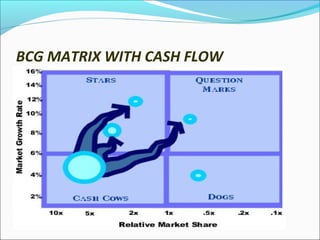
BCG MATRIX WITH CASH FLOW
BENEFITS
BCG MATRIX is simple and easy to understand.
It helps you to quickly and simply screen the

opportunities open to you, and helps you think about
how you can make the most of them.
It is used to identify how corporate cash resources
can best be used to maximize a company’s future
growth and profitability.
LIMITATIONS
BCG MATRIX uses only two dimensions, Relative

market share and market growth rate.
Problems of getting data on market share and market
growth.
High market share does not mean profits all the time.
Business with low market share can be profitable too.
PRACTICAL USE
MAHINDRA & MAHINDRA
HLL
Bajaj
scorpio

Jeep

balero
Though BCG MATRIX has its limitations it is one
of the most FAMOUS AND SIMPLE portfolio
planning matrix ,used by large companies
having multi-products.

PPT ON BCG Matrix

  • 1.
  • 2.
    INTRODUCTION  BOSTON CONSULTINGGROUP (BCG) MATRIX is developed by BRUCE HENDERSON of the BOSTON CONSULTING GROUP IN THE EARLY 1970’s.  According to this technique, businesses or products are classified as low or high performers depending upon their market growth rate and relative market share.
  • 3.
    To understand theBoston Matrix you need to understand how market share and market growth interrelate.
  • 4.
    MARKET SHARE • Marketshare is the percentage of the total market that is being serviced by your company, measured either in revenue terms or unit volume terms. • RELATIVE MARKET SHARE • RMS = Business unit sales this year Leading rival sales this year • The higher your market share, the higher proportion of the market you control.
  • 5.
    MARKET GROWTH RATE Market growthis used as a measure of a market’s attractiveness. MGR = Individual sales - individual sales this year last year Individual sales last year Markets experiencing high growth are ones where the total market share available is expanding, and there’s plenty of opportunity for everyone to make money.
  • 6.
    THE BCG GROWTH-SHARE MATRIX Itis a portfolio planning model which is based on the observation that a company’s business units can be classified in to four categories:  Stars  Question marks  Cash cows  Dogs It is based on the combination of market growth and market share relative to the next best competitor.
  • 8.
    STARS High growth, Highmarket share Stars are leaders in business. They also require heavy investment, to maintain its large market share. It leads to large amount of cash consumption and cash generation. Attempts should be made to hold the market share otherwise the star will become a CASH COW.
  • 9.
    CASH COWS Low growth, High market share They are foundation of the company and often the stars of yesterday. They generate more cash than required. They extract the profits by investing as little cash as possible They are located in an industry that is mature, not growing or declining.
  • 10.
    DOGS Low growth, Lowmarket share Dogs are the cash traps. Dogs do not have potential to bring in much cash. Number of dogs in the company should be minimized. Business is situated at a declining stage.
  • 11.
    QUESTION MARKS High growth, Low market share Most businesses start of as question marks. They will absorb great amounts of cash if the market share remains unchanged, (low). Why question marks? Question marks have potential to become star and eventually cash cow but can also become a dog. Investments should be high for question marks.
  • 12.
    WHY BCG MATRIX? To assess :  Profiles of products/businesses  The cash demands of products  The development cycles of products  Resource allocation and divestment decisions
  • 13.
    MAIN STEPS OFBCG MATRIX Identifying and dividing a company into SBU. Assessing and comparing the prospects of each SBU according to two criteria : 1. SBU’S relative market share. 2. Growth rate OF SBU’S industry. Classifying the SBU’S on the basis of BCG matrix. Developing strategic objectives for each SBU.
  • 14.
    BCG MATRIX WITHCASH FLOW
  • 15.
    BENEFITS BCG MATRIX issimple and easy to understand. It helps you to quickly and simply screen the opportunities open to you, and helps you think about how you can make the most of them. It is used to identify how corporate cash resources can best be used to maximize a company’s future growth and profitability.
  • 16.
    LIMITATIONS BCG MATRIX usesonly two dimensions, Relative market share and market growth rate. Problems of getting data on market share and market growth. High market share does not mean profits all the time. Business with low market share can be profitable too.
  • 17.
    PRACTICAL USE MAHINDRA &MAHINDRA HLL Bajaj
  • 18.
  • 19.
    Though BCG MATRIXhas its limitations it is one of the most FAMOUS AND SIMPLE portfolio planning matrix ,used by large companies having multi-products.