GRAND STRATEGY
Introduction Grand strategies , often called master or business strategies,  provide basic direction for strategic actions Indicate the time period over which long-range objectives are to be achieved  Firms involved with multiple industries, businesses, product lines, or customer groups usually combine several grand strategies Any one of these strategies could serve as the basis for  achieving the major long-term objectives of a single firm
Four Alternatives Stability Growth Combination Retrenchment
Stability To remain the same size or To grow slowly and in a controlled fashion
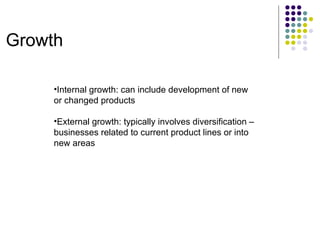
Growth Internal growth: can include development of new or changed products External growth: typically involves diversification – businesses related to current product lines or into new areas
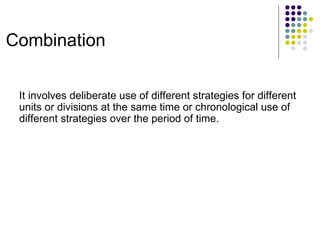
Combination It involves deliberate use of different strategies for different units or divisions at the same time or chronological use of different strategies over the period of time.
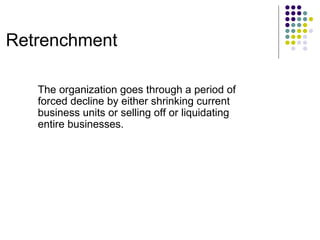
Retrenchment The organization goes through a period of forced decline by either shrinking current business units or selling off or liquidating entire businesses.
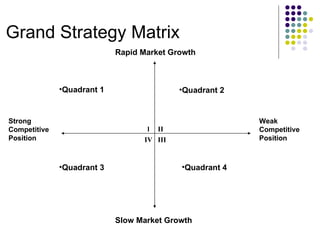
Grand Strategy Matrix Rapid Market Growth Slow Market Growth Quadrant 2 Quadrant 1 Strong Competitive Position Weak Competitive Position I II III IV Quadrant 3 Quadrant 4
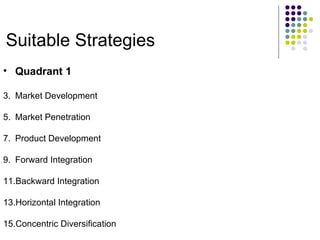
Suitable Strategies Quadrant 1 Market Development Market Penetration Product Development Forward Integration Backward Integration Horizontal Integration Concentric Diversification
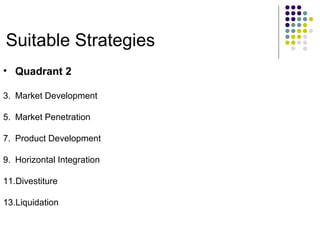
Suitable Strategies Quadrant 2 Market Development Market Penetration Product Development Horizontal Integration Divestiture Liquidation
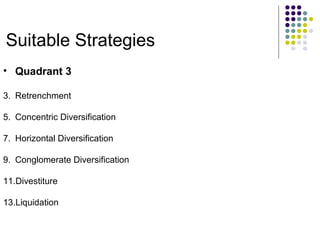
Suitable Strategies Quadrant 3 Retrenchment Concentric Diversification Horizontal Diversification Conglomerate Diversification Divestiture Liquidation
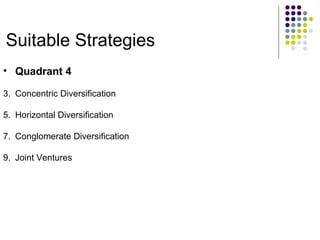
Suitable Strategies Quadrant 4 Concentric Diversification Horizontal Diversification Conglomerate Diversification Joint Ventures
Forward Integration It enables an organization to obtain increased control over its distributors or retailers. It can be implemented: When the distribution of an organization is costly, distributors are unreliable. When an organization is  earning high profit because of stable production. When an organization is not able to avail the advantage of competition due to lack of quality distribution.
Divestiture Divestiture is the selling of a division or a part of an organization to raise capital for future strategic investments. It can be implemented: When an organization failed to accomplish necessary improvements through retrenchment strategy. When a division needs more resources to be competitive than an organization can provide. When a single division is responsible for poor performance of the organization. When division is a misfit with the rest of an organization. This can result from different markets, customers, managers. Employees, values etc.
Liquidation Liquidation involves closing down of an organization and selling of its assets. It can be implemented: When an organization has pursued both retrenchment and divestiture strategy and neither has been successful.
Conglomerate Diversification In this new products or services that are related are added. It can be implemented: When basic industry of an organization is facing a downfall in annual sales and profit. When an organization has the opportunity to purchase an unrelated business that looks like an attractive investment. When there is a financial synergy between acquired and acquiring organization. When existing markets are saturated by the organization’s present products.

Grand Strategy

  • 1.
  • 2.
    Introduction Grand strategies, often called master or business strategies, provide basic direction for strategic actions Indicate the time period over which long-range objectives are to be achieved Firms involved with multiple industries, businesses, product lines, or customer groups usually combine several grand strategies Any one of these strategies could serve as the basis for achieving the major long-term objectives of a single firm
  • 3.
    Four Alternatives StabilityGrowth Combination Retrenchment
  • 4.
    Stability To remainthe same size or To grow slowly and in a controlled fashion
  • 5.
    Growth Internal growth:can include development of new or changed products External growth: typically involves diversification – businesses related to current product lines or into new areas
  • 6.
    Combination It involvesdeliberate use of different strategies for different units or divisions at the same time or chronological use of different strategies over the period of time.
  • 7.
    Retrenchment The organizationgoes through a period of forced decline by either shrinking current business units or selling off or liquidating entire businesses.
  • 8.
    Grand Strategy MatrixRapid Market Growth Slow Market Growth Quadrant 2 Quadrant 1 Strong Competitive Position Weak Competitive Position I II III IV Quadrant 3 Quadrant 4
  • 9.
    Suitable Strategies Quadrant1 Market Development Market Penetration Product Development Forward Integration Backward Integration Horizontal Integration Concentric Diversification
  • 10.
    Suitable Strategies Quadrant2 Market Development Market Penetration Product Development Horizontal Integration Divestiture Liquidation
  • 11.
    Suitable Strategies Quadrant3 Retrenchment Concentric Diversification Horizontal Diversification Conglomerate Diversification Divestiture Liquidation
  • 12.
    Suitable Strategies Quadrant4 Concentric Diversification Horizontal Diversification Conglomerate Diversification Joint Ventures
  • 13.
    Forward Integration Itenables an organization to obtain increased control over its distributors or retailers. It can be implemented: When the distribution of an organization is costly, distributors are unreliable. When an organization is earning high profit because of stable production. When an organization is not able to avail the advantage of competition due to lack of quality distribution.
  • 14.
    Divestiture Divestiture isthe selling of a division or a part of an organization to raise capital for future strategic investments. It can be implemented: When an organization failed to accomplish necessary improvements through retrenchment strategy. When a division needs more resources to be competitive than an organization can provide. When a single division is responsible for poor performance of the organization. When division is a misfit with the rest of an organization. This can result from different markets, customers, managers. Employees, values etc.
  • 15.
    Liquidation Liquidation involvesclosing down of an organization and selling of its assets. It can be implemented: When an organization has pursued both retrenchment and divestiture strategy and neither has been successful.
  • 16.
    Conglomerate Diversification Inthis new products or services that are related are added. It can be implemented: When basic industry of an organization is facing a downfall in annual sales and profit. When an organization has the opportunity to purchase an unrelated business that looks like an attractive investment. When there is a financial synergy between acquired and acquiring organization. When existing markets are saturated by the organization’s present products.