
STRATEGIC MANAGEMENT
      GEC MODEL


             Presented by,

                  Jincy Joseph
                  2nd year , MBA
STRATEGY

   Johnson and Scholes (Exploring Corporate Strategy)
    define strategy as follows:

    "Strategy is the direction and scope of an organisation
    over the long-term: which achieves advantage for the
    organisation through its configuration of resources
    within a challenging environment, to meet the needs of
    markets and to fulfil stakeholder expectations".
STRATEGY AT DIFFERENT LEVELS OF A
                      BUSINESS
    Strategies exist at several levels in any organisation - ranging from the
    overall business (or group of businesses) through to individuals
    working in it.
   Corporate Strategy - is concerned with the overall purpose and
    scope of the business to meet stakeholder expectations. This is a
    crucial level since it is heavily influenced by investors in the business
    and acts to guide strategic decision-making throughout the business.
    Corporate strategy is often stated explicitly in a "mission statement".
   Business Unit Strategy - is concerned more with how a business
    competes successfully in a particular market. It concerns strategic
    decisions about choice of products, meeting needs of customers,
    gaining advantage over competitors, exploiting or creating new
    opportunities etc.
   Operational Strategy - is concerned with how each part of the
    business is organised to deliver the corporate and business-unit level
    strategic direction. Operational strategy therefore focuses on issues of
    resources, processes, people etc.
STRATEGIC MANAGEMENT

   In its broadest sense, strategic management is about
    taking "strategic decisions"

   In practice, a thorough strategic management
    process has three main components :
i.    Strategic Analysis
ii.   Strategic Choice
iii. Strategy Implementation
   Strategic Analysis
    This is all about the analysing the strength of businesses' position
    and understanding the important external factors that may
    influence that position. The process of Strategic Analysis can be
    assisted by a number of tools, including:
    PEST Analysis ,SWOT Analysis ,Competitor Analysis… etc

   Strategic Choice
    This process involves understanding the nature of stakeholder
    expectations (the "ground rules"), identifying strategic options, and
    then evaluating and selecting strategic options.

   Strategy Implementation
    Often the hardest part. When a strategy has been analysed and
    selected, the task is then to translate it into organisational action.
BUSINESS PORTFOLIO
 The business portfolio is the collection of businesses
  and products that make up the company. The best
  business portfolio is one that fits the company's strengths
  and helps exploit the most attractive opportunities.
 The company must:

   (1) Analyse its current business portfolio and decide
  which businesses should receive more or less
  investment, and

    (2) Develop growth strategies for adding new products
    and businesses to the portfolio, whilst at the same time
    deciding when products and businesses should no longer
    be retained.
   The two best-known portfolio planning methods are the
    Boston Consulting Group Portfolio Matrix and the
    McKinsey / General Electric Matrix .

   In both methods, the first step is to identify the various
    Strategic Business Units ("SBU's") in a company
    portfolio. An SBU is a unit of the company that has a
    separate mission and objectives and that can be
    planned independently from the other businesses. An
    SBU can be a company division, a product line or even
    individual brands - it all depends on how the company
    is organised.
THE MCKINSEY / GENERAL ELECTRIC
                   MATRIX
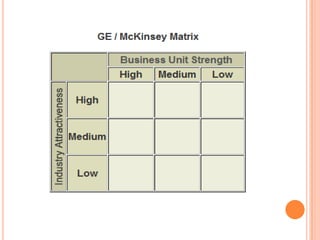
   GE Matrix is a tools that helps managers develop
    organizational strategy that is based primarily on market
    attractiveness and business strengths.

   In consulting engagements with General Electric in the
    1970's, McKinsey & Company developed a nine-cell
    portfolio matrix as a tool for screening GE's large
    portfolio of strategic business units (SBU). This business
    screen became known as the GE/McKinsey Matrix and
    is shown below:
   The GE / McKinsey matrix is similar to the BCG growth-share
    matrix in that it maps strategic business units on a grid of the
    industry and the SBU's position in the industry. The GE matrix
    however, attempts to improve upon the BCG matrix in the
    following two ways:

   The GE matrix generalizes the axes as "Industry
    Attractiveness" and "Business Unit Strength" whereas the
    BCG matrix uses the market growth rate as a proxy for industry
    attractiveness and relative market share as a proxy for the
    strength of the business unit.

   The GE matrix has nine cells vs. four cells in the BCG matrix.

   Industry attractiveness and business unit strength are
    calculated by first identifying criteria for each, determining the
    value of each parameter in the criteria, and multiplying that
    value by a weighting factor. The result is a quantitative
    measure of industry attractiveness and the business unit's
    relative performance in that industry.
Industry Attractiveness
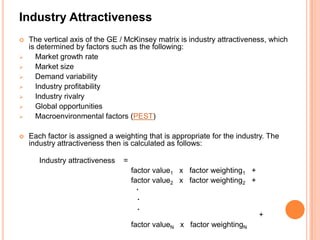
   The vertical axis of the GE / McKinsey matrix is industry attractiveness, which
    is determined by factors such as the following:
     Market growth rate
     Market size
     Demand variability
     Industry profitability
     Industry rivalry
     Global opportunities
     Macroenvironmental factors (PEST)

   Each factor is assigned a weighting that is appropriate for the industry. The
    industry attractiveness then is calculated as follows:

       Industry attractiveness   =
                                     factor value1 x factor weighting1 +
                                     factor value2 x factor weighting2 +
                                       .
                                       .
                                       .
                                                                           +
                                     factor valueN x factor weightingN
Business Unit Strength

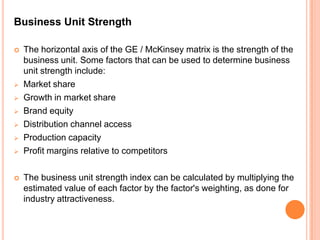
   The horizontal axis of the GE / McKinsey matrix is the strength of the
    business unit. Some factors that can be used to determine business
    unit strength include:
   Market share
   Growth in market share
   Brand equity
   Distribution channel access
   Production capacity
   Profit margins relative to competitors

   The business unit strength index can be calculated by multiplying the
    estimated value of each factor by the factor's weighting, as done for
    industry attractiveness.
STRENGTHS AND WEAKNESSES

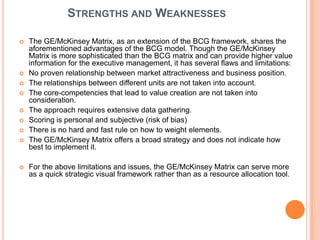
   The GE/McKinsey Matrix, as an extension of the BCG framework, shares the
    aforementioned advantages of the BCG model. Though the GE/McKinsey
    Matrix is more sophisticated than the BCG matrix and can provide higher value
    information for the executive management, it has several flaws and limitations:
   No proven relationship between market attractiveness and business position.
   The relationships between different units are not taken into account.
   The core-competencies that lead to value creation are not taken into
    consideration.
   The approach requires extensive data gathering.
   Scoring is personal and subjective (risk of bias)
   There is no hard and fast rule on how to weight elements.
   The GE/McKinsey Matrix offers a broad strategy and does not indicate how
    best to implement it.

   For the above limitations and issues, the GE/McKinsey Matrix can serve more
    as a quick strategic visual framework rather than as a resource allocation tool.
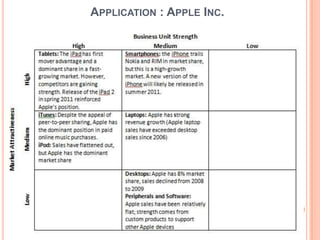
APPLICATION : APPLE INC.
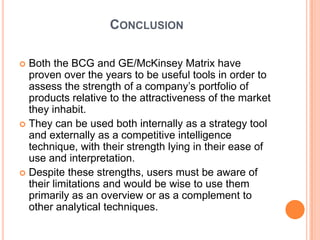
CONCLUSION

 Both the BCG and GE/McKinsey Matrix have
  proven over the years to be useful tools in order to
  assess the strength of a company’s portfolio of
  products relative to the attractiveness of the market
  they inhabit.
 They can be used both internally as a strategy tool
  and externally as a competitive intelligence
  technique, with their strength lying in their ease of
  use and interpretation.
 Despite these strengths, users must be aware of
  their limitations and would be wise to use them
  primarily as an overview or as a complement to
  other analytical techniques.
REFERENCES
   http://wiki.telfer.uottawa.ca/ci-
    wiki/index.php/BCG_Matrix_%26_GE/McKinsey_Matrix

   http://www.enotes.com/strategic-planning-tools-
    reference/strategic-planning-tools

   http://tutor2u.net/business/strategy/ge_matrix.htm

   http://managementinnovations.blogspot.in/2008/12/strat
    egy-formulation-tools.html

   http://www.quickmba.com/strategy/matrix/ge-mckinsey/

2nd mba Strategic Management

  • 1.
    STRATEGIC MANAGEMENT GEC MODEL Presented by, Jincy Joseph 2nd year , MBA
  • 2.
    STRATEGY  Johnson and Scholes (Exploring Corporate Strategy) define strategy as follows: "Strategy is the direction and scope of an organisation over the long-term: which achieves advantage for the organisation through its configuration of resources within a challenging environment, to meet the needs of markets and to fulfil stakeholder expectations".
  • 3.
    STRATEGY AT DIFFERENTLEVELS OF A BUSINESS Strategies exist at several levels in any organisation - ranging from the overall business (or group of businesses) through to individuals working in it.  Corporate Strategy - is concerned with the overall purpose and scope of the business to meet stakeholder expectations. This is a crucial level since it is heavily influenced by investors in the business and acts to guide strategic decision-making throughout the business. Corporate strategy is often stated explicitly in a "mission statement".  Business Unit Strategy - is concerned more with how a business competes successfully in a particular market. It concerns strategic decisions about choice of products, meeting needs of customers, gaining advantage over competitors, exploiting or creating new opportunities etc.  Operational Strategy - is concerned with how each part of the business is organised to deliver the corporate and business-unit level strategic direction. Operational strategy therefore focuses on issues of resources, processes, people etc.
  • 4.
    STRATEGIC MANAGEMENT  In its broadest sense, strategic management is about taking "strategic decisions"  In practice, a thorough strategic management process has three main components : i. Strategic Analysis ii. Strategic Choice iii. Strategy Implementation
  • 5.
    Strategic Analysis This is all about the analysing the strength of businesses' position and understanding the important external factors that may influence that position. The process of Strategic Analysis can be assisted by a number of tools, including: PEST Analysis ,SWOT Analysis ,Competitor Analysis… etc  Strategic Choice This process involves understanding the nature of stakeholder expectations (the "ground rules"), identifying strategic options, and then evaluating and selecting strategic options.  Strategy Implementation Often the hardest part. When a strategy has been analysed and selected, the task is then to translate it into organisational action.
  • 6.
    BUSINESS PORTFOLIO  Thebusiness portfolio is the collection of businesses and products that make up the company. The best business portfolio is one that fits the company's strengths and helps exploit the most attractive opportunities.  The company must: (1) Analyse its current business portfolio and decide which businesses should receive more or less investment, and (2) Develop growth strategies for adding new products and businesses to the portfolio, whilst at the same time deciding when products and businesses should no longer be retained.
  • 7.
    The two best-known portfolio planning methods are the Boston Consulting Group Portfolio Matrix and the McKinsey / General Electric Matrix .  In both methods, the first step is to identify the various Strategic Business Units ("SBU's") in a company portfolio. An SBU is a unit of the company that has a separate mission and objectives and that can be planned independently from the other businesses. An SBU can be a company division, a product line or even individual brands - it all depends on how the company is organised.
  • 8.
    THE MCKINSEY /GENERAL ELECTRIC MATRIX  GE Matrix is a tools that helps managers develop organizational strategy that is based primarily on market attractiveness and business strengths.  In consulting engagements with General Electric in the 1970's, McKinsey & Company developed a nine-cell portfolio matrix as a tool for screening GE's large portfolio of strategic business units (SBU). This business screen became known as the GE/McKinsey Matrix and is shown below:
  • 9.
    The GE / McKinsey matrix is similar to the BCG growth-share matrix in that it maps strategic business units on a grid of the industry and the SBU's position in the industry. The GE matrix however, attempts to improve upon the BCG matrix in the following two ways:  The GE matrix generalizes the axes as "Industry Attractiveness" and "Business Unit Strength" whereas the BCG matrix uses the market growth rate as a proxy for industry attractiveness and relative market share as a proxy for the strength of the business unit.  The GE matrix has nine cells vs. four cells in the BCG matrix.  Industry attractiveness and business unit strength are calculated by first identifying criteria for each, determining the value of each parameter in the criteria, and multiplying that value by a weighting factor. The result is a quantitative measure of industry attractiveness and the business unit's relative performance in that industry.
  • 11.
    Industry Attractiveness  The vertical axis of the GE / McKinsey matrix is industry attractiveness, which is determined by factors such as the following:  Market growth rate  Market size  Demand variability  Industry profitability  Industry rivalry  Global opportunities  Macroenvironmental factors (PEST)  Each factor is assigned a weighting that is appropriate for the industry. The industry attractiveness then is calculated as follows: Industry attractiveness = factor value1 x factor weighting1 + factor value2 x factor weighting2 + . . . + factor valueN x factor weightingN
  • 12.
    Business Unit Strength  The horizontal axis of the GE / McKinsey matrix is the strength of the business unit. Some factors that can be used to determine business unit strength include:  Market share  Growth in market share  Brand equity  Distribution channel access  Production capacity  Profit margins relative to competitors  The business unit strength index can be calculated by multiplying the estimated value of each factor by the factor's weighting, as done for industry attractiveness.
  • 13.
    STRENGTHS AND WEAKNESSES  The GE/McKinsey Matrix, as an extension of the BCG framework, shares the aforementioned advantages of the BCG model. Though the GE/McKinsey Matrix is more sophisticated than the BCG matrix and can provide higher value information for the executive management, it has several flaws and limitations:  No proven relationship between market attractiveness and business position.  The relationships between different units are not taken into account.  The core-competencies that lead to value creation are not taken into consideration.  The approach requires extensive data gathering.  Scoring is personal and subjective (risk of bias)  There is no hard and fast rule on how to weight elements.  The GE/McKinsey Matrix offers a broad strategy and does not indicate how best to implement it.  For the above limitations and issues, the GE/McKinsey Matrix can serve more as a quick strategic visual framework rather than as a resource allocation tool.
  • 14.
  • 15.
    CONCLUSION  Both theBCG and GE/McKinsey Matrix have proven over the years to be useful tools in order to assess the strength of a company’s portfolio of products relative to the attractiveness of the market they inhabit.  They can be used both internally as a strategy tool and externally as a competitive intelligence technique, with their strength lying in their ease of use and interpretation.  Despite these strengths, users must be aware of their limitations and would be wise to use them primarily as an overview or as a complement to other analytical techniques.
  • 17.
    REFERENCES  http://wiki.telfer.uottawa.ca/ci- wiki/index.php/BCG_Matrix_%26_GE/McKinsey_Matrix  http://www.enotes.com/strategic-planning-tools- reference/strategic-planning-tools  http://tutor2u.net/business/strategy/ge_matrix.htm  http://managementinnovations.blogspot.in/2008/12/strat egy-formulation-tools.html  http://www.quickmba.com/strategy/matrix/ge-mckinsey/